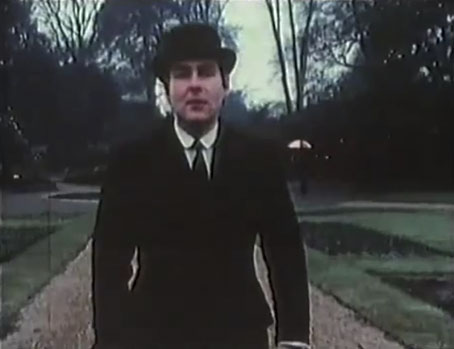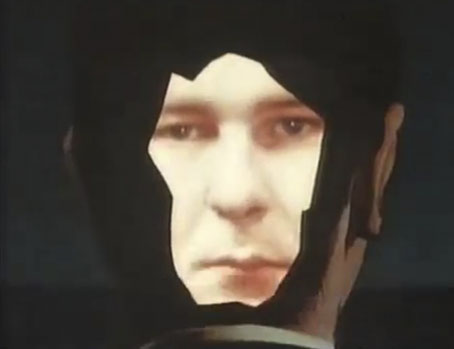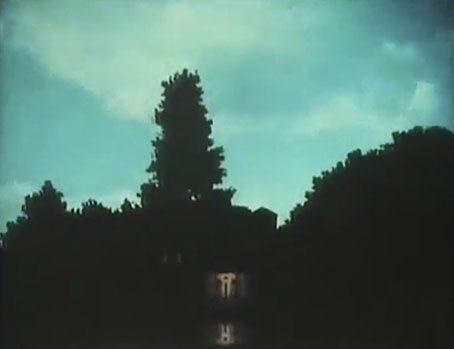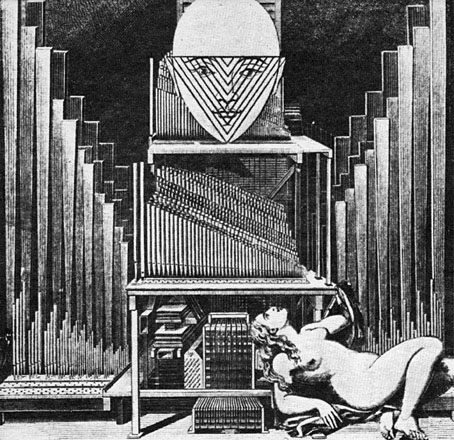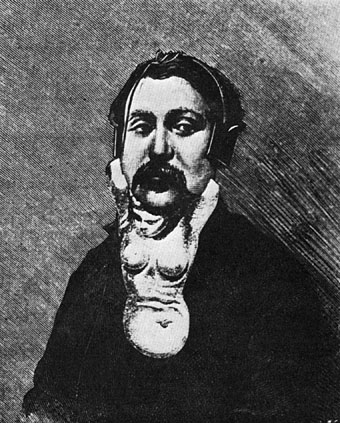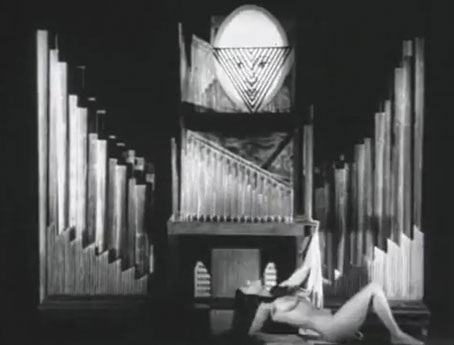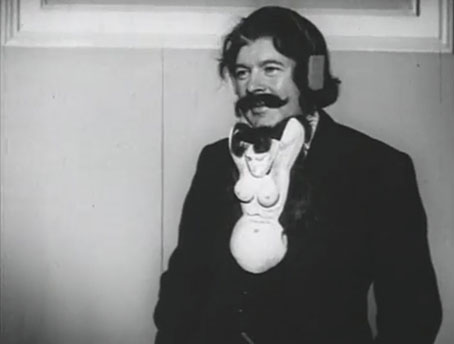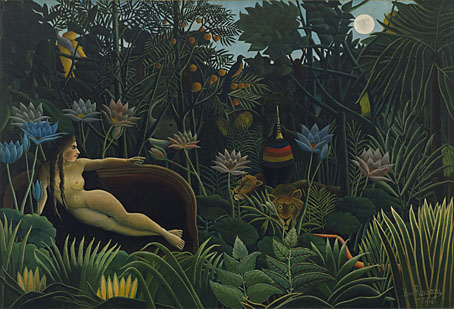
Brion Gysin’s walk, 1966

gysin.jpg

The Cut-Ups (1966).

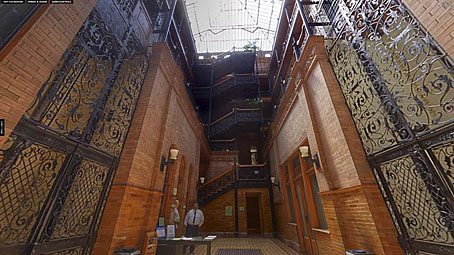
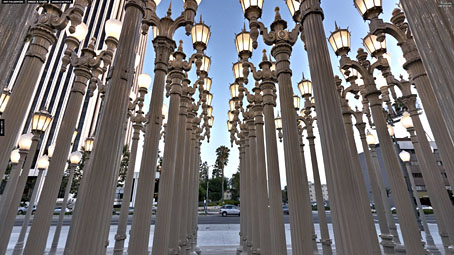
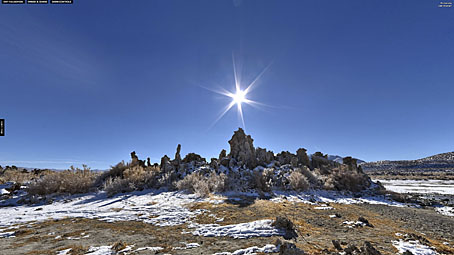
More of the present preoccupation. Choosing Brion Gysin as a subject seems like a detour but the shots above are from Antony Balch’s 1966 film The Cut-Ups which also features William Burroughs, Ian Sommerville and someone-or-other’s cute boyfriend of the time who’s only ever credited as “Baby Zen”, a person about whom I know nothing at all.

I first saw The Cut-Ups in video form projected on the screens of the Haçienda nightclub in Manchester during their Final Academy evening in 1982, an event at which Burroughs and John Giorno both gave readings. The film on that occasion was mixed with some of the other Antony Balch shorts including Towers Open Fire, and together they made a strong (and bewildering) impression. The Cut-Ups, as noted a few days ago, may have inspired some of the flash edits in Performance, although Nicolas Roeg had been cinematographer on Petulia for Richard Lester the year before, a film which uses similar Resnais-like flashbacks and flash-forwards. In Balch’s film several sequences each a foot in length are cut together at random, a process which was a lot more radical in 1966 than it looks today. The opening sequence shows Brion Gysin walking out of a shop, along a street, down an alley and into the Rue Git le Coeur where the Beat Hotel was located at no. 9, and into whose door he disappears. I visited the street the last time I was in Paris, and took a few snaps whilst there, but it wasn’t until I rewatched The Cut-Ups a couple of years later that I realised I’d made the same walk as Gysin, having inadvertently discovered the narrow passage (the Rue de L’Hirondelle) which connects Git le Coeur with the Boulevard Saint-Michel.

saintmichel1.jpg

The corner of the Boulevard Saint-Michel where Gysin’s walk begins.

The route can be traced (after a fashion) using Google’s Street View where the photos have the usual drawbacks of being positioned high in the air and with a field-of-view which makes narrow spaces look a lot more cramped than they seem when you’re there. For those who can’t visit Paris, however, you at least get a sense of the Latin Quarter, even though the area is a lot more gentrified today than it was in 1966. The Beat Hotel, as I’ve noted before, is now the expensive Hotel du Vieux Paris whose website makes no mention of their establishment having once been cheap lodgings for depraved writers, artists and junkies. As for the Gysin film, I still wonder where he began his walk: was it at the Tabac Saint-Michel or elsewhere? You can judge for yourself at Ubuweb which has a copy of The Cut-Ups in its Burroughs film collection.

saintmichel2.jpg

Rue de L’Hirondelle from the Boulevard Saint-Michel.

saintmichel3.jpg

Rue de L’Hirondelle from Rue Git le Coeur.

saintmichel4.jpg

Rue Git le Coeur looking towards the Seine. The former Beat Hotel is down the street on the right.

Elsewhere on { feuilleton }
The William Burroughs archive

William Burroughs interviews

bunker.jpg

With William Burroughs: A Report from the Bunker (1982) by Victor Bockris. Design by Neville Brody.

If it’s interviews you want, some of the most entertaining are in Victor Bockris’s collection of conversations between El Hombre Invisible and the various New York notables ferried round to sit at Burroughs’ table in his Bowery Bunker. The British edition published by Vermilion was always preferrable for its Neville Brody cover design beside which the US original looks very dull indeed. The encyclopedic Burroughs site Reality Studio has copious lists of earlier Burroughs interviews. They also note the occasions when he put on his journalist hat and went out to interview someone equally famous, usually at the behest of a music magazine. A couple of those pieces are online thanks to the diligence of various fans.

diamond_dogs.jpg

Diamond Dogs (1974), a blend of Lou Reed, George Orwell and William Burroughs.

One such is the 1974 interview with David Bowie for Rolling Stone in which Bowie discusses Burroughs as an influence while Burroughs informs the singer that the heroes of his latest novel, The Wild Boys, favour the Bowie knife as a weapon:

Bowie: Nova Express really reminded me of Ziggy Stardust, which I am going to be putting into a theatrical performance. Forty scenes are in it and it would be nice if the characters and actors learned the scenes and we all shuffled them around in a hat the afternoon of the performance and just performed it as the scenes come out. I got this all from you Bill… so it would change every night.

burroughspage.jpg

A year later Burroughs got together with Jimmy Page for Crawdaddy magazine where the discussion circles around some of the same subjects, notably the writer’s obsession with sound as a weapon. There’s also this comment from Burroughs which is the kind of thing that always gets my neurons firing:

Antony Balch and I collaborated on a film called Cut-Ups, in which the film was cut into segments and rearranged at random. Nicolas Roeg and Donald Cammell saw a screening of the film not long before they made Performance.

Roeg later directed Bowie, of course, and is one of the dinner guests in With William Burroughs, while Jimmy Page and Donald Cammell both appear in Kenneth Anger’s Lucifer Rising. The connections go round and round… Read the whole piece in a post I made a few years ago at the late, lamented Arthur magazine site.

Elsewhere on { feuilleton }
The William Burroughs archive

Science Friction by Stan VanDerBeek

vanderbeek.jpg

Ubuweb seems to have the best collection of films by experimental filmmaker Stan VanDerBeek (1927–1984) but not the one I was looking for, unfortunately, an abstract thing entitled Moirage. Searching around turned up Science Friction (1959), one of a number of collage animations VanDerBeek made in the 1950s. The juxtapositions of collage have always been good for comedy, and here they’re put to satirical effect in a comment on the Space Race and the tensions of the Cold War. When viewed today it’s impossible to ignore the resemblance to the later collage animation of Terry Gilliam. VanDerBeek wasn’t the only person doing this at the time—Walerian Borowczyk and Harry Smith also made collage films—but VanDerBeek’s sense of humour seems close enough to Gilliam’s to have given him ideas.

For more about the director there’s also Project Stan VanDerBeek.

Previously on { feuilleton }
Heaven and Earth Magic by Harry Smith
Gilliam’s shaver and Bovril by electrocution
Short films by Walerian Borowczyk

Weekend links 76

aftertime.jpg

Despite appearances I’m still doing bits of design and layout work for various musicians. In the past week I’ve been trying to reorganise this sprawling website a little so it’s easier to add new work quickly and easily. One recent job was more layout than design, a CD and vinyl package for a Roly Porter collection of instrumentals entitled Aftertime. Each track on the album is named after a different planet from Frank Herbert’s Dune books although the music isn’t as illustrative as that implies. Porter’s use of an Ondes Martenot and various acoustic instruments which he subjects to degrees of distortion is just the kind of thing I like hearing. One track can be heard at FACT where Porter is interviewed about his work. Aftertime is released this month on the Subtext label.

It is a rollicking saga that involves all sorts of things not normally associated with think tanks – chickens, pirate radio, retired colonels, Jean-Paul Sartre, Screaming Lord Sutch, and at its heart is a dramatic and brutal killing committed by one of the very men who helped bring about the resurgence of the free market in Britain.

Adam Curtis on the strange history of Britain’s think tanks and their hidden agendas.

• Other assorted music business: Getting down to the Cabinessence: “This is the first of what may become an intermittent series of observations about Smile, and how Brian Wilson tried to put his dream on this planet.” | After The Flood: Talk Talk’s Laughing Stock 20-Years On: a lengthy and detailed Quietus piece on one of the best albums of the 1990s. | Jonathan Barnbrook uses an old analogue video synth to create a visual accompaniment for Interplay by John Foxx & The Maths. The HD version is an eye-searing delight.

Meredith Yayanos favours the sister instrument of the Ondes Martenot, the theremin, which she uses to provide a spooky score for a new film, Empty Rooms. There’s more spectral ambience at her SoundCloud page.

giovani.jpg

A Jules Verne cover by Carlo Giovani for Editora Ática.

• Sculptor and writer Josiah McElheny transforms the Whitechapel Gallery into a hall of mirrors.

Jacob’s Lament, an animated collaboration between illustrator Ian Miller and Stijn Windig.

Pornographic Poem (1967) by John Giorno.

Oscar Wilde grandson scorns “new” play.

• Manhattan in marble by Yutaka Sone.

Paul Atreides pt. 1 (1978) by Richard Pinhas | Harkonnen (1979) by Zed (Bernard Szajner) | Prophecy Theme (1984) by Brian Eno.

Screening Kafka

kafka1.jpg

Kafka (1991).

This week I completed the interior design for a new anthology from Tachyon, Kafkaesque, edited by John Kessel and James Patrick Kelly. It’s a collection of short stories either inspired by Franz Kafka, or with a Kafka-like atmosphere, and features a high calibre of contributions from writers including JG Ballard, Jorge Luis Borges, Carol Emshwiller, Jeffrey Ford, Jonathan Lethem and Philip Roth, and also the comic strip adaptation of The Hunger Artist by Robert Crumb. When I knew this was incoming I rewatched a few favourite Kafka-inspired film and TV works, and belatedly realised I have something of a predilection for these things. What follows is a list of some favourites from the Kafkaesque dramas I’ve seen to date. IMDB lists 72 titles crediting Kafka as the original writer so there’s still a lot more to see.


wellestrial.jpg

The Trial (1962), dir: Orson Welles.

Orson Welles in one of his Peter Bogdanovich interviews describes how producer Alexander Salkind gave him a list of literary classics to which he owned the rights and asked him to pick one. Given a choice of Kafka titles Welles says he would have chosen The Castle but The Trial was the only one on the list so it’s this which became the first major adaptation of a Kafka novel. Welles always took some liberties with adaptations—even Shakespeare wasn’t sacred—and he does so here. I’m not really concerned whether this is completely faithful to the book, however, it’s a first-class work of cinema which shows Welles’ genius for improvisation in the use of the semi-derelict Gare d’Orsay in Paris as the main setting. (Welles had commissioned set designs but the money to pay for those disappeared at the last minute.) As well as scenes in Paris the film mixes other scenes shot in Rome and Zagreb, with Anthony Perkins’ Josef K frequently jumping across Europe in a single cut. The resulting blend of 19th-century architecture, industrial ruin and Modernist offices which Welles called “Jules Verne modernism” continues to be a big inspiration when I’m thinking about invented cities. Kafka has been fortunate in having many great actors drawn to his work. Here with Perkins there’s Welles himself as the booming and hilarious Advocate, together with Jeanne Moreau, Romy Schneider and Akim Tamiroff.


brazil.jpg

Brazil (1985), dir: Terry Gilliam.

Having watched Brazil again recently I was struck by how much it resembles the popular view of Kafka’s worlds rather than the Orwellian nightmare which Terry Gilliam first intended. The story is powered by a bureaucratic error caused by a crushed insect, after all, and Gilliam follows Welles in mashing up the styles and motifs of an authoritarian century to create a hybrid world he described as being “on the Belfast/Los Angeles border”. Tom Stoppard had a hand in the screenplay, and there’s another great cast with Jonathan Pryce, Katherine Helmond and Ian Holm. Also a nod to an Orson Welles role with the character named Harvey Lime.


insuranceman.jpg

The Insurance Man: Daniel Day-Lewis, Robert Hines & Jim Broadbent.

The Insurance Man (1986), dir: Richard Eyre.

Jim Broadbent played a plastic surgeon in Brazil; here he’s a clerk in the offices of the Worker’s Accident Insurance Institute in Prague. Writer Alan Bennett was preoccupied with Kafka in the mid-1980s: his stage play, Kafka’s Dick (the title does indeed refer to the writer’s penis), was staged the same year as this TV film directed by Richard Eyre, a 70-minute drama which sees a young factory worker trying to find a cure for an industrial illness at the Insurance Institute where one “Doctor Kafka” is employed. Needless to say, his quest for health and some measure of justice becomes Kafkaesque. Kafka here is portrayed by Daniel Day-Lewis in a typically enthralling performance which is never mannered but makes him seem a stranger creature (and a more sympathetic clerk) than his fellow workers. Most of this was filmed in Liverpool in some wonderful old office buildings using a sombre blue/grey palette. As with all Bennett’s dramas the dialogue is a treat. The film is now available on DVD in the Alan Bennett at the BBC collection.


metamorphosis.jpg

Tim Roth as Gregor Samsa.

Metamorphosis (1987), dir: Jim Goddard.

Another TV drama based on one of Steven Berkoff’s three stage adaptations of Kafka in which he also plays the part of Mr Samsa. Berkoff’s preference for physical theatre means there are no insect suits or special effects here, Gregor Samsa’s insectile nature is conveyed entirely through Tim Roth’s energetic performance, with shrieks, twisted limbs, and a climbing frame for when he needs to scuttle up the wall or hang from the ceiling. Not available on DVD but it’s scattered around YouTube if you can be bothered.


berkofftrial.jpg

The Trial (1991), dir: Steven Berkoff.

Another Berkoff adaptation which is available on DVD from his own company. As with his Salome, this is a filmed stage performance and highly recommended for its fidelity to the book, although of the two I prefer the Oscar Wilde play. Berkoff’s great innovation is the bare stage where the only props are a couple of chairs and a number of tall metal frames, one for each performer, which the actors use to create doors, windows, picture frames and even a series of moving corridors. Berkoff himself plays Titorelli the painter as a hyperactive Dalí type.


kafka2.jpg

Kafka (1991), dir: Steven Soderbergh.

A cult film of mine which I’ve written about before so there’s no need to go into great detail. It’s a shame that Daniel Day-Lewis couldn’t have played Kafka in this one instead of Jeremy Irons who does a decent job but always seems slightly wrong for the part. Ian Holm in Brazil had a role named after Terry Gilliam’s MAD-magazine mentor Harvey Kurtzman; here Holm is named after one of the great silent film directors in the role of the enigmatic Doctor Murnau. Shot on location in Prague.


franzkafka.jpg

Franz Kafka (1992), dir: Piotr Dumala.

After all the fake Kafkas, something which is at least close to genuine article in a short and wordless animated film by Piotr Dumala. Can be watched in its entirety here.


zoetrope.jpg

Zoetrope (1999), dir: Charlie Deaux.

Kafka’s In the Penal Colony is moved from its sun-blasted location to what looks like the interior of a power station in Charlie Deaux’s frenetic adaptation. The emphasis is very much on the industrial with the film nodding as much to David Lynch as Franz K. (And whatever happened to David Lynch’s proposed adaptation of The Metamorphosis?) The rumbling, clanging soundtrack by Lustmord provides the requisite Alan Splet-like atmospherics. Available on DVD from Soleilmoon.

Previously on { feuilleton }
Die Andere Seite by Alfred Kubin
Designs on Kafka
The Hourglass Sanatorium by Wojciech Has
Kafka’s porn unveiled
A postcard from Doctor Kafka
Alexandre Alexeieff and Claire Parker
Hugo Steiner-Prag’s Golem
Steven Soderbergh’s Kafka
Kafka and Kupka