Weekend links 288

gourmelin.jpg

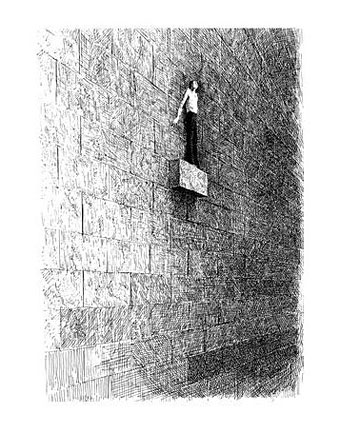
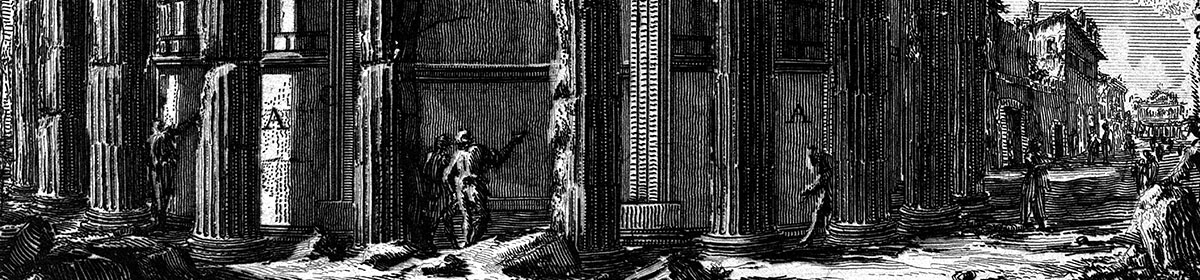
Untitled drawing by Jean Gourmelin.

• Yet another book featuring my design work (interiors this time) has been published in the past week. Leena Krohn: Collected Fiction is an 850-page selection of novels, novel extracts and short works from a prolific Finnish author of the fantastic. Many of the selections are being published in English for the first time:

From cities of giant insects to a mysterious woman claiming to be the female Don Quixote, Leena Krohn’s fiction has fascinated and intrigued readers for over forty years. Within these covers you will discover a pelican that can talk and a city of gold. You will find yourself exploring a future of intelligence both artificial and biotech, along with a mysterious plant that induces strange visions. Krohn writes eloquently, passionately, about the nature of reality, the nature of Nature, and what it means to be human. One of Finland’s most iconic writers, translated into many languages, and winner of the prestigious Finlandia Prize, Krohn has had an incredibly distinguished career. Collected Fiction provides readers with a rich, thick omnibus of the best of her work—including novels, novellas, and short stories. Appreciations of Krohn’s work are also included.

• “Not only is the nature of Rollin’s choice of images close to [Clovis] Trouille’s, the director structures his movies in a similar fashion, crowding his movies with dreamy horror iconography. Rollin has specifically cited the influence of Trouille’s paintings on his work alongside that of other Surrealist painters working in a figurative style.” Tenebrous Kate explores the influences (and influence) of Jean Rollin’s erotic horror films.

• “[Morton] Subotnick might just have been the first person to get a club full of people—including the entire Kennedy family—dancing to purely electronic music when he played his Silver Apples Of The Moon at the opening night of New York’s legendary Electric Circus.” Robert Barry interviews the pioneering composer.

• “What I actually wanted to do was make music that contained all that was new in the 20th century,” says Irmin Schmidt in an interview with Bruce Tantum. Good to read that Rob Young is writing a biography of Can.

• “…gay mainstream culture was never really about expressing individuality, for me. It always seemed very conformist,” says Bruce LaBruce in conversation with Mike Miksche.

• At Dangerous Minds: Paul Gallagher on the making of Ken Russell’s The Devils, and Martin Schneider on the return of Paul Kirchner’s wordless comic strip, The Bus.

• Two years ago a group of Russian urban explorers climbed the Pyramid of Cheops at night. They’ve just returned from South America, and have a report here.

• In the wake of their new album, Kannon, Jason Roche asks “Are drone-metal icons Sunn O))) the loudest band on the planet?”

Junji Ito returns to horror with two new titles. Related: Fuck Yeah Junji Ito.

• Mix of the week: FACT mix 527 by Jóhann Jóhannsson.

Anna von Hausswolff‘s favourite albums.

Touch (Beginning) (1969) by Morton Subotnik | Rapido De Noir (1981) by Irmin Schmidt & Bruno Spoerri | The Gates of Ballard (2003) by Sunn O)))

The Gods of HP Lovecraft

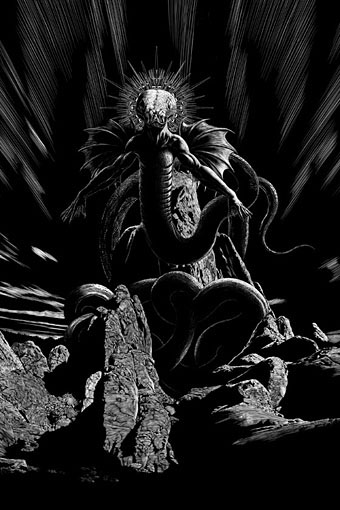
gods01.jpg

Yig for Rattled by Douglas Wynne.

Presenting one of this summer’s bigger projects, these are my drawings for The Gods of HP Lovecraft, a collection of 12 all-new stories edited by Aaron French for JournalStone. After I’d begun work I was asked whether I could illustrate all 12 stories but since I was already busy with The Monstrous it wasn’t possible. My drawings occupy the second half of the book, with the first half being filled out with suitable illustrations by Paul Carrick and Steve Santiago. The contents are as follows:

Call the Name by Adam LG Nevill (Cthulhu)
The Dark Gates by Martha Wells (Yog-Sothoth)
We Smoke the Northern Lights by Laird Barron (Azathoth)
Petohtalrayn by Bentley Little (Nyarlathotep)
The Doors that Never Close and the Doors that Are Always Open by David Liss (Shub-Niggurath)
The Apotheosis of a Rodeo Clown by Brett J. Talley (Tsathoggua)
Rattled by Douglas Wynne (Yig)
In Their Presence by Christopher Golden & James A. Moore (The Mi-Go)
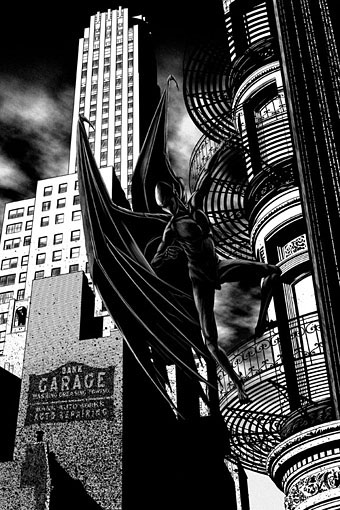
Dream a Little Dream of Me by Jonathan Maberry (Nightgaunts)
In the Mad Mountains by Joe R. Lansdale (Elder Things)
A Dying of the Light by Rachel Caine (Great Race of Yith)
Down, Deep Down, Below the Waves by Seanan McGuire (The Deep Ones)

gods02.jpg

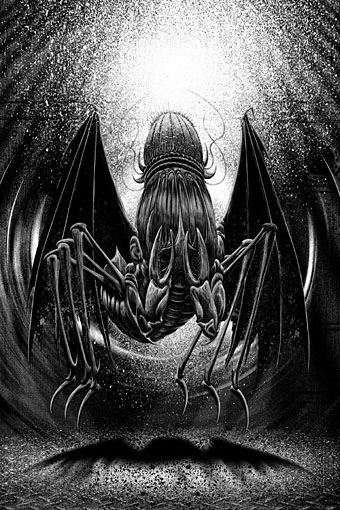
Mi-Go for In Their Presence by Christopher Golden & James A. Moore.

Despite having produced a fair amount of Lovecraft-related illlustration there’s still some areas of his work that I haven’t touched, especially where creature portraits are concerned. So this collection features my first attempts at rendering one of the Mi-Go and one of the Yithians from The Shadow Out of Time. The latter are often represented as fearsome monsters which always strikes me as erroneous when so much description in the story is devoted to their book reading and archive building. Aliens, yes, but monsters they are not. There was some concern when I delivered the artwork that the fine lines and detail might not print so well on paperback stock but the printing is excellent throughout. I recommend this collection for anyone in the mood for some new Lovecraftian fiction.

gods03.jpg

Night-Gaunt for Dream a Little Dream of Me by Jonathan Maberry.

Continue reading “The Gods of HP Lovecraft”

London: Signs and Signifiers

nico01.jpg

By coincidence, two of the projects I was working on in the summer are released this week. First up is London: Signs and Signifiers, a collection of Nico Hogg’s photographs of the streets and architecture of London’s East End. I’ve mentioned Nico’s photography before as his pictures have been used on several of the albums and singles I’ve designed for Keysound Recordings, some of which are featured in the book. This is being published as part of the Keysound catalogue, with a launch event taking place today (the 8th) at the Doomed Gallery, London. See this post for details, and a link to download a free chapter.

nico02.jpg

Nico’s work is notable for the way it avoids the stereotype of the style of urban photography that presents deprived or run-down areas in grim monochrome. Nico doesn’t avoid the decay—there are shots of burned-out flat-blocks, and a chapter devoted to the recent Tottenham riots—but the colour in his pictures shows a different side to these areas of the city.

nico03.jpg

My design for the book follows the minimal approach I’ve used on the Keysound albums, organising the information clearly and giving the photos as much room as possible. The font used for the titles and chapter headings is Transport, the typeface designed by Jock Kinneir and Margaret Calvert used on roads signs throughout the UK.

nico04.jpg

Continue reading “London: Signs and Signifiers”

Weekend links 286

ahmed.jpg

One of Faig Ahmed‘s melted Azerbaijani rugs.

• “I asked [William Burroughs] about the future of typography and he said that letterforms would go back to hieroglyphs, similar to the ancient Egyptians.” Jonathan Barnbrook discussing the thinking behind his design for blackstar, the new David Bowie album.

• “…a thick, yellow fog fills the air, sinks, crawls on the very ground; at 30 paces a house or a steam-ship look like ink-stains on blotting paper.” PD Smith review London Fog, a history of the capital’s lethal pea-soupers by Christine Corton.

• At Rue Morgue: Dejan Ognjanovic asks seven writers and editors why HP Lovecraft is still relevant. Related: big thanks to Paul Gallagher for plugging my Lovecraft calendar at Dangerous Minds.

• Some end-of-year weirdness from Moon Wiring Club: Into The Chattering Ground, a sample of the new releases available at the MWC website.

Elaine Lustig Cohen: accidental graphic designer. Related: book covers and other designs by Elaine Lustig Cohen.

• The tomb that architect John Soane built for his wife inspired the shape of Gilbert Scott’s red telephone box.

• Mix of the week: Stephen O’Malley at the controls of Stuart Maconie’s Freak Zone on BBC Radio 6.

• At Dirge Magazine: S. Elizabeth talks to Alice Rogers about art and occultism.

Simon Callow on taking 25 years to write a three-volume life of Orson Welles.

Todd Haynes on Cate Blanchett, Saul Leiter and Queer Cinema.

Le Freak (1978) by Chic | Freak (2003) by LFO | Jovan Freak (Rune Lindbaek Nomaden Mix) (2012) by Georges Vert

Folk Horror Revival: Field Studies

folkhorror.jpg

The particularly British sub-genre of folk horror receives a substantial examination in Folk Horror Revival: Field Studies, a 500-page collection of essays, interviews and artwork edited by Andy Paciorek.

Featuring essays and interviews by many great cinematic, musical, artistic and literary talents, Folk Horror Revival: Field Studies is the most comprehensive and engaging exploration to date of the sub-genre of Folk Horror and associated fields in cinema, television, music, art, culture and folklore.

Includes contributions by Kim Newman, Robin Hardy, Thomas Ligotti, Philip Pullman, Gary Lachman and many many more.

100% of all profits from sales of the book will be charitably donated to environmental, wildlife and community projects undertaken by The Wildlife Trusts.

sun2.jpg

Nuada rising, 1973 & 1976.

Among the contents there’s my 4000-word essay Sacred Demons: The Dramatic Art of David Rudkin, parts of which will be familiar to readers of my previous posts about Rudkin’s work. I’m not sure Rudkin would appreciate being subjected to such a narrow focus when his plays and TV films are much more personal and cerebral than most generic entertainments. But there is an intersection in a number of them with folk horror at its widest reach, and Rudkin did happen to adapt The Ash-Tree (1975) by MR James for the BBC’s series of ghost stories at Christmas. My piece covers this along with other TV films such as Penda’s Fen (1974) and Artemis 81 (1981), and many of the stage plays including Afore Night Come (1962), The Sons of Light (1965/76) and The Saxon Shore (1983). The stage plays I only know from their scripts which makes them difficult to appraise; maybe the renewed interest in Rudkin’s work will spur some revivals.

oldweird.jpg

Sight and Sound, August 2010. Illustration by Becca Thorne.

Paciorek’s book isn’t solely concerned with British subjects, other essays include studies of Weird Americana, the music of The Cremator and Morgiana, and Czech folk horror. The Lulu page apparently didn’t allow the listing of a full table of contents so I’m posting the details below.

Continue reading “Folk Horror Revival: Field Studies”