Weekend links 157

focusgroup.jpg

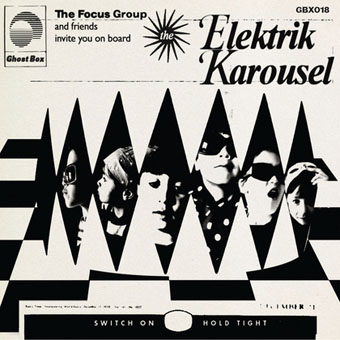
Elektrik Karousel, a new release on the Ghost Box label by The Focus Group. “For a clue to its moods, think Czech animation, Italian Giallo, early Radiophonics, HP Lovecraft stories, 1960s underground cinema, Lewis Carroll and baroque psych.” Julian House’s package design is “heavily inspired by 1960s underground press and conceived as a kind of mind altering DIY board game”.

Joseph Stannard of The Outer Church compiles a mix for Kit Records, and talks about rural psychedelia and malevolent lighthouses, among other things.

• At Sci-Fi-O-Rama: a sampling of Dan Nadel & Norman Hathaway’s Electrical Banana – Masters of Psychedelic Art (2012).

Stranger than Paradise: Tilda Swinton photographed by Tim Walker in the Surrealist Wonderland of Las Pozas, Mexico.

Whistler in Limehouse & Wapping: stunning etchings by the 25-year-old artist when he was newly arrived in London.

• The complete catalogue of Sunn O))) recordings is now on Bandcamp for preview and purchase.

La Danza de la Realidad: Alejandro Jodorowsky returns to his childhood in Tocopilla, Chile.

• Enjoy The Silence: Jude Rogers talks to Michael Rother about joy of quiet.

Dressing the Air, “the Bureau of Sensory Intelligence”, had a relaunch.

Fast forward – and press play again: Cassettes are back

The Lovecraft Expert: An Interview with S.T. Joshi

Book Graphics: an illustration blog.

Paint Box (1967) by Pink Floyd | Beat Box (1984) by Art of Noise | Glory Box (1994) by Portishead
Weekend links 154

poizat.jpg

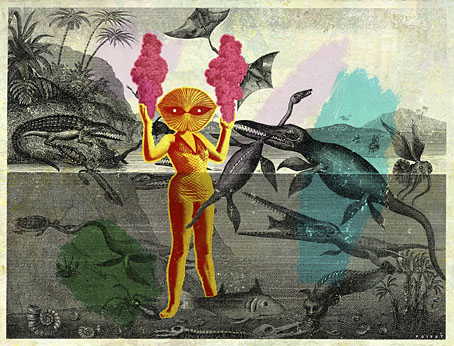
Collage by Chloé Poizat.

Xenis Emputae Travelling Band plays the Music of John Dee, and free at Bandcamp: Victorian Machine Music by Plinth, the “creaking, winding, piping, chiming and wood-knocking of Victorian parlour music machines”.

Jeremy Willard on Mikhail Kuzmin, “the Oscar Wilde of Russia”. Related: Conner Habib on the Disinfo podcast discussing pornography, sexuality, and whether sex be a revolutionary act.

Ed Vulliamy paid a visit to Hawkwind’s Hawkeaster festival. The Hawks’ Warrior On The Edge Of Time album is released in a remastered edition next month.

• Blasts from the past: Mahavishnu Orchestra, live in France, August 23rd, 1972, and Ashra (Manuel Göttsching & Lutz Ulbrich) in Barcelona, 1981.

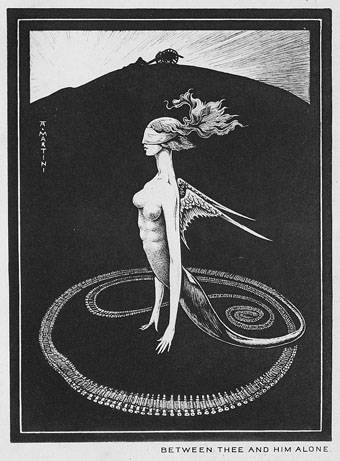
martini.jpg

An illustration by Alberto Martini for Raw Edges (1908) by Perceval Landon.

NASA’s cover designs for Space Program manuals, guidebooks, press kits, reports and brochures.

PingMag—”Art, Design, Life – from Japan”—makes a welcome return as an active blog.

Suzanne Treister‘s Hexen 2.0 Tarot designs.

Listening to records that no longer exist

The architectural origins of the chess set

The Bohemian Realm of Absinthiana

Les sources d’une île: a Tumblr

Hammer Without A Master (1998) by Broadcast | Test Area (1999) by Broadcast | Make My Sleep His Song (2009) by Broadcast & The Focus Group

Intuosity

intuos.jpg

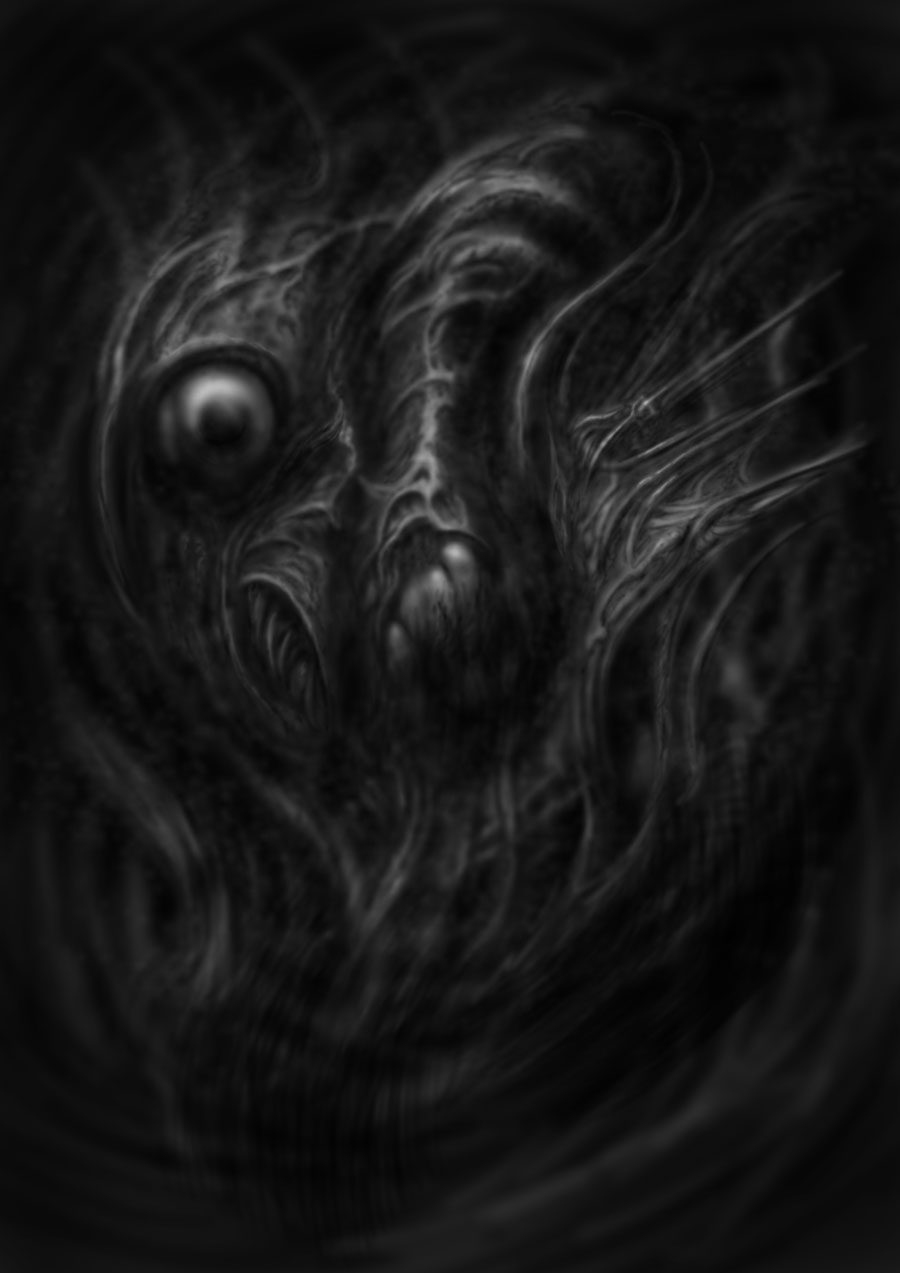
I never used a graphics tablet for drawing, in the past if I needed to draw something I’d use pencil and paper then scan the results. In recent years, however, I’ve grown dissatisfied with this process, especially after I rearranged my work area and packed away the space-hogging Ikea table I used to use as a drawing surface. This left me without a decent drawing area so this week I’ve finally capitulated and bought an Wacom Intuos tablet. The Giger-esque mess above is the result of playing around in Photoshop for a couple of hours. Having spent years using the blunt instrument of a mouse for Photoshop painting the combination of pen and tablet had immediate benefits, and I’ve found them both very easy to use. The sensitivity of the pen is impressive, something I was always dubious about. With the right brush selection it’s almost exactly like using a pencil or pen. Almost. I’m still not feeling as entirely in control of the end result as you do when drawing on paper, but I’ve not even used the thing for a whole day yet so I imagine that will change. I’m also surprised by how quickly the nib wears down; fortunately the pen comes supplied with a small stock of fresh nibs. The next week or so will be spent in further experimentation so if any interesting results materialise I’ll post them here.

London zoom

london01.jpg

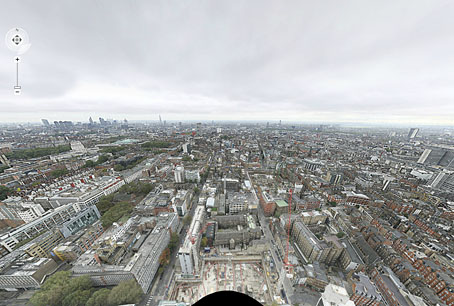
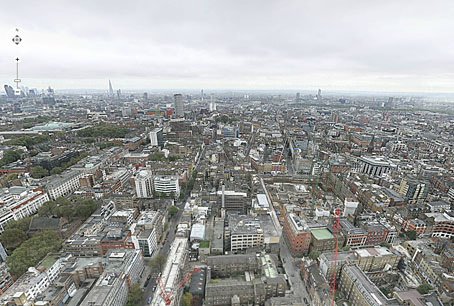
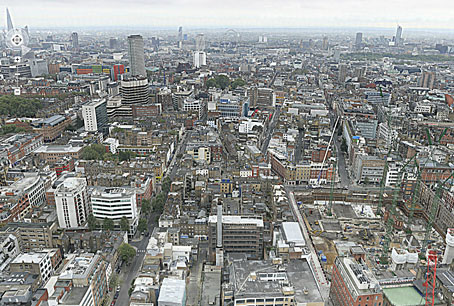
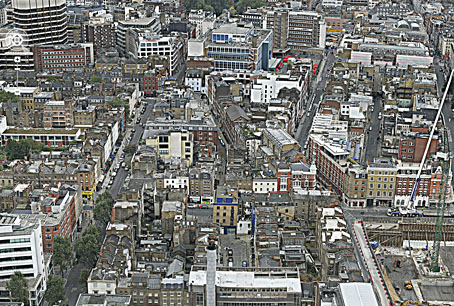
I’m generally indifferent to panoramic views of cities, especially London where the sprawl lacks the distinct contours of Manhattan or the Napoléonic severity of Hausmann’s Paris. This view is different, however, being a 320 gigapixel panorama of the capital seen from the top of the BT Tower. This view is currently the world’s largest panoramic photo, and while the wide view is of the usual grey cloudscape and undifferentiated vista of 19th-century roofs and 20th-century ducting, the ability to zoom down into the streets (and, in some cases, into windows) is unprecedented at this resolution.

london02.jpg

These screengrabs show a zoom towards the river from the widest angle down to the painted sign of the Duke of York pub on the corner of Rathbone Street and Charlotte Place in Fitzrovia. At the end of the zoom there’s a reverse view from Google Maps showing the pub itself, and the tower, the one landmark you won’t otherwise see. MetaFilter’s members have bookmarked various points of interest. I’m surprised there are so many roof gardens in this area of London although I think Paris still has the edge in that department.

london03.jpg

london04.jpg

Continue reading “London zoom”

Weekend links 141

nguyen.jpg

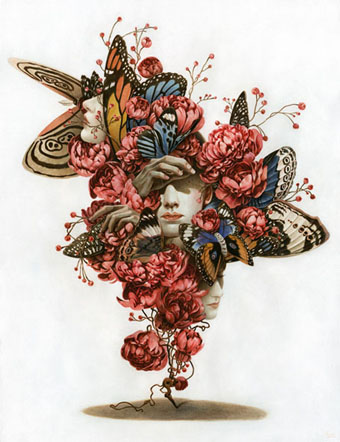
From the Beautiful Faces series (2012) by Tran Nguyen.

• “What possessed a generation of young European artists, and a few Americans, to suddenly suppress recognizable imagery in pictures and sculptures? Unthinkable at one moment, the strategy became practically compulsory in the next.” Peter Schjeldahl on the birth of abstraction.

• “A profanely mystical work of hyperpurple theory-porn, ObliviOnanisM is an auto-erotic intellectual fiction envisioning the phantastical unending odyssey of a young woman, Gemma, whom you will never know.”

Psychedelia—An Ancient Culture, A Modern Way of Life, a 520-page history of psychedelic culture by Patrick Lundborg. Related: Ken Kesey talks about the meaning of the Acid Tests.

[Hodges] made a convincing case that Turing’s teenage crush on a fellow schoolboy, Christopher Morcom, was an important catalyst for his lifelong preoccupation with the relationship between brain and mind. Morcom’s unexpected death at the age of eighteen was a shattering blow to Turing, who began to reflect on whether his friend’s consciousness might survive after death or whether it was simply a result of complex material processes and expired when life did. Hodges also linked the famous “Turing Test”, in which a computer attempts to pass as an intelligent human being, to Turing’s own dilemma as a gay man in a homophobic world. (Turing called his test the “imitation game”, and Hodges observed, “like any homosexual man, he was living an imitation game, not in the sense of conscious play acting, but by being accepted as a person that he was not”.)

Michael Saler reviews three books about computing pioneer Alan Turing

• Paul Gallagher at Dangerous Minds looks at Flowers, Lindsay Kemp’s theatrical staging of Genet’s Our Lady of the Flowers.

David Pearson designed a new edition of George Orwell’s Nineteen Eighty-Four for Penguin.

• Quadtone – Lumisonic Rotera: Mariska de Groot plays a light-to-sound instrument.

“Cash Mobs” Go Global—Battle Spreads Against Chain Store Dominance.

Cities and the Soul: a feast of Italo Calvino links at MetaFilter.

25 dessins d’un dormeur, Jean Cocteau, 1929.

Haunted Decor: a Flickr group.

Computer In Love (1966) by Perrey & Kingsley | Computer Love (1981) by Kraftwerk | Computer Love (1992) by The Balanescu Quartet