Weekend links 30

woody.jpg

Did someone say “woody”? Plenty more toy antics at TheOneCam.

• And yet more Haeckelisms: Praying in Haeckel’s Garden, recent works by artist Mary O’Malley.

Seasons of the Peacock, the perennial showoff as depicted by a handful of Art Nouveau artists. A couple of examples there I hadn’t seen before.

• Dorian Cope presents On This Deity, “Commemorating culture heroes and excavating world events.”

• At long last, Fantagraphics will be publishing Ah Pook is Here, the comic strip collaboration between William Burroughs and artist Malcolm McNeill. Something to look forward to for next year. Related: Malcolm McNeill’s website.

David Lynch Dark Splendor: “Der große Filmemacher David Lynch als Fotograf, Maler, Zeichner und Grafiker.”

More on the forthcoming album from Brian Eno, Leo Abrahams and Jon Hopkins. With this degree of hype the end result is going to be a disappointment.

Book design by Richard Hollis, including John Berger’s essential Ways of Seeing.

A fistful of Vignellis: the work of Lella and Massimo Vignelli celebrated.

• Berni Wrightson’s Frankenstein at Golden Age Comic Book Stories.

Jimi Hendrix, Philip José Farmer reader.

Imagerie du Chemin de Fer.

El UFO Cayó (2005) by Ry Cooder.

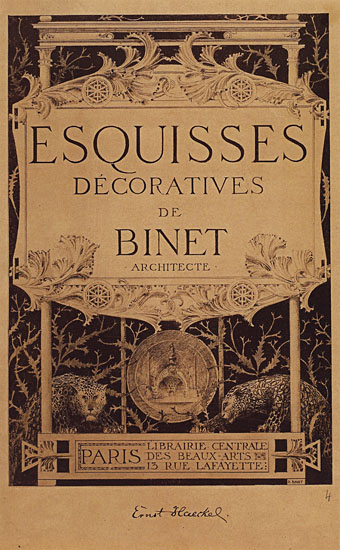
Esquisses Décoratives by René Binet

exposition1.jpg

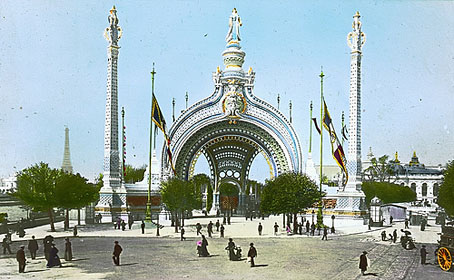
The work of French architect and designer René Binet (1866–1911) has been featured here before with one of his most famous creations, the monumental gate he designed for the Paris Exposition Universelle of 1900. Philippe Jullian in his 1974 book about the exposition, The Triumph of Art Nouveau, calls the gate the “Porte Binet” and also notes that it was referred to as “the Salamander” for its resemblance to the salamander stoves of the period.

binet1.jpg

The reference to nature is apt, albeit for a different reason, since it was Ernst Haeckel’s Kunst-Formen der Natur which Binet used as inspiration for his designs, the encrustation on the gate being based on Haeckel’s studies of shell forms. This influence was developed four years later in Binet’s Esquisses Décoratives, a series of speculative designs which applied Haeckel’s work to architecture and interior design as a whole; the Porte Binet can be seen on the title plate above and the print there seems to have been either signed by or dedicated to Haeckel.

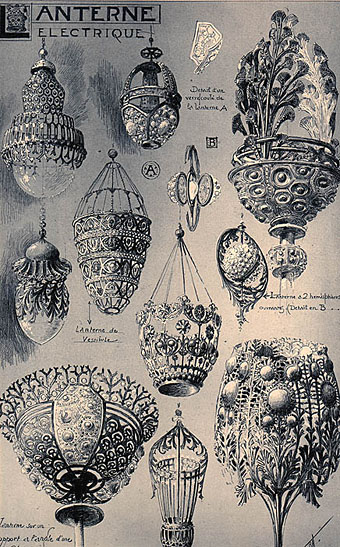
Art Nouveau design is usually thought of in terms of the curvaceous style derived from Alphonse Mucha and others, but there were several designers of the period looking to nature for inspiration in a way which went beyond William Morris’s application of plant forms to flat surfaces. Binet’s lamp designs below show how Haeckel’s sea-life could be transmuted into enclosures for electric lights. These designs hint at a direction which went unexplored in the 20th century; the Art Nouveau style was steadily vulgarised after the Exposition Universelle until it was replaced altogether by the development of Art Deco following the First World War. Binet went on to design the extension of the Paris department store, Printemps, but his huge Art Nouveau atrium was later destroyed by fire.

binet2.jpg

There aren’t many examples of Binet’s designs on web pages, the ones here are from this Flickr set and a vintage print seller. There is a recent study of Binet’s work available, however, René Binet: from Nature to Form by Olaf Breidbach. For an idea of how an entire city based on Haeckel might look, we have Schuiten and Peeters’ imaginary metropolis of Blossfeldtstad whose “Vegetalistic” architecture was featured in an earlier post.

Previously on { feuilleton }
Le Palais de l’Optique, 1900
Exposition Universelle films
Exposition jewellery
Exposition Universelle catalogue
Exposition Universelle publications
Exposition cornucopia
Return to the Exposition Universelle
The Palais Lumineux
Louis Bonnier’s exposition dreams
Exposition Universelle, 1900

Fascinating tentacula

squid.jpg

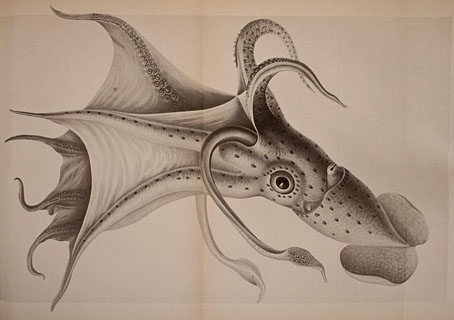
Histioteuthis ruppellii.

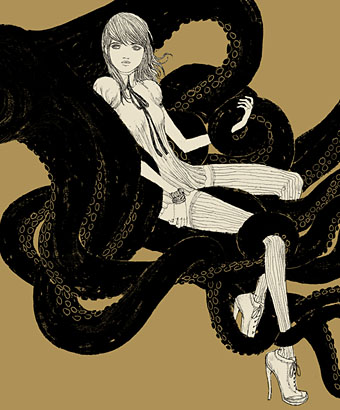
Suckered pseudopods flex and writhe again this week with simultaneous postings at BibliOdyssey and Sci-Fi-O-Rama. Coincidence or some cephalopodic zeitgeist thing? You decide. BibliOdyssey has a fine set of natural history plates showing various squid and octopuses while Sci-Fi-O-Rama presents a small collection of illustrations by Barnaby Ward. If it’s boys and tentacles you want (and who doesn’t?), then there’s always the art of NoBeast.

ward.jpg

Untitled drawing by Barnaby Ward.

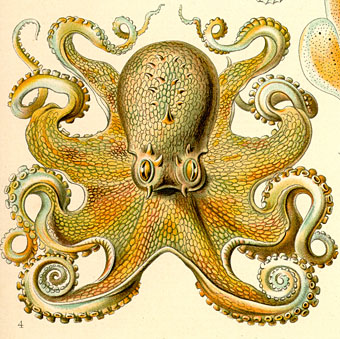
Ernst Haeckel remains my favourite tentacle illustrator, and the octopus below is one of his examples from Kunstformen der Natur (1899–1904). Somewhere (although Cthulhu knows where) I have a drawing by Hal Foster from one of his Prince Valiant strips showing a sinister octopus in a pit which is almost a match for Haeckel’s, and may even have been based on it. If I ever find it again I’ll post it here. Meanwhile, China Miéville’s Kraken is currently lurking on bookshelves, and let me remind you again that he discusses that novel and other works over at Salon Futura. While we’re on the subject, let’s not forget the Octopulps.

haeckel.jpg

Octopus by Ernst Haeckel.

Finally, a note to say that my webhost is moving this site to a new server which may cause some disruption to these pages for the next few days. As always, your patience is appreciated.

Previously on { feuilleton }
Jewelled butterflies and cephalopods
Haeckel fractals
Ernst Haeckel, Christmas card artist
The art of Rune Olsen
Octopulps
The art of NoBeast

Le Palais de l’Optique, 1900

optique1.jpg

Here at {feuilleton} the Paris Exposition Universelle of 1900 is never far away. This post is linked to those of the previous two days via the zodiac signs which decorate the lavish canopy on the Palais de l’Optique, one of the smaller exposition halls. The zodiac signs seem oddly inappropriate for displays of scientific endeavour until you discover that the principal attraction was François Deloncle’s Grande Lunette, or Great Telescope, one of the largest refracting telescopes ever built.

optique2.jpg

The astrological signs, then, signify the heavens which the telescope allowed an audience to view on a giant screen. The elegant poster advertising the attraction is by Georges Paul Leroux (1877–1957), and was discovered at Gatochy’s Flickr pages. The diagram below shows the colossal scale of thing and—appropriately—ought to be viewed at a larger size on Pignouf’s page. When you consider the small scale of film projections in 1900 the screenings from this monster must have been quite spectacular. The Exposition Universelle 3D Project has additional photos.

optique3.jpg

Previously on { feuilleton }
Exposition Universelle films
Exposition jewellery
Exposition Universelle catalogue
Exposition Universelle publications
Exposition cornucopia
Return to the Exposition Universelle
The Palais Lumineux
Louis Bonnier’s exposition dreams
Exposition Universelle, 1900
The Palais du Trocadéro

Weekend links 26

library.jpg

The interior of the Public Library of Cincinnati and Hamilton County “Old Main” Building, 1874. Reblogged over the past few days on numerous Tumblr postings, none of whom had bothered to find out any details about the picture. I’m with Silent Porn Star on the contextless reblogging issue.

Keith Richards et Mick Jagger à Londres, TV interviews with the Glimmer Twins from 1968 with some remarkable footage in the second half of Jagger filming the penultimate shot of Performance. That French video site requires further exploration. Also there is a short film from 1961 with Jacques Lasry demonstrating the Cristal Baschet. Related: Jacques Doyen & Jacques Lasry play their Cristals while Arlette Thomas and others read French poetry. I wrote something about the mystery of the Cristal two years ago this week.

• Two great album cover blogs from Jive Time Records: Project Thirty-Three is “a shrine to circles, dots, squares, rectangles and triangles, and the designers that make them come to life on album covers” while Groove Is In The Art “celebrates the era when psychedelic graphics and pop art met the mainstream”.

• At A Journey Round My Skull: Night Hallucinations: illustrations by Jaroslav Šerých for Tales of the Uncanny (Prague, 1976); Snark, Strangeness and Charm, Mahendra Singh’s illustrations for Lewis Carroll and others.

chaves.jpg

Laurence Chaves illustrates De Quincey’s Confessions of an English Opium-Eater at Golden Age Comic Book Stories.

Austin Osman Spare: Fallen Visionary at the Cuming Museum, Southwark, London in September, “will be the largest showcase of [Spare’s] work in a public museum since his death in 1956.” Jerusalem Press are publishing an expensive monograph to accompany the exhibition.

Freeing “Pale Fire” From Pale Fire; “the next big Nabokov controversy”. Probably not but the thesis is an interesting one.

Quintessential ‘topiary’ in Gandalf’s Garden: Barney Bubbles, head shops and Op Art graphic design.

• Monster Brains discovered some more paintings by Thomas Häfner.

• Spaceweather’s Northern Lights gallery.

The passion of Krzysztof Penderecki.

• More Bookshelf porn.

White peacocks.

Sussan Deyhim: Daylaman | Desert Equations (for Brion Gysin) (with Richard Horowitz) | An interview at WorldStreams.

Several links this week via Adrian Shaughnessy’s Twitter feed. Thanks!