Cocteau and Lovecraft

cocteau.jpg

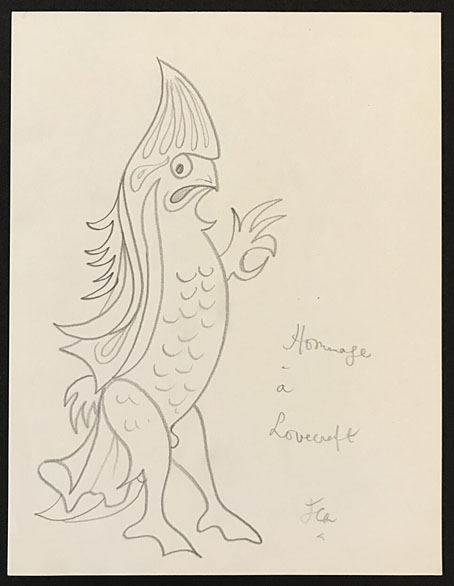
This one arrives via Tentaclii, via ST Joshi’s news page. Jean Cocteau paying homage in pencil to HP Lovecraft is both unlikely and almost too good to be true. But the drawing, circa 1951, is from a Beverly Hills gallery where other Cocteau artwork is up for sale so it can be accepted as the genuine article.

Cocteau’s enthusiasm for Lovecraft’s fiction doesn’t seem to be news either, even though this is the first I’ve heard of it. Another of Joshi’s links is to this newspaper feature from 1954 in which Cocteau together with various notables of the time are asked to choose their books of the year. While the other contributors list the kinds of titles you’d expect, Cocteau has a book about Atlantis by Denis Saurat, books about parapsychology and “les soucoupes volantes” (flying saucers), plus the first French collection of Lovecraft’s stories, translated by Jacques Papy. I knew that Cocteau had a mystical side—you’d expect nothing less from the director of Orphée—but this combination of Lovecraft and full-on crankery is a surprise. He lived just long enough to see the first publication of Pauwels and Bergiers’ Ur-text of the 70s’ crankosphere, The Morning of the Magicians, so I can imagine him lapping up that one as well.

gessner.jpg

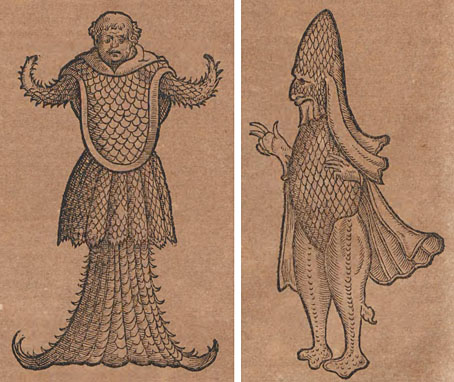
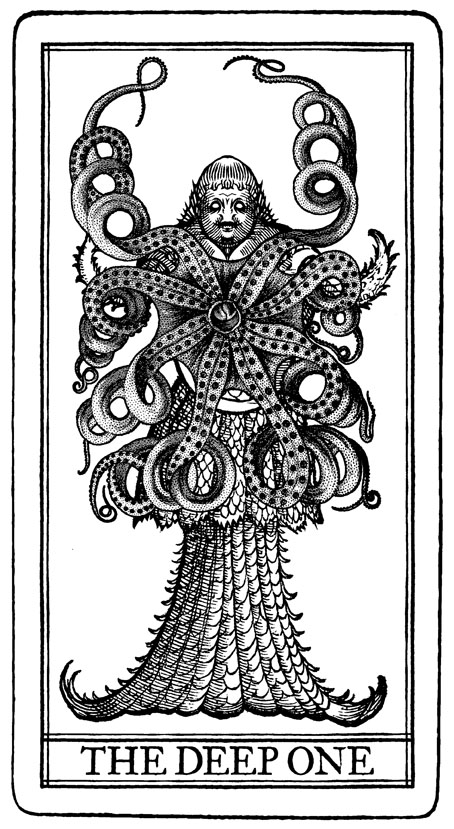
As for the doodle, this is Cocteau’s version of a sea-monster illustration from Conrad Gessner’s Historia Animalium (1551–1558), a five-volume study which includes a number of fantastic creatures among its descriptions of the animal life known to 16th-century Europeans. Gessner has a page or two about the so-called “sea bishop” which includes this illustration together with another one I adapted myself in 2010 for the Neil Gaiman story in Lovecraft’s Monsters. Good to know that Cocteau and I were on the same page, as it were.

deep-one.jpg

Elsewhere on { feuilleton }
The Lovecraft archive

Previously on { feuilleton }
Cocteau drawings
Querelle de Brest
Halsman and Cocteau
La Belle et la Bête posters
The writhing on the wall
Le livre blanc by Jean Cocteau
Cocteau’s sword
Cristalophonics: searching for the Cocteau sound
Cocteau at the Louvre des Antiquaires
La Villa Santo Sospir by Jean Cocteau

Weekend links 617

parent.jpg

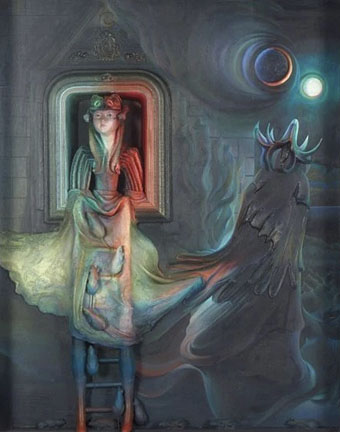
Diane (1977) by Mimi Parent.

Richard Pinhas expounds upon his favourite musical choices for Warren Hatter. The influence of Robert Fripp has always been to the fore in the Pinhas oeuvre—an early track by Heldon is titled In The Wake Of King Fripp—so there was bound to be a King Crimson album on the list. But which one? Click through the selections to find out.

• Vinyl is the product of a toxic manufacturing process, as well as being difficult to recycle without releasing yet more toxins, but you seldom see these issues discussed by today’s quality-conscious vinyl fetishists. Jono Podmore talks to some of the people trying to create an eco-friendly disc.

• “…these Renaissance images shock us because they are so frequently ithyphallic: Christ has risen, but not in the way we have come to expect.” Hunter Dukes on ostentatio genitalium in Renaissance art.

• At Wormwoodiana: Mark Valentine on those music projects that used to be described as “hauntological”, with an emphasis on The Machinery of the Moment, a new release from The British Space Group.

• “Like Delia Derbyshire jamming with This Heat.” Jesse Locke tours the Broadcast discography.

• 50 Watts announces the birth of 50 Watts Books, a publisher of strange and/or unusual art books.

• “Black lights turn this North Carolina mine into a psychedelic wonderland.”

• At Dennis Cooper’s: Bill Morrison Day.

Black Lightening Light (1968) by The Shy Guys | Black Light (1994) by Material | Transmission Nine: Black Light (2013) by Pye Corner Audio

Weekend links 615

tesla.jpg

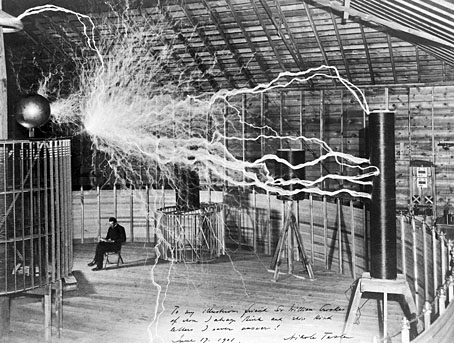
Tesla does the Astro. Hunter Dukes at Public Domain Review examines the promotion of Nikola Tesla’s ideas via this famous photograph.

• Coming soon from Side Real Press: Kokain—The Modern Revue, a magazine produced in Vienna that ran for five issues during 1925. “Original copies are so rare that it scarcely appears in any of the literature relating to the Weimar period and its contents have remained almost entirely ignored and certainly untranslated. Until now.”

• “Magritte had gotten this far in life by refusing to obey anyone, and in a way his disobedience proved that he understood Surrealism better than the leader of the Surrealists.” Jackson Arn reviewing Magritte: A Life by Alex Danchev.

• “Go as far into your dream as possible and find your own unique voice.” Meredith Monk (again) talking to Elizabeth Aubrey.

• Coming soon from Strange Attractor: City of the Beast: The London of Aleister Crowley by Phil Baker.

• At Spoon & Tamago: The natural world springs to life in kirie paintings by Tamami Kubota.

Antonia Mufarech on why sunflowers are Ukraine’s national flower.

• At Dennis Cooper’s: Etienne-Louis Boullée’s unbuildable tombs.

• Mix of the week: I Can’t Go For That by The Ephemeral Man.

• New music: Triumph Of The Oak by The Lord.

• RIP Philip Jeck.

Tesla (1997) by Jimi Tenor | Tesla (2011) by They Might Be Giants | Tesla Coil (2016) by Xhei

Weekend links 604

ware.jpg

Poster by Chris Ware for Uncle Boonmee Who Can Recall His Past Lives (2010).

• “He is a proponent of “slow cinema,” which is to say, movies that inspire reflection because they are unhurried but fluid, clear but framed by mystery.” Hilton Als on the metaphysical world of Apichatpong Weerasethakul.

• “You could take off your clothes and lay in the sun, nude, with other guys looking for sex, right in Manhattan. And the police didn’t care. It was safe…” Stanley Stellar on his photographs of New York’s “Gay Piers”.

• At Wormwoodiana: An interview with RB Russell who talks about his new book, Robert Aickman: An Attempted Biography.

• New music: Mysterium by Held By Trees; A Journey by Hinako Omori; Waves by The Soundcarriers.

• Get some cosmic perspective with an updated version of Charles & Ray Eames’ Powers of Ten.

• You Cut Your Hair and Made a Friend: Richard Conway on Ladytron’s 604 and Light & Magic.

• At Unquiet Things: The Tawdry Technicolor Horrors of Vicente B. Ballestar.

• Alexis Petridis compiles a list of the late James Mtume’s greatest recordings.

• Steven Heller’s Font of the Month is Valvolina.

Slow Motion (1978) by Ultravox | Slow And Low (1995) by Tetsu Inoue | Slow Burning Ghosts (1996) by Paul Schütze

Weekend links 603

weird.jpg

Weird Tales (Canada), May 1942. Cover art by Edmond Good.

• “…in 1968, seven years after the MOMA retrospective, Orson Welles appreciatively got in touch and suggested that Bogdanovich do a book-length set of interviews with him like the one that Bogdanovich had just done with Ford. The resulting book, This Is Orson Welles (which took a winding path to publication, in 1992, seven years after Welles’s death), is a classic of the literature of movies.” Richard Brody on the late Peter Bogdanovich. The book of Welles interviews is one of my favourite film books, as good in its way as Hitchcock/Truffaut, and like Truffaut’s book you wish it was twice as long.

• At Public Domain Review: Paloma Ruiz and Hunter Dukes on Johann Caspar Lavater’s frog-to-human physiognomies. If you reverse the sequence, as I did for one of the illustrations in Lovecraft’s Monsters, you approach The Shadow Over Innsmouth.

• The week in virtual exploration (via MetaFilter): Mini Tokyo 3D and Explore the Soane Museum, London.

• Submissions are open for the 16th issue of Dada journal Maintenant which will have the theme “Nyet Zero”.

• At Spoon & Tamago: Artists and artisans collaborate on exhibition of 144 maekake aprons.

• DJ Food unearths flyers and posters for the Million Volt Light & Sound Rave, 1967.

• Mix of the week: Isolatedmix 116 by Chris SSG.

• At Dennis Cooper’s: Stephen Dwoskin Day.

The Little Blue Frog (1970) by Miles Davis | Jail-House Frog (1972) by Amon Düül II | Tree Frog (1995) by Facil