Weekend links 271

flyhead.jpg

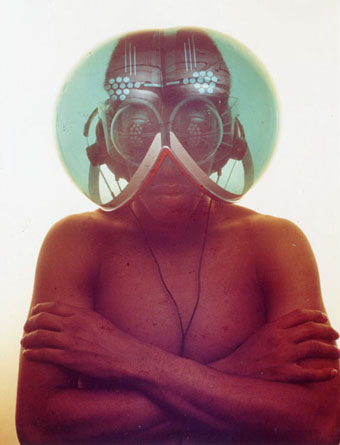
Environment Transformer/Flyhead Helmet by Haus-Rucker-Co (1968). From Hippie Modernism at the Walker Art Center, Minneapolis.

• From 2006: Weird Tales: The Strange Life of HP Lovecraft. Geoff Ward examines Lovecraft’s life and work for BBC Radio 3 with contributions from Neil Gaiman, ST Joshi, Kelly Link, China Miéville and Peter Straub. Meanwhile, Ned Beauman wonders whether Ford Madox Ford is “as scary as Lovecraft”.

• Alexei German’s years-in-the-making feature film, Hard to be a God (previously), receives a UK release this week. Paul Duane reports on an overwhelming viewing experience, while Nigel Andrews says it “may be the greatest film since the millennium began”.

• Mixes of the week: Adventures In Sound And Music, 30 July 2015, hosted by Joseph Stannard, and RCMIX9 by worriedaboutsatan.

As Nabokov insisted, “Literature is invention. Fiction is fiction. To call a story a true story is an insult to both art and truth.” The genre thrives because its deceptions are liberating. For Wood, the thrill of reading fiction is intimately connected with the awareness that fiction constitutes “an utterly free space, where anything might be thought, anything uttered.” The excitement comes when, as readers, we’re allowed to participate in this freedom and experience the fiction imaginatively, without being required to believe that it is true.

Joanna Scott on The Virtues of Difficult Fiction

• “Writing used to be a solitary profession. How did it become so interminably social?” asks Meghan Tifft.

• The original, real-life dystopian cityscape of Kowloon Walled City, and the artwork it inspired.

• The Long, Lonely Walk: Nick Ripatrazone on hallways in horror films.

New cover designs for the Essentials range from Penguin Books.

Lemi Ghariokwu: “How I designed Fela Kuti’s album covers”.

• “Do CDs sound better than vinyl?” asks Chris Kornelis.

• Magic Fly (1977) by Space | Human Fly (1978) by The Cramps | I Am The Fly (1978) by Wire
The art of Karel Thole, 1914–2000

thole4.jpg

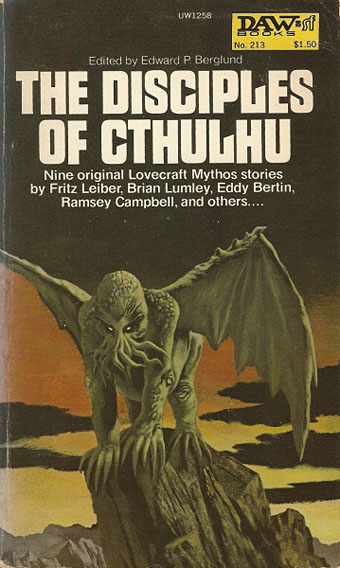
The Disciples of Cthulhu (1976).

A disagreement I have with the burgeoning world of Lovecraft art is the relentless focus on monsters—and I say this in a week when I’ve been working on a new commission of exactly this: six pictures of Lovecraftian creatures. Lovecraft famously emphasised atmosphere as the paramount ingredient in a weird story, and atmosphere in his fiction is often generated by his descriptions of landscape and architecture; Angela Carter’s insightful essay in the George Hay Necronomicon (1978) was entitled Lovecraft and Landscape. Architecture often receives considerable attention in the stories: The Call of Cthulhu, The Dreams in the Witch House, The Haunter of the Dark, and At the Mountains of Madness all concern invented (or reimagined) architectural settings. Given this, you’d expect architecture to be more represented in Lovecraft art but this is seldom the case. When it comes to Cthulhu, a creature whose myriad representations must be reaching some kind of critical mass, artists will lavish great attention on tentacles, claws and flourished wings but the Cyclopean stones of R’lyeh are invariably reduced to a tentative backdrop.

thole1.jpg

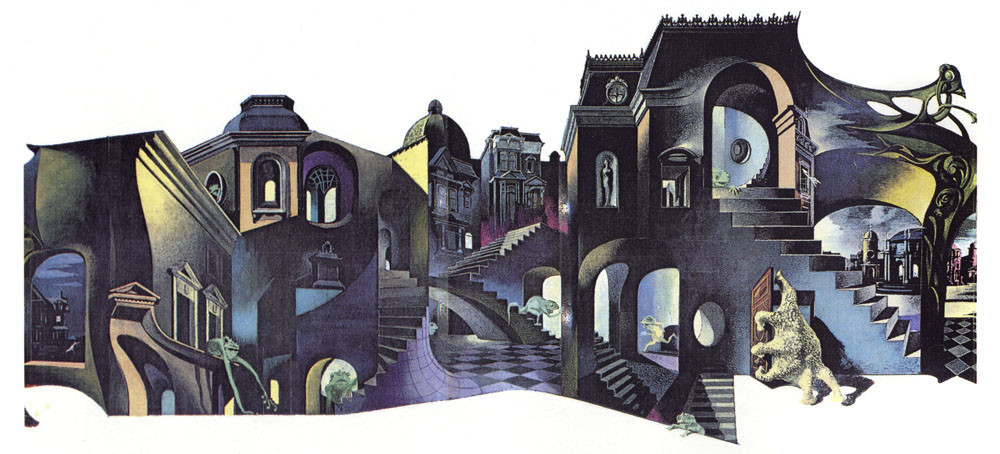
I mostri all’angolo della strada (The Monsters on the Street Corner, 1966).

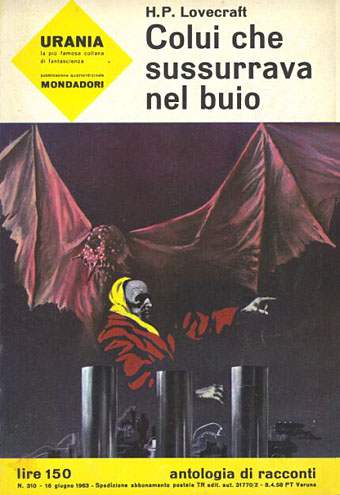
Hence the attraction of the wraparound cover by Karel Thole for I mostri all’angolo della strada, a Lovecraft story collection with one of the few cover designs I’ve seen that attempts to communicate anything of the writer’s preoccupations with angled space. Thole was a very prolific Dutch artist, producing many covers for Italian publisher Mondadori, and painting covers for Mondadori’s SF magazine, Urania, for over 20 years. The first paintings of Cthulhu I saw were those by Thole (above) and Bruce Pennington in Franz Rottensteiner’s The Fantasy Book (1978); Thole’s monster doesn’t have the required scale (and Pennington’s cover is a favourite) but for me it still carries a Proustian charge. The art for I mostri all’angolo della strada was featured in The Cosmical Horror of HP Lovecraft (1991), one of the first attempts to anthologise Lovecraft-related illustration past and present. The book contains many excellent reprints together with dubious material from European comics. Thole’s street scene—a curious combination of Escher, De Chirico and Art Nouveau—stood out among page after page of slavering abominations. I’d like to see more art that follows this direction; less of the monsters, more of the monstrous architecture.

thole2.jpg

Colui che sussurrava nel buio (The Whisperer in Darkness, 1963).

Continue reading “The art of Karel Thole, 1914–2000”

Weekend links 270

ufo.jpg

Cover design for UFOs and Extra-Terrestrials in History (four vols, 1978) by Yves Naud.

Come To The Sabbath, “a festival of dark arts delving into the influence of Black Magick, Witchcraft, Demonology and Satanism in pop culture”, takes place at Apiary Studios, 458 Hackney Road, London, from Tues 18th–Sun 23rd August.

• “Visitors, if there had ever been any, would have said that the little town of Mansfield was haunted.” Showdown is a previously unpublished short story by Shirley Jackson.

• “A sandbox stealthy immersive sim in a surreal, horror-y world inspired by writers like Burroughs and Ballard…” Alice O’Connor previews the forthcoming computer game, Tangiers.

Sometime in the late 1960s, the artist Robert Smithson took a trip to southwestern Ohio. He saw the Great Serpent Mound there and decided that he would make a great spiral too. […] Because the Great Salt Lake’s levels vary several feet from year to year, and also from season to season, Spiral Jetty is not always visible even if you make the trip to Utah. You could go out to Spiral Jetty and find that the entire earthwork is invisible underwater. When Robert Smithson created this earthwork in 1970, he did not care if it could be easily seen or who owned it. And so, even today, no one knows to whom Spiral Jetty really belongs. To view it requires a pilgrimage.

Stefany Anne Goldberg on earthworks, new and ancient, and the art of disappearance

• “Commercial book cover design is a minor portion of Gorey’s award-winning legacy, but not a lesser art.” Steven Heller on Edward Gorey: cover designer.

• “You are accepted,” he says, “by the genre that can accept you.” Samuel R. Delany talked to Peter Bebergal about being an outsider in the world of science fiction.

A battle of Witts: A brief look at ‘Taboos’ and the work of The Passage. Mark Griffiths on a great, if seldom-remembered, Manchester band.

• “Hispanic photomonteur Josep Renau aimed Technicolor jets of scorn at the mirage of US consumerist culture,” says Rick Poynor.

• Because the internet is really big… Kelli Anderson reworks the Eames’ The Powers of Ten using imagery found via Google searches.

Against Nature is a forthcoming musical adaptation of Huysmans’ À Rebours by Marc Almond, Jeremy Reed and Othon.

“What makes a film noir?” Adam Frost & Melanie Patrick have an infographic for you.

• Mixes of the week: Gizehcast #20 by LCC, and Jenny Hval‘s WEIRD Quietus mix.

• Mysterium Tremendum: Russell Cuzner on The Strange World of Lustmord.

• The charming march of the Penguin Books logo.

Cosey Fanni Tutti: Agent Provocateur

Dark Times (Peel Session) (1980) by The Passage | XOYO (1982) by The Passage | Revelation (1982) by The Passage

Weekend links 269

cluster.jpg

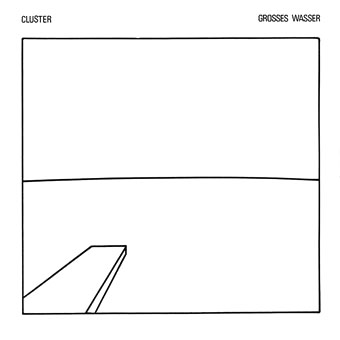
Grosses Wasser (1979) by Cluster. Cover art by Dieter Moebius.

• RIP Dieter Moebius: one half of Cluster (with Hans-Joachim Roedelius), one third of Harmonia (with Roedelius and Michael Rother), and collaborator with many other musicians, including Brian Eno and Conny Plank. Geeta Dayal, who interviewed Moebius for Frieze in 2012, chose five favourite recordings. From 2008: Cosmic Outriders: the music of Cluster and Harmonia by Mark Pilkington. At the Free Music Archive: Harmonia playing at ATP, New York in 2008. Live recordings of Cluster in the 1970s have always been scarce but in 1977 they played a droning set at the Metz Science-Fiction Festival, a performance that was broadcast on FM radio (the Eno credit there seems to be an error).

• “I’ve since had the feeling that, if the attacks against The Satanic Verses had taken place today, these people would not have defended me, and would have used the same arguments against me, accusing me of insulting an ethnic and cultural minority.” Salman Rushdie on the fallout from the Charlie Hebdo killings.

• “The effect of these memories is to make you think you know the film better than you do, and wonder what it’s like actually to sit down and watch it.” Michael Wood on rewatching Orson Welles’ Touch of Evil (1958). Related: Tipping My Fedora on the film’s source novel, Badge of Evil (1956).

“To me, it’s simple,” he says. “Fantasy became as bland as everything else in entertainment. To be a bestseller, you’ve got to rub the corners off. The more you can predict the emotional arc of a book, the more successful it will become.

“I do understand that Game of Thrones is different. It has its political dimensions; I’m very fond of the dwarf and I’m very pleased that George [R R Martin], who’s a good friend, has had such a huge success. But ultimately it’s a soap opera. In order to have success on that scale, you have to obey certain rules. I’ve had conversations with fantasy writers who are ambitious for bestseller status and I’ve had to ask them, ‘Yes, but do you want to have to write those sorts of books in order to get there?’”

Michael Moorcock talking to Andrew Harrison about fantasy, science fiction, the past and the present.

• “Architects love Blade Runner, they just go bonkers. When I was working on the film, it was all about, let’s jam together Byzantine and Mayan and Post-Modern and even a little bit of Memphis, just mash it all together.” Designer and visual futurist Syd Mead talking to Patrick Sisson.

• “Lucian of Samosata’s True History reads like a doomed acid trip,” says Cecilia D’Anastasio, who wonders whether or not the book can be regarded as the earliest work of science fiction.

• Mixes of the week: A Tribute to Dieter Moebius by Vegan Logic, and another by Totallyradio.

• The Phantasmagoria of the First Hand-Painted Films by Joshua Yumibe.

Islamic Geometric: calligraphic tessellations by Shakil Akram Khan.

Michael Prodger on The Dangerous Mind of Richard Dadd.

A chronological list of synth scores and soundtracks.

Touch Of Evil (Main Theme) (1958) by Henry Mancini | Badge Of Evil (1982) by Cabaret Voltaire | Touch Of Evil (2009) by Jaga Jazzist

Weekend links 268

paul.jpg

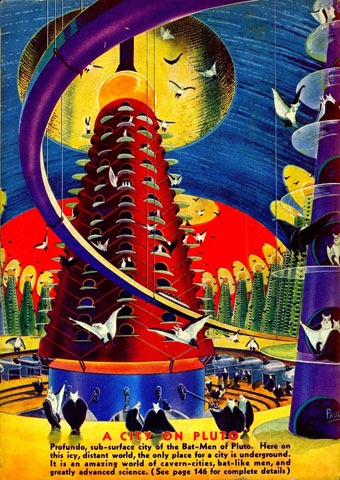
A City on Pluto (1940) by Frank R. Paul. Related: Paul’s predictions about life on other planets.

23 Skidoo’s Peel Session from September 16th, 1981. Only 18 minutes of music but I’m thrilled for its being unique material that’s never been given an official release. There are many more Peel Sessions at the uploader’s channel, not all of which were reissued on the Strange Fruit label. Download favourites in their as-broadcast form (some with John Peel’s introductions) before they vanish or get blocked like the 1981 Cabaret Voltaire session. Related: Wikipedia’s list of Peel Sessions.

• Mixes of the week comprise two collections by Jon Dale of strange and beguiling Italian music: The Prevarications Of The Sky Against The Earth and La Verifica Incerta; the Summer Window Mix (“telly detritus, new-not-new synth nonsense & off-colour pop oddities”) by Moon Wiring Club; and Secret Thirteen Mix 158 by Haunter Records.

• “Hello, this is David Bowie. It’s a bit grey out today but I’ve got some Perrier water, and I’ve got a bunch of records…” Two hours of the Thin White Duke playing favourite music on BBC Radio One, 20th May, 1979.

Some of Vidal’s guests were writers, not exactly his favorite group. “Writers are the only people who are reviewed by people of their own kind,” Vidal said in an interview. “And their own kind can often be reasonably generous—if you stay in your category. I don’t. I do many different things rather better than most people do one thing. And envy is the central fact of American life.”

Frank Pizzoli reviews Sympathy for the Devil: Four Decades of Friendship with Gore Vidal by Michael Mewshaw

• Yair Elazar Glotman’s new album, Études, conjures “bone-rattling resonance, thick, alien-like atmospheres, and percussive fragments”. Stream it in full here.

• London’s Lost Department Store of the Swinging Sixties: Inge Oosterhoff on the splendours of Biba.

• It’s that Ungeziefer again: Richard T. Kelly on 100 years of The Metamorphosis by Franz Kafka.

• The History of Creepy Dolls: Linda Rodriguez McRobbie explores the uncanny valley.

• At Dangerous Minds: Matt Groening tells the story of The Residents in 1979.

• The NYT collects NASA’s photos from the New Horizons Pluto flyby.

The Museum of Imaginary Musical Instruments

Written on the Body: tattoos in cinema

The Doll’s House (1981) by Landscape | Voodoo Dolly (1981) by Siouxsie and the Banshees | Devils Doll Baby (1986) by Sonny Sharrock