Weekend links 43

broadcast.jpg

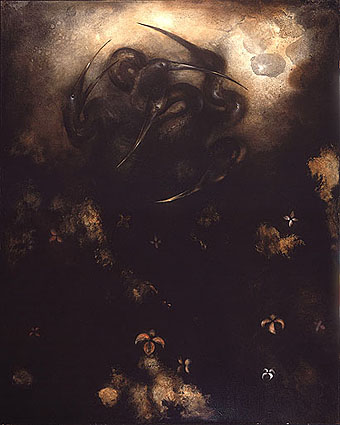
From the video for I See, So I See So by Broadcast.

RIP Trish Keenan of Broadcast. Tributes here and here. The Broadcast/Focus Group collaboration …investigate Witch Cults of the Radio Age was The Wire‘s album of the year for 2009. Joseph Stannard interviewed Trish Keenan and James Cargill in October of that year.

Who Knows What Tomorrow Might Bring, a new pay-what-you-please Arthur mixtape. Also at Arthur, Sunday Lectures by Freeman House here, here, here and here.

• Cormac McCarthy’s description of American pioneers in Suttree (1979) kept coming to mind during the past week:

Where hunters and woodcutters once slept in their boots by the dying light of their thousand fires and went on, old teutonic forebears with eyes incandesced by the visionary light of a massive rapacity, wave on wave of the violent and the insane, their brains stoked with spoorless analogues of all that was, lean aryans with their abrogate semitic chapbook reenacting the dramas and parables therein and mindless and pale with a longing that nothing save dark’s total restitution could appease.

Born This Way: “A photo/essay project for gay viewers (male and female) to submit pictures from their childhood (roughly ages 4 to 14), with snapshots that capture them, innocently, showing the beginnings of their innate LGBT selves. It’s nature, not nurture!”

Mischievous street art characters. Chris Marker wouldn’t want us to forget Monsieur Chat. Speaking of Chris Marker, there’s Plato’s Cave as Kino: Owl’s Legacy Excerpt & Becoming Imperceptible.

With the point of a knife Dr. LeBaron took from the little round box a small quantity of a dark, greenish-colored gum, which, as it was passed from one to another for inspection, gave off an agreeable, aromatic odor. Then, as he was engaged in filling two capsules from the box, he explained:

“As le docteur read from ze book of Monsieur Richet, ze favoreet méthode in ze Orient ees to take ze Haschisch by ze smoke in ze Persian pipe—ze hookah, ze nargileh. But zey also take eet in ze great varieté. Ze principal kind zat come to ze market of Europe, ees zat I show you—ze Haschisch, an’ ve take eet like ze dose of quinine,” said he, as he handed a well-filled capsule to both Smith and Arnold.

Throwing back his head, Smith bolted his dose without ceremony, and Arnold immediately followed his example.

Haschisch: A Novel (1886) by Thorold King. Related: Haschisch Hallucinations (1905) by HE Gowers.

• Dan Hill’s personal report from the drowned world of Brisbane. Related: Hayley Campbell recalls swimming in the city’s hazardous floodwaters when she was a wild child. Also: Canoeing in McDonald’s.

Cabinet Card Backmarks, florid advertisements from Victorian cabinet photos. Callum James made a post on the subject in 2008 and has a Flickr set showing his discoveries.

• The Brothers Quay made a public information film about AIDS in 1996. (Now deleted from YouTube…boo!)

The secret stories of book inscriptions. Related: The Book Inscriptions Project.

• Ani, Turkey: City of 1001 Churches, all of them abandoned and ruined.

Vulgar Army: Octopus in Propaganda and Political Cartoons.

• Designer John Gall makes collages in his spare time.

Phantasmaphile at Tumblr.

Witch Cults and I See, So I See So, both by Broadcast & The Focus Group.
Weekend links 42

martin.jpg

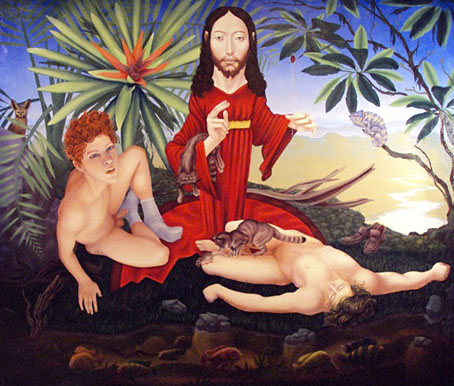
Blasphemous Rumours (2009/2010) by Ryan Martin. The artist now has a dedicated site for his paintings.

The Museum of Censored Art, a mobile gallery, will be showing the withdrawn David Wojnarowicz film outside the National Portrait Gallery, Washington DC, until their contentious gay art exhibition closes next month. Related: Bishop of Mallorca criticises calendar—which shows Catholic youths posing naked—for ‘not respecting Christian symbols’.

• Didier Lestrade published French gay zine Magazine in the 1980s, and later co-founded Têtu. He’s interviewed at BUTT and has started uploading the entire run of Magazine about which he says: “I don’t want to stamp some kind of logo on this material. It’s gay. It’s gay history. It belongs to everybody. If you want to take a piece of it, please try to mention the origins of it, a simple code word “Magazine” will be enough. If you wanna be more specific, be my guest.”

HMV, Britain’s last big music chain, is closing 60 branches. Yet a new wave of CD stores is thriving. Oh, HMV, how I’ll miss your £17 CDs (and double-CDs at £34)… On second thoughts, no I won’t, your wretched retail barns always exemplified the greed endemic in the music business.

kasner.jpg

Love Comes/Destroyer by Stephen Kasner.

• Artist Stephen Kasner‘s work has adorned music releases by Sunn O))), Isis and others. He’s currently another American creator in need of assistance with medical expenses. Details here.

The Ghosts of Old London: the gloomy Victorian metropolis in all its deteriorated splendour. See also: In Search of Relics of Old London.

• “It’s time to recognise [Sandy] Denny as not simply a folksinger but one of Britain’s great poets of song,” says Rob Young.

Louis Pattison talks to Locrian about JG Ballard, old VHS tapes and their new album The Crystal World.

The Dreams That Stuff Is Made Of: Lebbeus Woods’ big drawings.

Hannes Bok portfolios at Golden Age Comic Book Stories.

An Iranian rapper named Salome. Also here and here.

A Moment of (Alan) Moore.

RIP Mick Karn.

Book Worship.

Sons of Pioneers (1981) by Japan; Tao-Tao (1982) by Masami Tsuchiya; Glow World (1983) by Bill Nelson.

Deutsche Kunst und Dekoration #1

dkd01-01.jpg

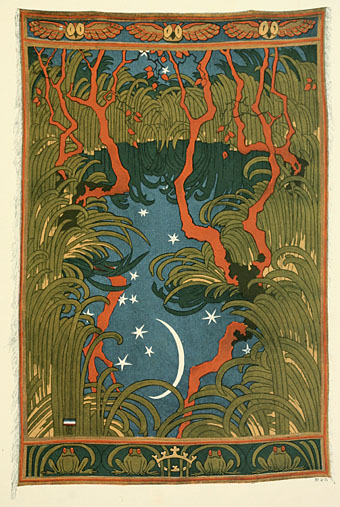
Last year saw an exploration here of the fecund pages of Jugend magazine so in the same spirit I’m embarking on a serial delve into Jugend‘s more serious contemporary Deutsche Kunst und Dekoration. I’ve made a couple of posts in this direction already but these were done before I’d had a chance to look properly through the editions at the Internet Archive, the first thirty of which form a collection which comprises some 7500 pages. Since few people would want to download and sort through that mountain these posts can serve as a select guide to the contents.

dkd01-02.jpg

Deutsche Kunst und Dekoration was published by Alexander Koch in Darmstadt and the first volume is dated October 1897–March 1898. Jugend was a humour magazine so the contents tend to be frivolous and lighthearted, Koch’s title by contrast was a guide to the best of German contemporary art and design and has the advantage of featuring furniture and architectural designs as well as graphic material. The content of this first edition is relatively sedate compared to some of the later numbers when the Art Nouveau style builds up a head of steam. There’s some astonishing design work in subsequent issues, as well as further illustration discoveries like Marcus Behmer. Watch this space.

Continue reading “Deutsche Kunst und Dekoration #1”

The Snow Queen

dulac1.jpg

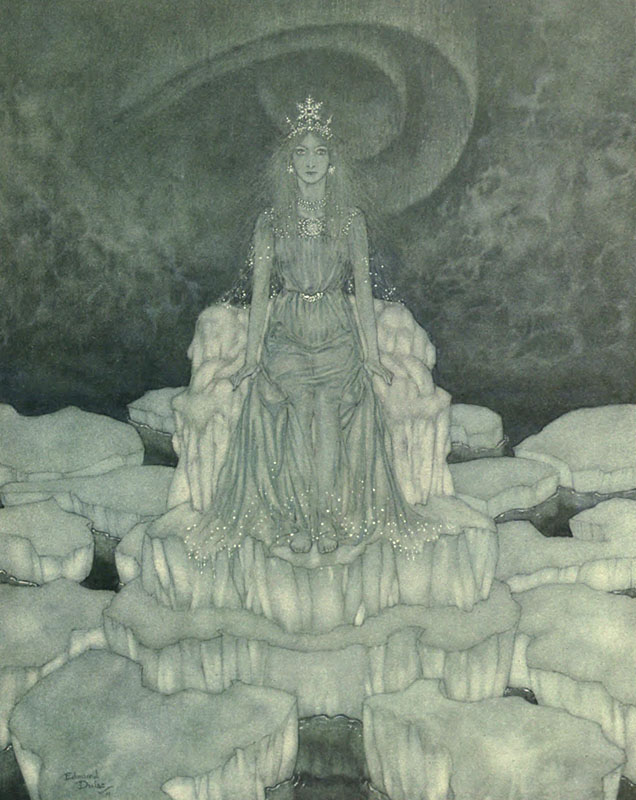
Edmund Dulac.

Empty, vast, and cold were the halls of the Snow Queen. The flickering flame of the northern lights could be plainly seen, whether they rose high or low in the heavens, from every part of the castle. In the midst of its empty, endless hall of snow was a frozen lake, broken on its surface into a thousand forms; each piece resembled another, from being in itself perfect as a work of art, and in the centre of this lake sat the Snow Queen, when she was at home. She called the lake “The Mirror of Reason,” and said that it was the best, and indeed the only one in the world.

Here in Britain it may not be quite as cold as it was earlier in the month but the Snow Queen still has us in her thrall. Hans Christian Andersen’s fairy tale was published in 1845 and, like many of the writer’s stories, is a blend of the beguiling and irritating: beguiling for the traces of older folk tales in its trolls, their magic mirror, and the Snow Queen as an embodiment of the season; irritating for the Christian gloss which is layered over everything like a sugar-coating. In this respect it’s a lot like Christmas; religiose sentimentality papered over winter rituals that are older and darker than the celebrations we’re supposed to acknowledge.

dulac2.jpg

Edmund Dulac.

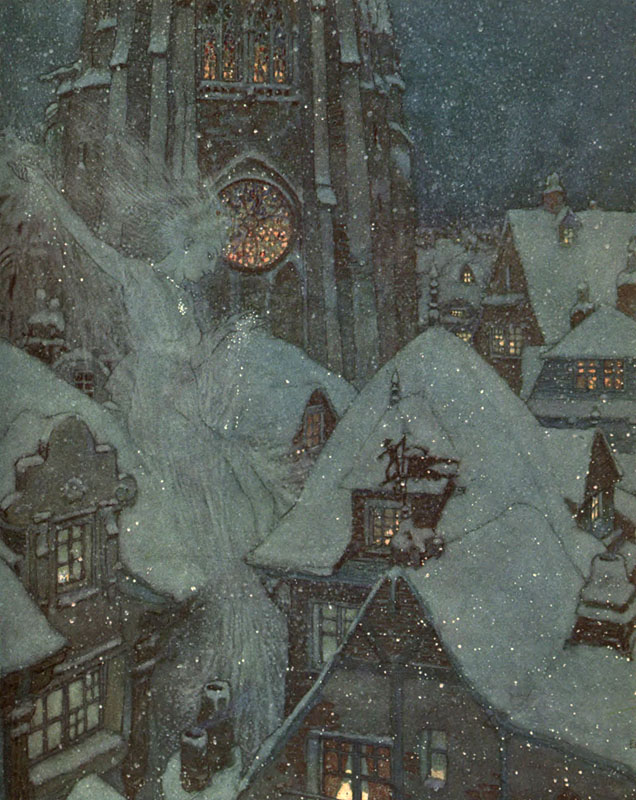
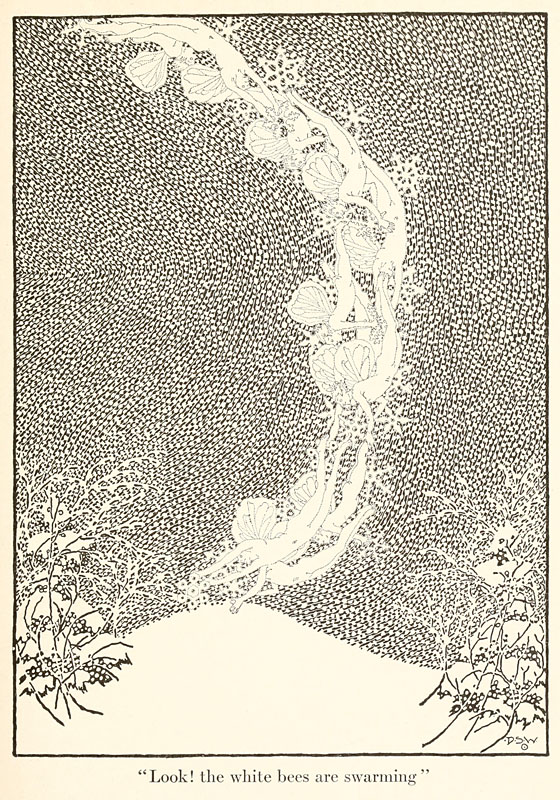
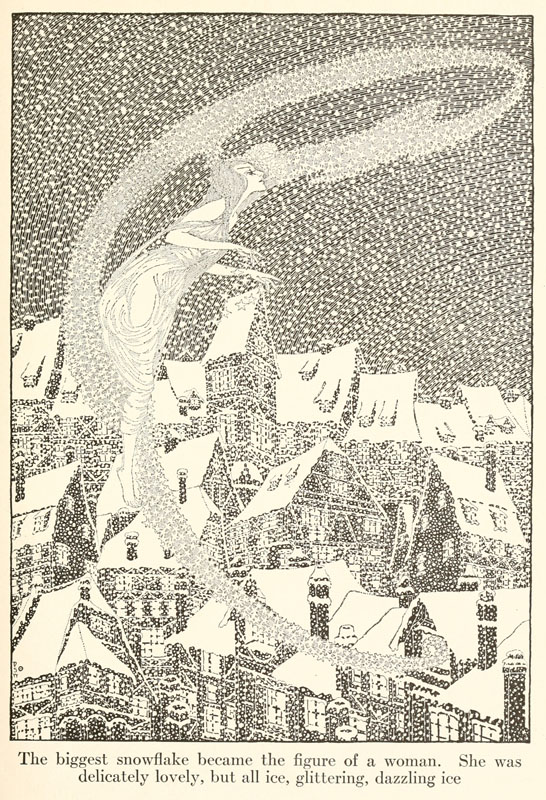
Andersen’s story has been illustrated and filmed many times with varying success. The Internet Archive has several illustrated editions, the selections here being from two of the better ones. Edmund Dulac’s Stories from Hans Andersen (1911) is one of the shorter collections and features predominantly colour pictures while Dugald Stewart Walker’s Fairy Tales from Hans Christian Andersen (1914) is one of the most heavily illustrated as well as having finer renderings of many stories. But not of the Snow Queen in her palace, Dulac beats everyone there.

walker2.jpg

Dugald Stewart Walker.

This description stood out from the second part of Andersen’s tale:

In winter all this pleasure came to an end, for the windows were sometimes quite frozen over. But then they would warm copper pennies on the stove, and hold the warm pennies against the frozen pane; there would be very soon a little round hole through which they could peep…

My sister and I had been reminiscing recently about growing up in the 1960s when central heating and double-glazing were a lot less common than they are today. This meant little or no heating in bedrooms, so very cold weather often meant the same frozen windows which Andersen describes. People in rural places will be familiar with this but it’s something I haven’t seen for years. When you’re a child it’s quite an excitement waking up to find that Jack Frost has paid a visit but these days I prefer a warm house.

As usual I’ll be away for a few days so the archive feature will be activated to summon posts from the past. Have a good one. And Gruß vom Krampus!

walker1.jpg

Dugald Stewart Walker.

Elsewhere on { feuilleton }
The illustrators archive

Previously on { feuilleton }
Dugald Stewart Walker revisited
More Arabian Nights
The art of Dugald Stewart Walker, 1883–1937

Weekend links 41

2001.jpg

Being an inveterate Kubrickphile I was naturally pleased to hear that some of the excised scenes from 2001: A Space Odyssey have survived in a watchable form, even though I’m often ambivalent about the restoration of such material. While it was good to see at last the missing French compound sequence of Apocalypse Now, for example, that sequence added nothing to the film as a whole and its inclusion was spoiled by music which Coppola used for sentimental reasons. In Kubrick’s case, there’s a longer version of The Shining which the director allowed to be screened on UK TV in the 1980s but, again, most of the unseen material was incidental and added nothing to the film.

• Related: Roger Ebert’s review of 2001 from 1968; Olivier Mourgue, designer of the Djinn chairs seen in the film’s space Hilton scenes; Magnificent obsession, a Vanity Fair piece from 2002 about the search for the missing scenes from The Magnificent Ambersons. Meanwhile, the trailer for Terrence Malick’s new film, The Tree of Life, features some surprising cosmic moments among its scenes of family life.

The separate history [of gay and lesbian artists] has been kind of edited out of art history but in fact art history is very much interwoven with gay or queer history. In a way the two can’t be separated. America doesn’t like anything uncomfortable. I find in my dealings with museums that if I ask a question and the answer is ‘no,’ they don’t answer. If the answer is ‘yes,’ I get these amazingly enthusiastic responses. I find it sort of strange sometimes, not being American myself. In a way what they’re doing is editing out the uncomfortable. David Wojnarowicz’s work can make you uncomfortable — and they’ve edited out that possibility in the show.

Canadian artist AA Bronson (see below).

• More on the Smithsonian versus David Wojnarowicz affair: Frank Rich examined the train of events in a comment piece, Gay Bashing at the Smithsonian, for the NYT; the Andy Warhol Foundation threatened to withdraw their funding for future Smithsonian events unless the work is reinstated, the Robert Mapplethorpe Foundation will be doing the same; another artist featured in the National Portrait Gallery exhibition, AA Bronson, requested that the gallery withdraw his work from the show in protest; the NPG refused, citing a contractual arrangement; among the increasing number of galleries showing support for Wojnarowicz, Tate Modern, London, will host an event in January which will feature a screening of the contentious video; lastly, there’s a protest event in New York City today (Sunday, December 19th) at 1.00pm, details here.

• More censorship in America: Jeffrey Deitch Censors Blu’s Political Street Art Mural. In the book world, writer Selena Kitt finds her erotic incest stories removed from Amazon’s Kindle store. Other authors, Jess C Scott and Esmerelda Green, have had their erotic titles removed from the store. Selena Kitt says:

When some of my readers began checking their Kindle archives for books of mine they’d purchased on Amazon, they found them missing from their archives. When one reader called to get a refund for the book she no longer had access to, she was chastised by the Amazon customer service representative about the “severity” of the book she’d chosen to purchase.

Can you imagine buying a paper book and the bookstore then paying you a visit to forcibly reclaim it? To date no adequate explanation from Amazon has been forthcoming but they’ll be happy to sell you a Kindle edition of the Marquis de Sade’s The 120 Days of Sodom.

m51.jpg

Galaxy M51 aka The Whirlpool. One of the Top Astronomy Pictures of the Year from a selection by Bad Astronomy. Photo by the Hubble Heritage Team & Robert Gendler.

• More cosmic events: there’ll be a total lunar eclipse this coming Monday, visible in much of the Northern Hemisphere.

• “Heterosexuality is the opiate of the masses!” The Raspberry Reich (2004), a film by Bruce LaBruce.

New editions of Borges poetry. Fine so long as you accept that the translations can never truly satisfy.

• Just the thing for the winter weather, illustrations for Pushkin’s Queen of Spades from 1966.

• Another Ghost Box download: Radio Belbury Programme 1: “Holidays & Hintermass”.

Monsters, Inc: Arcimboldo and the Wunderkammer of Rudolf II.

• Silent Porn Star found some burlesque lamps.

Giant airship powered by algae.

Space Oddity (1969) by David Bowie.