The Snow Queen

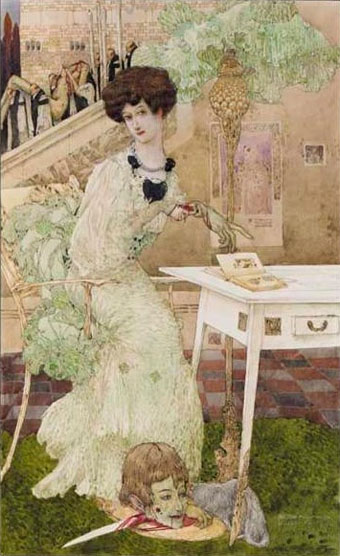
dulac1.jpg

Edmund Dulac.

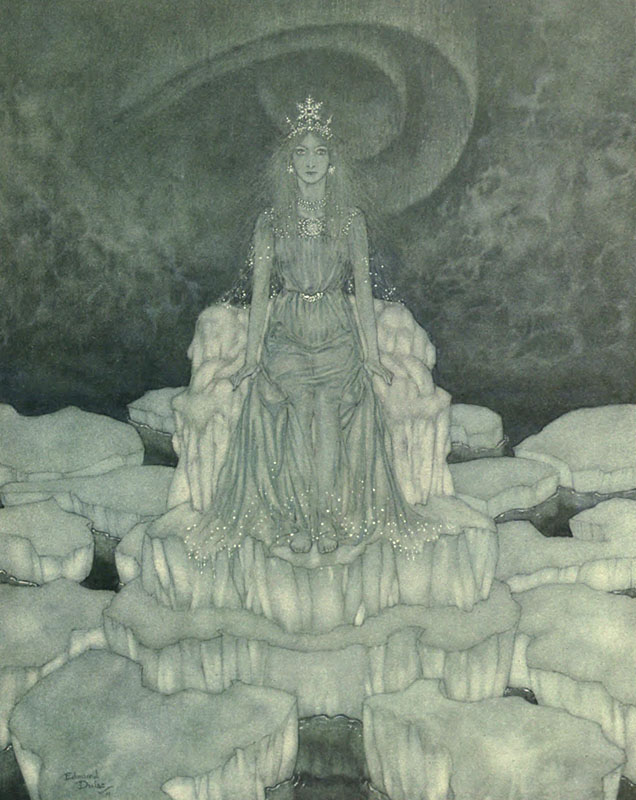
Empty, vast, and cold were the halls of the Snow Queen. The flickering flame of the northern lights could be plainly seen, whether they rose high or low in the heavens, from every part of the castle. In the midst of its empty, endless hall of snow was a frozen lake, broken on its surface into a thousand forms; each piece resembled another, from being in itself perfect as a work of art, and in the centre of this lake sat the Snow Queen, when she was at home. She called the lake “The Mirror of Reason,” and said that it was the best, and indeed the only one in the world.

Here in Britain it may not be quite as cold as it was earlier in the month but the Snow Queen still has us in her thrall. Hans Christian Andersen’s fairy tale was published in 1845 and, like many of the writer’s stories, is a blend of the beguiling and irritating: beguiling for the traces of older folk tales in its trolls, their magic mirror, and the Snow Queen as an embodiment of the season; irritating for the Christian gloss which is layered over everything like a sugar-coating. In this respect it’s a lot like Christmas; religiose sentimentality papered over winter rituals that are older and darker than the celebrations we’re supposed to acknowledge.

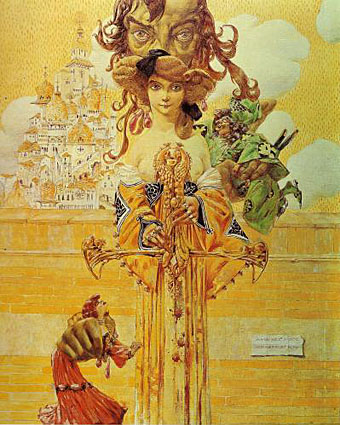
dulac2.jpg

Edmund Dulac.

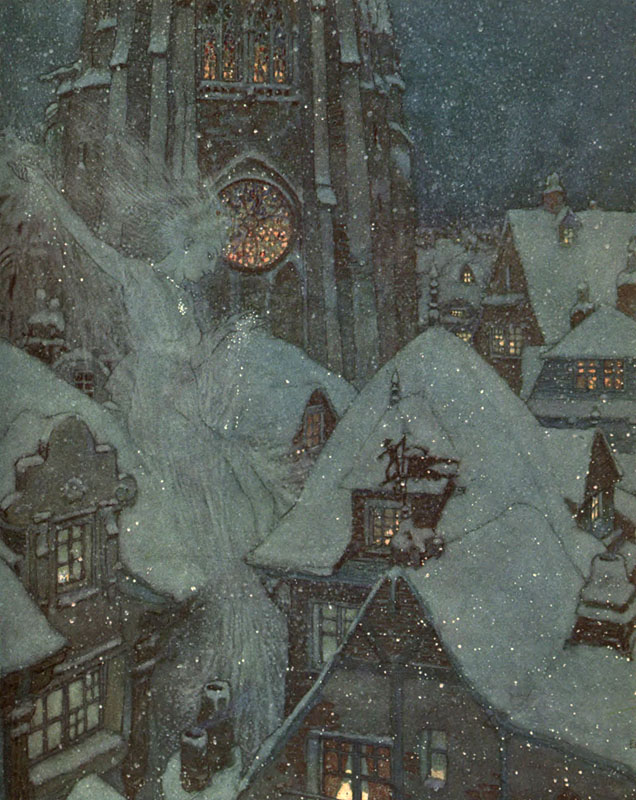
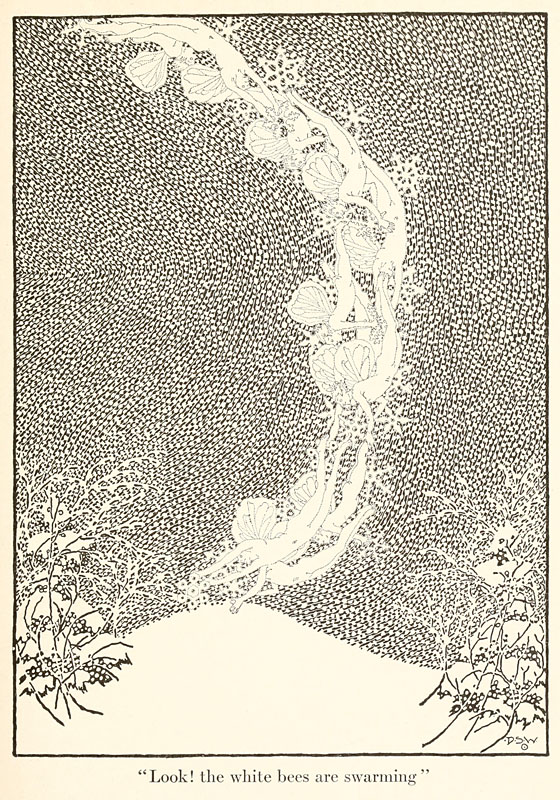
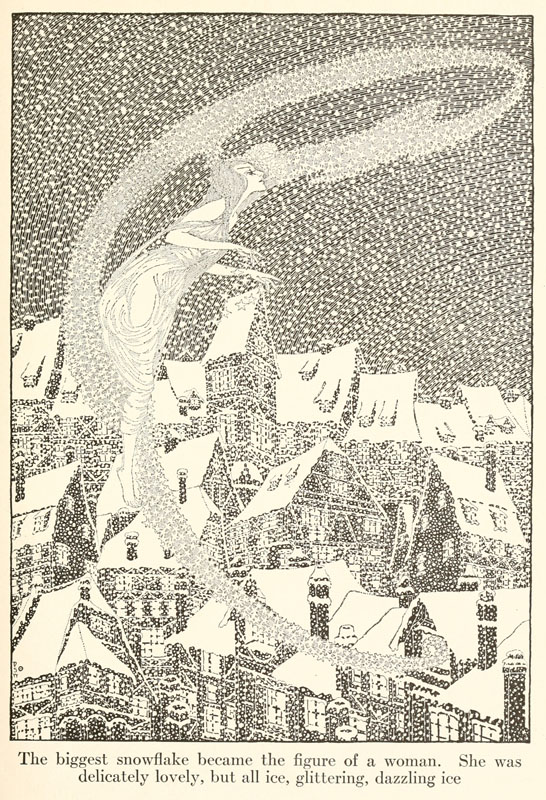
Andersen’s story has been illustrated and filmed many times with varying success. The Internet Archive has several illustrated editions, the selections here being from two of the better ones. Edmund Dulac’s Stories from Hans Andersen (1911) is one of the shorter collections and features predominantly colour pictures while Dugald Stewart Walker’s Fairy Tales from Hans Christian Andersen (1914) is one of the most heavily illustrated as well as having finer renderings of many stories. But not of the Snow Queen in her palace, Dulac beats everyone there.

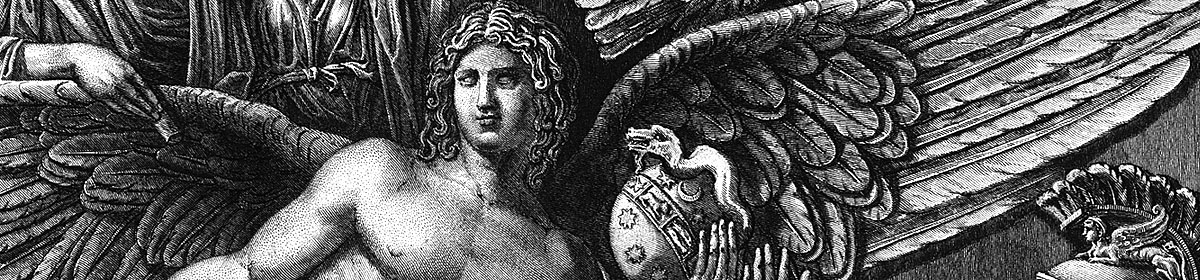
walker2.jpg

Dugald Stewart Walker.

This description stood out from the second part of Andersen’s tale:

In winter all this pleasure came to an end, for the windows were sometimes quite frozen over. But then they would warm copper pennies on the stove, and hold the warm pennies against the frozen pane; there would be very soon a little round hole through which they could peep…

My sister and I had been reminiscing recently about growing up in the 1960s when central heating and double-glazing were a lot less common than they are today. This meant little or no heating in bedrooms, so very cold weather often meant the same frozen windows which Andersen describes. People in rural places will be familiar with this but it’s something I haven’t seen for years. When you’re a child it’s quite an excitement waking up to find that Jack Frost has paid a visit but these days I prefer a warm house.

As usual I’ll be away for a few days so the archive feature will be activated to summon posts from the past. Have a good one. And Gruß vom Krampus!

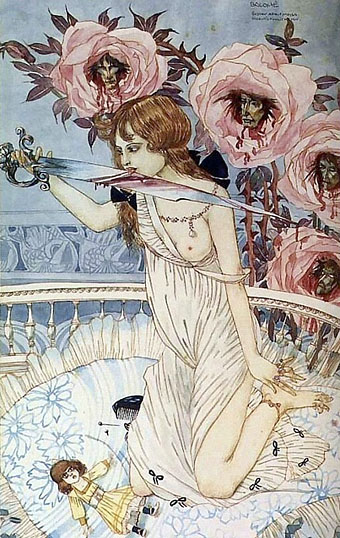
walker1.jpg

Dugald Stewart Walker.

Elsewhere on { feuilleton }
The illustrators archive

Previously on { feuilleton }
Dugald Stewart Walker revisited
More Arabian Nights
The art of Dugald Stewart Walker, 1883–1937

Weekend links 41

2001.jpg

Being an inveterate Kubrickphile I was naturally pleased to hear that some of the excised scenes from 2001: A Space Odyssey have survived in a watchable form, even though I’m often ambivalent about the restoration of such material. While it was good to see at last the missing French compound sequence of Apocalypse Now, for example, that sequence added nothing to the film as a whole and its inclusion was spoiled by music which Coppola used for sentimental reasons. In Kubrick’s case, there’s a longer version of The Shining which the director allowed to be screened on UK TV in the 1980s but, again, most of the unseen material was incidental and added nothing to the film.

• Related: Roger Ebert’s review of 2001 from 1968; Olivier Mourgue, designer of the Djinn chairs seen in the film’s space Hilton scenes; Magnificent obsession, a Vanity Fair piece from 2002 about the search for the missing scenes from The Magnificent Ambersons. Meanwhile, the trailer for Terrence Malick’s new film, The Tree of Life, features some surprising cosmic moments among its scenes of family life.

The separate history [of gay and lesbian artists] has been kind of edited out of art history but in fact art history is very much interwoven with gay or queer history. In a way the two can’t be separated. America doesn’t like anything uncomfortable. I find in my dealings with museums that if I ask a question and the answer is ‘no,’ they don’t answer. If the answer is ‘yes,’ I get these amazingly enthusiastic responses. I find it sort of strange sometimes, not being American myself. In a way what they’re doing is editing out the uncomfortable. David Wojnarowicz’s work can make you uncomfortable — and they’ve edited out that possibility in the show.

Canadian artist AA Bronson (see below).

• More on the Smithsonian versus David Wojnarowicz affair: Frank Rich examined the train of events in a comment piece, Gay Bashing at the Smithsonian, for the NYT; the Andy Warhol Foundation threatened to withdraw their funding for future Smithsonian events unless the work is reinstated, the Robert Mapplethorpe Foundation will be doing the same; another artist featured in the National Portrait Gallery exhibition, AA Bronson, requested that the gallery withdraw his work from the show in protest; the NPG refused, citing a contractual arrangement; among the increasing number of galleries showing support for Wojnarowicz, Tate Modern, London, will host an event in January which will feature a screening of the contentious video; lastly, there’s a protest event in New York City today (Sunday, December 19th) at 1.00pm, details here.

• More censorship in America: Jeffrey Deitch Censors Blu’s Political Street Art Mural. In the book world, writer Selena Kitt finds her erotic incest stories removed from Amazon’s Kindle store. Other authors, Jess C Scott and Esmerelda Green, have had their erotic titles removed from the store. Selena Kitt says:

When some of my readers began checking their Kindle archives for books of mine they’d purchased on Amazon, they found them missing from their archives. When one reader called to get a refund for the book she no longer had access to, she was chastised by the Amazon customer service representative about the “severity” of the book she’d chosen to purchase.

Can you imagine buying a paper book and the bookstore then paying you a visit to forcibly reclaim it? To date no adequate explanation from Amazon has been forthcoming but they’ll be happy to sell you a Kindle edition of the Marquis de Sade’s The 120 Days of Sodom.

m51.jpg

Galaxy M51 aka The Whirlpool. One of the Top Astronomy Pictures of the Year from a selection by Bad Astronomy. Photo by the Hubble Heritage Team & Robert Gendler.

• More cosmic events: there’ll be a total lunar eclipse this coming Monday, visible in much of the Northern Hemisphere.

• “Heterosexuality is the opiate of the masses!” The Raspberry Reich (2004), a film by Bruce LaBruce.

New editions of Borges poetry. Fine so long as you accept that the translations can never truly satisfy.

• Just the thing for the winter weather, illustrations for Pushkin’s Queen of Spades from 1966.

• Another Ghost Box download: Radio Belbury Programme 1: “Holidays & Hintermass”.

Monsters, Inc: Arcimboldo and the Wunderkammer of Rudolf II.

• Silent Porn Star found some burlesque lamps.

Giant airship powered by algae.

Space Oddity (1969) by David Bowie.

Weekend links 40

peterloo.jpg

Manchester, August, 1819: yeomanry on horseback charge a crowd of demonstrators; London, November, 2010: Mounted police charge demonstrators; London, December, 2010: “…police horses have charged the crowd once and appear to be about to do so again.”

Rise like lions after slumber
In unvanquishable NUMBER!
Shake your chains to earth, like dew
Which in sleep had fall’n on you:
YE ARE MANY–THEY ARE FEW.

Percy Shelley, The Masque of Anarchy (1819).

• Amid the rest of the week’s tumult, discussion and activity around the censoring of David Wojnarowicz’s A Fire in My Belly film at the National Portrait Gallery, Washington DC, continues to rumble on. I’d missed this appraisal of the exhibition at The Smart Set. Hide/Seek: Too shocking for America features an interview with Jonathan Katz, co-creator of the exhibition in the eye of the storm:

“When,” Katz asks, “will the decent majority of Americans stand against a fringe that sees censorship as a replacement for debate?” Hide/Seek sought to conquer what Katz calls “the last acceptable prejudice in American political life” – but the conservative right, rampant after last month’s midterm elections, won’t relinquish their prejudices without a fight. And so, “an exhibition explicitly intended to break a 21-year blacklist against the representation of same-sex desire,” says a dispirited Katz, “now finds itself in the same boat.”

Related: Q&A with Hide/Seek curators Jonathan Katz and David C. Ward. The Smithsonian Institution issued a fatuous statement saying they stand by the exhibition despite having forced the removal of one of its works. One of the NPG commissioners resigned in protest at the gallery’s capitulation to political pressure. Other protestors were banned from the Smithsonian after playing a video of the work on an iPad. There’s video of the iPad protest here and the protestors have their own blog. In my earlier post on the subject I noted that the actions of censorious Catholics have given Wojnarowicz’s work far more public exposure than it would otherwise receive. The LATimes has details of some of the galleries throughout the US showing the video as a result of its removal in Washington.

• Related to the above, Bruce Sargeant and His Circle: Figure and Form, a book by artist Mark Beard about the work of his “Bruce Sargeant” alter ego. Homotography has a preview.

• “We focus most strongly at the margins, on the music that others may be blind to. We don’t care whether it is electronic, metal, jazz, folk, classical, noise, world music or whatever. We are as excited by the experimental, as we are exhausted by the ephemeral. We listen. We mosh. We think. We dance. We write words. We capture images. We hope to do justice to the art which inspires us. We are The Liminal”.

rotary.jpg

Rotary Signal Emitter, a vinyl zoetrope by audiovisual duo Sculpture.

Rest Easy Sleazy, a small mix dedicated to Peter Christopherson. Related: A Peter Christopherson tribute mix. Another mix: Mixhead was a 1997 promo CD by Portishead.

• Related to the above: What if we could touch our music again? (Hello? Some of us still play—and create—CDs and vinyl…) Is the mix tape as object-of-seduction a dead concept in a virtual world? “We traded connection for convenience,” says I Miss My Pencil. Their proposed solution, C60 Redux, is an RFID reader plus speakers, packaged in a smart 12-inch case.

• Iannis Xenakis: How an architect took music back to mathematical roots. Related: the Xenakis exhibition at MOCA, Los Angeles.

The Body Electric at Ikon, Birmingham, is the first retrospective exhibition in the UK of work by New Zealand artist Len Lye.

Hayley Campbell has a blog. This week you can read about her contribution to Jamie McCartney‘s Great Wall of Vagina.

More David Lynch: he really does love cherry pie but isn’t 100% sure how magnets work. I sympathise on both counts.

2019: A Future Imagined. Visual Futurist Syd Mead reflects on the nature of creativity and how it drives the future.

Quashed Quotatoes by Michael Wood, reviewing a new edition of Finnegans Wake.

New Weird Australia.

• Portishead’s 2008 performance for the Canal+ show Concert Privé is one of their best filmed concerts. YouTube has the whole thing.

Weekend links 39

galas.jpg

The Divine Punishment (1986) by Diamanda Galás. Design by Paul White/Me Company.

What the Catholic League and certain members of the House presumably wish to remove from their consciousness is thirty years of death sentences handed down to their parishioners and citizenry, who were told not to wear condoms, and the mistreatment of those stigmatized as miscreants and sinners by their viral status and/or homosexuality and/or status as drug addicts.

• Diamanda Galás responds in her usual forthright manner to the censoring of David Wojnarowicz’s film (and her music which accompanied it) by the Catholic League and members of the House of Representatives earlier this week. Related: Demonstrators gather to protest removal of Wojnarowicz art from NPG | Is the censored David Wojnarowicz video really ‘anti-Christian’? | Vengeance is hers: a conversation with Diamanda Galás.

Update: Hide/Seek: Too shocking for America. One of the exhibition curators speaks out against the censorship.

“Their attitude is: ‘Next time you think of writing about sex, don’t,'” said Susie Bright, who was the editor of the Best American Erotica anthology series for 15 years. “I can’t think of any other fundamental human experience that writers would be encouraged to keep to themselves.” Melissa Katsoulis, a literary reviewer for the Times of London, certainly seemed to conform to Bright’s impression when asked to comment on the award by the BBC: “Sex is a subject best avoided altogether,” she said. “If I was writing a novel, I wouldn’t attempt to write it except in the most Victorian and prim way, because it’s awful. It’s a cliché, but the moments of genuine frisson in books are when hardly anything happens.” Speak for yourself, missy.

Laura Miller dissing the Literary Review‘s annual Bad Sex Award. Good to find more voices being raised against this drivel and the admission of failure which it implies.

The latest offbeat experiment from filmmaker David Lynch: pop singles. He gets crazy with the vocoder here. Related: David Lynch talks new music projects.

scenaillustrata.jpg

Scena Illustrata (1914). Cover by Ezio Anichini (?). Via this set of magazine covers from 1880–1920.

• Tumblrs of the week: Heart Killer and Pretty Pictures from the Paleo-Future Blog.

The Big Picture’s 2010 Hubble Space Telescope Advent Calendar.

National Geographic‘s Best Underwater Views of 2010.

A seasonal gift from a famous Northampton resident.

Paris versus New York: A Tally of Two Cities.

This is your browser on drugs.

Double-Barrel Prayer (1988) by Diamanda Galás, with a video directed by the late Peter Christopherson.

Ecce homo redux

serrano.jpg

Piss Christ (1987) by Andres Serrano.

If the news of the past few weeks has felt like a re-run of the 1980s—ongoing recession, government cuts, riots in London, Tories casting aspersions on the undeserving poor, the threat of another royal wedding—then add to the list of déjà vu moments a flurry of outrage concerning art and religion in America that’s like a recapitulation of the Helms vs. NEA spats of 1989. On that occasion Andres Serrano’s Piss Christ was in the firing line, accused of being a blasphemous portrayal. This week it’s been the turn of a video installation of a short film made the same year, A Fire in My Belly, by David Wojnarowicz, a work featured in an exhibition I linked to a couple of weeks ago, Hide/Seek: Difference and Desire in American Portraiture at the National Portrait Gallery, Washington DC. A Los Angeles Times piece previewing the exhibition also connected Hide/Seek and the earlier attacks by the right against the NEA, ending by saying “Times and attitudes change”. Well, not always…

fire.jpg

A Fire in My Belly (1987) by David Wojnarowicz.

Piss Christ notoriously shows a plastic crucifix immersed in urine; A Fire in My Belly is a 30-minute film which features among its blizzard of images a crucifix besieged by marauding ants. Wojnarowicz’s work wasn’t even mentioned in the LA Times piece but this week’s furore has made it the focus of the entire show after the gallery withdrew the video following protests from the usual suspects, the Catholic League and a right-wing politician, Rep. John Boehner. The complaints are the standard bluster about blasphemy (again) and taxpayers funding “filth”. None of the complainants appear to care that Wojnarowicz’s film is a tribute made by a gay artist to his friends as they were dying from AIDS during the 1980s, a disease which also killed him in 1992, they see the work only as an offensive act. It’s too much to expect anyone reacting with such fervour to consider that the artist may have been comparing the suffering and treatment of people with Aids in that decade with Christ’s suffering on the cross, to do so would be to admit that the artist might have a point. In response to the work’s withdrawal the Transformer Gallery in Washington DC has been screening the film and organised a protest at the National Portrait Gallery. (Update: They also issued an open letter urging the reinstatement of the work.)

Continue reading “Ecce homo redux”