Weekend links 47

beksinski1.jpg

DG-2499 (1975) by the fantastic (in every sense of the word) Zdzisław Beksiński (1929–2005). See the Dmochowski Gallery for a comprehensive collection of the artist’s work. Thanks to BibliOdyssey for the tip.

• More ICA events: From Animism to Zos: Strange Attractor Salon will be “a series of weekly events, consisting of a talk and a film, exploring some lesser-known intersections of culture, history, mind and nature” running from 10 March–12 May, 2011.

• And on May 10, the London Word Festival presents a Dodgem Logic evening with entertainment provided by contributors to that magazine:

Alan Moore’s reinvigoration of the underground fanzine, Dodgem Logic, comes alive in the non-conformist surroundings of Hackney’s Round Chapel. A night of art, comedy, comment and put-something-back localism. (…) With Robin Ince heading up a colossal stand-up bill, artists Steve Aylett, Savage Pencil, Melinda Gebbie and Kevin O’Neill panel-up to talk about their comic work, while music comes from hyperactive racketeers The Retro Spankees. With an exhibition of artwork from the magazine, and conducted by editor-in-chief Alan Moore.

• Taschen publishes a collection of Dennis Hopper’s photographs this week. The Independent has a small selection here. Also new from Tachen, Alex Steinweiss, The Inventor of the Modern Album Cover.

Bass Notes: The Film Posters of Saul Bass at the Kemistry Gallery, London.
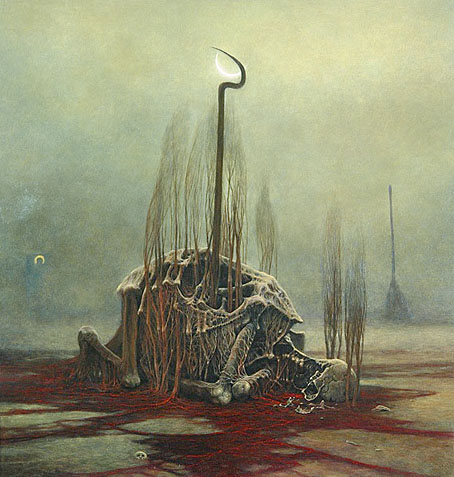
beksinski2.jpg

DG-2507 by Zdzisław Beksiński.

While riding through the bustling streets of London from 1603 to 1621, one was liable to hear the shout “Long live Queen James!” King James I of England and VI of Scotland was so open about his homosexual love affairs that an epigram had been circulated which roused much mirth and nodding of the heads: Rex fuit Elizabeth: nunc est regina Jacobus—”Elizabeth was King: now James is Queen.”

There’s more about the private life of the man who gave his name to the King James Bible here.

Addams and Evil, a Tumblr devoted to the great Charles Addams.

Hannes Bok again at Golden Age Comic Book Stories.

Caravaggio’s crimes exposed in Rome’s police files.

Deserted City, photographs by Kim Høltermand.

• The blue sand dunes of the planet Mars.

• A map of the ghost signs of Chicago.

The movie title stills collection.

The pitfalls of e-book buying.

Life On Mars? (1971) by David Bowie | Uncle Sam’s On Mars (1979) by Hawkwind | Eyes On Mars (1980) by Chrome | Cache Coeur Naif (1997) by Mouse on Mars.

Mossa’s Salomés

mossa5.jpg

Salomé (1901).

Monsieur Wiley prompted this post by drawing my attention to the picture above. I’d already seen another Salomé by Gustav Adolf Mossa on this page a few days ago but resisted the temptation to mention it. A bit more searching revealed yet another Mossa rendering of the theme which perhaps isn’t so surprising given the artist’s obsession with lethal women. The first exceeds all previous depictions of the Biblical temptress by having her actually licking blood from the executioner’s sword. In the third picture she’s content merely to use a severed hand as a page-turner while John the Baptist’s mutilated body is carted away by servants.

The search for pictures turned up a blog I hadn’t seen before, Women in the Bible (“This is no religious blog!”), which has several Salomé postings. And there’s also Les voiles de Salomé: Labyrinthique errance, virevoltes et volutes.

mossa6.jpg

Encor Salomé (1905).

mossa7.jpg

Salomé (1908).

Elsewhere on { feuilleton }
The Salomé archive

Weekend links 43

broadcast.jpg

From the video for I See, So I See So by Broadcast.

RIP Trish Keenan of Broadcast. Tributes here and here. The Broadcast/Focus Group collaboration …investigate Witch Cults of the Radio Age was The Wire‘s album of the year for 2009. Joseph Stannard interviewed Trish Keenan and James Cargill in October of that year.

Who Knows What Tomorrow Might Bring, a new pay-what-you-please Arthur mixtape. Also at Arthur, Sunday Lectures by Freeman House here, here, here and here.

• Cormac McCarthy’s description of American pioneers in Suttree (1979) kept coming to mind during the past week:

Where hunters and woodcutters once slept in their boots by the dying light of their thousand fires and went on, old teutonic forebears with eyes incandesced by the visionary light of a massive rapacity, wave on wave of the violent and the insane, their brains stoked with spoorless analogues of all that was, lean aryans with their abrogate semitic chapbook reenacting the dramas and parables therein and mindless and pale with a longing that nothing save dark’s total restitution could appease.

Born This Way: “A photo/essay project for gay viewers (male and female) to submit pictures from their childhood (roughly ages 4 to 14), with snapshots that capture them, innocently, showing the beginnings of their innate LGBT selves. It’s nature, not nurture!”

Mischievous street art characters. Chris Marker wouldn’t want us to forget Monsieur Chat. Speaking of Chris Marker, there’s Plato’s Cave as Kino: Owl’s Legacy Excerpt & Becoming Imperceptible.

With the point of a knife Dr. LeBaron took from the little round box a small quantity of a dark, greenish-colored gum, which, as it was passed from one to another for inspection, gave off an agreeable, aromatic odor. Then, as he was engaged in filling two capsules from the box, he explained:

“As le docteur read from ze book of Monsieur Richet, ze favoreet méthode in ze Orient ees to take ze Haschisch by ze smoke in ze Persian pipe—ze hookah, ze nargileh. But zey also take eet in ze great varieté. Ze principal kind zat come to ze market of Europe, ees zat I show you—ze Haschisch, an’ ve take eet like ze dose of quinine,” said he, as he handed a well-filled capsule to both Smith and Arnold.

Throwing back his head, Smith bolted his dose without ceremony, and Arnold immediately followed his example.

Haschisch: A Novel (1886) by Thorold King. Related: Haschisch Hallucinations (1905) by HE Gowers.

• Dan Hill’s personal report from the drowned world of Brisbane. Related: Hayley Campbell recalls swimming in the city’s hazardous floodwaters when she was a wild child. Also: Canoeing in McDonald’s.

Cabinet Card Backmarks, florid advertisements from Victorian cabinet photos. Callum James made a post on the subject in 2008 and has a Flickr set showing his discoveries.

• The Brothers Quay made a public information film about AIDS in 1996. (Now deleted from YouTube…boo!)

The secret stories of book inscriptions. Related: The Book Inscriptions Project.

• Ani, Turkey: City of 1001 Churches, all of them abandoned and ruined.

Vulgar Army: Octopus in Propaganda and Political Cartoons.

• Designer John Gall makes collages in his spare time.

Phantasmaphile at Tumblr.

Witch Cults and I See, So I See So, both by Broadcast & The Focus Group.

Weekend links 42

martin.jpg

Blasphemous Rumours (2009/2010) by Ryan Martin. The artist now has a dedicated site for his paintings.

The Museum of Censored Art, a mobile gallery, will be showing the withdrawn David Wojnarowicz film outside the National Portrait Gallery, Washington DC, until their contentious gay art exhibition closes next month. Related: Bishop of Mallorca criticises calendar—which shows Catholic youths posing naked—for ‘not respecting Christian symbols’.

• Didier Lestrade published French gay zine Magazine in the 1980s, and later co-founded Têtu. He’s interviewed at BUTT and has started uploading the entire run of Magazine about which he says: “I don’t want to stamp some kind of logo on this material. It’s gay. It’s gay history. It belongs to everybody. If you want to take a piece of it, please try to mention the origins of it, a simple code word “Magazine” will be enough. If you wanna be more specific, be my guest.”

HMV, Britain’s last big music chain, is closing 60 branches. Yet a new wave of CD stores is thriving. Oh, HMV, how I’ll miss your £17 CDs (and double-CDs at £34)… On second thoughts, no I won’t, your wretched retail barns always exemplified the greed endemic in the music business.

kasner.jpg

Love Comes/Destroyer by Stephen Kasner.

• Artist Stephen Kasner‘s work has adorned music releases by Sunn O))), Isis and others. He’s currently another American creator in need of assistance with medical expenses. Details here.

The Ghosts of Old London: the gloomy Victorian metropolis in all its deteriorated splendour. See also: In Search of Relics of Old London.

• “It’s time to recognise [Sandy] Denny as not simply a folksinger but one of Britain’s great poets of song,” says Rob Young.

Louis Pattison talks to Locrian about JG Ballard, old VHS tapes and their new album The Crystal World.

The Dreams That Stuff Is Made Of: Lebbeus Woods’ big drawings.

Hannes Bok portfolios at Golden Age Comic Book Stories.

An Iranian rapper named Salome. Also here and here.

A Moment of (Alan) Moore.

RIP Mick Karn.

Book Worship.

Sons of Pioneers (1981) by Japan; Tao-Tao (1982) by Masami Tsuchiya; Glow World (1983) by Bill Nelson.

Deutsche Kunst und Dekoration #1

dkd01-01.jpg

Last year saw an exploration here of the fecund pages of Jugend magazine so in the same spirit I’m embarking on a serial delve into Jugend‘s more serious contemporary Deutsche Kunst und Dekoration. I’ve made a couple of posts in this direction already but these were done before I’d had a chance to look properly through the editions at the Internet Archive, the first thirty of which form a collection which comprises some 7500 pages. Since few people would want to download and sort through that mountain these posts can serve as a select guide to the contents.

dkd01-02.jpg

Deutsche Kunst und Dekoration was published by Alexander Koch in Darmstadt and the first volume is dated October 1897–March 1898. Jugend was a humour magazine so the contents tend to be frivolous and lighthearted, Koch’s title by contrast was a guide to the best of German contemporary art and design and has the advantage of featuring furniture and architectural designs as well as graphic material. The content of this first edition is relatively sedate compared to some of the later numbers when the Art Nouveau style builds up a head of steam. There’s some astonishing design work in subsequent issues, as well as further illustration discoveries like Marcus Behmer. Watch this space.

Continue reading “Deutsche Kunst und Dekoration #1”