
Dodgem Logic #4

dodgem1.jpg

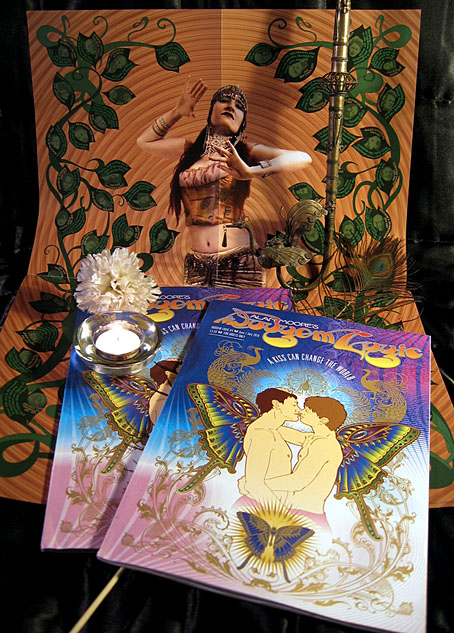
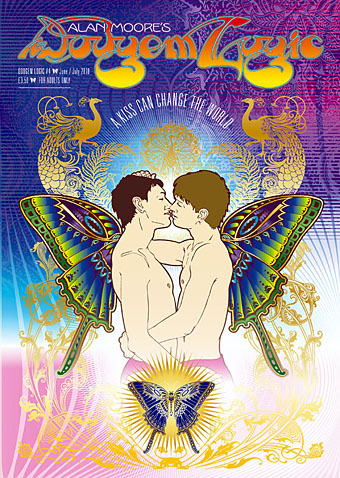
The magazine isn’t out for another couple of weeks but my cover art has been posted to various websites so I can finally show this here. Alan Moore was in touch at the beginning of February asking for a wraparound cover design, the only brief being that he liked my Alice in Wonderland calendar and asked for something equally florid or—for want of a better term—psychedelic. Alan’s magazine owes something to the underground mags of the 1960s and a common feature of those, especially Oz magazine, was a degree of provocation in the choice of cover art. A picture of two boys kissing is nothing more than a show of affection yet to many people the sight still inspires enormous outrage. This was demonstrated a week or so after I’d finished the cover when the Washington Post was deluged by angry letters and emails after they showed a photo of two newly-weds outside the Washington DC Superior Court. People used to have a similar reaction to the sight of a black man kissing a white woman; the only way attitudes change is when something becomes so commonplace it’s no longer worthy of note.

dodgem2.jpg

Aside from the politics, this was also an excuse to run riot with more Art Nouveau motifs, especially peacocks and butterflies. The butterfly-winged boys are a nod to the paintings of Yannis Tsarouchis, and this in turn gave me an excuse to borrow from another magazine cover, Frank X Leyendecker’s 1922 painting of The Flapper for Life. Frank X was the brother of the more renowned illustrator JC Leyendecker. Joseph C was known to have been discreetly homosexual; so too was brother Frank according to this article in which case his butterfly woman has an additional resonance.

dodgem3.jpg

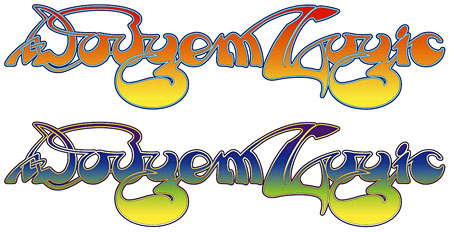
Having written a lengthy polemic about Roger Dean’s work in January I had the idea of doing the magazine title in his lettering style. I spent the best part of two days working on these as I wanted the result to be as accurate as possible. All the gold parts of the cover shown here are gradients but I made a slightly different version for print which will render those areas in gold ink. I’m looking forward to seeing this printed.

Previously on { feuilleton }
Roger Dean: artist and designer
The art of Yannis Tsarouchis, 1910–1989
Dodgem Logic
Psychedelic Wonderland: the 2010 calendar
Butterfly women

Weekend links 17

bowie.jpg

Aladdin Sane (1973). Cover photo by Brian Duffy who died this week.

• Among the obituaries this week: artist Louise Bourgeois; poet and partner of Allen Ginsberg, Peter Orlovsky; film director Joseph Strick, a man who dared to film James Joyce’s Ulysses; photographer Brian Duffy.

The dustbin of art history: “Why is so much contemporary art awful? We’re living through the death throes of the modernist project—and this isn’t the first time that greatness has collapsed into decadence.” Admirable sentiments but galleries and dealers have far too much invested in the corrupt edifice to let it collapse any time soon.

• Edinburgh film festival to screen ‘lost and forgotten’ British movies including the director’s cut of Jerry Cornelius film The Final Programme.

gogoharder.jpg

Delectable Bawdville burlesque boy Chris “Go-Go” Harder. Via EVB who have more pics.

Homobody by Rio Safari, “a scrappy diy zine about queerness”. Obliquely related: Lizzy the Lezzie, animations at the Sundance Channel.

• Richard Norris aka Time and Space Machine puts together a psychedelic mixtape for FACT. Fab stuff.

• Diamanda Galás has a message for critics: “Stick to reviewing plant life and leave the Witches alone.”

Brion Gysin: Dream Machine will be the first US survey of Gysin’s work in NYC next month.

• Geeta Dayal’s study of Another Green World by Brian Eno reviewed at Ballardian.

• For type-heads: font anatomy wallpaper by Sigurdur Armannsson.

If it was my home: visualising the BP oil disaster.

Antony Gormley’s Breathing Room III.

The Paris Review has a new blog.

• Bizarre juxtaposition of the week: John Martyn’s sublime Small Hours with, er… The Clangers.

Lynn Redgrave, 1943–2010

smashing.jpg

Lynn Redgrave did a lot more than just Georgy Girl (1966) and Smashing Time (1967), of course, but the latter especially made an indelible impression on me when it turned up on TV in the early 1970s. George Melly’s smart and funny poke at the pretensions of Swinging London has a satirical edge which meant nothing to a nine-year-old, I just loved the exaggerated modishness, the Richard Lester-style wacky direction and especially Lynn and Rita, two girls from “up north” who I’d have loved to have as older sisters. I haven’t seen Smashing Time for years, it was one of those films which was so much of its time that it seemed to vanish from TV schedules and was never available in video form. I see there was a DVD release in the US although that’s now been deleted. Happily YouTube is more reliable, so here’s Rita and the splendidly camp Murray Melvin (both of whom were in A Taste of Honey) in the ‘Too Much’ boutique, and Lynn recording I’m So Young, the song which makes her a pop star. Austin Powers is a fake, baby, this is the real thing.

Previously on { feuilleton }
Through the Wonderwall

Weekend links 13

metropolis01.jpg

Watch the trailer for the newly-restored version of Fritz Lang’s masterwork, Metropolis.

My cover design for Jeff VanderMeer’s Finch was voted best cover in the 2010 Spinetingler Awards.

• Figment announces the 2nd Annual Figment Album Cover Design Contest. The judge this time round is William Schaff.

• Two interviews at The Quietus: Jon Brooks of The Advisory Circle and Richard H Kirk of Cabaret Voltaire.

• “Merely a Man of Letters.” Jorge Luis Borges interviewed in 1977.

• Another Engelbrecht: The Miniature Theatres of Martin Engelbrecht.

The Unearthing Box Set by Alan Moore & Mitch Jenkins.

• The gays: RIP Felix Lance Falkon, author of the landmark study, A Historic Collection of Gay Art (1972). The Independent is the latest newspaper to look at sexuality in the animal kingdom.

Publisher to Release Philip K Dick’s Insights Into Secrets of the Universe.

• Roger Ebert shows the world a draft of his unfilmed Sex Pistols screenplay, Who Killed Bambi? Jon Savage comments.

• Further Flickr sets: History of the Book/Typography and Dutch Graphic Design. Related: more Dutch graphic design at the NAGO.

Far Red: Video by u-matic & telematique, music by Monolake.

Has steampunk jumped Captain Nemo’s clockwork shark yet?

An edge over which it is impossible to look.

Surrender. It’s Brian Eno.

Ecstatic Peace Library.

• Songs of the week: See Emily Play by Pink Floyd and Metropolis by Kraftwerk.

Nirvana and The Conquerors

nirvana.jpg

All Of Us by Nirvana (1968).

Every now and then the web’s great proliferation of images serves a useful purpose by solving some minor artistic conundrum. All Of Us is the second album by UK psychedelic band Nirvana (no relation to Kurt and co.) and the striking cover painting—a long line of emperors and warriors from different ages parading down an avenue of corpses—is annoyingly uncredited. The notes for the 2003 CD reissue inform us that “Patrick had found, in an exhibition of Nazi art (in Bremen, Germany), a still shot from a propaganda film directed by Adolf Hitler’s favourite film-maker, Leni Riefenstahl.” Setting aside the bizarre use of such a picture by one of London’s more effete psychedelic groups, I wasn’t convinced that this was a Nazi-era painting. The style is more like a piece of Neoclassical academic art from the late 19th century, and that’s what it turns out to be.

fritel1.jpg

Les Conquérants (1892) by Pierre Fritel. From this Flickr page.

It was a search for works by French academician George Antoine Rochegrosse that turned up a copy of the painting in Google Images. “Aha, it’s Rochegrosse, then!” thought I, only it wasn’t. The picture is entitled Les Conquérants and the artist responsible is one Pierre Fritel (1853–1942) about whom there’s very little information on the web. There is, however, a discussion here which details the painting’s symbolism:

Through the Valley of the Shadow of Death, whose limits are obscured in darkness, advance, hollow-eyed and remorseful, the conquerors of all ages, marching in close ranks between a double row of corpses, stripped and rigid, lying packed close together with their feet toward the procession. In the center of the van rides Julius Caesar, whom Shakespeare has pronounced “the foremost man of all this world.” On his right are the Egyptian called by the Greeks Sesostris, now known to be Rameses II., Attila, “the Scourge of God,” Hannibal the Carthaginian, and Tamerlane the Tartar. On his left march Napoleon, the last world-conqueror, Alexander of Macedon, Nebuchadnezzar of Babylon, that “head of gold” in the great image seen in his vision as interpreted by the prophet Daniel, and Charlemagne, who restored the fallen Roman Empire.

There’s a follow-up discussion on MetaFilter where a commenter makes the Nirvana connection, and the Internet Archive even has the catalogue for the Salon of 1892 which lists the painting’s first public appearance. See a larger monochrome version here. The only mystery now is the whereabouts of the painting itself. Artnet tells us it was sold in 1988, and they have a poor quality colour photo of the picture (below) which looks a lot less dramatic than the moody monochrome reproductions. If anyone knows the current location of Fritel’s canvas, please leave a comment.

fritel2.jpg

Elsewhere on { feuilleton }
The album covers archive

Previously on { feuilleton }
The art of Vasili Vereshchagin, 1842–1904