Weekend links 261

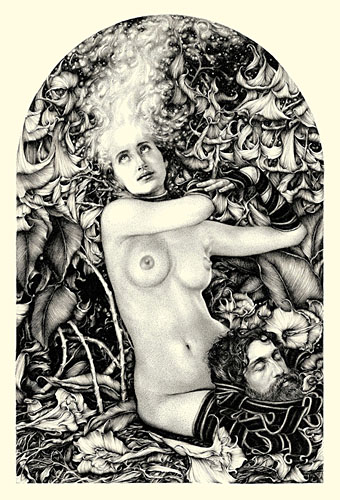
hardie.jpg

Salome (2013) by Lucie Hardie.

Aickmanesque, “A list of films that possess the same strange ambiguities, disturbing illogicalities, grim mundanities, psychological unpleasantness, narrative open-endedness, Freudian oddness and genuine disturbing moments of horror as the short stories of Robert Aickman.” One of those films, Symptoms (1974), has been out of circulation for a long time but may be watched at YouTube.

• “If this was psychedelia, then it had more in common with the variety peddled by US bands like The Rain Parade, The Three O’Clock…and The Bangles…all of whom had been grouped into a movement known as The Paisley Underground.” Joseph Stannard looks back at Around The World In A Day by Prince And The Revolution.

• “…what I do is not magical realism. I do realistic magic.” Alejandro Jodorowsky talking to Ilan Stavans about writing and filmmaking. A substantial interview in which Jodorowsky isn’t forced to express himself solely in English.

[Angela] Carter thoroughly upset the bien pensants with her essay The Sadeian Woman (1978) where she argued that Sade “was unusual in his period for claiming rights of free sexuality for women and in installing women as beings of power in his imaginary worlds … I would like to think that he put pornography in the service of women, or, perhaps, allowed it to be invaded by an ideology not inimical to women.” She also makes the connection between Sade’s misanthropy, as she calls it, and his splitting of women’s bodies from “the mothering function”. McQueen seems to me to fascinate for similar reasons. Some of the pull he exerts on huge numbers of people arises from this side of his sensibility: there’s no hint of motherhood; he disliked the way that traditional décolletage revealed the breasts, and instead encased the whole female torso in coiled silver, mussel shells or razor clams—even glass.

Marina Warner on Alexander McQueen whose Savage Beauty exhibition is currently running at the V&A

• London’s American poster king: Graham Twemlow on E. McKnight Kauffer’s posters for the London Underground.

• At Celluloid Wicker Man: Electronic music and mental illness in cinema.

• Mix of the week: Secret Thirteen Mix 154 by Moniek Darge.

#1 (1994), the first album by Skylab, has been reissued.

Vir·tu·al Ge·om·e·try

Tamborine (1985) by Prince And The Revolution | Indigo (1994) by Skylab | Metronomic Underground (1996) by Stereolab
More trip texts

parry1.jpg

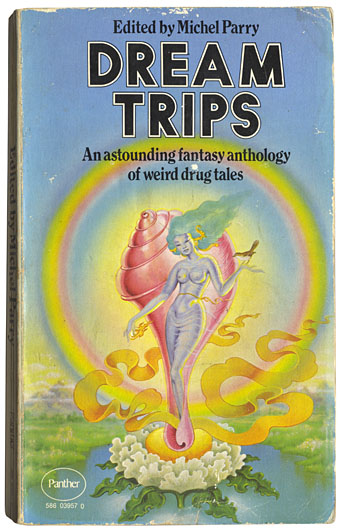
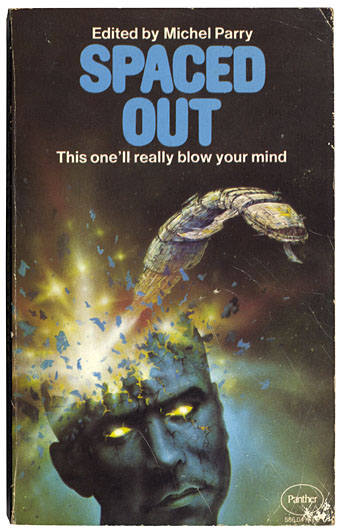
More psychedelia of a sort. Anthologist Michel Parry, who died last year, was a familiar name to British readers of fantasy, horror and science fiction for his themed collections: Beware of the Cat (1972; horror stories about cats), The Devil’s Children (1974; horror stories about children), The Hounds of Hell (1974; horror stories about dogs), Jack the Knife (1975; Jack the Ripper stories), The Supernatural Solution (1976; occult investigators), Sex in the 21st Century (1979), and so on.

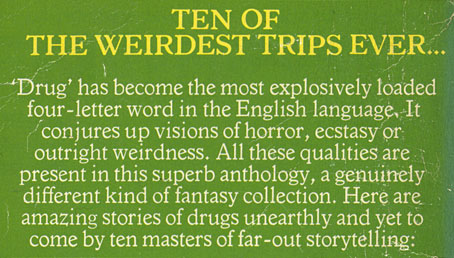
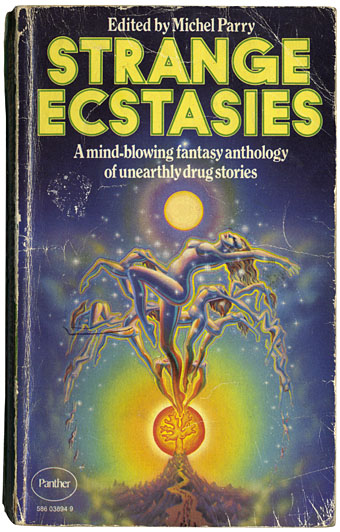
Parry also compiled multi-volume anthologies throughout the 1970s, two of which have always stood out for me: the Mayflower Books of Black Magic Stories ran to six volumes presenting a wide range of occult fiction that included a number of obscure tales from Victorian and Edwardian writers; for Panther Books he compiled three collections of drug-related fantasy and SF stories that are just as varied, and may even be unique for the way they place authors as such as Lord Dunsany and Norman Spinrad together in the same volume. Both series are very much of their time—occult psychedelia!—and are worth seeking out, if you can find them. I emphasise the last point because it’s taken me a while to find a copy of Strange Ecstasies that wasn’t being offered for bizarrely inflated prices; my paperback habit has its limits… None of these anthologies have been reprinted so they’ll become increasingly scarce. For more invented drugs, there’s a good list at Wikipedia.

parry2.jpg

Cover art by Bob Haberfield.

Strange Ecstasies (1973)
The Plutonian Drug (1934) by Clark Ashton Smith
The Dream Pills (1920) by FH Davis
The White Powder (1895) by Arthur Machen
The New Accelerator (1901) by HG Wells
The Big Fix (1956) by Richard Wilson
The Secret Songs (1962) by Fritz Leiber
The Hounds of Tindalos (1929) by Frank Belknap Long
Subjectivity (1964) by Norman Spinrad
What to Do Until the Analyst Comes (1956) by Frederik Pohl
Pipe Dream (1972) by Chris Miller

parry3.jpg

Cover art by Bob Haberfield.

Dream Trips (1974)
The Hashish Man (1910) by Lord Dunsany
As Dreams Are Made On (1973) by Joseph F. Pumilia
The Adventure of the Pipe (1898) by Richard Marsh
Dream-Dust from Mars (1938) by Manly Wade Wellman
The Life Serum (1926) by Paul S. Powers
Morning After (1957) by Robert Sheckley
Under the Knife (1896) by HG Wells
The Good Trip (1970) by Ursula K. Le Guin
No Direction Home (1971) by Norman Spinrad
The Phantom Drug (1926) by AW Kapfer

parry4.jpg

Cover art by Brian Froud.

Spaced Out (1977)
The Deep Fix (1964) by Michael Moorcock
All the Weed in the World (1961) by Fritz Leiber
The Roger Bacon Formula (1929) by Fletcher Pratt
Smoke of the Snake (1934) by Carl Jacobi
Melodramine (1965) by Henry Slesar
My Head’s in a Different Place, Now (1972) by Grania Davis
Sky (1971) by RA Lafferty
All of Them Were Empty— (1972) by David Gerrold

Previously on { feuilleton }
Trip texts
Acid albums
Acid covers
Lyrical Substance Deliberated
The Art of Tripping, a documentary by Storm Thorgerson
Enter the Void
In the Land of Retinal Delights
Haschisch Hallucinations by HE Gowers
The art of LSD
Hep cats

Art that transcends

ca56.jpg

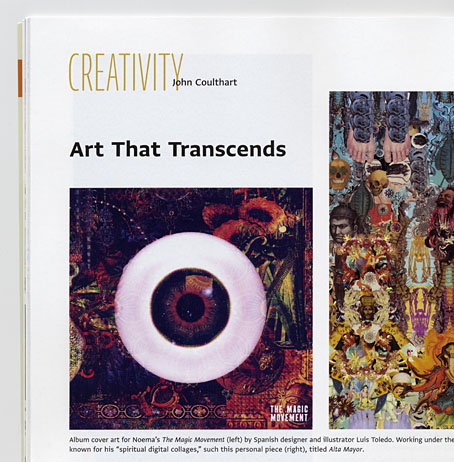
Late last year, US design magazine Communication Arts asked me to write a piece about psychedelic art, past and present. The resulting feature has been out for a couple of weeks in the May/June issue (no. 56) but I hadn’t seen it in print until a copy turned up today. Attempting to wrangle discussion of a very wide-ranging and amorphous field into 1500 words isn’t an easy task but I managed to sketch a history of psychedelic art beginning with Aldous Huxley and Humphrey Osmond’s mescaline experiments in the 1950s. Art that can be considered psychedelic goes back into prehistory but Huxley’s The Doors of Perception (1954) is the first book that considered art in general from a psychedelic viewpoint. That book, and the later Heaven and Hell (1956), are still valuable for their aesthetic meditations however much Huxley’s optimism may have been tainted by the ferment of the 1960s.

earth.jpg

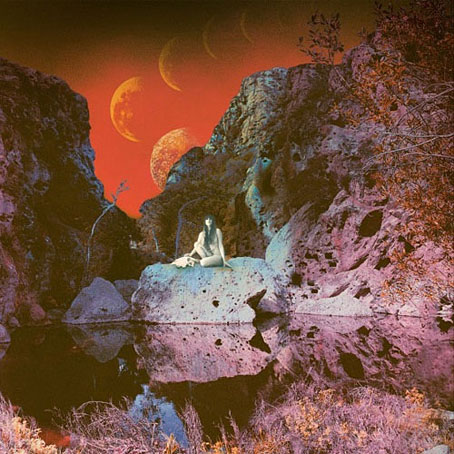
Primitive And Deadly (2014) by Earth. Art by Samantha Muljat.

The psychedelic art of the 60s isn’t exactly overlooked so I paid more attention to tracing the influence of the psychedelic style, and also mentioning painters such as Ernst Fuchs, Alex Grey, Martina Hoffmann and Mati Klarwein. Among the more recent artists, I was pleased that Samantha Muljat‘s album cover for Earth was featured. I’ve been listening to this album a great deal over the past few months, and loved that cover as soon as I saw it. One of the other contemporary names, Brazilian artist Duda Lanna, works in a very different style: bold, vivid, and often abstract. There seems to be a lot of this kind of work around at the moment, so much so that I kept spotting new examples after the article had been delivered. It’s difficult to say whether this is a developing trend or simply a case of there being more of everything around these days. I’ll play safe and suggest it’s probably a bit of both although, as I say at the end of the article, if the movement to legalise drugs gains momentum we can expect to see a lot more psychedelic art.

lanna.jpg

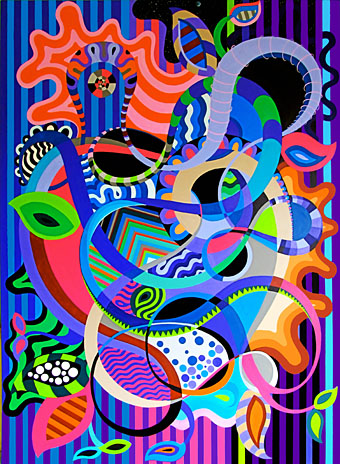
Garden of Psychedelic Delights by Duda Lanna.

Weekend links 258

stalenhag.jpg

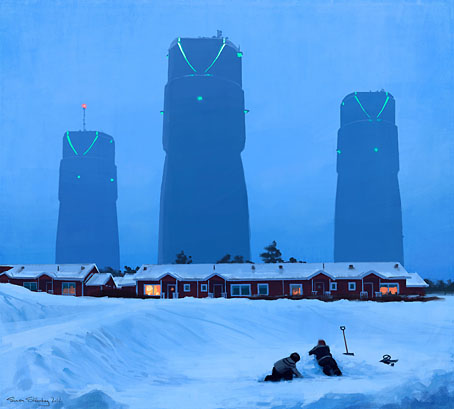
Simon Stålenhag‘s SF artwork will be published in book form if funding is secured. In the future everything will be crowdfunded for 15 minutes.

• Mixes of the week: FACT Mix 494 is a fantastic dub selection by Colleen; Secret Thirteen Mix 151 is by Sally Dige; Stephen Mallinder‘s return to the doom-laden Industrial music of the 1980s suits the post-election mood. Mallinder’s mix is helping promote Industrial Soundtrack for the Urban Decay, a documentary by Amélie Ravalec.

• “…it felt more like real life to me than the average hour-long television show.” Sopranos creator David Chase on what he enjoyed about Twin Peaks. Related: Twin Peaks Tarot cards.

Sound & Song in the Natural World edited by Tobias Fischer & Lara Cory. A book about animal music and communication with a 60-minute CD of field recordings.

• “The psychedelic renaissance has already begun, and for the most part I welcome it,” says Erik Davis in a wide-ranging interview with Sean Matharoo.

• It rumbles on: Brown Pundits on “An Embarrassment at PEN”. A useful collection of stories, reactions and polemic from the past two weeks.

Fanny and Stella: The Shocking True Story, a play by Glenn Chandler about Victorian London’s scandalous pair of cross-dressing men.

• Artist Charles Ray causes a problem for the Whitney Museum of American Art with his sculpture of a naked Jim and Huckleberry Finn.

• “Don’t believe Orson Welles,” says his biographer Simon Callow, “especially when he calls himself a failure.”

• A return to Adolph Sutro’s Cliff House features several photos I’d not seen before.

• More Tarot: Arcana: The Tarot Poetry Anthology is looking for funding.

• At Dangerous Minds: The ancient magic of the record label.

Foreign Movie Posters

Tarot (Ace of Wands theme, 1970) by Andy Bown | Distant Dreams (Part Two) (1980) by Throbbing Gristle | The Devil In Me (1982) by Stephen Mallinder

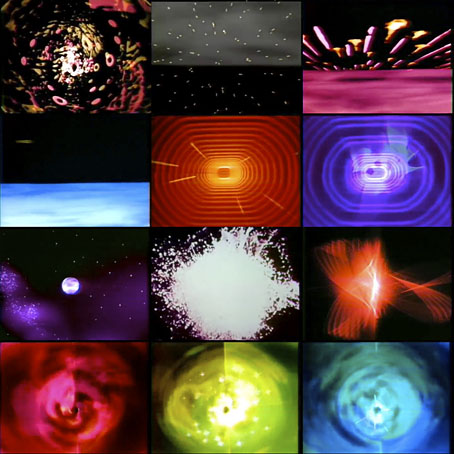
White Hole, a film by Toshio Matsumoto

whitehole.jpg

Another short film by Matsumoto. This one was made in 1979, and seems to employ video effects, but the results are cosmic and psychedelic enough to have appeared ten years earlier. The electronic score is by Joji Yuasa. An entrancing 6-minute trip. Watch it here.

Previously on { feuilleton }
Atman, a film by Toshio Matsumoto
Metastasis, a film by Toshio Matsumoto