Weekend links 79

brody-va.jpg

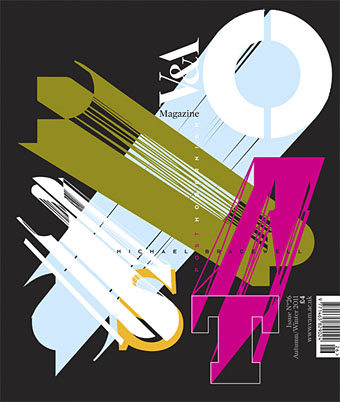
Neville Brody creates a cover design for an issue of the V&A magazine tied to the museum’s current exhibition, Postmodernism: Style and Subversion 1970–1990. Brody’s comment amused me for the way he smartly explained the thinking behind the design whilst also distancing himself from its theme:

For me, Post Modernism felt like a kind of facade built to cover over the cracks of a divided world, a surface of plucked effects and stylistic devices emptied of meaning, an extrusion of hollow traces and flat outlines forcing 2D into apparent depth. I was never a Post Modernist, rather a Modernist exploring humanist lines of enquiry in the collapsing world behind a wall of decoration.

• It’s a common thing today to give images from the past a queer reappraisal, finding homoerotic qualities in pictures which, when they were made, would have seemed free of any sexual subtext. This post finds such a subtext in recruitment posters for US armed forces although none of the examples are as overt as this wartime magazine ad. Over at Front Free Endpaper Callum notes that many vintage photos which people regard today as evidence of gay relationships are unlikely to be quite that. The photo he posts, however, really does appear to show a pair of men who were more than just good friends.

• A play by Ororo Productions of HP Lovecraft’s The Dunwich Horror will be staged at the London Horror Festival from October 25th. Related: Horror Made Delightful: The Strange Stories of Sheridan Le Fanu, MR James, and Robert Aickman. “Aickman never spells out his meaning,” says Greer Mansfield, “His stories end abruptly and inconclusively, and in fact the ‘meaning’ is less important than the utter mysteriousness of what happens.” Which is just what some of us enjoy.

deville.jpg

Black Beauty, a decorated horse skull by Julia deVille.

• “Jackpot is a comedic short film about a 14-year-old gay boy in 1994 who sets off on a quest to find a stash of gay porn and get it home before anyone finds out.” Director Adam Baran is requesting completion funds at Kickstarter.

Gendai Shogyo Bijutsu Zenshu (The Complete Commercial Artist), published in Tokyo from 1927 to 1930.

Ishac Bertran tries some analogue sampling by chopping up vinyl discs with a laser cutter.

Steve Jobs does LSD and The Residents pay tribute to Steve Jobs.

• A rare post at Ballardian: Outpost 13: The Atrocity Exhibition.

• It’s all fun and games until Charles Manson turns up…again.

The Edgar Allan Poe Portfolio (1976) by Berni Wrightson.

• RIP David Bedford and Bert Jansch.

John Waters: Roles of a Lifetime.

Octopi Wall Street!

Homocomix.

Poison (1969) by Bert Jansch | Pentangle at the BBC (1970): Train Song | House Carpenter | Hunting Song | Light Flight
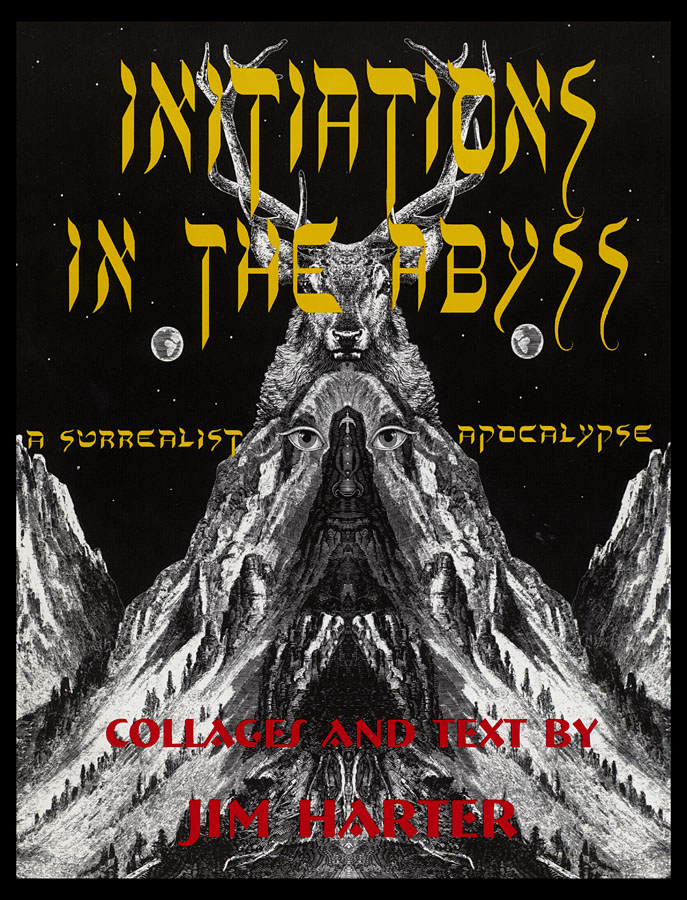
Initiations in the Abyss: A Surrealist Apocalypse

harter1.jpg

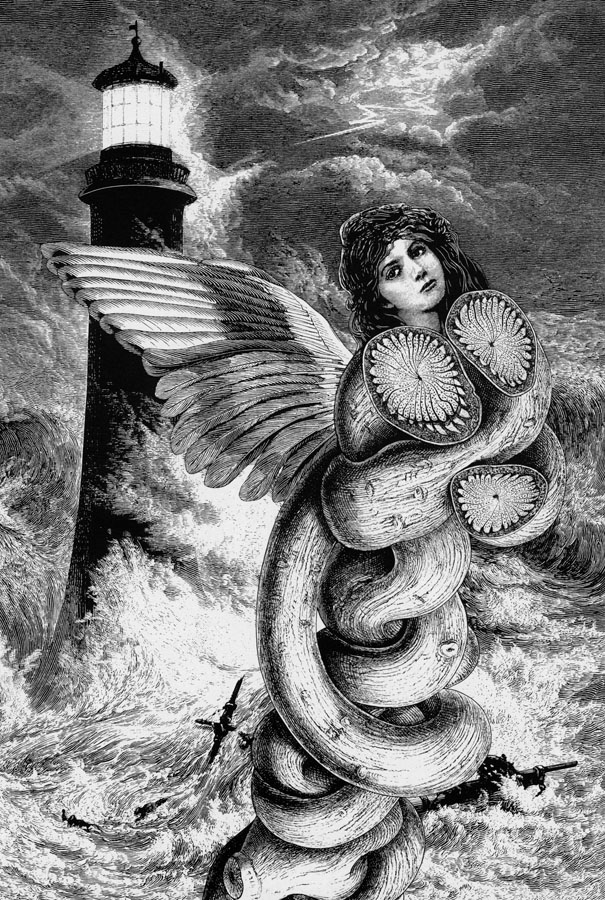
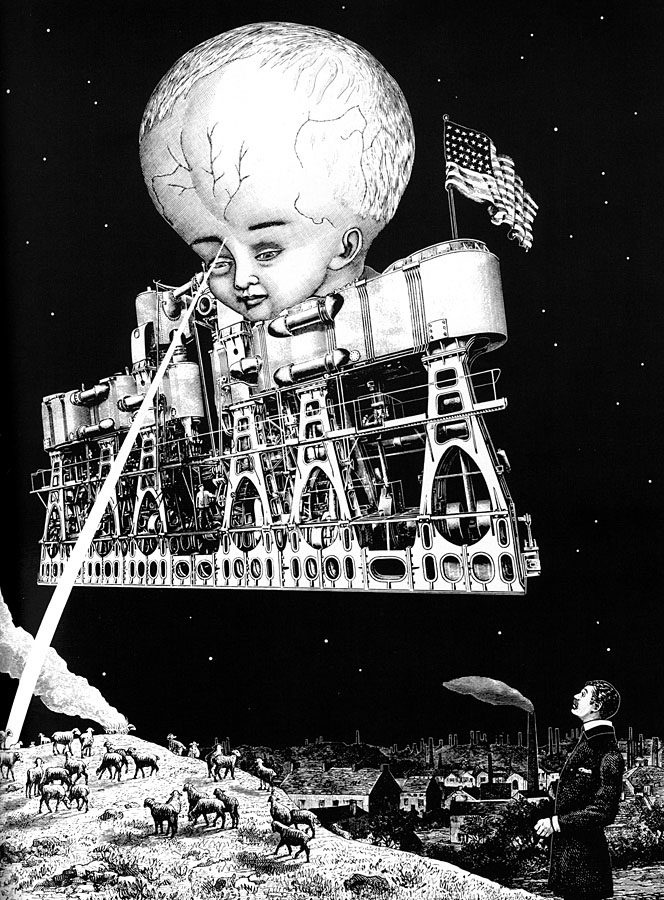
Among the many books inspired or influenced by the events of September 11th, 2001, Jim Harter’s Initiations in the Abyss: A Surrealist Apocalypse is one of the more obscure titles, and one you’re unlikely to hear about elsewhere. Harter is an American artist and archivist best known for his collections of wood engraving illustration published by Dover Publications, Harmony Books, Bonanza Books and others. I mentioned his work recently in a piece about steampunk illustration which will be appearing later this month at Tor.com. Harter’s books are invaluable source material for the style of collage popularised by Max Ernst and Wilfried Sätty. Harter was a friend of Sätty’s, with collages by the pair appearing in Harter’s Picture Archive for Collage and Illustration (1978).

harter5.jpg

The first collection of Harter’s collages, Journeys in the Mythic Sea: An Innerspace Odyssey, appeared in 1985. Initiations in the Abyss is the follow-up featuring work which dates from 1986, some of which was exhibited in 1988 at the Nicholas Roerich museum in New York. The book wasn’t published until 2003, however, and in his introduction Harter acknowledges the influence the events of the past two years had on his conception of the work as a whole. The book is reminiscent of Sätty’s Time Zone (1973), a book with a similar intent in its use of Surrealist collage techniques to make satirical or polemical points as well as to create striking and fantastic images. With both artists it’s the latter works which I find most successful. There’s a limit, for example, to how effectively our world can be represented using pictures which are over a hundred years old, and without the single-minded focus and attack of a John Heartfield the polemic can risk seeming diffuse or glib.

harter3.jpg

Harter’s book is divided into four parts—Mutant Faces of the Form Destroyer, The Holy Abattoir, The Archive of Dreams and Mystery Play—with 72 full-page plates printed on glossy paper. The quality of the printing is so good it makes me wish that Sätty and Ernst could receive the same treatment. In addition there’s a very long introductory essay by Harter which somewhat contradicts his Surrealist intent by explaining at great length some of the philosophy behind pictures whose interpretation he wants left to the reader. Near the end of his piece he says:

It could be said that the purpose of the collages in the present book’s first two sections is to ring an alarm bell. The canaries in the mine are dying and it is time to do something. At the same time, the images of the last two sections are intended as a kind of mystery play. They suggest a movement in another direction: a quest to seek a more universal vision, one where we can perhaps discard our religious fanaticism, ethnocentrism, and myths of apocalypse, and instead create a world of greater unity and harmony, eventually becoming one human family. On another level entirely, this work might be seen as a kind of shamanic soul journey, where all false attachments, beliefs, and illusions are destroyed through an ego death experience before the soil is allowed to proceed to dimensions of healing and revelation. Thus the first two sections might be seen as an encounter with what the Tibetans call the “wrathful deities,” spirits that mirror back one’s own unconscious darkness.

The last two sections of the book feature the best of his dream-like imagery, some of which are a match for Sätty’s superb creations. The examples here are mostly from the end sections. Further examples can be seen on this page where the plates have been coloured by the artist.

Initiations in the Abyss is available to buy direct from the publisher, Wings Press, while some of Harter’s psychedelic poster art can be seen here and here.

Continue reading “Initiations in the Abyss: A Surrealist Apocalypse”

Weekend links 73

sun2.jpg

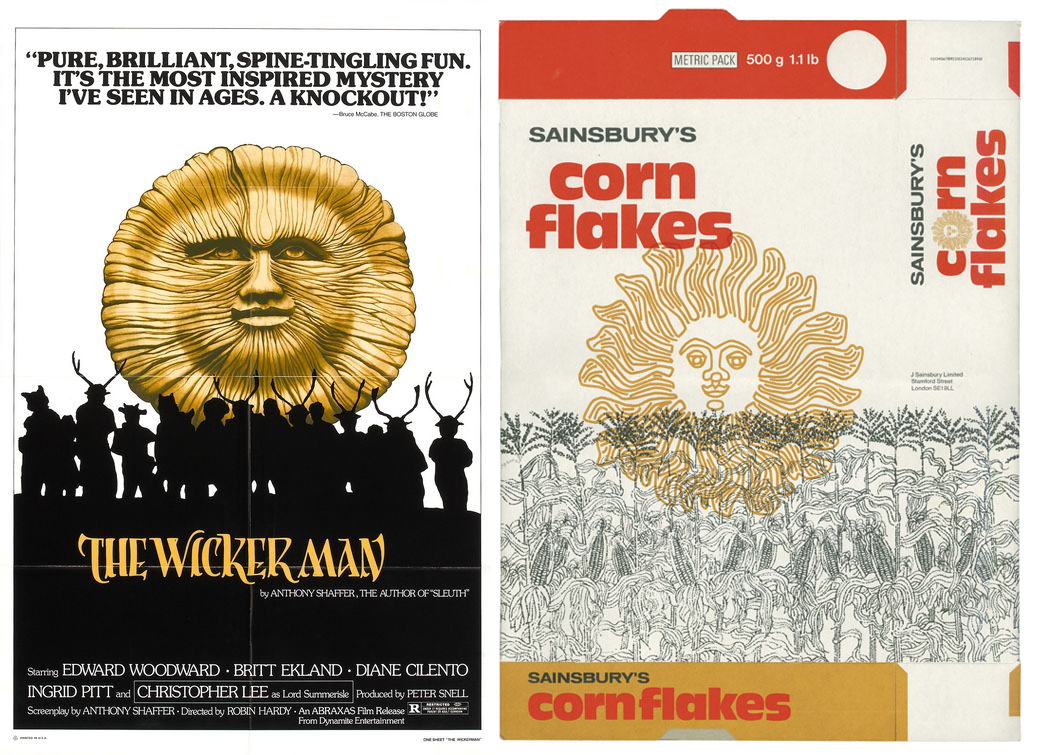
Johnny Trunk of Trunk Records reissued the soundtrack to The Wicker Man in 1997. Mr Trunk’s latest delve into the cultural past is Own Label: Sainsbury’s Design Studio, a book from Fuel examining the supermarket chain’s packaging design of the 1960s and 1970s. Creative Review shows some examples while I have to note the uncanny similarity between one of the posters for The Wicker Man and an old Sainsbury’s corn flakes box. Now we see that the Old Weird Britain wasn’t only hiding in the fields and the folk songs but was also lurking on the supermarket shelves.

Related: a new DVD set from the BFI, Here’s a Health to the Barley Mow: A Century of Folk Customs and Ancient Rural Games. And let’s not forget the ley lines of Milton Keynes, and a new edition of Ritual by David Pinner, said to be the novel which inspired The Wicker Man.

• “He wrote me…” Sans Soleil (1983), Chris Marker’s beguiling accumulation of memories, dreams and reflections, is recalled in a Quietus piece entitled Things that Quicken the Heart. Not the first time on DVD as it says there (Nouveaux Pictures released it with La Jetée in 2003) but it’s good to know it’s being reissued.

• Marker’s film references Tarkovsky’s Stalker a couple of times, most notably in the comment, “On that day there will be emus in the Zone.” Geoff Dyer has what he describes as “a very detailed study” of Stalker out next year.

I don’t like those commentators who keep on saying that London will never be the same again. London is always the same again. I remember those comments were made very loudly after the [July 2005] terrorist attacks – “London will never be the same again, London has lost its innocence” – it was all nonsense. London was exactly the same again the following day. Rioting has always been a London tradition. It has been since the early Middle Ages. There’s hardly a spate of years that goes by without violent rioting of one kind or another. They happen so frequently that they are almost part of London’s texture. The difference is that in the past the violence was more ferocious, and the penalties were more ferocious – in most cases, death.

Peter Ackroyd, reminding us that the Four Horsemen of the Apocalypse don’t wear hoodies and ride bikes.

Wolf Fifth: “rare vinyl records from the golden era of avant garde and experimental music”. And in FLAC as well, not crappy mp3; I want to hear all those scratches uncompressed, dammit!

Another great mix at FACT, this time compiled by snd who throw together Morton Feldman, Siberian shamen, Einstürzende Neubauten, Dome, Oval and many others.

• Colin Marshall asks “how weird is Australia?” in an appraisal of Nicolas Roeg’s Walkabout.

A Comprehensive Solution to the Tokyo Umbrella Problem.

• More poster art from Hapshash and the Coloured Coat.

Morbid Excess, a series of drawings by May Lim.

Conrad Schnitzler (1937–2011) by Geeta Dayal.

Neopolitan cephalopods.

Willow’s Song (1973) by Paul Giovanni & Magnet | The Willow Song (1989) by The Mock Turtles | Wicker Man Song (1994) by Nature and Organisation.

Weekend links 72

lesyeux.jpg

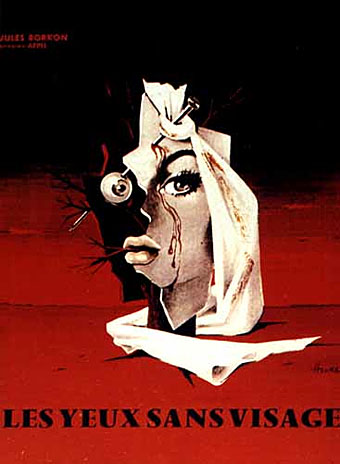
If Jean Cocteau had made a horror film it might have resembled George Franju’s dreamy and disturbing body-horror masterwork Les Yeux Sans Visage (1960). I’ve not been able to trace the artist for this poster but it’s a good example of the diluted Surrealism which was still prevalent in poster graphics at this time.

If I were asked what’s needed today, I’d say innovation, and greater timbral variety. If you truly want the audience to experience the clammy thrill of the grotesque, the uncanny and the fearful, you have to reach for the unfamilar, the perplexing, even the ugly; there’s an infinite Lovecraftian sound-world out there waiting to be explored. We need new combinations, new textures in film scoring. Horror has a licence to be weird – it’s supposed to mess with our heads. (more)

Stephen Thrower.

Stephen Thrower is an ex-member of Coil, a current member of Cyclobe, was the editor of a great magazine, Eyeball, devoted to horror cinema and what Kim Newman (casting about for a wider, non-generic label) calls “nightmare movies”, and is the author of Nightmare USA and Beyond Terror: The Films of Lucio Fulci. In other words, he’s more than qualified to write about horror film soundtracks. The reason is an event at the South Bank Centre, London, two weeks from now, Sound of Fear: The Musical Universe of Horror, one of the highlights of which will be a performance by John Carpenter’s soundtrack collaborator Alan Howarth. Related: my post about Italian horror soundtracks from 2008.

lovato.jpg

Art by Justin Lovato.

Mind Over Matter: Alan Fletcher’s The Art of Looking Sideways. “The Art of Looking Sideways captures the sensory overload of contemporary visual culture, while also acting as a primer in visual intelligence.” Related: Alan Fletcher profiled at the Design Museum.

• More music and more psychedelia: Past Present Future Space-Time “Wysing Arts Centre explores the legacy of psychedelia in this year’s annual music event”.

The Coilhouse International Silent Auction is GO and ends Sunday night if you want to bid for some rare and special things.

The Garden of Kama and Other Love Lyrics from India (1901), illustrated by John Byam Shaw.

• Chris Marker’s take on the recent London riots: Overnight.

• Bristol’s graffiti artists are redecorating the city’s streets.

• Women and knives: a Dario Argento poster gallery.

Inferno (1993) by Miranda Sex Garden, from their album Suspiria.

Weekend links 71

orazi.jpg

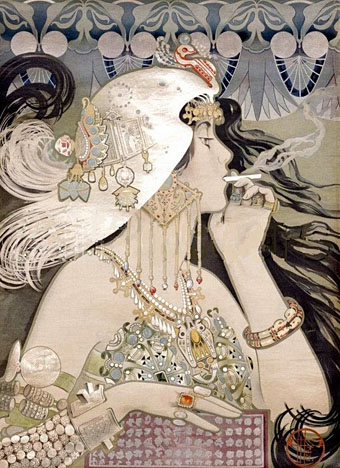
Manuel Orazi (1860–1934) was one of the best of the many Mucha imitators. An untitled & undated posting at Indigo Asmodel.

The mob now appeared to consider themselves as superior to all authority; they declared their resolution to burn all the remaining public prisons, and demolish the Bank, the Temple, Gray’s Inn, Lincoln’s Inn, the Mansion House, the Royal palaces, and the arsenal at Woolwich. The attempt upon the Bank of England was actually made twice in the course of one day; but both attacks were but feebly conducted and the rioters easily repulsed, several of them falling by the fire of the military, and many others being severely wounded.

To form an adequate idea of the distress of the inhabitants in every part of the City would be impossible. Six-and-thirty fires were to be seen blazing in the metropolis during the night.

An Account of the Riots in London in 1780, from The Newgate Calendar.

In a week of apparently limitless bloviation, a few comments stood out. Hari Kunzru: “Once, a powerful woman told us there was no such thing as society and set about engineering our country to fit her theory. Well, she got her way. This is where we live now, and if we don’t like it, we ought to make a change.” Howard Jacobson: “One medium-sized banker’s bonus would probably pay for all the trash that’s been looted this past week.” Meanwhile Boff Whalley complained about the predictable misuse of the word “anarchy” by lazy journalists.

• For further historical perspective, a list of rioters and arsonists from The Newgate Calendar (1824), and an account of the looting in London during the Blitz.

svanberg.jpg

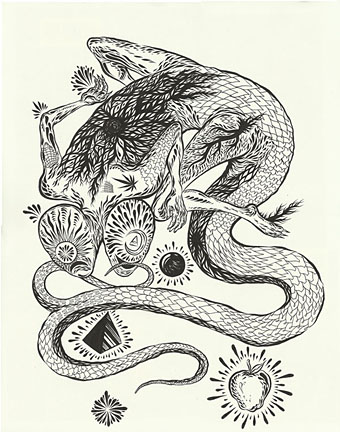
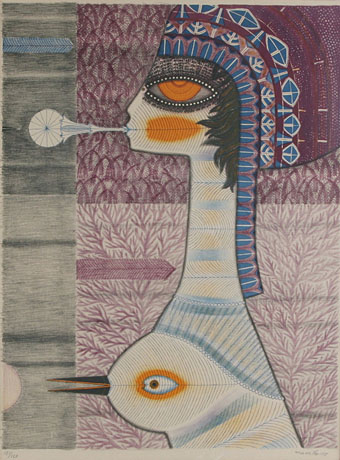
From a selection of works by Max Walter Svanberg (1912–1994) at But Does It Float. There’s more at Cardboard Cutout Sundown.

• NASA posted a gorgeous photo from the surface of the planet Mars. Related: Astronomers have discovered the darkest known exoplanet. Obliquely related: Julio Cortázar’s From the Observatory, a prose poem inspired by the astronomical observatories at Jaipur and New Delhi, India, receives its first English translation.

The Advisory Circle is still in a Kosmische groove. Not Kosmische at all, Haxan Cloak’s mix for FACT has Wolf Eyes, Sunn O))) and Krzysztof Penderecki competing to shatter your nerves.

• The wonderful women (and friends) at Coilhouse magazine are having a Black, White and Red fundraising party in Brooklyn, NYC, on August 21st. Details here.

• Sodom’s ambassador to Paris: the flamboyant Jean Lorrain is profiled at Strange Flowers.

Empire de la Mort: Photographs of charnel houses and ossuaries by Paul Koudounaris.

The Craft of Verse by Jorge Luis Borges: The Norton Lectures, 1967–68.

• Jesse Bering examines The Contorted History of Autofellatio.

Robert Crumb explains why he won’t be visiting Australia.

The Crackdown (1983) by Cabaret Voltaire.