Weekend links 116

sherer.jpg

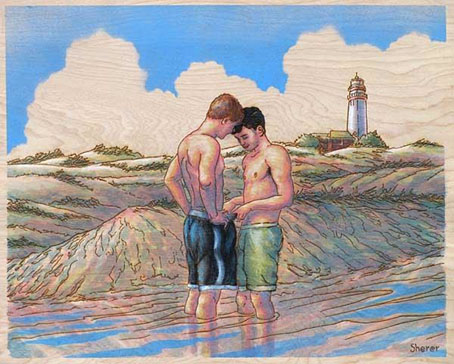
Ankle Deep, a pyrograph by Robert Sherer whose work is showcased at The Advocate.

• “Bertrand Russell wrote in 1932, during another period of economic distress, ‘that immense harm is caused by the belief that work is virtuous, and that what needs to be preached in modern industrial societies is quite different from what always has been preached.’ ” From The Devilishness Of Idleness by Alex Gallo-Brown. Related: Owen Hatherley says “It’s the 21st century – why are we working so much?”

Restoring James Joyce’s book of the night: Joyce biographer Gordon Bowker reviews the new edition of Finnegans Wake. Over at the NYRB Michael Chabon has a great piece about his own relationship with Joyce’s novel that manages to make some very un-NYRB references to Cthulhu, the Necronomicon and Michael Moorcock’s Elric. Related: Leopold’s Day, a limited edition (and expensive) map of Dublin using typography to depict the people and places of Bloomsday.

Verbally, it feels as though Burroughs, Joyce and Beckett are text messaging haikus back and forth: ‘beautiful/last/random fragments of poetry/finding syllables,/the waters fall/the waves fall/musical./pencil murmuring’.

James Kidd on A Humument by Tom Phillips.

The Expanding Universe (1980), an album of early computer music by American composer Laurie Spiegel, will be reissued with additional recordings in September.

• A previously unreleased remix by Surgeon of Teenage Lighting by Coil has been made public.

collard.jpg

Small Museum of Nature and Industry (2010) by Susan Collard.

Queer Kids In America, a photo project by M. Sharkey.

Walter Benjamin’s Grave: A Profane Illumination.

The Visual Art and Design of Famous Writers.

Nylon Sculptures by Rosa Verloop.

Froschroom (1994) by Mouse on Mars | Bib (1995) by Mouse on Mars | Cache Coeur Naïf (1997) by Mouse on Mars.

Weekend links 113

leonard.jpg

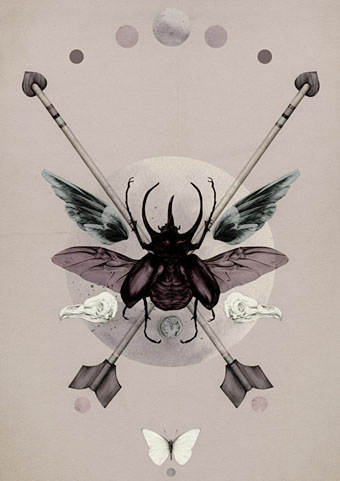
Wunderkammer (2011) by Emma Leonard.

As someone who was eight years old at the time of the Apollo moon landing, I remember calculating that I would be thirty-nine in the magic year 2000 and wondering what the world would be like. Did I expect I would be living in such a world of wonders? Of course. Everyone did. Do I feel cheated now? It seemed unlikely that I’d live to see all the things I was reading about in science fiction, but it never occurred to me that I wouldn’t see any of them.

A quote from Of Flying Cars and the Declining Rate of Profit, an essay by David Graeber. Related: Another World: David Graeber interviewed by Michelle Kuo at Artforum.

Constellation, a series of portraits by Kumi Yamashita: “This body of work consists of three simple materials that, when combined, produce the portraits: a wooden panel painted a solid white, thousands of small galvanized nails, and a single, unbroken, common sewing thread.”

Nicole Rudick at The Paris Review on the history of psychedelic art. Related: The psychedelic art and design of Keiichi Tanaami. Also Manifesting the Mind: Footprints of the Shaman, a two-hour documentary about psychedelic drugs.

• Already mentioned here, The Lost Tapes, a 3-CD collection of previously unreleased recording by the mighty Can, is out on Monday. There’s a preview of ten of the tracks here.

• “I can’t think of anybody who would have a good word to say for centipedes…” Duncan Fallowell (a Can associate for many years) interviewed William Burroughs in 1982.

Herb Lubalin: American Graphic Designer and the Herb Lubalin Study Center’s Flickr sets.

Strange Flowers goes to the movies with everyone’s favourite Bavarian king, Ludwig II.

The Sphinx’s Riddle: The Art of Leonor Fini at the Weinstein Gallery, San Francisco.

• More Teutonica: A Spacemusic Primer by Dave Maier.

Van Dyke Parks: return of a musical maverick.

Forty Posters for Forty Years at Pentagram.

Donovan’s Colours (1968) by Van Dyke Parks | Sailin’ Shoes (1972) by Van Dyke Parks | Clang Of The Yankee Reaper (1975) by Van Dyke Parks.

Weekend links 109

magritte.jpg

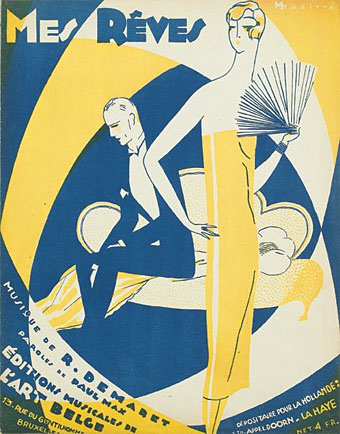
Dreams before Surrealism: a sheet music cover from 1926 by René Magritte.

• The week in music: Listen to compositions by Annea Lockwood. | At the Free Music Archive: Uncomfortable Music, a tribute to David Lynch’s Eraserhead (and, it should be said, to Alan Splet’s unique soundtrack). | Alan Licht plays a track from Trout Mask Replica then loops some Donna Summer and improvises guitar noise over it. | Music Experiments with Terror: The Spooky Isles presents Joseph Stannard‘s list of recent eldritch sounds from British musicians.

Great art, or, let’s just say, more modestly, original art is never created in the safe middle ground, but always at the edge. Originality is dangerous. It challenges, questions, overturns assumptions, unsettles moral codes, disrespects sacred cows or other such entities. It can be shocking, or ugly, or, to use the catch-all term so beloved of the tabloid press, controversial. And if we believe in liberty, if we want the air we breathe to remain plentiful and breathable, this is the art whose right to exist we must not only defend, but celebrate. Art is not entertainment. At its very best, it’s a revolution.

Salman Rushdie on the censorship of art

• All Diamond, No Rough” says the School Library Journal about the first volume of The Graphic Canon. Volume two should be out in August.

Scientific American asks: Do Psychedelics Expand the Mind by Reducing Brain Activity?

• From 2010: A Dandy in Aspic – A letter from Derek Marlowe.

Tom Phillips and A Humument: how a novel became an oracle.

Timeline Maps at the David Rumsey Map Collection.

• Happy 50th birthday, A Clockwork Orange.

Jim Dandy (1956) by LaVern Baker | Larks’ Tongues in Aspic, part one (1972) by King Crimson, live on Beat Club.

Weekend links 108

newyorker.jpg

Bob Staake’s cover illustration acknowledges President Obama’s statement last week in favour of gay marriages.

• Related to the above: Gay rights in the US, state by state, an infographic and a useful riposte to people like Orson Scott Card (yes, him again) who claim that gay Americans are equal in everything but the right to marry. On the same theme, “Now Obama’s come out on same-sex marriage, maybe so will I,” says Edmund White (yes, him again), and Eric Berkowitz, author of Sex & Punishment: 4,000 Years of Judging Desire, who writes that “In the period up to roughly the thirteenth century, male bonding ceremonies were performed in churches all over the Mediterranean.”

• The fifth edition of A Humument by Tom Phillips will be published soon by Thames & Hudson. The Tom Phillips website has just been relaunched in a form which now incorporates the notes I made in December about Phillips’ album cover designs.

• The Greenfriars are encouraging people to follow their example and get involved with their local communities (the habits are optional). Kudos for the choice of a Dürer knot.

The action centres on the arrival of a man who may or may not be a prophet, or the devil, or just a violent con-man, in a rotting, rain-drenched Hungarian hamlet. This is the “estate”, apparently some sort of failed collective, where all hope has been lost and all the buildings are falling down. It is inhabited by a cast of semi-crazed inadequates: desperate peasants cack-handedly trying to rip each other off while ogling each other’s wives; a “perpetually drunk” doctor obsessively watching his neighbours; young women trying to sell themselves in a ruined mill; a disabled girl ineptly attempting to kill her cat.

Sátántango by László Krasznahorkai is published in a new translation by George Szirtes

• The Quietus interviewed Kevin Shields following the long-awaited reissue of the My Bloody Valentine catalogue.

• The first volume of Russ Kick’s Graphic Canon (to which I’m a contributor) has been sighted in the wild.

Rise of the Living Type: Stylised 17th century floriated letterforms & grotesque mask sprinkles.

Ed Jansen’s Camera Obscura III, a tour of museums, galleries and venues, 2009–2011.

• io9 reports on the new translation of Roadside Picnic by Arkady & Boris Strugatsky.

Shanghai Expression: Graphic Design in China in the 1920s and 30s.

Liberty Realm, a monograph of drawings by Catharyne Ward.

• 100 mins of Adrian Sherwood‘s best dub productions.

Strange Flowers checked into the Chelsea Hotel.

Chelsea Girls (1967) by Nico | Chelsea Morning (1968) by Fairport Convention | Chelsea Hotel #2, Rufus Wainwright sings Leonard Cohen.

Reverbstorm: an introduction and preview

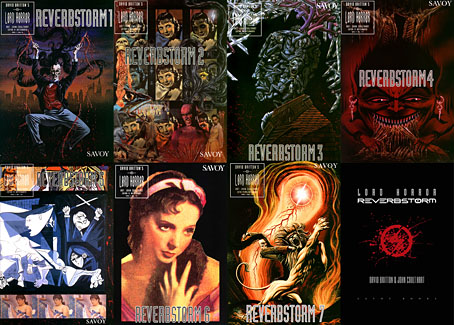
reverbstorm-covers.jpg

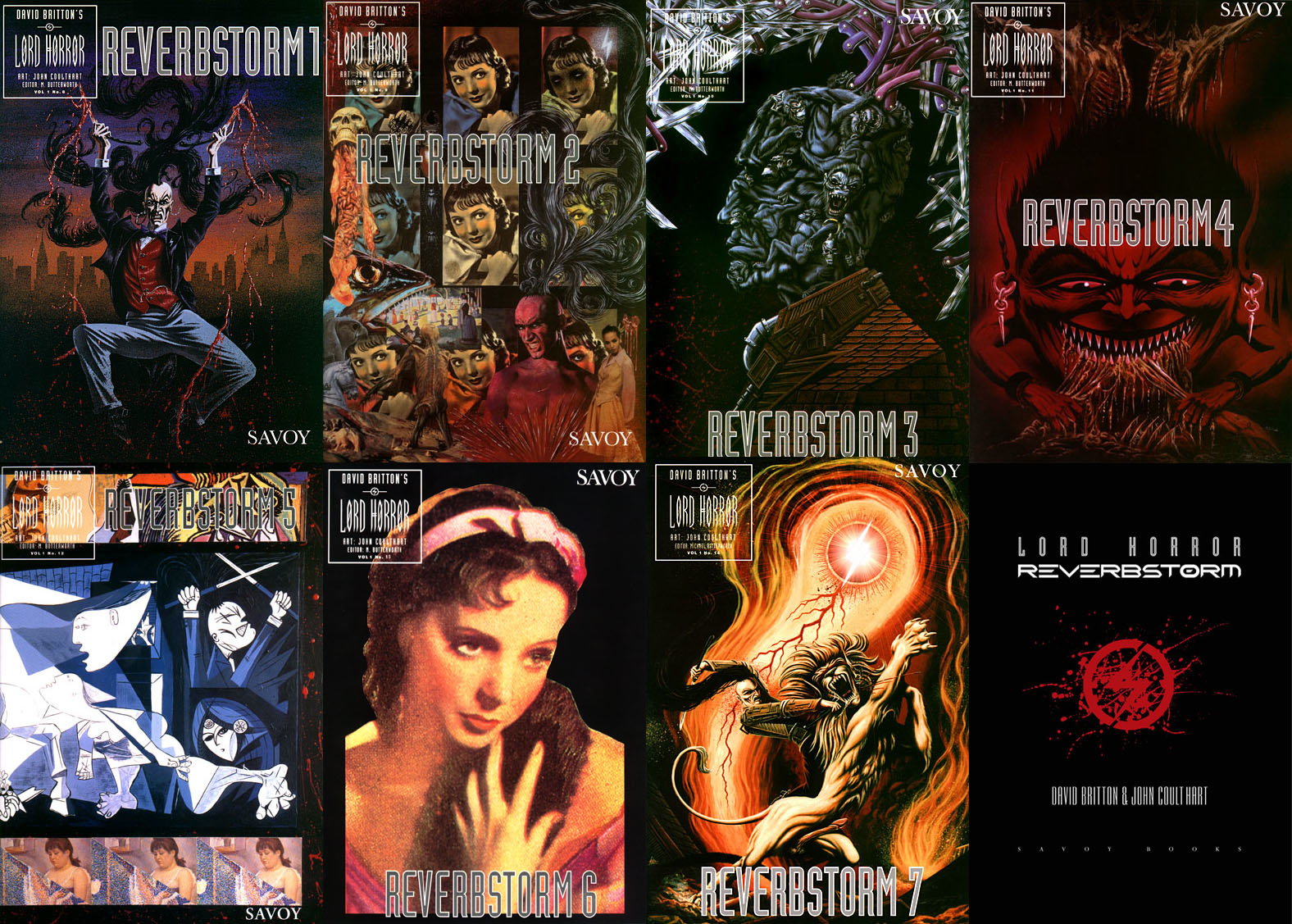
Reverbstorm: 1994–2012.

Art, intellectual pursuits, the development of the natural sciences, many branches of scholarship flourished in close spacial, temporal proximity to massacre and the death camps. It is the structure and meaning of that proximity that must be looked at. […] But there is a […] danger. Not only is the relevant material vast and intractable: it exercises a subtle, corrupting fascination. Bending too fixedly over hideousness, one feels queerly drawn. In some strange way the horror flatters attention, it gives to one’s own limited means a spurious resonance. […] I am not sure whether anyone, however scrupulous, who spends time and imaginative resources on these dark places, can, or indeed, ought to leave them personally intact. Yet the dark places are at the centre. Pass them by and there can be no serious discussion of human potential.

George Steiner, In Bluebeard’s Castle: Some Notes Towards the Re-definition of Culture (1971)

Reverbstorm is an eight-part comic series which I began drawing in 1990. Last week I finished work on the final section, and also completed the layout and design for the collected edition, a 344-page volume which Savoy Books will be publishing later this year. All the artwork has been scanned afresh, re-lettered and, in a few places, improved to fix compromises and print errors present in the published issues. This unfinished project has been hanging over me for so long that I make this announcement with some relief. The book will be published without a foreword so this post can serve as an introduction for the uninitiated. But before I get to the details, some history.
rev1.jpg

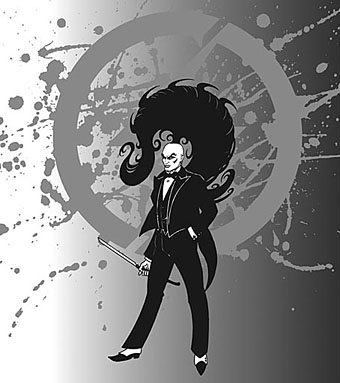
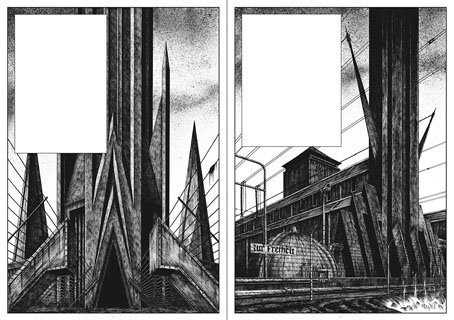
David Britton was the writer and instigator of Reverbstorm, the series being a continued exploration in the comics medium of his Lord Horror character. Lord Horror is an alternate-history equivalent of the real-life William Joyce, a member of the British Union of Fascists in the 1930s whose propaganda broadcasts to Britain from Nazi Germany during the Second World War led the press to dub him Lord Haw-Haw. The first five-part Lord Horror comic series, Hard Core Horror, showed the evolution of Horace William Joyce, aka Lord Horror, from charismatic politician to Nazi collaborator; the final two issues of the series concerned Horror’s involvement in the Holocaust. In Britton’s mythos James Joyce is the brother of Horace Joyce while Jessie Matthews, a popular British musical star of the 1930s, is Lord Horror’s wife. (Britton’s Lord Horror novels are examined in detail by Keith Seward in his Horror Panegyric essay.) My fellow artist at Savoy, Kris Guidio, drew the first four issues of Hard Core Horror; I drew issue five which was less a comic story, more a portfolio of static scenes of death-camp architecture. The series was well-received by regular Savoy readers but mostly ignored by the British comics world, with some justification: the comics were a glossy production but the narrative was very erratic, even technically inept in places. At Savoy the series was regarded as a failed experiment, Kris’s drawing style and flair for cartooning being more suited to the broad humour of the Meng & Ecker strips. But Dave liked what I’d done with the final issue and felt we could try something new that was also more original than a fictional skate through recent history.
rev2.jpg

In addition to producing comics in the late 1980s, Savoy had been recording a number of eccentric cover versions, most of them sung by PJ Proby. A music journalist, Paul Temple, came to interview Proby about the songs and stayed in touch. He subsequently approached the company with a song of his own entitled Reverbstorm, a bombastic number best described as “Wagnerian Northern Soul” which Savoy recorded in 1993. (Temple recounts the origin of the song here.) This gave a title to the new comic series that Dave was planning, the story outline being expanded from a scenario that he and Savoy colleague Michael Butterworth had sketched out when a film company showed some fleeting interest in Lord Horror. Kris Guidio and I worked on the opening pages, the initial idea being that Kris would continue drawing the Lord while I would do everything else. Once I’d convinced Dave that I could draw his Lordship to his satisfaction I took over the series while Kris carried on with the Meng & Ecker comics. I spent most of 1991–1996 drawing the first seven parts of Reverbstorm which were published as separate comics during that period. The first issue came with a CD single of Paul Temple’s song which was sung by Sue Quinn but credited to Jessie Matthews. (It’s now available on iTunes.) The last part of the series was always going to be something that differed from the preceding sections but I didn’t know how this might manifest until 1997 when I painted a series of monochrome double-spreads intended to form backgrounds for Dave’s text. That’s where the series stalled after the paintings had improvised themselves to such a degree of abstraction and incoherence that I didn’t feel able to continue. The breakthrough came a couple of years ago when I started scanning all the artwork into the computer and thinking again about the series. I realised I could complete everything now that my computer graphics skills were adequate enough to complement the earlier issues whilst also adding something new.

Continue reading “Reverbstorm: an introduction and preview”