Weekend links 141

nguyen.jpg

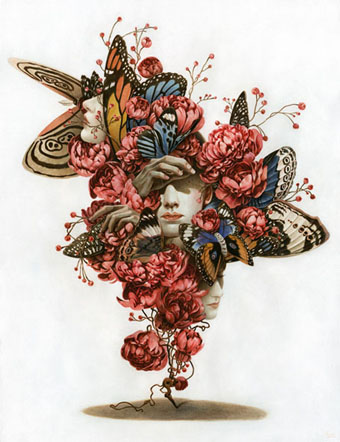
From the Beautiful Faces series (2012) by Tran Nguyen.

• “What possessed a generation of young European artists, and a few Americans, to suddenly suppress recognizable imagery in pictures and sculptures? Unthinkable at one moment, the strategy became practically compulsory in the next.” Peter Schjeldahl on the birth of abstraction.

• “A profanely mystical work of hyperpurple theory-porn, ObliviOnanisM is an auto-erotic intellectual fiction envisioning the phantastical unending odyssey of a young woman, Gemma, whom you will never know.”

Psychedelia—An Ancient Culture, A Modern Way of Life, a 520-page history of psychedelic culture by Patrick Lundborg. Related: Ken Kesey talks about the meaning of the Acid Tests.

[Hodges] made a convincing case that Turing’s teenage crush on a fellow schoolboy, Christopher Morcom, was an important catalyst for his lifelong preoccupation with the relationship between brain and mind. Morcom’s unexpected death at the age of eighteen was a shattering blow to Turing, who began to reflect on whether his friend’s consciousness might survive after death or whether it was simply a result of complex material processes and expired when life did. Hodges also linked the famous “Turing Test”, in which a computer attempts to pass as an intelligent human being, to Turing’s own dilemma as a gay man in a homophobic world. (Turing called his test the “imitation game”, and Hodges observed, “like any homosexual man, he was living an imitation game, not in the sense of conscious play acting, but by being accepted as a person that he was not”.)

Michael Saler reviews three books about computing pioneer Alan Turing

• Paul Gallagher at Dangerous Minds looks at Flowers, Lindsay Kemp’s theatrical staging of Genet’s Our Lady of the Flowers.

David Pearson designed a new edition of George Orwell’s Nineteen Eighty-Four for Penguin.

• Quadtone – Lumisonic Rotera: Mariska de Groot plays a light-to-sound instrument.

“Cash Mobs” Go Global—Battle Spreads Against Chain Store Dominance.

Cities and the Soul: a feast of Italo Calvino links at MetaFilter.

25 dessins d’un dormeur, Jean Cocteau, 1929.

Haunted Decor: a Flickr group.

Computer In Love (1966) by Perrey & Kingsley | Computer Love (1981) by Kraftwerk | Computer Love (1992) by The Balanescu Quartet
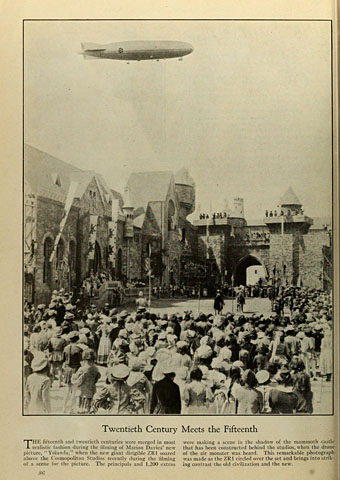

Twentieth Century Meets the Fifteenth

dirigible.jpg

Something spotted whilst browsing issues of Photoplay magazine at the Internet Archive, a photo showing the US dirigible ZR1 drifting over the Cosmopolitan Studios in 1923 during the filming of Yolanda. I don’t doubt that the ZR1 really did fly over Hollywood although it looks here to be at an odd perspective (it’s also being completely ignored by the crowd of extras). This makes me think the magazine may have comped two separate photos for convenience, as famously occurred with the cover photo of Pink Floyd’s Animals album.

kibardin.jpg

Searching around for details about the ZR1 turned up this 1931 poster by Georgii Kibardin exhorting Soviet citizens to build a fleet of airships in Lenin’s name. The Hindenberg disaster six years later put an end to this kind of enthusiasm.

Previously on { feuilleton }
Zeppelinology
Vickers Airship Catalogue
The Air Ship
Dirigibles
The Airship Destroyer
Zeppelin vs. Pterodactyls

Weekend links 136

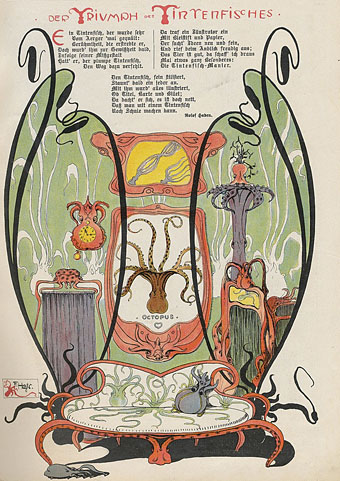
tintenfisches.jpg

Der Triumph des Tintenfisches from Meggendorfer-Blätter (c. 1900). Via Beautiful Century.

Much dismay this week at the news that Coilhouse—the web and print magazine founded in 2008 by Nadya Lev, Meredith Yayanos and Zoetica Ebb—was closing its doors for the foreseeable future. I always loved what they were doing, and was delighted when S. Elizabeth interviewed me for the website two years ago. Looking at the list of their featured articles is like seeing the contents of my head laid bare. Have a browse and see what you may have missed. And fingers crossed they return soon.

• “I think we are just used to seeing naked women because they are used as objects of desire in advertisements and TV. Naked men are not that common—we are not used to seeing a penis. I think that is the main problem for people.” The shock of the (male) nude.

Michael Clarke asks “What Can Publishers Learn from Indie Rock?” Also: Michelle Dean on the value of used books.

Queers find themselves on both sides of the free speech question. Those of us who are writers want the freedom to write and say what we want. I know I do. Yet a preponderance of LGBT people have become part of the larger wave of those who would limit free speech. Because while we want to be able to say whatever we want about “them,” we do not want “them” to say whatever they want about us.

Victoria Brownworth on The Case Against Censorship

• Caspar Henderson re-reads The Book of Imaginary Beings by Jorge Luis Borges.

One hundred classic minimalism, electronic, ambient and drone recordings.

• BLDGBLOG visits the Chand Baori stepwell in Abhaneri, India.

Brion Gysin’s Dreamachine is launched in the UK.

Ken Hollings visits Ludwig II’s Venus Grotto.

• A guide to Meredith Monk‘s music.

• RIP Boris Strugatsky.

Maldorora: a Tumblr.

Stalker: Meditation (1979) by Edward Artemiev | Undulating Terrain (1995) by Robert Rich & B. Lustmord | Stalker (2004) by Shackleton.

Weekend links 132

janini1.jpg

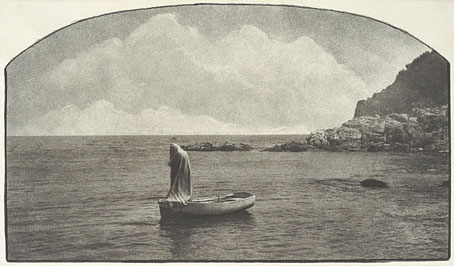
La Hora del Fantasma (no date) by Joaquim Pla Janini.

• Many of the art links featured here are tips from Thom Ayres, so it’s only right to point to his new album project which he’s funding through Kickstarter and embellishing with his own nature photography.

• Anne Billson is another writer beguiled by Philippe Jullian’s masterwork, Dreamers of Decadence. And thanks to Ms Billson for drawing attention to the insane opening of Crime Without Passion (1934).

• Does this fake ad for The Necronomicon use one of my Cthulhu pictures? Possibly. Get the picture for yourself in this year’s Cthulhu calendar. (My thanks to everyone who’s bought a copy so far.)

To break the ice, I talk about books: he is delighted to discover that I have read his beloved Denton Welch, also J. W. Dunne’s An Experiment With Time. I have found them in my old school library, and know both have been a tremendous influence on him in different ways. Knowing of his interest I also mention that I have just read Colin Wilson’s The Quest For Wilhelm Reich, published the year before. He likes Wilson, he says, jokes that “the Colonel” with his cottage in Wales in Wilson’s Return of the Lloigor and his own Colonel Sutton-Smith from The Discipline of DE are one and the same. On something of a roll, I mention Real Magic by Isaac Bonewits, and he acknowledges that it has “some good information” – but is much more enthusiastic about Magic: An Occult Primer by David Conway [years later I would discover that Burroughs & Conway had in fact exchanged letters on various subjects pertaining to magic, occultism, and psychic phenomena – but that is decidedly another story!]

Matthew Levi Stevens recalls The Final Academy and an encounter with William Burroughs thirty years ago.

Locomotif: A short survey of trains, music & experiments: Gautam Pemmaraju on Kraftwerk, Pierre Schaeffer, Luigi Russolo and others.

A flip-through of The Graphic Canon, volume 2. Wait to the end and you’ll see a couple of my Dorian Gray pages. Imprint has a review of the book.

• Julian Bell reviews two new books about Romantic painter Caspar David Friedrich.

Alan Moore talks to The Occupied Times about art, education and anarchism.

• Colin Dickey reviews Vilém Flusser’s Vampyroteuthis Infernalis: A Treatise.

janini2.jpg

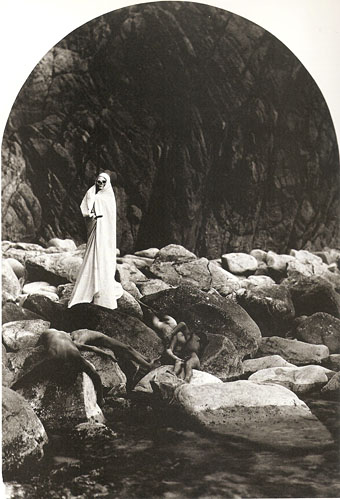
Las Parcas II (1930) by Joaquim Pla Janini.

• Michael Newton reviews A Natural History of Ghosts by Roger Clarke.

• Golden Age Comic Book Stories revisits the work of Sidney Sime.

Front Free Endpaper asks “What’s in an inscription…?”

Mormon Missionary Positions

Amateur Aesthete

Ghosts (1981) by Japan | Ghosts (2008) by Ladytron | Ghosts (2012) by Monolake.

Wildeana #8

happy.jpg

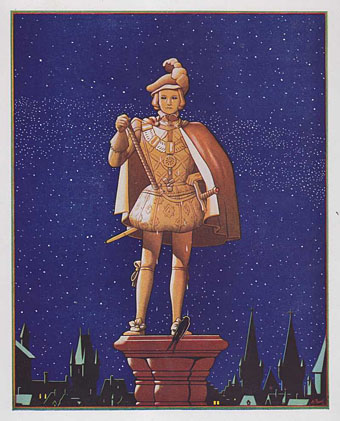
Illustration by H. Paul.

Continuing an occasional series.

Front Free Endpaper has illustrations by one H. Paul from a “talking book” adaptation of Wilde’s The Happy Prince. This was a hardcover volume published in 1948 which came with a 78rpm vinyl disc containing a recording of the story by BBC newsreader Frank Phillips. Callum found the reading on YouTube. By coincidence I discovered this week that Klaus Kinski recorded some of Wilde’s stories in 1959, German versions of The Happy Prince (again) and The Selfish Giant, and also a reading of The Young King.

Wilde is strikingly prophetic in his denunciations of what he describes here as “authoritarian socialism”.  He says again that in the present state of affairs, at least some men with the advantages of privilege manage to find themselves, to realise their potential “If the Socialism is authoritarian; if there are governments to be armed with economic power as they are now with political power; if, in a word, we are to have industrial tyrannies, then the last state of man will be worse than the first.”  At least some can have freedom now, in this state, no-one would at all. Wilde sees no virtue at all in the equitable distribution of misery.  The collectivism of compunction which existed in Soviet Russia or Mao’s China was precisely the nightmare scenario he was warning against. It seems clear though that Wilde actually thought the sheer unattractiveness of this made it unlikely. “I hardly think any Socialist, nowadays, would seriously propose that an inspector should call every morning to see that each citizen rose up and did manual labour for eight hours”.  He may have ‘hardly thought’ it, but at the same time Wilde wrote this there were plenty of socialists who had just such a vision in mind – and sadly their type were to proliferate, and in some areas to predominate. No wonder that The Soul of Man was an inspiration to many revolutionaries rebelling against the Tsars of Russia, but was later suppressed and banned by Stalin himself.

Ben Granger takes a lengthy and perceptive look at The Soul of Man Under Socialism (1891), an essay of Wilde’s that seldom receives the same degree of attention as his other works.

• “As the weeks have gone by, it’s become clear to my actors that Dorian is the work of a much darker – more radical, and more modern – writer than the flippant genius we’re all so familiar with.” So says Neil Bartlett whose new stage production of The Picture of Dorian Gray is currently running at the Abbey Theatre, Dublin.

• A recipe for Oscar Wilde Strawberry Champagne cocktails? Yes, please.

Elsewhere on { feuilleton }
The Oscar Wilde archive