Wildeana 6

robinson1.jpg

“The rich making merry in their beautiful houses, while the beggars were sitting at the gates.” Above and below: illustrations by Charles Robinson from The Happy Prince and Other Tales, an edition from 1920.

Continuing an occasional series. I’ve yet to see a copy of the recent annotated and unexpurgated edition of The Picture of Dorian Gray but Alex Ross wrote a marvellous essay for the New Yorker about the novel, its creation, its public reception, and Wilde’s decision to tone down the overt homoeroticism of its earlier drafts. This is one of the best pieces I’ve seen for a while about Wilde, replete with choice detail:

The gay strain in Wilde’s work is part of a larger war on convention. In the 1889 story “The Portrait of Mr. W. H.,” a pseudo-scholarly, metafictional investigation of Shakespeare’s sonnets to a boy, Wilde slyly suggests that the pillar of British literature was something other than an ordinary family man. In the 1891 play “Salomé,” Wilde expands a Biblical anecdote into a sumptuous panorama of decadence. Anarchists of the fin de siècle, especially in Germany, considered Wilde one of their own: Gustav Landauer hailed Wilde as the English Nietzsche. Thomas Mann expanded on the analogy, observing that various lines of Wilde might have come from Nietzsche (“There is no reality in things apart from their experiences”) and that various lines of Nietzsche might have come from Wilde (“We are basically inclined to maintain that the falsest judgments are the most indispensable to us”). Nietzsche and Wilde were, in Mann’s view, “rebels in the name of beauty.”

As for the novel, I’m feeling rather Dorian Grayed-out at the moment, having recently completed ten illustrations based on the story for a forthcoming anthology. More about that later.

Elsewhere, the William Andrews Clarke Memorial Library in Los Angeles has been running an exhibition, Oscar Wilde & the Visual Art(ists) of the Fin-de-Siecle, since July, and will continue to do so until the end of September. No word about what’s on display but this page on their website has details of their collection of Wilde materials which they say is the most comprehensive in the world.

Finally, the majority of visits to these pages in recent days have come from this post about Ivan Albright’s astonishing Dorian Gray painting in the Art Institute of Chicago. The post links to an earlier one of mine about the paintings used in Albert Lewin’s 1945 film of the book.

robinson2.jpg

Elsewhere on { feuilleton }
The Oscar Wilde archive

Weekend links 71

orazi.jpg

Manuel Orazi (1860–1934) was one of the best of the many Mucha imitators. An untitled & undated posting at Indigo Asmodel.

The mob now appeared to consider themselves as superior to all authority; they declared their resolution to burn all the remaining public prisons, and demolish the Bank, the Temple, Gray’s Inn, Lincoln’s Inn, the Mansion House, the Royal palaces, and the arsenal at Woolwich. The attempt upon the Bank of England was actually made twice in the course of one day; but both attacks were but feebly conducted and the rioters easily repulsed, several of them falling by the fire of the military, and many others being severely wounded.

To form an adequate idea of the distress of the inhabitants in every part of the City would be impossible. Six-and-thirty fires were to be seen blazing in the metropolis during the night.

An Account of the Riots in London in 1780, from The Newgate Calendar.

In a week of apparently limitless bloviation, a few comments stood out. Hari Kunzru: “Once, a powerful woman told us there was no such thing as society and set about engineering our country to fit her theory. Well, she got her way. This is where we live now, and if we don’t like it, we ought to make a change.” Howard Jacobson: “One medium-sized banker’s bonus would probably pay for all the trash that’s been looted this past week.” Meanwhile Boff Whalley complained about the predictable misuse of the word “anarchy” by lazy journalists.

• For further historical perspective, a list of rioters and arsonists from The Newgate Calendar (1824), and an account of the looting in London during the Blitz.

svanberg.jpg

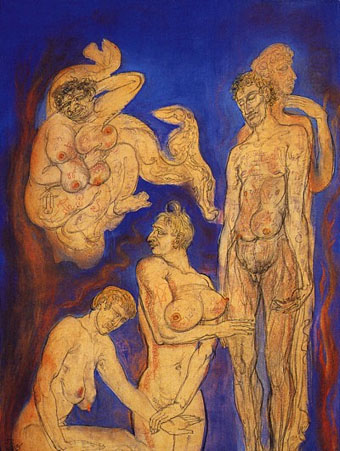
From a selection of works by Max Walter Svanberg (1912–1994) at But Does It Float. There’s more at Cardboard Cutout Sundown.

• NASA posted a gorgeous photo from the surface of the planet Mars. Related: Astronomers have discovered the darkest known exoplanet. Obliquely related: Julio Cortázar’s From the Observatory, a prose poem inspired by the astronomical observatories at Jaipur and New Delhi, India, receives its first English translation.

The Advisory Circle is still in a Kosmische groove. Not Kosmische at all, Haxan Cloak’s mix for FACT has Wolf Eyes, Sunn O))) and Krzysztof Penderecki competing to shatter your nerves.

• The wonderful women (and friends) at Coilhouse magazine are having a Black, White and Red fundraising party in Brooklyn, NYC, on August 21st. Details here.

• Sodom’s ambassador to Paris: the flamboyant Jean Lorrain is profiled at Strange Flowers.

Empire de la Mort: Photographs of charnel houses and ossuaries by Paul Koudounaris.

The Craft of Verse by Jorge Luis Borges: The Norton Lectures, 1967–68.

• Jesse Bering examines The Contorted History of Autofellatio.

Robert Crumb explains why he won’t be visiting Australia.

The Crackdown (1983) by Cabaret Voltaire.

The art of Ludwig von Hofmann, 1861–1945

dkd24-01.jpg

Ludwig von Hofmann was a German artist whose work has already appeared via the above example from Deutsche Kunst und Dekoration. Many of Hofmann’s drawings and paintings appeared in that magazine’s rival publication, Pan magazine, for which the artist also provided a cover design for the collected editions, and vignettes for the interiors.

hofmann01.jpg

Hofmann is also of note for those of us who search art history for potentially gay art or artists. A handful of his works turn up continually on forums where homoerotic artwork is posted even though I’ve yet to see any evidence that his desires ran in this direction. It’s true that many of Hofmann’s pictures focus exclusively on the naked male form, but it’s equally true that he painted and drew a large number of naked women. Males and females often appear together in Adam and Eve pictures, a theme which was so common in German art at this time it’s easy to assume that most artists were using the subject as the merest excuse to represent the unclothed figure.

hofmann02.jpg

Ganymede poster design from Pan (1895).

Biographical details state that Hofmann married his cousin in 1899 although he still may have been  bisexual, of course. If I was making a case for a Uranian inclination in his art I’d point to his poster design on the Ganymede theme (a favourite among gay artists with its story of Zeus falling for a beautiful boy), his many drawings of bathing boys and naked riders on horseback (the latter seems an obsession), Thomas Mann’s admiration for his work, and at least one sketch of a boy from Capri, an island with a long history as a favourite holiday resort for the rich and famous homosexuals of Europe. Whatever the truth, many of Hofmann’s pictures remain homoerotic, intentionally or not, and a few further examples are posted here. I should note that two of the pictures have been cropped to focus on the male figures, and that many of them lack verifiable dates.

Continue reading “The art of Ludwig von Hofmann, 1861–1945”

The fantastic and apocalyptic art of Bruce Pennington

pennington-pastel.jpg

The Pastel City (1971), the first in M. John Harrison’s peerless series of Viriconium books.

Today’s post is another guest entry over at Tor.com. I’d been intending on writing something about Bruce Pennington‘s art for some time, having already covered the work of Ian Miller, my other favourite genre cover artist of the 1970s. (By coincidence both artists have illustrated the work of M. John Harrison and HP Lovecraft.) My hand was forced this month by the news of the first ever exhibition of Pennington’s paintings which is being held at Britain’s foremost occult book emporium, the Atlantis Bookshop in Museum Street, London. There’s a catalogue of the works on display here, many of which will be for sale. If I had the cash I’d consider buying one, Pennington’s work made a big impression on my imagination when I was reading many of the titles he’d illustrated for the first time. His art was unique for me in its occasionally Surrealist overtones, and as a cover artist he was unusual in working across a range of genres. Like Frank Frazetta his imagination and technique were able to suggest a great deal with a minimum of brush strokes.

pennington-cthulhu.jpg

The Mask of Cthulhu (1976).

This post can be taken as an appendix to the Tor one which I didn’t want to overburden with pictures. The Derleth cover is purloined from Jovike’s excellent Flickr collection which includes several Pennington covers. Below are some pages from Pennington’s first book, Eschatus, a large-format collection of paintings interpreting the prophecies of Nostradamus as an apocalyptic science fiction narrative taking place in the 24th century.

Pennington has many examples of his work on his website, and there’s also a feature about his paintings in this month’s Fortean Times. The Atlantis exhibition runs to August 27th.

pennington-eschatus1.jpg

Eschatus (1976).

Continue reading “The fantastic and apocalyptic art of Bruce Pennington”

The art of Leonidas Kryvošej

kryvosej1.jpg

Anděl západního okna.

Leonidas Kryvošej is a contemporary Czech Surrealist whose work I’d known for a while from an exhibition catalogue. I’d always wanted to see more so it’s a pleasure to discover a substantial set of paintings on the website he shares with Lucie Hrusková. A biographical note tells us that:

Leonidas Kryvošej was born 14th May, 1957 in Moravská Třebová. He lives in Ondratice near Prostějov. He has been a member of the surrealist group in Sternberk (later A.I.V) since 1986. Since 1997 a member Czech and Slovak surrealist group.

Most of the text on the site is Czech-only but the green painting above was one of the catalogue works whose English title, The Angel of the Western Window, we can no doubt assume is borrowed from Gustav Meyrink’s occult novel about Elizabethan magus John Dee. Occultism and alchemical symbolism seem to fuel Kryvošej’s art, and I like the profusion of wings and mutated bird-like creatures. There’s a lot of work on his gallery pages, all of it worth seeing for anyone who favours this kind of imagery.

kryvosej2.jpg

Ptací hra.

Elsewhere on { feuilleton }
The fantastic art archive