Weekend links 159

francov2.jpg

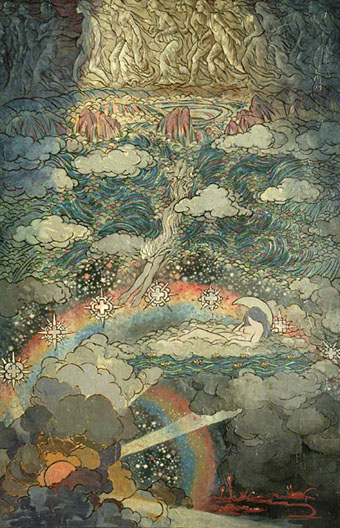
El Banquete Magnético (2011) by Cristina Francov.

Did Vertigo Introduce Computer Graphics to Cinema? asks Tom McCormack. He means Saul Bass’s title sequence which mostly uses still harmonographs but also features some animated moments by John Whitney.

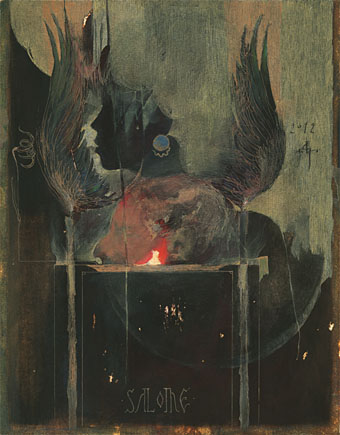
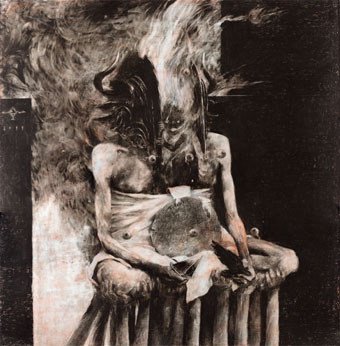
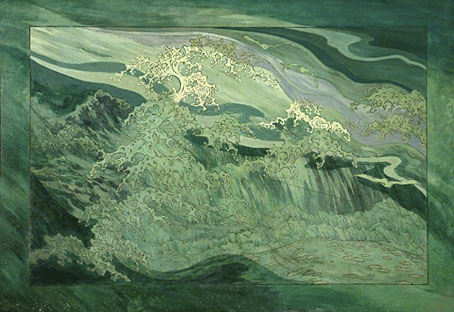
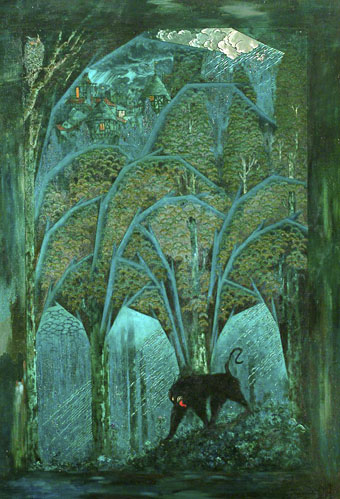
•  Temple of the Vanities by Thomas Jorion. “Pictured here are political monuments and munitions depots, hulking concrete forms that marked the edges of empires.” Related: Paintings by Minoru Nomata.

• Musical reminiscences: Matt Domino on the Small Faces’ psychedelic magnum opus Ogden’s Nut Gone Flake, and Richard Metzger on the sombre splendours of Tuxedomoon.

Harrison is best known as one of the restless fathers of modern SF, but to my mind he is among the most brilliant novelists writing today, with regard to whom the question of genre is an irrelevance. To read his work is to encounter fiction doing what fiction must: carrying out the kinds of thinking and expression that would be possible in no other form. I pass through his novels feeling a mixture of wonder, calmness and disturbance; I end them brain-jarred and unsettled. Metaphysical echoes persist for days afterwards. It feels as if I have had a strabismus induced, causing illusions that slowly resolve into insights.

Robert Macfarlane on M. John Harrison and the reissue of Climbers.

• Divine Machinery: An Interview with Paul Jebanasam. Arvo Pärt, Cormac McCarthy and Algernon Blackwood are folded into his new album, Rites.

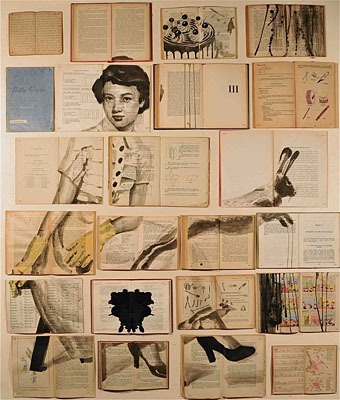
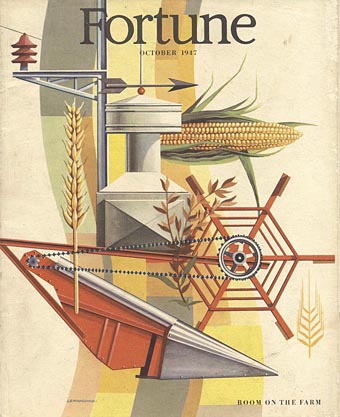
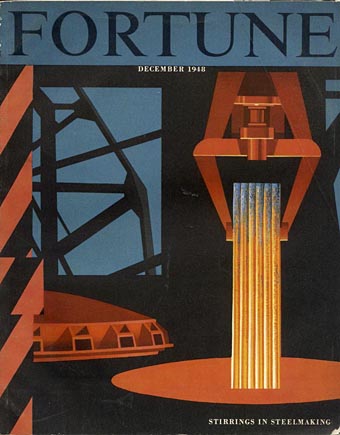
Autostraddle shows the evolution of twelve queer book cover designs. As is often the case in cover design, latest isn’t always best.

• “My Definition Of Hell? It’s Other People, At The Cinema!” Anne Billson on the very thing that finished me as a cinema-goer.

• “London in the 1830s was a truly weird and terrifying place.” Spring-Heeled Jack, The Terror of London.

• At Scientific American: The Reading Brain in the Digital Age: The Science of Paper versus Screens.

Van Dyke Parks: “I was victimised by Brian Wilson’s buffoonery.”

Colour film of London in 1927.

Abandonedography

Social Dead Zone

• Tuxedomoon: Tritone (Musica Diablo) (1980) | Desire (1981) | Incubus (Blue Suit) (1981)

I:MAGE: An Exhibition of Esoteric Artists
francov.jpg

El Trigono de las lesiones (2010) by Cristina Francov.

I:MAGE is an exhibition of occult-inspired art which opens a week on Sunday, 19th May at the Store Street Gallery, Bloomsbury, London. As exhibitions go it’s modest in scale but with an impressive roster of contributors old and new: Agostino Arrivabene, Ithell Colquhoun, Denis Forkas Kostromitin, Steffi Grant, Orryelle, David Chaim Smith, Michael Bertiaux, Andrew Chumbley, Cristina Francov, Barry William Hale, Francesco Parisi, Austin Osman Spare, Jesse Bransford, Peter Dyde, Rik Garrett, Noko, Residue, and Michael Strum. A few examples of the work on display are shown here, some of which will be available for purchase.

The event is being organised by Fulgur Esoterica, and their website has details of some related events including John Constable’s one-man play, Spare (about artist Austin Osman Spare), a one-off performance which will be held at Treadwell’s, London, on the 24th. This catches my attention because Constable was responsible for the acclaimed theatre adaptation of Mervyn Peake’s Gormenghast which David Glass and company staged in the 1990s. It’s always good to find one’s favourite people joined through these lateral connections.

garrett.jpg

The Earth Magic Series (2012) by Rik Garrett.

grant.jpg

Steffi Grant.

kostromitin.jpg

Demon by Denis Forkas Kostromitin.

Weekend links 158

soderberg.jpg

Pan II (2012) by Fredrik Söderberg.

• “Aubade was a surprise success, selling some 5000 copies and going into a second printing and an edition published in America.  Martin was immediately a minor celebrity, being interviewed for articles that couldn’t mention what his book was actually about.” Rediscovering the works of Kenneth Martin.

• “I can’t stand covers which imitate other covers, or which slavishly look like whatever their designated genre is supposed to look like.” Ace cover designer Peter Mendelsund is interviewed.

• At The Outer Church Isablood & Henry of Occult Hand are interviewed about their mixtape.

I’d decided to pay my respects in an unorthodox way, by time-travelling into the period of Thatcher’s pomp, when she occulted the light, alchemised the bad will of the populace and did her best to choke the living daylights out of the awkward, sprawling, socially coddled essence of metropolitan London. Hers was a tyranny of the suburbs operating from a position of privilege at the centre: she might have invested in a Dulwich retirement property, but she couldn’t sleep in it.

Iain Sinclair visits Tilbury on the day of the Thatcher funeral. Related: Iain Sinclair and Jonathan Meades in Conversation, Oxford Brookes University, March 2013.

Ormond Gigli’s best photograph: women in the windows in Manhattan. See it full size here.

Balzac and sex: How the French novelist used masturbation to fuel his writing process.

• At Dangerous Minds: Kenneth Williams and John Lahr discuss Joe Orton in 1978.

• Yet more Bowie: Sukhdev Sandhu reviews Ziggyology by Simon Goddard.

The Spectacular, Wild World of Tenjo Sajiki and its Posters.

• In 1967 Susan Sontag made lists of her likes and dislikes.

Stephen Sparks on fin de siècle author Marcel Schwob.

Day Jobs of the Poets by Grant Snider.

James Turrell’s Ganzfeld Experiment.

The Pan Piper (1960) by Miles Davis & Gil Evans | Panorphelia (1974) by Edgar Froese | Pandora (1984) by Cocteau Twins

Burt Shonberg’s Poe paintings

usher1.jpg

House of Usher (1960): Vincent Price and Mark Damon.

This post ought to have followed the one in January about the sinister portraits glimpsed in Roman Polanski’s Dance of the Vampires. I still don’t know who was responsible for those paintings but the artist who created the equally outré family portraits in Roger Corman’s House of Usher (1960) was credited for his work. Burt Shonberg (1933–1977) was a friend of Corman’s who had to produce the six portraits at speed (the entire film was shot in fifteen days) so the results are sketchier than they might have been in a production with a bigger budget. I always liked the anachronism of these pictures, the way they look very much of their time; the effect is a jarring one that adds a note of much-needed strangeness to Corman’s otherwise sparse interiors.

usher2.jpg

Shonberg was a curious artist, the gallery page on his website shows a progression from Picasso-style early works in the 1950s to his own brand of mystical psychedelia. Some of his paintings from around the time of House of Usher have that stained-glass fragmentation one finds in the work of Leo & Diane Dillon from the same period. Shonberg’s biography says Corman used more paintings in The Premature Burial (1962) but I don’t have a copy of that to hand and haven’t found any examples. There’s also the detail that Shonberg was involved for a while with Marjorie Cameron, herself an artist who appeared as the mysterious “Water Witch” in another AIP production, Curtis Harrington’s Night Tide, a year after House of Usher.

usher3.jpg

usher4.jpg

Continue reading “Burt Shonberg’s Poe paintings”

Vertumnus

arcimboldo1.jpg

Rudolf II of Habsburg as Vertumnus (detail).

With the spring here starting to show its reluctant face it’s an apt moment to find a handful of Giuseppe Arcimboldo’s paintings at the Google Art Project. Vertumnus is the perennial favourite, Arcimboldo’s portrait of his patron, Rudolf II of Hapsburg, as the Roman god of the seasons. I’ve always thought this portrait flattered Rudolf more than those which faithfully depict his homely features. We’re told the Emperor was very pleased with his fruity likeness.

arcimboldo2.jpg

Rudolf II of Habsburg as Vertumnus (1590).

arcimboldo3.jpg

Summer (1563).

arcimboldo4.jpg

Four Seasons in One Head (c. 1590).

Previously on { feuilleton }
Arcimboldo’s Four Elements