Weekend links 154

poizat.jpg

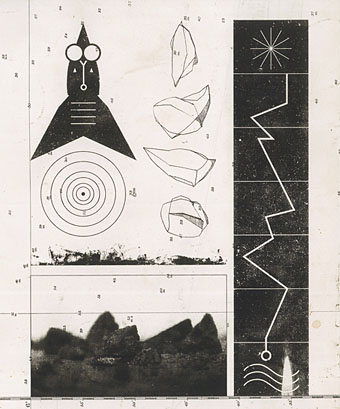
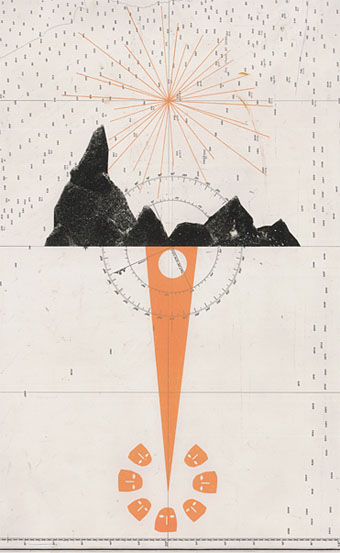
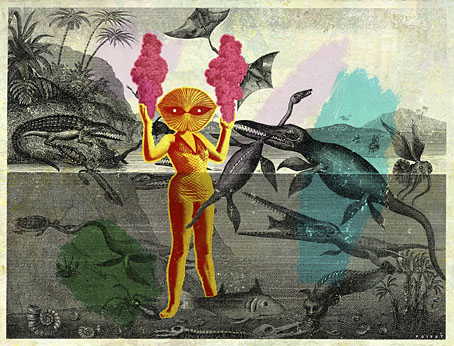
Collage by Chloé Poizat.

Xenis Emputae Travelling Band plays the Music of John Dee, and free at Bandcamp: Victorian Machine Music by Plinth, the “creaking, winding, piping, chiming and wood-knocking of Victorian parlour music machines”.

Jeremy Willard on Mikhail Kuzmin, “the Oscar Wilde of Russia”. Related: Conner Habib on the Disinfo podcast discussing pornography, sexuality, and whether sex be a revolutionary act.

Ed Vulliamy paid a visit to Hawkwind’s Hawkeaster festival. The Hawks’ Warrior On The Edge Of Time album is released in a remastered edition next month.

• Blasts from the past: Mahavishnu Orchestra, live in France, August 23rd, 1972, and Ashra (Manuel Göttsching & Lutz Ulbrich) in Barcelona, 1981.
martini.jpg

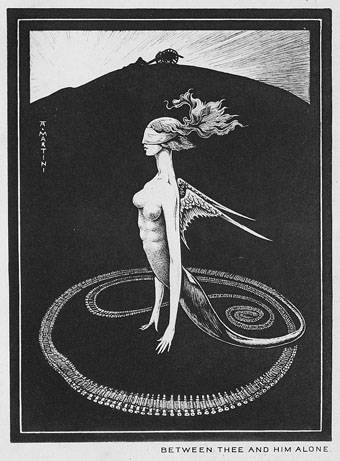
An illustration by Alberto Martini for Raw Edges (1908) by Perceval Landon.

NASA’s cover designs for Space Program manuals, guidebooks, press kits, reports and brochures.

PingMag—”Art, Design, Life – from Japan”—makes a welcome return as an active blog.

Suzanne Treister‘s Hexen 2.0 Tarot designs.

Listening to records that no longer exist

The architectural origins of the chess set

The Bohemian Realm of Absinthiana

Les sources d’une île: a Tumblr

Hammer Without A Master (1998) by Broadcast | Test Area (1999) by Broadcast | Make My Sleep His Song (2009) by Broadcast & The Focus Group
Hodgsonian vibrations

utpatel.jpg

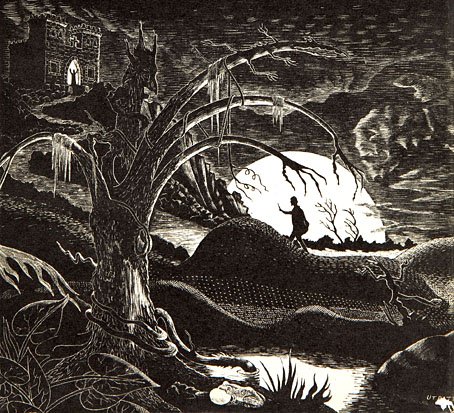
Illustration by Frank Utpatel from the 1947 Arkham House edition of Carnacki, the Ghost-Finder.

“Presently I got hold of myself a bit, and marked out a pentacle hurriedly with chalk on the polished floor; and there I sat in it almost until dawn. And all the time, away up the corridor, the door of the Grey Room thudded at solemn and horrid intervals. It was a miserable, brutal night.”

The Gateway of the Monster (1913) by William Hope Hodgson

“Word falling – Photo falling – Time falling – Break through in Grey Room”

The Ticket That Exploded (1962) by William S. Burroughs

Among other things, 2013 is the centenary of the first book publication of William Hope Hodgson’s collection of weird tales, Carnacki, the Ghost-Finder, and while I don’t believe that William Burroughs was referring to the supernatural eruption that occurs in Hodgson’s Grey Room it would be remiss of me to ignore the connection. Listening this week to Music for Thomas Carnacki by Jon Brooks (he of The Advisory Circle) had me wondering whether there’s any other Hodgson-derived music of note. Lovecraft has inspired hours of musical endeavour while Hodgson’s weird contemporaries, Algernon Blackwood and Arthur Machen, are referenced on some of the Ghost Box releases. Hodgson is the poor relation in these celebrations, often passed over despite the sonic potential of Carnacki stories such as The Whistling Room, The Horse of the Invisible, and especially The Hog, a tale whose manifestations are almost wholly perceived through the medium of sound. Searching around turned up the following examples.

tactile.jpg

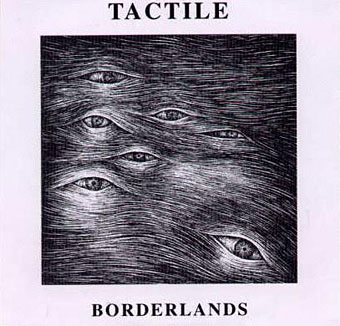
Borderlands (1999) by Tactile.

The House on the Borderland is the big favourite in this list, this album being a series of tracks by John Everall based on Hodgson’s novel. John Balance of Coil appears on the first track, Grief, reading the poem which opens the book.

Continue reading “Hodgsonian vibrations”

Weekend links 153

scarfolk.jpg

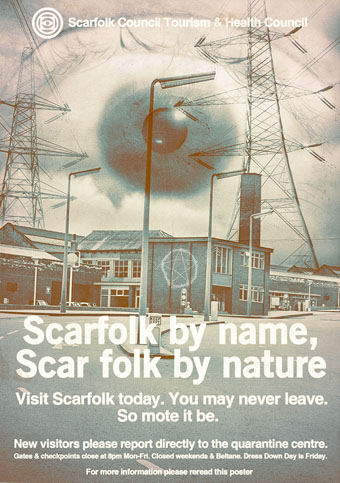
Scarfolk, as was noted here last month, is a home from home, especially if you grew up in the 1970s. The mayor of the rabies-afflicted town, Richard Littler, talked to Creative Review about his unheimlich design project.

Ensemble Pearl, an album stream of “cosmic psychedelic space-doom minimal drone soundscapes” by Atsuo, William Herzog, Eyvind Kang, Michio Kurihara, Stephen O’Malley and Timba Harris.

• At Dangerous Minds: Louise Huebner’s Seduction Through Witchcraft (1969), an album of occult instruction with an electronic soundtrack by Louis & Bebe Barron.

My apartment is teeming with unfinished books. They cover my desk, coffee table, and nightstand. They sit two rows deep on my bookshelves. There they remain, neglected, misunderstood, unappreciated, still with the last read page firmly marked with a piece of paper, a subscription card, or a proper bookmark: a reminder of my stagnation, my failure to engage.

Gabrielle at The Contextual Life on The Secret Lives of Unfinished Books.

• Hauntological mix of the week: Electronic Music For Schools by Pattern & Shape. Related: Pye Corner Audio live at Cafe OTO, March 2013.

• Tumblrs of the week: Des Hommes et des Chatons, Remarkably Retro, The Pop-Up Museum of Queer History, and Shit My Cats Read.

Icons: An exhibition of Kenneth Anger’s Hollywood memorabilia, and other material from his home, at Sprüth Magers, London.

hooray.jpg

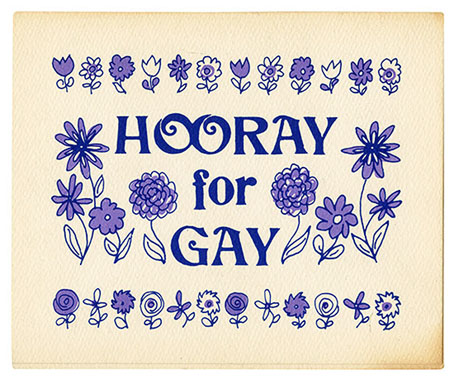
Hooray for Gay, an exhibition of pre-Stonewall images at Boo-Hooray, NYC.

The Servant, “a 60s masterwork that hides its homosexuality in the shadows”.

The Cosmic Bicycle, collages by Wilfried Sätty made into a short film.

• Photos of the derelict R Power Plant in Pennsylvania.

1913: The Year of Modernism

• RIP Richard Griffiths

Wildspot (2005) by Belbury Poly | Now Ends The Beginning (2011) by The Advisory Circle | Wildspot (2012) by The Advisory Circle | Now Ends The Beginning (2012) by Belbury Poly

Tarotism and Fergus Hall

gille.jpg

Gille Lettmann pictured in 1973 flourishing some of Fergus Hall’s Tarot cards. At the time Ms Lettmann was helping run partner Rolf-Ulrich Kaiser’s Kosmische Musik, Pilz and Ohr record labels, and thus oversaw the release of many fine albums—and a few dubious ones—before Kaiser’s empire imploded amid much bad feeling. It’s a fascinating saga, detailed at length here. Gille’s photo stood out for me in a week when I’ve been working on some new Tarot designs (about which more later) whilst listening to the latest Deutsche Elektronische Musik compilation from Soul Jazz Records which includes among its tracks a couple of Kosmische and Pilz recordings. Gille’s Tarot cards will have been a result of Kaiser’s most ambitious project, a double-disc concept album entitled Tarot (1973), and credited to Swiss artist Walter Wegmüller whose narration is backed by Ash Ra Tempel and members of Wallenstein. The album came in a lavish metallic silver box with a sheet of cut-out-and-keep Tarot trumps of Wegmüller’s own design, not the Fergus Hall cards Gille is holding. Wegmüller’s Major Arcana was expanded into a deck he calls the Gipsy Tarot. (I have the later CD box which included a complete deck of the Tarot cards.)

hall1.jpg

The Tarot of the Witches by Fergus Hall.

All of which gives me the opportunity to draw attention to Fergus Hall, an idiosyncratic Scottish artist who achieved worldwide prominence in 1973 when his Tarot designs were used on the cards seen in the James Bond film Live and Let Die. A complete deck called The Tarot of the Witches was later published as a spin-off from the film. I like his naive painting style which seemed a surprising choice for a blustering Bond movie; the production people could easily have used the Waite deck or something which suited the film’s vague Voodoo theme.

hall2.jpg

hall3.jpg

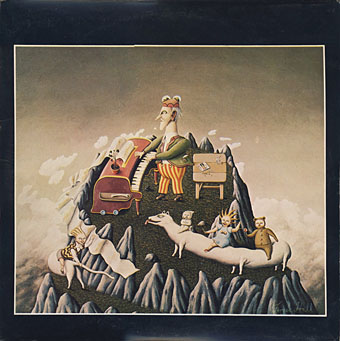
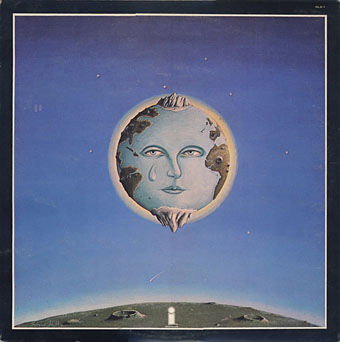
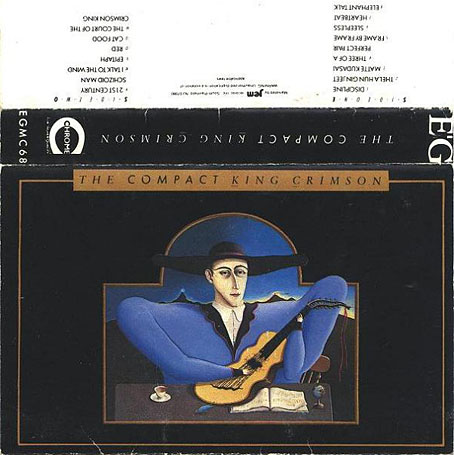
Robert Fripp liked Fergus Hall’s paintings enough to buy some of them. Two of these can be seen on the sleeve of the vinyl-only compilation A Young Person’s Guide to King Crimson (1975), while a third appeared a decade later on a King Crimson tape compilation. Despite this attention the artist’s only other major work is a book for children, Groundsel (1982), which features many more of his strange paintings. The compilations and the children’s book are all long out of print but decks of the Tarot of the Witches are still being published. As for Hall himself, his Wikipedia page says he’s now a Buddhist monk.

kc1.jpg

A Young Person’s Guide to King Crimson (front).

kc2.jpg

A Young Person’s Guide to King Crimson (back).

kc3.jpg

The Compact King Crimson (1986).

Elsewhere on { feuilleton }
The album covers archive

Previously on { feuilleton }
Giger’s Tarot
The Major Arcana by Jak Flash
The art of Pamela Colman Smith, 1878–1951
The Major Arcana