Weekend links 298

liu-wong.jpg

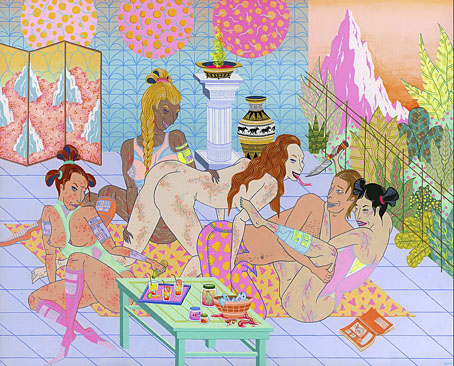
The Gathering (2015) by Kristen Liu-Wong.

• Tom of Finland’s house in Echo Park, Los Angeles, “is a trove of homoerotic masterpieces“. The house and its former owner are celebrated in Tom House, a book by Michael Reynolds with photos by Martyn Thompson. Related: Tom House exposed by Rizzoli.

• “Underlying the heightened nature of the films was a deep, questioning soulfulness related to literary antecedents coupled with a vision of cinema open to shifting levels of perception and fantasy.” David Thompson on Andrzej Żuławski.

• Memories of the Space Age: Photos by Roland Miller of the ruins of NASA’s old launch pads, bunkhouses and research facilities. A British equivalent (and a much more modest affair) is the Highdown Rocket Site on the Isle of Wight.

• Statues allegedly made for the John Huston film of The Maltese Falcon are among the most expensive props in cinema history even though there’s still dispute about their authenticity. Bryan Burrough investigates.

• Mixes of the week: The Solar Gate: Female Private Press New-Age Music – Vol.1 by Michael Tanner, and an “alchemical” Bowie selection by The Ephemeral Man.

• “What Does It Take To Be A ‘Bestselling Author’? $3 and 5 Minutes.” Brent Underwood on why Amazon ratings can’t be trusted.

Edward Gorey/Derek Lamb title sequences from the PBS/WGBH show Mystery! (1981).

• A Painter Possessed: Kate Kellaway on the occult abstractions of Hilma af Klint.

Invertebrate Harmonics: a new composition by Chris Watson.

• Frozen in time: Inside Bangkok’s first ever department store.

Roly Porter’s Favourite Space Records

• Space-Age Couple (1970) by Captain Beefheart & His Magic Band | Space Age Batchelor Pad Music (Mellow) (1993) by Stereolab | Space Age Ballad (2001) by Acid Mothers Temple & The Melting Paraiso U.F.O.

Weekend links 296

invisiblecreature.jpg

Mars (variant design): one of three new posters for NASA by Invisible Creature.

• “If the point of Sade’s work was to marry sexual frustration and release to the practice of interpersonal violence, he could confidently gaze out on the landscape of our popular culture and declare it a fait accompli.” Hussein Ibish on The United Sades of America.

• Gravitational Waves Exist: The Inside Story of How Scientists Finally Found Them by Nicola Twilley. Sean Carroll explains the importance of the discovery.

• Another This Heat interview: Bruce Tantum interrogates Charles Bullen and Charles Hayward about being a group ahead of their time.

The English word comes ultimately from Greek magike (in which the original Persian word is spliced with tekhne, “art”), while the Persian magos “one of the members of the learned and priestly class” ultimately derives from magush, “to be able, to have power”, from which we may also derive the word “machine”. So my social hierarchy is your magic, and my magic might be your craft—or even your machinery. My religion is your magic. Your religion is my fairy lore. Or your religions might be a mass of fakery and trickery and foolery. Hence in making magic into an intellectual discipline, I theorize based on my observations, which might not be mine but those of others, heritable observations. But because what I do looks very like empiricism, as I examine materials for the tricks or fooleries, or for the real alterations, checking my results against descriptions of previous experiments, what I do feels like science, feels like the template for Baconian empiricism and its great instauration.

Diane Purkiss reviewing The Book of Magic: From Antiquity to the Enlightenment, edited by Brian Copenhaver

• The Strange World Of…The Residents: Sean Kitching talks to The Residents’ resident artist, Homer Flynn.

• At Strange Flowers: film of Natalie Barney in 1962 reminiscing about Oscar Wilde and Marcel Proust.

• From Battleship Potemkin to Baker Street: Ian Christie on Sergei Eisenstein’s trip to London.

• Mixes of the week: Krautrock Mix by Tarotplane, and Mix #15 (Transversales) by Jon Brooks.

• From Rock en Stock (France, 1973): Can and Agitation Free in live performance.

• Twenty classic British folk-horror stories: a selection by Kai Roberts.

Immemory: a Flash version of Chris Marker’s CD-ROM.

Cronenberg Valentines

Static Gravity (1980) by Chrome | Zero Gravity (2001) by Monolake | Gravity (2013) by Roly Porter

Can esoterics

aumgn.jpg

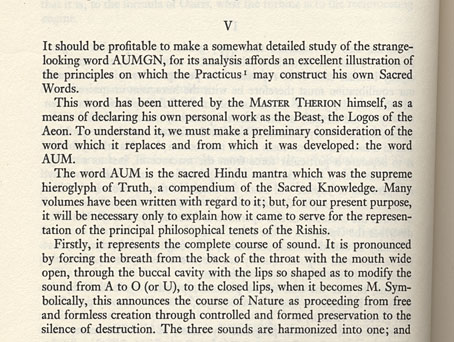
As usual, one thing leads to another. Most people who listen to Tago Mago (1971), the third album by Can, won’t be aware of the Aleister Crowley reference in the long improvisation that fills side three (track 5 on the CD). Aumgn was a spontaneous creation that includes one member of the band intoning an OM-like mantra while the other musicians clatter their way around the studio. The Crowley connection is in the unusual spelling of the title which is Crowley’s own amendment of the more familiar AUM. He explains the reasoning over several pages in Magick in Theory and Practice (1929), some of which involves the numerical values of the five letters. Not that this marks Can as Crowleyans but anyone unacquainted with Crowley’s augmented word would simply have used OM or AUM instead.

Update: I’ve been re-reading the book that came with the Can Box (1999), and came across this forgotten passage in Michael Karoli’s interview:

At the time I was very interested in magic spells, and Irmin knew of the spell “Aumgn” through me. But I had a completely different concept of what one could do with it, than to irreverently quote it in a piece of music. At the age of 21, I wouldn’t have dared to put this recklessly on an album. For me it was black magic. It was Aleister Crowley and all of that, and it gave me the creeps. I told Irmin to stop pronouncing magic spells in the room, but Irmin naturally overrode that with his arrogant grin.

futuredays.jpg

Design by Ingo Trauer & Richard J. Rudow.

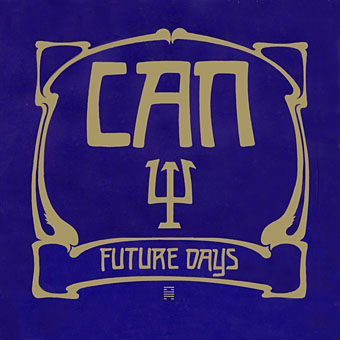
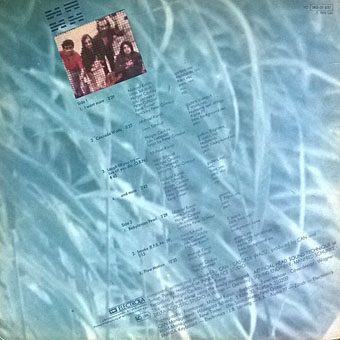
The fifth studio album, Future Days (1973) has another esoteric detail on the front and back of its elegant Art Nouveau sleeve: Hexagram 50 from the I Ching, translated in the Richard Wilhelm edition as Ting / The Cauldron. The same text has the judgement for Ting as “great good success”, and the album happens to be considered one of their best musically, although it was also the end of an era when vocalist Damo Suzuki left after its release. On a more mundane level, a cauldron is a container, as is a can.

There’s also the unexplained Greek letter in the centre of the sleeve: Psi is the 23rd letter of the Greek alphabet, and is commonly used as a symbol for psychology although it’s also used as a symbol in quantum mechanics. This last reference might be relevant given that the piece that ends their next album, Soon Over Babaluma (1974), is entitled Quantum Physics.

flowmotion.jpg

Design by Wagner Design Unit. Cover photos by Michael Karoli & Peter Hehner.

There are more I Ching hexagrams on the back of Flow Motion (1976), the group’s eighth album. Hexagram 29 is K’an / The Abysmal (Water) also known as “gorge” or “abyss”. Hexagram 59 is Huan / Dispersal (Dissolution). Taken together these could be interpreted as “flow motion” (and may well be the origin of the title—interviews with the group have seldom discussed these things) although they might also be seen as ominous signs for Can’s future. Flow Motion gave them a hit single in the UK (I Want More) but it’s also the last album that’s musically satisfying throughout. Can persevered for another two years (minus Holger Czukay) before disbanding in 1978. As to the esoterics, Rob Young is apparently writing a biography of the band so we may learn more about all of this when his book is published.

Previously on { feuilleton }
Can soundtracks
Can’s Lost Tapes

Aleister Crowley: Wandering The Waste revisited

ac1.jpg

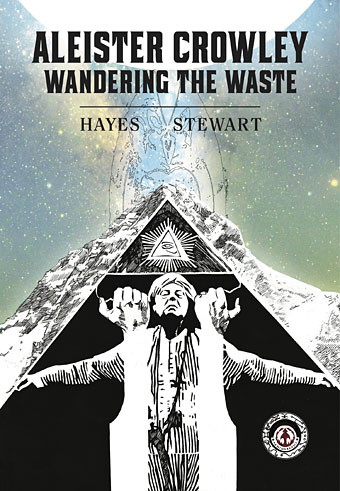
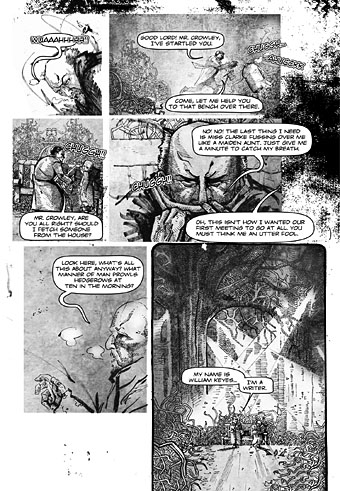
Martin Hayes was in touch this week with news of a reprint of his commendable comic-book biography of Aleister Crowley. Martin was the writer of Aleister Crowley: Wandering The Waste, and RH Stewart the artist. The first edition, which I reviewed in 2013, was a paperback whereas the new volume from Markosia will be a hardback with revised text and some new content:

Aleister Crowley: Wandering the Waste, the critically-acclaimed graphic novel by Martin Hayes, Roy Huteson Stewart, and Paul McLaren is re-launching at LSCC 2016. A meticulously researched exploration of the life of Aleister Crowley, with a foreword by renowned Crowley scholar Richard Kaczynski. This new edition has been revised and completely redesigned with a new cover and additional bonus content—fully annotated and complete with bibliography and rarities.

Aleister Crowley: Wandering the Waste is published by Markosia and will launch at London Super Comic Con in the Excel Centre on Saturday 20th of February, 2016.

Written by Martin Hayes, whose previous projects include the graphic novels Project Luna: 1947 and Abominable Glory, along with several serials for Aces Weekly. With art by Roy Huteson Stewart, who has illustrated for Vincent Price Presents and FutureQuake. Lettered by Paul McLaren. Aleister Crowley: Wandering the Waste is a meticulously researched, intricately illustrated autopsy on the life of the Great Beast. 140 pages.

Martin and Roy will be signing at the Markosia booth from 2–3pm on the Saturday of LSCC. Martin will be there from 11–12 on the Sunday.

ac2.jpg

Previously on { feuilleton }
Konx om Pax
Aleister Crowley: Wandering The Waste
Brush of Baphomet by Kenneth Anger
Rex Ingram’s The Magician
The Mysteries of Myra
Aleister Crowley on vinyl

Weekend links 294

napoleon.jpg

Painting by Alex Tavoularis.

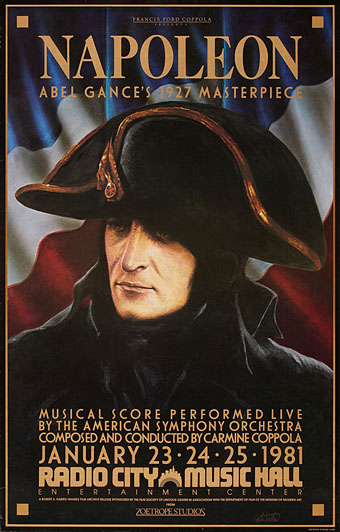
• There are silent films, and then there is Abel Gance’s Napoleon (1927), a five-and-a-half hour historical drama following the emperor’s life from boyhood to the invasion of Italy. The word “epic” is overused but Gance’s film demands the description: in addition to the recreation of huge battles and scenes from the French Revolution, cinema screening required three projectors for sequences which are either multi-screen or three times the width of the Academy ratio. The film was revived in the early 1980s after an extensive restoration by Kevin Brownlow, but Napoleon is still more talked about than seen so news of a forthcoming digital release by the BFI is very welcome indeed. The poster above is from this collection which includes more information about the film and its troubled history. Related: a trailer for a 2012 screening at the San Francisco Silent Film Festival.

• “His films broke with traditional production methods, having virtually no shooting script and capturing the freshness of their genesis.” RIP Jacques Rivette. In 1998 Frédéric Bonnaud talked to Rivette about the director’s cinematic likes and dislikes. Elsewhere, Jonathan Romney speculates that Rivette’s Céline and Julie Go Boating (1974) “might be the only film in which the story is dreamed by a passing cat”.

Strange Flowers‘ selects 16 books for (what’s left of) 2016. Stand-out for me is Aubrey Beardsley: A Catalogue Raisonné by Linda Gertner Zatlin which will be published in May. Two cased volumes, a total of 1104 pages, and a price tag of $300.

It’s a powerful trope, but it also risks trading one stigma for another: ‘‘Phobia’’ is now so embedded in our language that it’s easy to forget that it is a metaphor comparing bigots to the mentally ill. The comparison also has the effect of excusing those Americans—like certain presidential candidates in the 2016 race—who wield prejudices strategically. It’s not your fault if you get sick. But hating people is a choice.

Amanda Hess on how “-phobic” became a weapon in the identity wars

• Delving into the shadowy world of occult art: Priscilla Frank talks to Pam Grossman about her Language of the Birds exhibition. Related: “The occult never quite goes away,” says Kenneth Anger.

• “It was a magic day in our happy, young lives.” A proposal for a monument in Baltimore celebrating the final scene of John Waters’ Pink Flamingos.

• Mixes of the week: Wrap Up Warm Mix by Moon Wiring Club, Secret Thirteen Mix 175 by Inner8, and FACT mix 533 by Roly Porter.

• “He was less an architect than a Busby Berkeley with a penchant for Black Masses.” Jonathan Meades on Albert Speer.

• More film posters: Benjamin Lee on the compromises that have made contemporary posters “drab and uninspiring”.

• The vast and ghostly landscape of “Britain’s only desert”: photographs by Robert Walker.

Wyrd Daze, Lvl2 Issue 5, is free and brimming with the weird.

• The films of Michael Mann in 44 shots.

Laurie Anderson‘s favourite films.

Flamingo (1959) by Henry Mancini | Moon Occults The Sun (2006) by Espers | The Moon Occults Saturn at Dawn (2015) by Steve Moore