Undercurrents

undercurrents.jpg

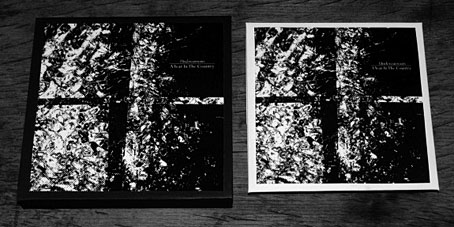
Undercurrent: a word whose meanings offer many worthwhile associations, from submerged currents of air and water to suppressed activities, and anything that moves unseen beneath the surface. Undercurrents is the latest release from A Year In The Country, artist and label, the latter having had a particularly busy year. The country happens to be the focus of the new release:

Undercurrents was partly inspired by living in the countryside for the first time since I was young, where because of the more exposed nature of rural life I found myself in closer contact with, more overtly affected by and able to directly observe the elements and nature than via life in the city.

This coincided with an interest in and exploration of an otherly take on pastoralism and creating the A Year In The Country project; of coming to know the land as a place of beauty, exploration and escape that you may well drift off into but where there is also a sometimes unsettled undercurrent and layering of history and culture.

I found myself drawn to areas of culture that draw from the landscape, the patterns beneath the plough, the pylons and amongst the edgelands and where they meet with the lost progressive futures, spectral histories and parallel worlds of what has come to be known as hauntology.

Undercurrents is an audio exploration and interweaving of these themes – a wandering amongst nature, electronic soundscapes, field recordings, the flow of water through and across the land and the flipside of bucolic dreams.

The electronic nature of these recordings contradicts the usual expectation that anything to do with the country—especially the English countryside—has to be presented in a folk idiom and with acoustic instruments. This adds further resonances to the theme, making me think of electric currents, dowsing maps and John Michell’s eccentric (to say the least) take on Alfred Watkins’ ley lines, which hauled Watkins’ idea of trade routes used by ancient Britons into a New-Age soup of cosmic energy, numerology and UFOs. Michell’s zone is a little more far out than A Year In The Country’s explorations (and already mapped on albums by Tim Blake, Steve Hillage and others), the sounds here being more restrained and allusive, as they ought to be for undercurrents. The atmospheres are closer to Xenis Emputae Travelling Band but without the esoteric pattern, Earth mysteries intuited but left unresolved.
stonehenge.jpg

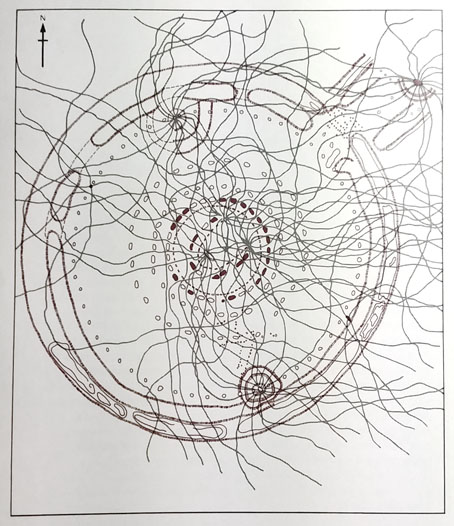
A map produced by dowsers showing alleged underground streams around Stonehenge. From The World Atlas of Mysteries (1978) by Francis Hitching.

Undercurrents will be released on 8th August in a range of monochrome formats, and is available to pre-order now.

Previously on { feuilleton }
From The Furthest Signals
The Restless Field
The Marks Upon The Land
The Forest / The Wald
The Quietened Bunker
Fractures

Weekend links 366

kashiki.jpg

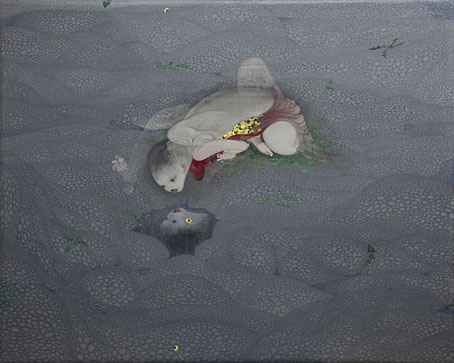
Dandelion (2009) by Tomoko Kashiki.

• “Standard Ebooks takes ebooks from sources like Project Gutenberg, formats and typesets them using a carefully designed and professional-grade style guide, lightly modernizes them, fully proofreads and corrects them, and then builds them to take advantage of state-of-the-art ereader and browser technology.”

Obscenity and the Arts, a previously unpublished essay by Anthony Burgess, will appear in book form later this year via Pariah Press.

• Mixes of the week: VF Mix 97: Talk Talk by The Last Dinosaur, and Secret Thirteen Mix 225 by Janek Schaefer.

Rub any two writers together and similarities will show. No two writers, however different, are completely different. Here’s a crucial instance: Lovecraft and Ballard both put architecture at the heart of their fiction, even though neither had the slightest formal training in the subject. And it is via this interest that the two intersect in an unexpected way. They are connected, through time and space, by that most humble of architectural events: the corner, the junction between two walls. What Lovecraft and Ballard did was to make the corner into a place of nightmares — and in doing so, they reveal its secret history.

Will Wiles in a long and rewarding essay, The Corner of Lovecraft and Ballard

• Dungeons Deep, Forests Dark – A beginner’s guide to Dungeon Synth by Daniel Pietersen.

Alex Ross on Joséphin Péladan, the Symbolists and the occult roots of Modernism.

• Cooling the Tube: engineering heat out of the [London] Underground by IanVisits.

Caroline on the mysteries of Pye Corner: Flames, poltergeists and bodysnatchers.

• The Saint of Sin City – Tony Kail Visits Las Vegas’ Santuario de la Santa Muerte.

• Photographs of Art Nouveau architecture by Keiichi Tahara.

• A stream of the new Porter Ricks album, Anguilla Electrica.

Jasper Sharp on 100 years of Japanese animation.

• At Dennis Cooper’s: 197 clocks.

On The Corner [Take 4] (1972) by Miles Davis | Corner Crew Dub (1976) by Augustus Pablo | Empty Avenues And Dark Corners (Pye Corner Audio Mix) (2013) by John Foxx and the Belbury Circle

Weekend links 364

focusgroup.jpg

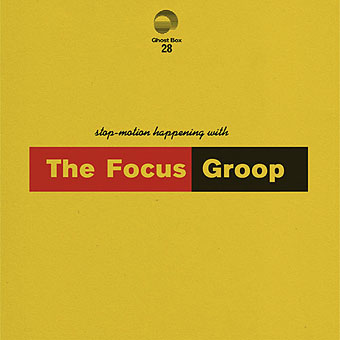
Stop-Motion Happening with The Focus Groop is a new album by The Focus Group (now a Groop, apparently, à la Stereolab), and the next release on the Ghost Box label. Design, as always, by Julian House.

• At Dennis Cooper’s: Sypha presents…Voyager en Soi-Même: a Tribute to JK Huysmans’ Là-Bas. Related: Henry Chapront’s illustrations for a 1912 edition of Huysmans’ novel.

• At the BFI: Graham Fuller on Penda’s Fen and the Romantic tradition in British film; Pamela Hutchinson and Alex Barrett choose 10 great German Expressionist films.

• The Provenance of Providence: Chris Mautner on the Lovecraftian comic series by Alan Moore and Jacen Burrows.

Luke Turner on Sunn O))): the ecstatic doom metallers turning rock concerts into “ritualist experiences”.

• At Dangerous Minds: The homoerotic “needleporn” art of Zachary Nutman.

Conor McGrady on the visual art of Nurse With Wound’s Steven Stapleton.

• Collage and Mechanism: Anita Siegel’s art for Doubleday Science Fiction.

• Mix of the week: My name is Legion: Chapter 1 by The Ephemeral Man.

ChrisMarker.org is asking for small donations to help keep it running.

• 1967 is the year pop came out, says Jon Savage.

Allen Ginsberg’s Howl goes online.

Groupmegroup (1981) by Liquid Liquid | If I Were A Groupie (1995) by Pizzicato Five | Group Four (1998) by Massive Attack

Weekend links 363

sommers.jpg

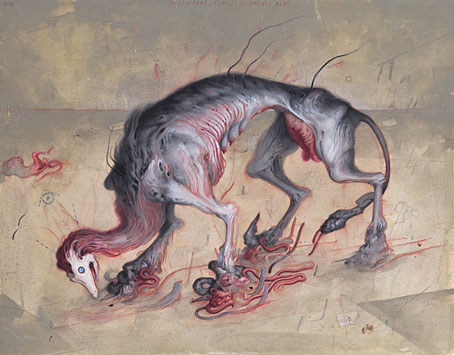
The Constant Drumbeat of Terrible News (no date) by Allison Sommers.

• Nadia Khomami on Gay UK: Love, Law and Liberty, an exhibition at the British Library. Related: Simon McCallum‘s potted history of LGB characters on British screens. Elsewhere: writer and philanthropist Chuck Forester on gay sex in the 1970s.

The Panic Fables: Mystic Teachings and Initiatory Tales by Alejandro Jodorowsky. Finally available in English, a collection of all the comic strips written and illustrated by Jodorowsky when he was living in Mexico in the 1960s.

• A trailer for the restored print of The Fabulous Baron Munchausen (1961) by Karel Zeman. Related: collage designs by Graphic Manipulator for a Japanese collection of Zeman’s films.

• “Whether divining ancient wisdoms or elevating the art of cold reading, Tarot is a form of therapy, much like psychoanalysis,” says James McConnachie.

James Reith on “the Icelandic publisher that only prints books during a full moon – then burns them”.

• Mixes of the week: Wire 400 Mix #6 by Emptyset, and Secret Thirteen Mix 223 by Constantine.

• Mud And Flame: Penda’s Fen re-examined by Matthew Harle and James Machin.

Tilda Swinton in a Leonora Carrington-inspired fashion shoot for i-D magazine.

• At Dennis Cooper’s: Spotlight on William Burroughs’ The Wild Boys.

Applied Ballardianism: A Theory of Nothing by Simon Sellars.

• At Dangerous Minds: The Dark Rift by Jim Jarmusch’s Sqürl.

French Underground Rock: 1967–1980; a Discogs list.

Suzanne Ciani‘s favourite albums.

Infinite artwork: Untitled, 2017

Rip, Rig And Panic (1965) by The Roland Kirk Quartet | Panic (1984) by Coil | Flash Of Panic (1994) by Axiom Ambient

Weekend links 362

yoshi47.jpg

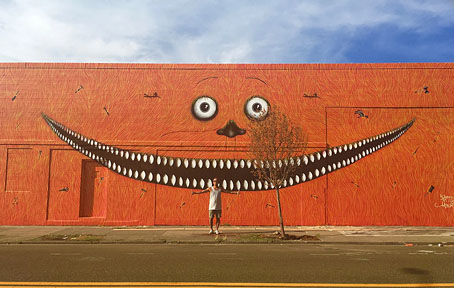
A mural for Forest For The Trees, 2016, by Yoshi47.

• “Who’s the real cunt?” Andrew O’Hagan on the Daily Mail‘s hypocrisies, Little England bigotries and omni-outrage in a review of Mail Men: The Unauthorised Story of the ‘Daily Mail’, the Paper that Divided and Conquered Britain by Adrian Addison.

Deutschlandspiegel 198/1971: a short film at the German Federal Archive which includes footage of Popol Vuh (still in their electronic phase) six minutes in.

• A meeting of remarkable minds: a live radio discussion between Annea Lockwood and Pauline Oliveros from December 1972.

The House In The Woods (aka Martin Jenkins of Pye Corner Audio) at Rare Air, Seattle, 14th May 2017.

• “Peaceful but not to be messed with.” Tony Naylor on how the bee came to symbolise Manchester.

• Mixes of the week: FACT Mix 602 by Deathprod, and Secret Thirteen Mix 222 by Yuji Kondo.

Emptyset and Mouse On Mars’s Jan St Werner on space, time and the evolution of sound.

• At Indiegogo, a funding call for Subotnick: Portrait of an Electronic Music Pioneer.

Shannon Taggart’s Camera Fantastica: an interview by Peter Bebergal.

Study finds mushrooms are the safest recreational drug.

Mary Anne Hobbs‘ favourite albums.

Bumble Bee Bolero (1957) by Harry Breuer | Bee Stings (1998) by Coil | The Bees Made Honey In The Lion’s Skull (2008) by Earth