Hipgnosis interview

hipgnosis1.jpg

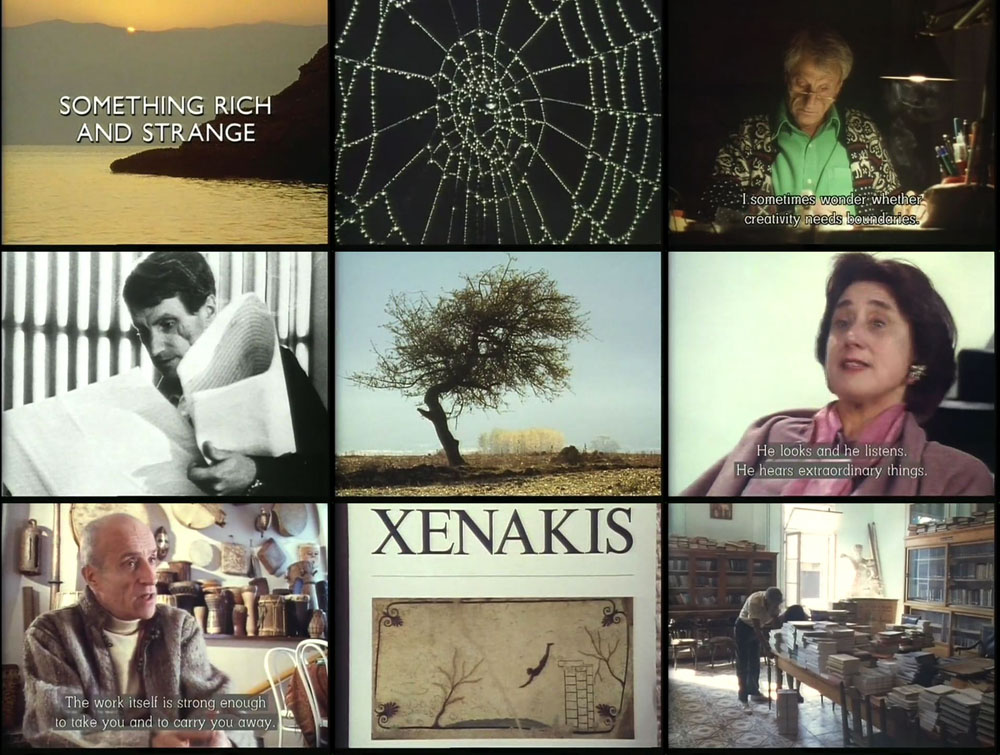
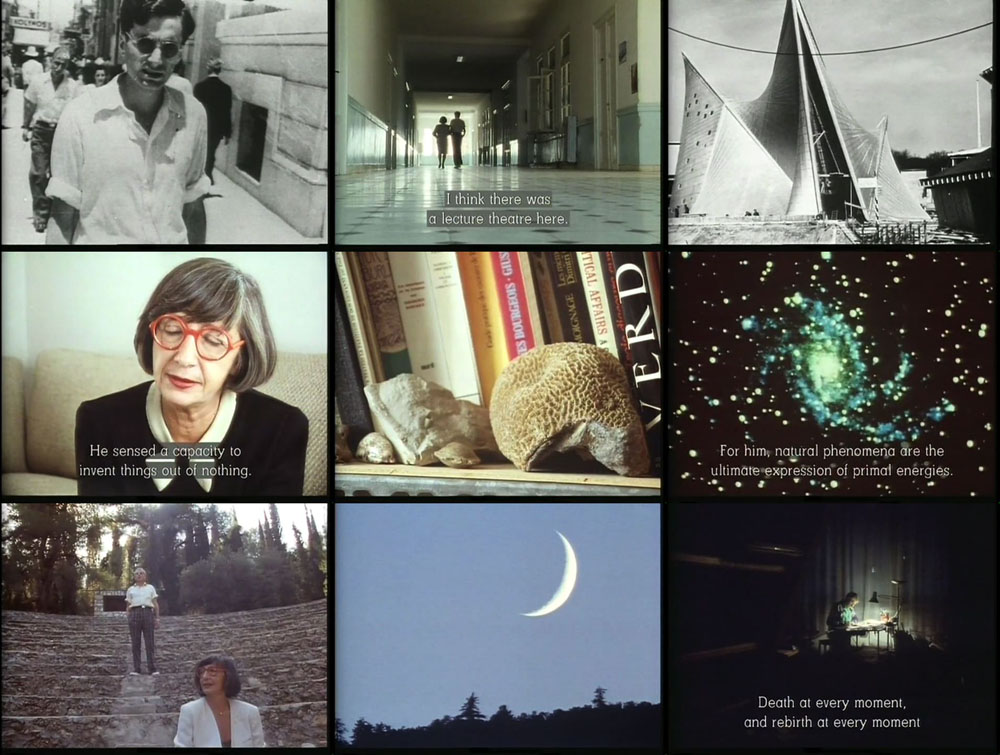
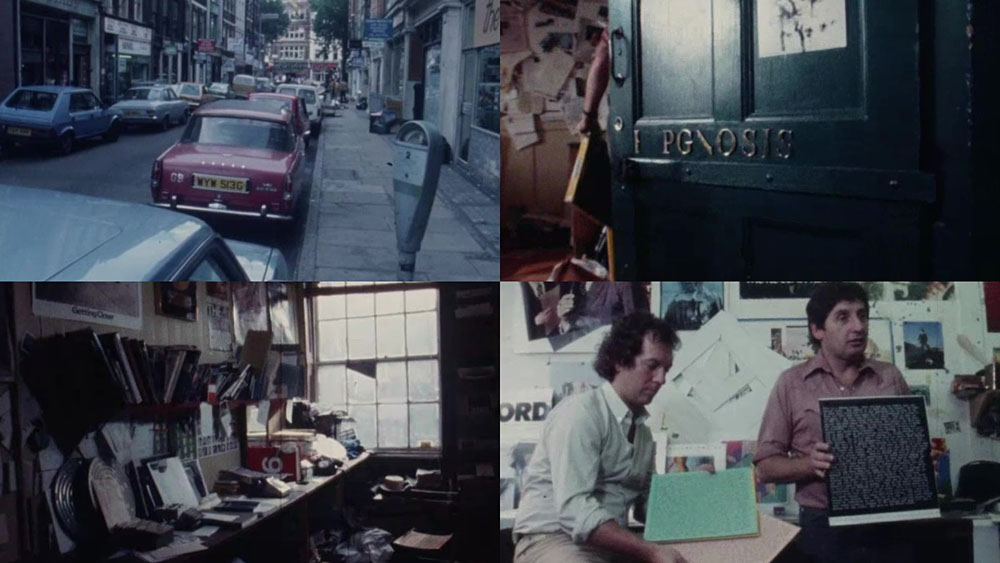
This is a frustratingly short piece of film—a mere 16 minutes—but it’s fascinating all the same for the brief views it gives inside the London studio of the Hipgnosis design partnership at the tail end of their golden decade, the 1970s. Being an occasional album cover designer as well as a minor Hipgnosis obsessive I like to see where so many of the team’s album covers originated. The two Hipgnosis founders, Aubrey Powell and Storm Thorgerson are both interviewed; the third member of the partnership, Peter Christopherson, is absent. The film is also undated but the discussion of the cover photo for Look Hear? by 10cc puts the year at around 1980. The views of the studio aren’t much different from the rather murky shots of the place in the first Hipgnosis book, An ABC of the Work of Hipgnosis: Walk Away René (1978), but the film gives a better sense of the dishevelled actuality: those stairs that Thorgerson runs up at the opening are the same ones that form the background to the melting Peter Gabriel photo used on the cover of Gabriel’s third album. Powell and Thorgerson are such engaging interviewees they really ought to have been profiled at greater length by the BBC or ITV, not given a few minutes to discuss some of their more notable creations by a small French film crew.
hipgnosis2.jpg

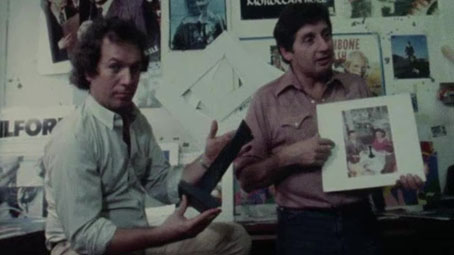
Aubrey Powell shows off the mystery object from the Presence album by Led Zeppelin.

The Hipgnosis studio occupied two floors of a building in Denmark Street, a minor thoroughfare off the Charing Cross Road that used to be a home to music publishers, rehearsal rooms and many of London’s musical instrument vendors. For a few years it was also home to the original and equally dishevelled Forbidden Planet book and comic shop, a place I first visited shortly after it opened in 1978. I always used to visit Forbidden Planet when I was in the capital but the Hipgnosis team had gone their separate ways by the time I found out they’d been based in the same street. Had I known about this earlier I probably would have wandered around for a while wondering which door led to their rooms. With its clutter and blithe disregard for client-flattering furnishings (the reception room, said Thorgerson, had nowhere to sit down) the studio was a long way from anybody’s idea of a well-appointed design business. The place reminds me of the offices occupied for many years by Savoy Books in Deansgate, Manchester: ancient, first-floor rooms whose better days were long past, with tools of the trade littering every surface, recent works-in-progress on the walls and old stickers peeling off the door. In Walk Away René, Thorgerson also admits that the studio lacked a toilet so they had to resort to pissing in a sink, a disgraceful expediency also shared by the Savoy office. In such places was art once made.

Previously on { feuilleton }
• Design as virus 16: Prisms
• Storm Thorgerson, 1944–2013
• Hipgnosis turkeys
• Peter Christopherson, 1955–2010
• Storm Thorgerson: Right But Wrong
Weekend links 610

durer.jpg

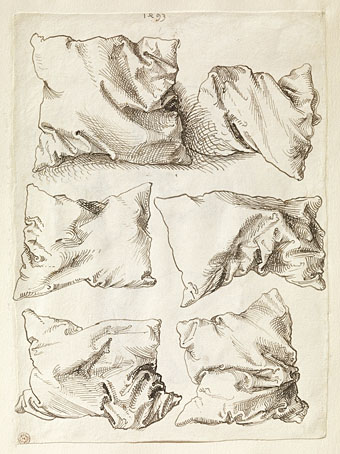
Pillow Studies (1493) by Albrecht Dürer.

• “Without ever writing a song, without ever fronting a group, Khan changed the face of British music.” Michael Hann talks to Morgan Khan about bringing New York Electro to the UK with his Streets Sounds label.

• James Balmont offers “an introduction to Japan’s visceral cyberpunk cinema in five cult films”. This reminds me that I’ve not seen Shinya Tsukamoto’s Tetsuo films for years. Time to reacquaint myself.

• At Aquarium Drunkard: 15-minutes of Alice Coltrane from 1970, talking about her music and performing with Pharoah Sanders et al. Amazing.

• Clive Hicks-Jenkins presents Beauty & Beast, an animated fairy tale made to showcase his toy theatre design.

• Carl Dreyer’s horror masterpiece, Vampyr (1932), is released on blu-ray by Eureka in May.

• At Wormwoodiana: Mark Valentine explores the mysteries of the Egg Language.

• DJ Food unearths paintings by Syd Mead for a Celcon Steel brochure, 1965.

• Jamie Sutcliffe enters The Strange World of Junji Ito.

• Mix of the week: Isolatedmix 117 by Refracted.

• Keeley Forsyth‘s favourite music.

• Electrocharge (1980) by Blackbeard | Electrodub1 (1980) by Chris Carter | Ano Electro (Andante) (1993) by The Sabres Of Paradise

Invisible Jukeboxes

jukeboxes.jpg

A collection of visible jukeboxes.

Invisible Jukebox is one of the longest running regular features in The Wire magazine, a cross between music interview and music quiz in which a different interviewee each month is asked to listen to a piece of music and identify the title and artist. The musical selections all have a link either to the interviewee’s career or the idiom in which they operate. Right or wrong answers aren’t really the point, the interest comes from the way in which each piece prompts a discussion about either the music itself or some related matter. For the past two years the magazine has kept the feature Covid-free by asking musician colleagues or partners to test each other.

A large cache of Wire back issues turned up recently at the Internet Archive, the bulk of which is a complete run from 1982 to 1999. In its early years the magazine was almost solely devoted to jazz, old and new, but it changed direction in 1991 when the agenda broadened and the magazine slowly transformed into the forum for new music it still is today. I only became a regular reader in 1994 so it’s good to find these older issues and be able to read some of the Invisible Jukeboxes that I’d missed. What follows is a list of all the interviewees from the first Invisible Jukebox in 1991 up to the end of 1999, together with links to the relevant issue. I hadn’t realised before that the feature wasn’t always as regular as it seemed, there are occasional gaps in the first few years. The earliest ones also asked the interviewee to give each piece of music a rating from one to five, a rather pointless request that was soon dropped. Despite the increasing diversity of the magazine’s contents the list below remains male-heavy to the end. This may reflect the dominance of men in the music business as a whole but I’d still liked to have seen the test applied to (for starters) Laurie Anderson, Sheila Chandra, Alice Coltrane, Sussan Deyhim, Pauline Oliveros, Annette Peacock…

1991
• Mark Springer
• John Harle
• Bob Stewart
• Kate & Anna McGarrigle
• Leon Redbone
• Bill Bruford
• Taj Mahal

1992
• Cabaret Voltaire
• Asley Maher
• James Moody
• Julian Lloyd Webber
• Steve Martland
• Ali Farka Toure
• Humphrey Lyttleton & Acker Bilk
• Billy Jenkins
• Neneh Cherry

1993
• Sonic Youth
• Don Pullen
• Coldcut
• Jack Bruce
• Lester Bowie
• Lydia Lunch
• Pee Wee Ellis
• Paul Weller
• Holger Czukay

Continue reading “Invisible Jukeboxes”

Weekend links 609

tv1.jpg

Cover of Tom Veitch Magazine #1 (1970).

• RIP Tom Veitch, a writer with whom I almost created a comic-book series in the 1990s. Things didn’t work out for a variety of reasons but we had some good conversations. All the news notices focus on his writing for comics, a career which ranged from angry, political strips with Greg Irons to typical franchise fare. But he had short stories published in New Worlds magazine when it was at its peak under Michael Moorcock’s editorship, and in Quark, a short-lived paperback magazine edited by Samuel Delany & Marilyn Hacker. Veitch was also among the first 35 contributors to John Giorno’s Dial-a-Poem service when it launched in 1968, part of a select group that included John Ashbery, William Burroughs and Allen Ginsberg. Related: An interview with Tom Veitch on William Burroughs at Reality Studio.

• “I won’t deny that I thought very much about a post punk influence on it. Everybody knows that I love post punk, but I didn’t want to copy anybody.” Robert Hampson talking to Jonathan Selzer about the return of Loop.

• “What Joyce and Eliot, Ulysses and The Waste Land, had in common was a showiness, an overt ambition as well as a magpie approach to literature as assemblage.” John Self on the year 1922, “literature’s year zero”.

• At Spoon & Tamago: All of Japan’s 47 prefectures captured in expressive typography.

• At Public Domain Review: Composition (1905) by Arthur Wesley Dow, a book for art students influenced by the example of Japanese prints.

• At Wormwoodiana: Mark Valentine on the unending attempts to solve The Mystery of Edwin Drood.

• Mixes of the week: Fact Mix 846 by Ehua, and Soylent Green – No Escape by The Ephemeral Man.

• At Dennis Cooper’s: Matthew Suss presents…Joseph Cornell Day.

• At Bandcamp: A guide to Alvin Lucier.

• Loop The Loop (1980) by Young Marble Giants | Q-Loop (1995) by Basic Channel | Loop-Loop (1996) by Michael Rother

Something Rich and Strange: The Life and Music of Iannis Xenakis

xenakis1.jpg

In the days before our present age of cultural plenitude, recordings by Greek composer Iannis Xenakis weren’t always easy to find. My haphazard introduction to contemporary composition came via record libraries and secondhand shops but even in these havens of obscurity discs of Xenakis music remained frustratingly elusive. Today I do own a few Xenakis CDs but there’s still a large portion of his work that I’ve yet to hear. After watching Mark Kidel’s documentary I’m persuaded once again that the gaps in my listening ought to be filled.

20th-century composition can be intimidating to the unitiated. Intimidating to listen to when so much of it is about finding new sounds, new structures, new modes of performance; and intimidating to read about when the discussion involves the analysis of very cerebral or technical conceptions. It can also disappoint when the results of those conceptions fail to hold the attention or excite the emotions. Many Xenakis compositions had their origin in mathematics or scientific theory but the musical results are consistently powerful and dramatic, even unnerving in a manner familiar from the works of Penderecki and Scelsi.

xenakis2.jpg

Mark Kidel’s hour-long documentary gives a small taste of the musical power and drama, especially in Roger Woodward’s performance of Eonta, a short composition for solo piano that’s astonishing to hear and see. Something Rich and Strange was made for the BBC in 1990 but it’s one I missed on its original broadcast so it’s good to find in a quality copy on the director’s Vimeo pages. The note there describes the film as a definitive portrait which sounds like a boast but there aren’t many Xenakis documentaries to choose from and it is very good, if a little too short for its subject. The film follows the composer and his wife, Françoise, as they journey to the Greek island of Spetsai where Xenakis spent several years at school in the 1930s. His reminiscences (or refusal of them) are interwoven with a sketch of his remarkable life which in its early years involved fighting with the Greek Resistance during the Second World War (and losing the sight in one eye as a result), fleeing to Paris in the post-war period after being condemned to death in absentia by the authoritarian Greek government, and working as an architect with Le Corbusier in the 1950s before deciding to devote the rest of his life to music. Kidel’s views of the Greek landscape wordlessly demonstrate the parallels between Xenakis’s music and the sounds of that landscape—goat bells, water lapping in a cave, a priest hammering a piece of wood—but we don’t hear much discussion of the composer’s musical evolution. His interest in electronic music, for example, is briefly mentioned but dismissed as being a direction he was unwilling to follow. But it was a direction he followed intermittently for at least a decade, and his electronic compositions would occupy several hours of your time if listened to in sequence. That’s the problem with trying to sum up a diverse career within the bite-sized limits of broadcast media; if the film was longer there would have been more time to address both the life and the details of the work. As it is, this is still an excellent introduction to a great composer.

Previously on { feuilleton }
• Vasarely, a film by Peter Kassovitz
• A playlist for Halloween: Orchestral and electro-acoustic