Weekend links 675

stuck.jpg

Lucifer (1890) by Franz Stuck.

• “I wanted to reclaim the word ‘psychonauts’ and take it back into the 19th century, where it describes not only renegades and rebels, but also establishment scientists, doctors, and pillars of the literary establishment. The word that was used at the time was “self-experimenter.” Mike Jay (again) talking to Steve Paulson about psychoactive research and the scientists who taste their own medicine.

• “How did countercultures commune before the internet?” asks J. Hoberman, reviewing Heads Together: Weed and the Underground Press Syndicate, 1965–1973 by David Jacob Kramer.

• At Public Domain Review: Medieval advice concerning the mythical Bonnacon: “the protection which its forehead denies this monster is furnished by its bowels”.

• DJ Food unearths posters and badges for The Kaleidoscope, a short-lived Los Angeles music venue of the late 60s.

• At Spoon & Tamago: Gaku Yamazaki has documented thousands of unusual road signs across Japan.

• New music: Psalm013: Unland by Pram of Dogs, and Intimaa by Bana Haffar.

• At Unquiet Things: A sneak peek from the forthcoming The Art of Fantasy.

• The Strange World of…Shirley Collins.

• At Dennis Cooper’s: Bruce Posner Day.

Kenneth Anger: a life in pictures.

• RIP Tina Turner.

Kaleidoscope (1967) by Kaleidoscope (UK) | Kaleidoscope (1984) by Rain Parade | Collideascope (1987) by The Dukes Of Stratosphear

Weekend links 674

moon.jpg

The Far Side of the Moon, as photographed by NASA’s Lunar Reconnaissance Orbiter.

• “It goes against centuries of traditional belief to accept that the moon is barren, that it is indifferent, that it is innocent of any role in monthly spikes in the crime rate or in the cycles of menstrual unreason. When telescopic observation had found nothing on the near side (Roger Boscovich had established by 1753 that it lacks even an atmosphere), the far side still remained a site for the projection of fantasies of a different, neighbouring world.” Justin EH Smith working his way towards a history of the dark side of the moon.

• “It shocks me that movies still lean in so hard to all these outmoded gay narrative tropes: coming out, coming of age; very identity-oriented representations of gay characters. It’s much easier to represent a gay boy who’s repressed in high school and comes out and makes friends. It’s very mainstream, and kind of played out.” Bruce LaBruce on cinematic trends in relation to his new film, a gay-porn take on Pasolini’s Teorema.

• At Cartoon Brew: Pavel Sannikau explains how he developed his own techniques of digital animation in order to create the ever-expanding Floor796.

• There’s always more Poe: Mysterium, Incubus et Terror, Poe-inspired music by a variety of artists, plus illustrations by John D. Chadwick.

• At Smithsonian Magazine: The results of a themed contest in the Close-Up Photographer of the Year Challenge.

• Mixes of the week: In Praise of the Saddest Chord at Ambientblog, and The Funky Eno Pts 2 & 3 by DJ Food.

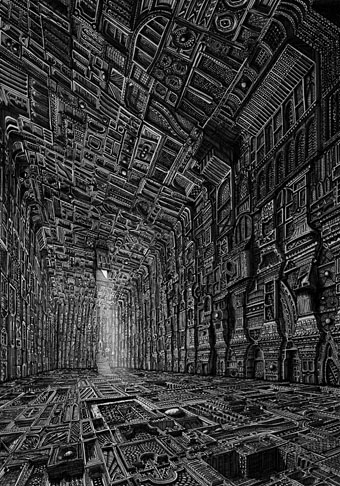
• Steven Heller talks to Hungarian artist István Orosz about his Escher-like drawings.

• At Unquiet Things: Caitlin McCormack’s ghostly chains of knotted memory.

• At Spoon & Tamago: Intricate and organic sculptures by ceramicist Eriko Inazaki.

• New music: Illumina by Call Super with Julia Holter.

Dark Side Of The Mushroom (1967) by The Chocolate Watchband | Dark Side Of The Star (1984) by Haruomi Hosono | On The Dark Side Of The Sun (live) (2003) by Helios Creed

California Images: Hi-fi for the Eyes

california1.jpg

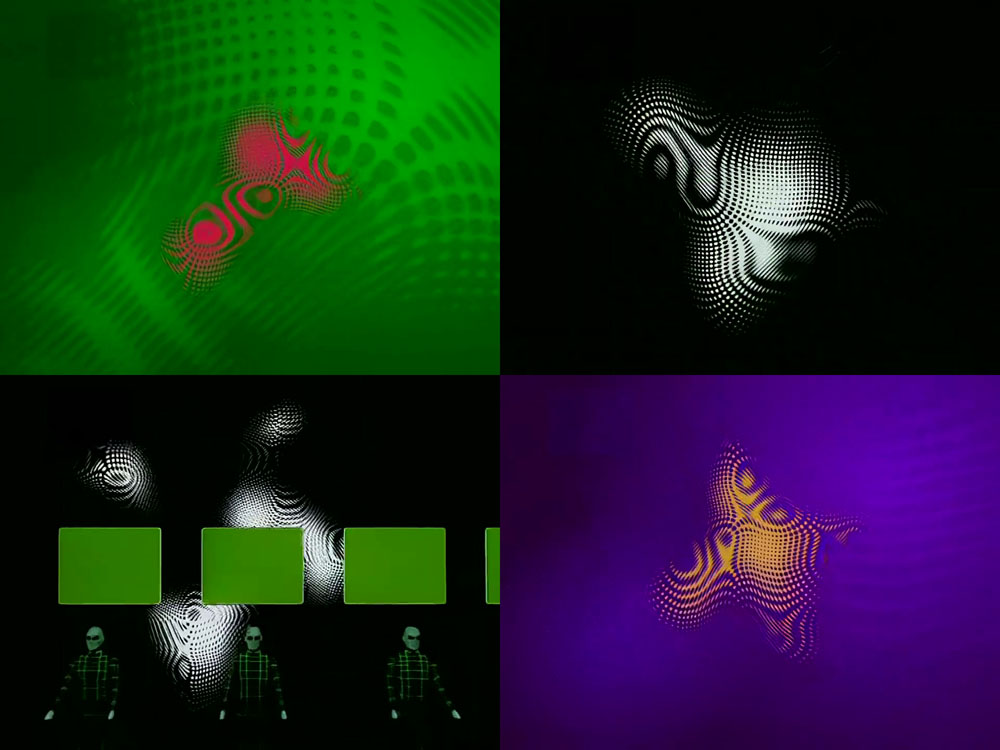
More psychedelia-adjacent visuals. California Images (1985) is another of those video collections that pairs computer graphics and animation with music that’s mostly electronic, 54 minutes of cathode exotica aimed at armchair psychonauts with video-recorders. This one was produced by Pilot Video, and is subtitled “Hi-fi for the Eyes”, the term “hi-fi” doing a lot of work there for an NTSC video cassette. The quality, artistic as well as technical, may not be first-rate but I’m still pleased to see videos like this being resurrected. As I’ve said before, nobody would want to reissue these compilations today, especially the present example whose contents don’t always work well together.

california2.jpg

All the pieces are presented as separate shorts rather than running into each other, with most of them being very simple computer animation or the products of video feedback plus video synthesis. On the visual side, many of them seem to have had the slit-scan lightshow from 2001: A Space Odyssey as their ideal, while their soundtracks are mostly New-Age synth burblings which range from the okay to the mediocre. Between these clips are a couple of other items which don’t suit the hippy-trippy mood at all, especially the one titled Speed, several minutes of nocturnal driving footage accompanied by harsh industrial rhythms more suited to the TV Wipeout collection released by Cabaret Voltaire in 1984. Oddest of all is the inclusion of Oskar Fischinger’s Allegretto (1936), a classic of abstract animation whose meticulous artistry puts to shame many of the other offerings. The collection ends with Ed Emshwiller’s Sunstone (1979), one of the earliest attempts to push computer animation beyond pattern-making. Emshwiller’s luminous faces look towards the digital future. I remain partial to analogue video effects, however, and Electric Light Voyage, aka Ascent 1, is still my favourite of all the TV lightshows I’ve seen to date. The search for more like this one will continue.

Elsewhere on { feuilleton }
The abstract cinema archive

Previously on { feuilleton }
Dazzle
The Gate to the Mind’s Eye

Weekend links 673

ay-o.jpg

Butterfly (1988) by Ay-O.

• “[Mike] Jay says there are notional lessons to be learned about what happens next from the characters who populate Psychonauts but says they would have been of greatest benefit to ‘the legislators, the bureaucrats, the statisticians and social scientists of the early 20th century who created the idea of “good drugs” and “bad drugs”.’ It is the framework of ‘drugs’ itself which needs to be dismantled.” John Doran discussing Psychonauts: Drugs and the Making of the Modern Mind with the book’s author, Mike Jay. The piece ends with an extract from the book itself. There’s another extract at Nautilus.

• “From the eerie electronics of Earth Calling through to the warp speed crescendo of Master Of The Universe, Space Ritual is like no other live record released at the time or since.” Joe Banks explores the events that led to the recording of the definitive Hawkwind album, Space Ritual, which was released 50 years ago this week.

• “You know, it’s actually all about life, and love, and death, and it’s sexy, and it’s funny and it’s not depressing.” Simon Fisher Turner talking to Emily Bick about Blue Now, a new live staging of Derek Jarman’s final film.

mm.jpg

From The Castaway Captives (1934): Mickey Mouse in a deep fix.  Ignore the signature, this one was written and illustrated by Floyd Gottfredson.

• New music: Kinder Der Sonne (From Komplizen) by Alva Noto, and S.W.I.M. by Gunnar Jónsson Collider.

• Mixes of the week: Isolatedmix 120 by Lord Of The Isles, and XLR8R Podcast 799 by KMRU.

• Take a radiating, immersive trip into Ay-O’s Happy Rainbow Hell.

• At Dennis Cooper’s: New Queer Cinema 1985–1998 Day.

• Steven Heller’s font of the month is Hopeless Diamond.

Rainbow Chaser (1968) by Nirvana | Rainbows (1969) by Rainbows | Rainbow (2006) by Boris With Michio Kurihara

Weekend links 672

heilbronn.jpg

Le Vice Errant (1902) by Vincent Lorant-Heilbronn.

• “So however surreal those cities, the invisible ones that he builds, they have their counterpart in the real. They always have their counterpart in visible cities.” Darran Anderson on Italo Calvino’s Invisible Cities.

• At Wormwoodiana: Mark Valentine on the centenary of The Riddle and Other Stories by Walter de la Mare, with special attention paid to The Vats, a very strange story.

• New music: A Bad Attitude by African Head Charge; Lapsed Gasps by Push For Night + Jon Mueller; Forevervoiceless by Brian Eno.

The strands of medicine, consciousness expansion, intoxication, addiction, and crime were tightly entangled in fin-de-siècle Paris, where ether and chloroform circulated among bohemian demi-mondaines alongside morphine, opium, cocaine, hashish, and wormwood-infused absinthe. These solvents were often carried in small glass vials and medicine bottles by the asthmatic, tubercular, and neurasthenic, added to patent tonics and syrups, and, on occasion, to cocktails: an ether-soaked strawberry floating in champagne produced a heady rush, the fruit preventing the volatile liquid from evaporating too quickly. Literary references to ether abounded, either as a signifier of decadence or as a literary prop to shift a realistic narrative into the landscape of dreams and symbols, where its dissociative qualities became a portal to strange mental states, psychological hauntings, uncanny doublings, and slippages of space and time.

Mike Jay on Jean Lorrain and the ether dreams of fin-de-siècle Paris

• At Aquarium Drunkard: Jim Jarmusch and Carter Logan talk about the recording of Silver Haze, their first album as Sqürl.

James Balmont offers a beginner’s guide to the films of Dario Argento.

• At Unquiet Things: Rachael Bridge’s Luminous, Technicolor Shadows.

• Mix of the week: A mix for The Wire by Erika.

Ether Ships (1978) by Steve Hillage | Ether (1998) by Redshift | Ether (2000) by Coil