Weekend links 508

lee-nova.jpg

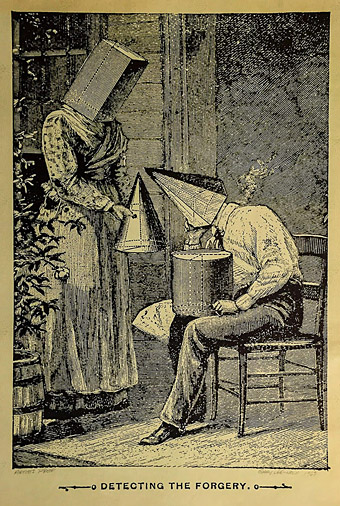
Detecting the Forgery (1967), a collage print by Gary Lee-Nova.

• Nigel Kneale’s adaptation of Susan Hill’s The Woman in Black was given a UK TV screening in 1989, followed by a brief video release after which it was buried for years, and subsequently overshadowed by the later (inferior) big-budget feature film. Network will be releasing the Kneale version on blu-ray in May. I wrote about the TV film a while ago.

• At the BFI: David Parkinson on 10 essential films featuring the late Max von Sydow, a welcome riposte to obituaries that headlined the often mediocre Hollywood fare that Von Sydow elevated with his minor roles. And at the same site, John Berra on where to begin with the martial arts films of King Hu.

• “Enthusiasts Archive, an artistic project by Neil Cummings and Marysia Lewandowska, is the result of extensive research amongst the remnants of amateur film clubs in Poland under socialism. It is a critical archive of amateur films found, restored and made available online.”

Stephen Calloway, co-curator of the Tate Britain Aubrey Beardsley exhibition, and drag performer Holly James Johnston sit down to tea to discuss the “dos and don’ts” of dandyism according to the artist.

• Mutinous Jester: The Collage Novels of Akbar Del Piombo by Gregory Stephenson. Related: Fuzz Against Junk: The Saga of the Narcotics Brigade (1959) by Akbar Del Piombo.

• Michael Richey on chindogu, the useless inventions of Kenji Kawakami.

• From farting to fornication: John Boardley on early print censorship.

Douglas A. Anderson on a case of plagiarism in Weird Tales.

• Mix of the week: mr.K’s Soundstripe vol 3 by radioShirley.

How To Get To Spring is a new album by Jon Brooks.

Rufus Wainwright‘s favourite music.

• At Dennis Cooper’s: Occultists.

Spring Rounds From The Rite Of Spring (1975) by Alice Coltrane | Springlight Rite (1981) by Irmin Schmidt & Bruno Spoerri | Spring Returns (1999) by Isao Tomita
Weekend links 505

brown.jpg

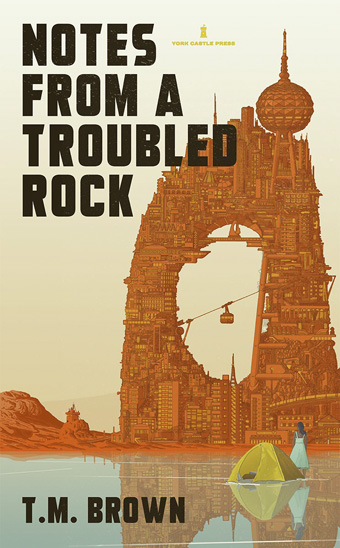
An imaginary book cover by Toby Melville-Brown.

• At the Internet Archive (for a change): Directory 1979, a collection of John Cooper Clarke’s poetry designed by Barney Bubbles; 25 issues of Wrapped in Plastic, the magazine devoted to all things David Lynch; and Cinefantastique, 1970–2002, the magazine about special effects in cinema whose making-of articles were often the first such analyses published anywhere. No contents list for the latter, unfortunately, but the covers shown here give an idea of the main features.

• “Physicist Andreas Schinner recounted a rumor that the Voynich manuscript can be ‘pure poison’ for a scholarly career, because when studying the manuscript there’s ‘always an easy option to make a ridiculous mistake.'” Jillian Foley on the strange quest to decipher the Voynich manuscript.

• At the BFI: Stephen Puddicombe examines six mysterious paintings on film, and Anna Bogutskaya selects ten examples of Lovecraftian cinema. Regarding the latter, I deplore the omission of Huan Vu’s Die Farbe (2011).

• In The Driver’s Seat: Neil Fox on the demented fun of Nicolas Winding Refn’s streaming site for cinematic obscurities, ByNWR.

• “Feed your head”: Akim Reinhardt on the progress of a White Rabbit from Charles Lutwidge Dodgson’s novel to Grace Slick’s song.

• Mixes of the week: Marshland: The Andrew Weatherall Mix, and Music’s Not For Everyone, hours of Weatherall mixes at NTS.

Borderland, an album of music by Fordell Research Unit based on The House on the Borderland by William Hope Hodgson.

• At Dangerous Minds: Thirteen-year-old Mariangela and her adventurous pop album, produced by Vangelis, 1975.

• Heavy Metal, Year One: Kory Grow on the inside story of Black Sabbath’s groundbreaking debut.

• “Theire Soe Admirable Herbe”: How the English Found Cannabis by Benjamin Breen.

Derek Jarman and friends in Dungeness: unseen pictures.

Closing periods at Flickr.

Heavy Rock (1976) by Sound Dimension | Heavy Denim (1994) by Stereolab | Heavy Soul (2002) by The Black Keys

Weekend links 499

konoike.jpg

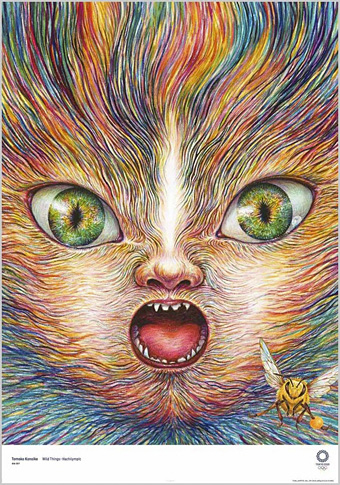
Wild Things – Hachilympic, a poster by Tomoko Konoike for the Tokyo 2020 Olympics.

• Hidden Jewels in ‘The Garden of Orchids’: Steve Toase on Der Orchideengarten (1919–1921), the German magazine of fantastic art and literature. Since the article doesn’t mention it, I’ll note again that the first Anglophone appraisal of the magazine (and also the place where it was drawn to the attention of myself and 50 Watts) was in Franz Rottensteiner’s The Fantasy Book (Thames & Hudson/Collier, 1978).

• “In its furtive, sotto-voce way, Gorey’s work is in conversation with gay history, gay literary influences, and, now and then, the gay-straight tensions of his time.” Mark Dery on the attempts by Edward Gorey’s readers and critics to ignore the obvious signs of a personal sexuality in his work.

• The Apotheosis of the Grotesque: illustrator Sidney Sime interviewed by Arthur H. Lawrence in The Idler, January 1898.

Goff would experiment with form, material, structure and ornament to almost absurd degrees. Materials he used in his buildings included aviation parts, goose feathers, oil rig equipment, orange artificial turf (on the roof), lumps of coal, and any kind of glass he could get his hands on. His 1948 Ledbetter House, also in Oklahoma, features a recurring motif of vertical lines of diamond-shaped glass studs set into doors and columns. In fact they are dime-store glass ashtrays.

Steve Rose on the restoration of “outsider architect” Bruce Goff

• At the BFI: Adam Scovell on where to begin with Delphine Seyrig; Kat Ellinger on giving Fellini’s later films their due; and Matthew Thrift on 10 great Acid Westerns.

• RIP Ivan Passer and Neil Peart. A reminder that John Patterson described Passer’s Cutter’s Way as a cinematic masterpiece. So it is.

Geeta Dayal on musician/composer Arthur Russell and yet another posthumous release.

Haunted And Known, a new recording by Six Organs Of Admittance.

• At Dennis Cooper’s: Hidden.

2112 (1976) by Rush | Xanadu (1977) by Rush | La Villa Strangiato (1978) by Rush

Illustrating Zothique

zothique00.jpg

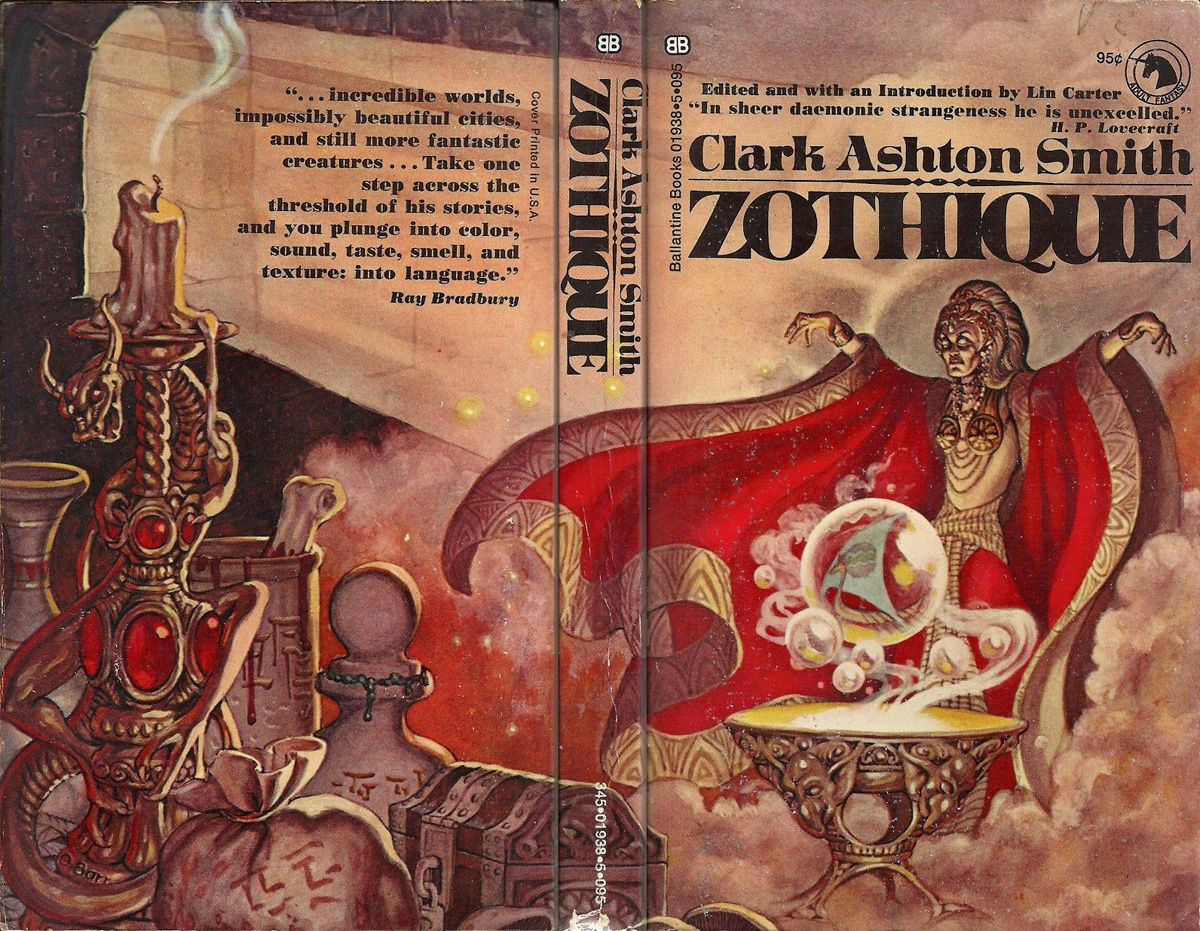
Cover art by George Barr, 1970.

A few years ago I wrote a short piece about Virgil Finlay’s illustrations for a Zothique story by Clark Ashton Smith, The Garden of Adompha, so this post may be regarded as a more substantial sequel. If Smith remains something of a cult author then Zothique is the pre-eminent cult creation from his career as a writer of weird fiction. Most of Smith’s stories can be grouped together according to their location: Atlantis, Hyperborea, Averoigne in medieval France, the planet Mars, and so on. Zothique was a more original conception than his other worlds, being the last continent on Earth in the final years of the planet, an idea which had precedents in earlier novels such as William Hope Hodgson’s The Night Land but which hadn’t been used before as a setting for a cycle of stories. The distant future suggests science fiction but, as with the Zothique-influenced Dying Earth of Jack Vance, science and technology is long-forgotten and sorcery rules the day. The poetry that Smith wrote before he took to writing short stories had a distinctly Decadent quality—”like a verbal Gustave Moreau painting“—and Zothique is a richly Decadent world, with the entire planet in a state of decay along with its barbarous, demon-worshipping peoples.

zothique01.jpg

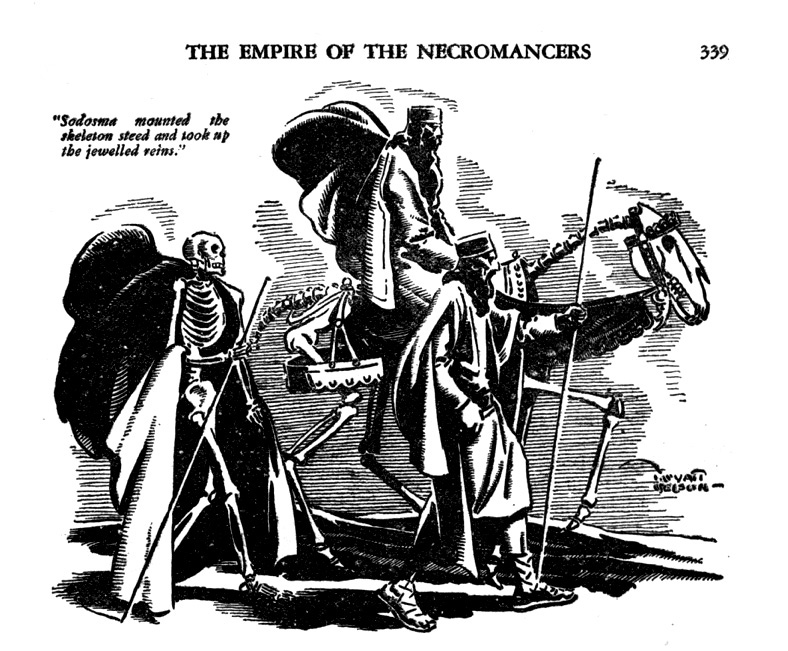
Weird Tales, September 1932. Art by T. Wyatt Nelson.

All the Zothique stories had their first printings in Weird Tales, a magazine that ran illustrations with most contributions, but unless you’re a pulp collector many of the illustrations have been difficult to see until very recently. One of the pleasures of looking through fiction magazines is seeing how their stories might have been illustrated when they were first published. Popular tales eventually find their way into book collections but their illustrations tend to be marooned in the titles where they first appeared unless the artist is of sufficient merit to warrant a collection of their own.

zothique02.jpg

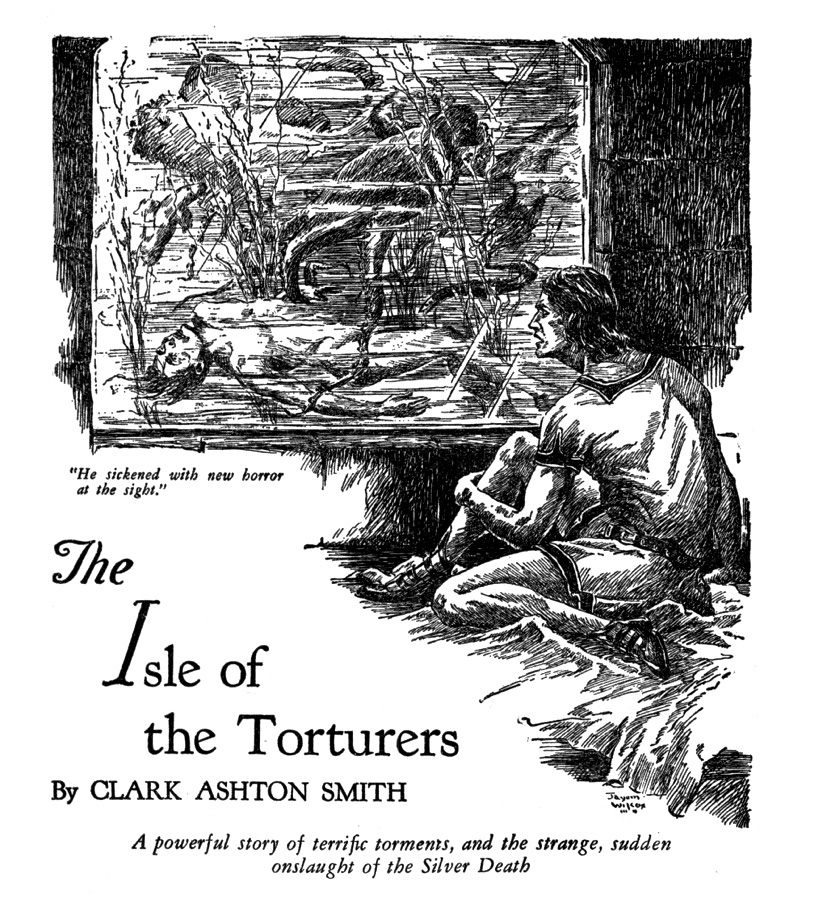
Weird Tales, March 1933. Art by Jayem Wilcox.

The examples here are all from recent uploads at the Internet Archive which now has a complete run of Weird Tales from 1923 to 1954. The illustrations also run in order of publication with links to the relevant issues, although I agree with Lin Carter’s ordering of the stories. Smith never organised them himself, and the later reprints from Arkham House and others tend to scatter them through separate volumes. When Lin Carter edited the Zothique collection in 1970 he put the stories into an order that follows the very loose chronology running through the cycle.

zothique06.jpg

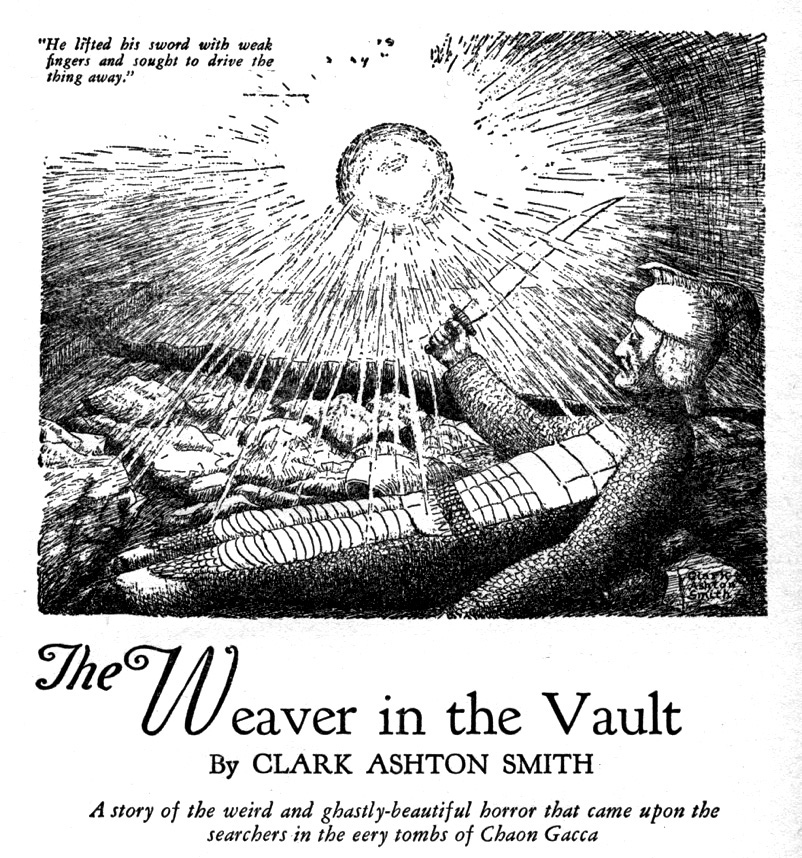
Weird Tales, January 1934. Art by Clark Ashton Smith.

One surprise of this search was discovering that Smith himself had provided illustrations for several of the stories. Some Smith enthusiasts like his drawings and paintings but I’m afraid I’m not among them, his sculpture work is better. It’s doubtful that these would have been printed at all if they weren’t the work of the author.

Continue reading “Illustrating Zothique”

Weekend links 498

mead.jpg

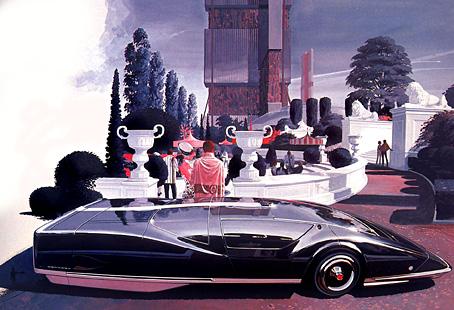
The Sentinel 280, a car design by Syd Mead from 1964.

• “Boris Dolgov did not exist. The man who bore that name may have existed, but there never was a man in the United States with that name until 1956, too late for Weird Tales.” Teller of Weird Tales on the mysterious identity of a magazine artist.

• Saying goodbye to 2019 also meant saying farewell to Vaughan Oliver, Neil Innes and Syd Mead. Related: Vaughan Oliver at Discogs; I’m The Urban Spaceman; a look back at Syd Mead’s vehicle designs.

Lanre Bakare on how ambient music became cool. (Again. This begs the question of when it became uncool, especially when a ten-year-old Brian Eno piece about “the death of uncool” is being quoted.)

Westerners interpreted the peyote experience very differently from the practitioners of the peyote religion, where the focus was “ritual, song and prayer, and to dissect one’s private sensations was to miss the point”. Writers such as Havelock Ellis, who published an essay on his peyote experiences in the Lancet in 1897 (it’s likely that he also administered the substance to his friends W.B. Yeats and Arthur Symons), instead tended to focus on its visual effects. Ellis described “the brilliance, delicacy and variety of the colours” and “their lovely and various textures”. Peyote reached Europe in tandem with the X-ray, cinema and electric lights, Jay notes, and “nothing delighted the eye of the mescal eater so much as the new electrical sublime”.

Emily Witt reviewing Mescaline: A Global History of the First Psychedelic by Mike Jay

Peter Bradshaw takes on the thankless task of ranking Federico Fellini’s feature films.

Geoff Manaugh on when Russia and America coöperated to avert a Y2K apocalypse.

• “Music is an ideal medium for interstellar communication,” says Daniel Oberhaus.

Keith Allison on Karel Zeman, a creator of remarkable cinematic fantasies.

•  Japanese Designer New Year’s Cards of 2020.

• At Dennis Cooper’s: Vera Chytilová Day.

2020 in public domain.

Sentinel (1992) by Mike Oldfield | Sentinels (2001) by Cyclobe | Sentinel (2004) by Transglobal Underground