Weekend links 199

cordal.jpg

Follow the Leader (London, 2011) by Isaac Cordal.

• “Brutalism is the decor of dystopian films, literature and comics, just as gothic is for horror.” Jonathan Meades‘ A-Z of brutalism.

Vitaly Shevchenko on the urban explorers of the ex-USSR. Related: Photos by Vitaliy Raskalov from the top of the Shanghai Tower.

Joe Banks reviews the throbbing, hissing, minatory pulses of the Black Mill Tapes 1–4 by Pye Corner Audio.

Walter Benjamin is the only one among the commentators who attempts to pin down the anonymous, evanescent quality of Walser’s characters. They come, he says, “from insanity and nowhere else. They are figures who have left madness behind them, and this is why they are marked by such a consistently heartrending, inhuman superficiality. If we were to attempt to sum up in a single phrase the delightful yet also uncanny element in them, we would have to say: they have all been healed.” Nabokov surely had something similar in mind when he said of the fickle souls who roam Nikolai Gogol’s books that here we have to do with a tribe of harmless madmen, who will not be prevented by anything in the world from plowing their own eccentric furrow.

Le Promeneur Solitaire: WG Sebald on Robert Walser

Drink The New Wine, an album by Kris Force, Anni Hogan, Jarboe, Zoe Keating and Meredith Yayanos.

• At 50 Watts: Illustrations by Fortuné Méaulle for Alphabet des Insectes by Leon Becker.

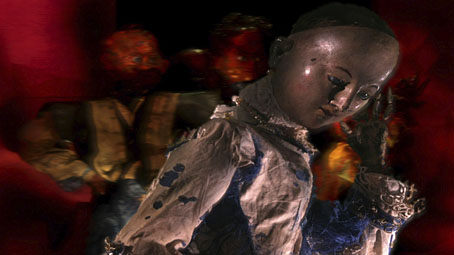
Lawrence Gordon Clark, Master of Ghostly Horror. An interview by John D’Amico.

• Chapel Perilous: Notes From The New York Occult Revival by Don Jolly.

• Mix of the week: Secret Thirteen Mix 107 by Ernestas Sadau.

• An Occult History of the Television Set by Geoff Manaugh.

• Was Ist Das? The Krautrock Album Database.

• First dérive of the year by Christina Scholz.

John Waters’ Youth Manifesto.

Gardens of Earthly Delights

Psychedelic Folkloristic

Water Music I / Here Comes The Flood / Water Music II (1979) by Robert Fripp & Peter Gabriel | After The Flood (1991) by Talk Talk | Flood (1997) by Jocelyn Pook

Seward/Howard

burroughssphinx.jpg

William Burroughs, New York, 1953. Photo by Allen Ginsberg.

Lonely lemur calls whispered in the walls of silent obsidian temples in a land of black lagoons, the ancient rotting kingdom of Jupiter – smelling the black berry smoke drifting through huge spiderwebs in ruined courtyards under eternal moonlight – ghost hands at the paneless windows weaving memories of blood and war in stone shapes – A host of dead warriors stand at petrified statues in vast charred black plains – Silent ebony eyes turned toward a horizon of always, waiting with a patience born of a million years, for the dawn that never rises – Thousands of voices muttered the beating of his heart – gurgling sounds from soaring lungs trailing the neon ghost writing – Lykin lay gasping in the embrace can only be reached through channels running to naked photographic process – molded by absent memory, by vibrating focus scalpel of the fishboy gently in a series of positions running delicious cold fingers “Stand here – Turn around – Bend”

The Ticket that Exploded (1962)

William Burroughs always talked favourably of Ernest Hemingway, and the famously spare style of Hemingway’s prose is evidently a style he sought himself, especially in the later works where there’s less of an emphasis on linguistic pyrotechnics. Something that always strikes me when I return to Burroughs’s earlier novels is the quality of passages like the one above which is a long way from the Hemingway style. What’s even more noticeable—and this is something which attracted me to Burroughs’s work from the outset—is the degree to which some of these passages are reminiscent of HP Lovecraft. In the case of the example above, taken from The Black Meat chapter of The Ticket that Exploded, some of this may be the work of Michael Portman who Burroughs credits as co-writer. What Portman contributed to The Black Meat and another chapter of that novel I’ve never discovered but there are plenty of other examples by Burroughs alone to show that he wasn’t incapable of this himself. The Ticket that Exploded was the first Burroughs book I read, and part of the shock and fascination came from encountering a recognisable Weird Tales-style atmosphere wrenched into inexplicable and thoroughly alien territory.

hpl.jpg

Frank Belknap Long and HP Lovecraft, New York, 1931. Photo by WB Talman.

There are others connections beyond literary style. When the Simon Necronomicon was published in 1977 Burroughs was asked to provide a blurb for the book. He wasn’t as effusive as the publishers might have hoped but the dubious volume was still advertised with his recommendation:

Let the secrets of the ages be revealed. The publication of the Necronomicon may well be a landmark in the liberation of the human spirit.

If it wasn’t for this then the extraordinary Invocation which opens Cities of the Red Night (1981) would have been diminished. Among the other “gods of dispersal and emptiness” whose names are called, Burroughs mentions “Kutulu, the Sleeping Serpent who cannot be summoned”, and “the Great Old One”, among a number of the usual Mayan gods, and several Sumerian deities whose descriptions (as with Kutulu) are taken from the pages of the Simon Necronomicon. It’s impossible to imagine Saul Bellow or John Updike opening a novel this way, just as it’s impossible to imagine many genre writers wandering into the areas that Burroughs explores elsewhere in that novel. This is one reason why Burroughs (and JG Ballard) were included in DM Mitchell’s The Starry Wisdom anthology in 1994, an attempt to expand the acceptable boundaries of Lovecraftian fiction, and also wilfully trample the fences that separate the genre and literary camps. I campaigned at the time for The Black Meat chapter to be included but Dave was set on Wind Die, You Die, We Die from Exterminator! (1973), a lesser piece although in the end it didn’t seem out of place in the book as a whole.

Elsewhere on { feuilleton }
The Lovecraft archive
The William Burroughs archive

Polypodes

jianfu.jpg

Sepia (no date) by Gao Jianfu.

Quelquefois, dans une nuit d’orage, pendant que des légions de poulpes ailés, ressemblant de loin à des corbeaux, planent au-dessus des nuages, en se dirigeant d’une rame raide vers les cités des humains, avec la mission de les avertir de changer de conduite, le caillou, à l’œil sombre, voit deux êtres passer à la lueur de l’éclair, l’un derrière l’autre; et, essuyant une furtive larme de compassion, qui coule de sa paupière glacée, il s’écrie: «Certes, il le mérite; et ce n’est que justice.» Après avoir dit cela, il se replace dans son attitude farouche, et continue de regarder, avec un tremblement nerveux, la chasse à l’homme, et les grandes lèvres du vagin d’ombre, d’où découlent, sans cesse, comme un fleuve, d’immenses spermatozoïdes ténébreux qui prennent leur essor dans l’éther lugubre, en cachant, avec le vaste déploiement de leurs ailes de chauve-souris, la nature entière, et les légions solitaires de poulpes, devenues mornes à l’aspect de ces fulgurations sourdes et inexprimables.

Les Chants de Maldoror (1869) by the Comte de Lautréamont

maldoror.jpg

Sometimes on a stormy night while legions of winged squids (at a distance resembling crows) float above the clouds and scud stiffly towards the cities of the humans, their mission to warn men to change their ways—the gloomy-eyed pebble perceives amid flashes of lightning two beings pass by, one behind the other, and, wiping away a furtive tear of compassion that trickles from its frozen eye, cries: “Certainly he deserves it; it’s only justice.” Having spoken thus it reverts to its timid pose and trembling nervously, continues to watch the manhunt and the vast lips of the vagina of darkness whence flow incessantly, like a river, immense shadowy spermatozoa that take flight into the dismal aether, the vast spread of their bat’s wings obscuring the whole of nature and the lonely legions of squids—grown downcast viewing these ineffable and muffled fulgurations.

Translation by Alexis Lykiard, 1970

pennington-cthulhu.jpg

The Mask of Cthulhu, 1976 paperback reprint. Cover art by Bruce Pennington.

Above these apparent hieroglyphics was a figure of evidently pictorial intent, though its impressionistic execution forbade a very clear idea of its nature. It seemed to be a sort of monster, or symbol representing a monster, of a form which only a diseased fancy could conceive. If I say that my somewhat extravagant imagination yielded simultaneous pictures of an octopus, a dragon, and a human caricature, I shall not be unfaithful to the spirit of the thing. A pulpy, tentacled head surmounted a grotesque and scaly body with rudimentary wings; but it was the general outline of the whole which made it most shockingly frightful. Behind the figure was a vague suggestion of a Cyclopean architectural background.

The Call of Cthulhu (1928) by HP Lovecraft

Previously on { feuilleton }
Ulysses versus Maldoror
Maldoror
Vampyroteuthis Infernalis by Vilém Flusser
Books of blood
Magritte’s Maldoror
Frans De Geetere’s illustrated Maldoror
Maldoror illustrated

Weekend links 196

wellcome1.jpg

Cochemare (1810) by Jean Pierre Simon. One of 100,000 high-resolution images now available from Wellcome Images.

• Ted Morgan’s Literary Outlaw: The Life and Times of William S. Burroughs (1990) was a solid biography blighted by a bizarrely bad-tempered and judgemental attitude towards many of Burroughs’ friends and colleagues. Morgan says Burroughs disliked the book (he also says his subject died in 1993, not 1997…) so I’m looking forward to the new biography by Barry Miles, Call Me Burroughs: A Life. There’s a curious detail in Jeremy Lybarger’s piece about August Derleth, HP Lovecraft’s publisher and lifetime champion, causing a fuss after the Chicago Review published extracts from Naked Lunch in 1958. Burroughs enjoyed Lovecraft’s fiction but it’s unlikely that Lovecraft would have been anything other than appalled by Burroughs’s work. Barry Miles will be holding a Q&A session at the ICA, London, next month following a screening of Howard Brookner’s restored documentary, Burroughs: The Movie.

• Mix of the week: Secret Thirteen Mix 105 by Sturqen. At 3quarksdaily Dave Maier writes in praise of drones (the musical variety), and links to three mixes.

• Interviews: Haakon Nelson talks to Harold Budd, Joseph Burnett talks to William Basinski, John Stezaker talks to Nicolas Roeg.

Derek responded to an invitation to address [AIDS] hysteria by lining the gallery with a set of tarred and feathered mattresses loaded with the traces of queer love-making and then framing them against wallpaper made from Xeroxed, blood-spattered front pages. In the middle of all this he then constructed a makeshift barbed-wire cage that imprisoned and protected a pair of apparently naked lovers – usually a pair of handsome, sleeping boys, but for one afternoon at least Tilda Swinton dropped by, just to make the point that the boys didn’t have an exclusive stake in or artistic rights to this crisis. Between the walls and the cage, the air of the gallery was thick with tension and hatred – sometimes literally so, as visitors to the gallery objected vociferously to what they were seeing.

Neil Bartlett on celebrating Derek Jarman 20 years after his death.

• William Friedkin’s Wages of Fear remake, Sorcerer (1977), receives an overdue reissue on DVD/Blu-ray in April.

James Knowlson asks “What lies beneath Samuel Beckett’s half-buried woman in Happy Days?”

• The UK’s web filtering seems to be blocking common sense says Jane Fae.

wellcome2.jpg

A devil buggering a man (19th century).

• The poetry of Hart Crane, from the American epic to personal belonging.

The Sonny Sharrock Quartet play Stupid Fuck, live 1988.

Pinterest nightmares

Borogoves

• Lutinemusic: Espera | Died Of Love | All I Have Is Gold

Lynd Ward’s Frankenstein

ward1.jpg

Mary Shelley’s novel illustrated in woodcuts by the great Lynd Ward (1905–1985). This edition appeared in 1934, a couple of years after the release of James Whale’s first Frankenstein film whose popularity may have led to its commission. It’s good to see Dover Publications keeping this one in print when first editions go for hundreds of pounds. VTS has more of the illustrations (there’s also this site), and many more examples of Ward’s work.

ward2.jpg

ward3.jpg

ward4.jpg

Elsewhere on { feuilleton }
The illustrators archive

Previously on { feuilleton }
Two Brides
Berni Wrightson’s Frankenstein
Cain’s son: the incarnations of Grendel
Gods’ Man by Lynd Ward