Polypodes

jianfu.jpg

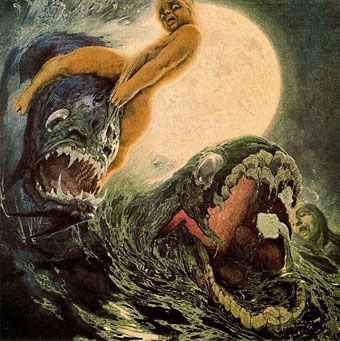
Sepia (no date) by Gao Jianfu.

Quelquefois, dans une nuit d’orage, pendant que des légions de poulpes ailés, ressemblant de loin à des corbeaux, planent au-dessus des nuages, en se dirigeant d’une rame raide vers les cités des humains, avec la mission de les avertir de changer de conduite, le caillou, à l’œil sombre, voit deux êtres passer à la lueur de l’éclair, l’un derrière l’autre; et, essuyant une furtive larme de compassion, qui coule de sa paupière glacée, il s’écrie: «Certes, il le mérite; et ce n’est que justice.» Après avoir dit cela, il se replace dans son attitude farouche, et continue de regarder, avec un tremblement nerveux, la chasse à l’homme, et les grandes lèvres du vagin d’ombre, d’où découlent, sans cesse, comme un fleuve, d’immenses spermatozoïdes ténébreux qui prennent leur essor dans l’éther lugubre, en cachant, avec le vaste déploiement de leurs ailes de chauve-souris, la nature entière, et les légions solitaires de poulpes, devenues mornes à l’aspect de ces fulgurations sourdes et inexprimables.

Les Chants de Maldoror (1869) by the Comte de Lautréamont

maldoror.jpg

Sometimes on a stormy night while legions of winged squids (at a distance resembling crows) float above the clouds and scud stiffly towards the cities of the humans, their mission to warn men to change their ways—the gloomy-eyed pebble perceives amid flashes of lightning two beings pass by, one behind the other, and, wiping away a furtive tear of compassion that trickles from its frozen eye, cries: “Certainly he deserves it; it’s only justice.” Having spoken thus it reverts to its timid pose and trembling nervously, continues to watch the manhunt and the vast lips of the vagina of darkness whence flow incessantly, like a river, immense shadowy spermatozoa that take flight into the dismal aether, the vast spread of their bat’s wings obscuring the whole of nature and the lonely legions of squids—grown downcast viewing these ineffable and muffled fulgurations.

Translation by Alexis Lykiard, 1970
pennington-cthulhu.jpg

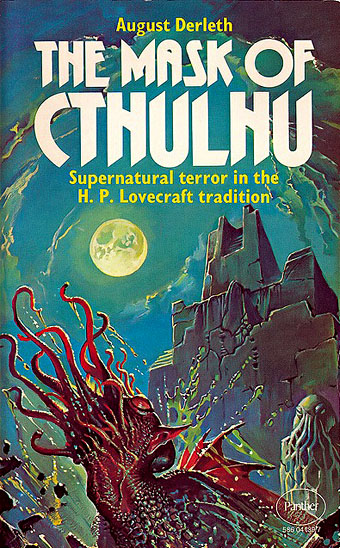
The Mask of Cthulhu, 1976 paperback reprint. Cover art by Bruce Pennington.

Above these apparent hieroglyphics was a figure of evidently pictorial intent, though its impressionistic execution forbade a very clear idea of its nature. It seemed to be a sort of monster, or symbol representing a monster, of a form which only a diseased fancy could conceive. If I say that my somewhat extravagant imagination yielded simultaneous pictures of an octopus, a dragon, and a human caricature, I shall not be unfaithful to the spirit of the thing. A pulpy, tentacled head surmounted a grotesque and scaly body with rudimentary wings; but it was the general outline of the whole which made it most shockingly frightful. Behind the figure was a vague suggestion of a Cyclopean architectural background.

The Call of Cthulhu (1928) by HP Lovecraft

Previously on { feuilleton }
Ulysses versus Maldoror
Maldoror
Vampyroteuthis Infernalis by Vilém Flusser
Books of blood
Magritte’s Maldoror
Frans De Geetere’s illustrated Maldoror
Maldoror illustrated

Weekend links 196

wellcome1.jpg

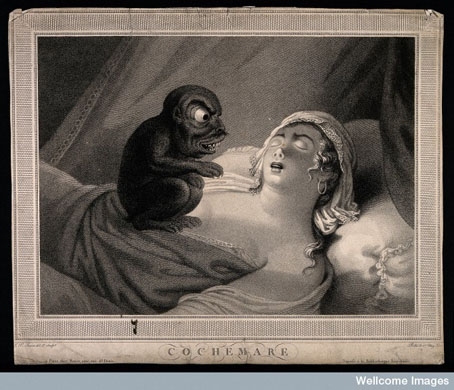
Cochemare (1810) by Jean Pierre Simon. One of 100,000 high-resolution images now available from Wellcome Images.

• Ted Morgan’s Literary Outlaw: The Life and Times of William S. Burroughs (1990) was a solid biography blighted by a bizarrely bad-tempered and judgemental attitude towards many of Burroughs’ friends and colleagues. Morgan says Burroughs disliked the book (he also says his subject died in 1993, not 1997…) so I’m looking forward to the new biography by Barry Miles, Call Me Burroughs: A Life. There’s a curious detail in Jeremy Lybarger’s piece about August Derleth, HP Lovecraft’s publisher and lifetime champion, causing a fuss after the Chicago Review published extracts from Naked Lunch in 1958. Burroughs enjoyed Lovecraft’s fiction but it’s unlikely that Lovecraft would have been anything other than appalled by Burroughs’s work. Barry Miles will be holding a Q&A session at the ICA, London, next month following a screening of Howard Brookner’s restored documentary, Burroughs: The Movie.

• Mix of the week: Secret Thirteen Mix 105 by Sturqen. At 3quarksdaily Dave Maier writes in praise of drones (the musical variety), and links to three mixes.

• Interviews: Haakon Nelson talks to Harold Budd, Joseph Burnett talks to William Basinski, John Stezaker talks to Nicolas Roeg.

Derek responded to an invitation to address [AIDS] hysteria by lining the gallery with a set of tarred and feathered mattresses loaded with the traces of queer love-making and then framing them against wallpaper made from Xeroxed, blood-spattered front pages. In the middle of all this he then constructed a makeshift barbed-wire cage that imprisoned and protected a pair of apparently naked lovers – usually a pair of handsome, sleeping boys, but for one afternoon at least Tilda Swinton dropped by, just to make the point that the boys didn’t have an exclusive stake in or artistic rights to this crisis. Between the walls and the cage, the air of the gallery was thick with tension and hatred – sometimes literally so, as visitors to the gallery objected vociferously to what they were seeing.

Neil Bartlett on celebrating Derek Jarman 20 years after his death.

• William Friedkin’s Wages of Fear remake, Sorcerer (1977), receives an overdue reissue on DVD/Blu-ray in April.

James Knowlson asks “What lies beneath Samuel Beckett’s half-buried woman in Happy Days?”

• The UK’s web filtering seems to be blocking common sense says Jane Fae.

wellcome2.jpg

A devil buggering a man (19th century).

• The poetry of Hart Crane, from the American epic to personal belonging.

The Sonny Sharrock Quartet play Stupid Fuck, live 1988.

Pinterest nightmares

Borogoves

• Lutinemusic: Espera | Died Of Love | All I Have Is Gold

Lynd Ward’s Frankenstein

ward1.jpg

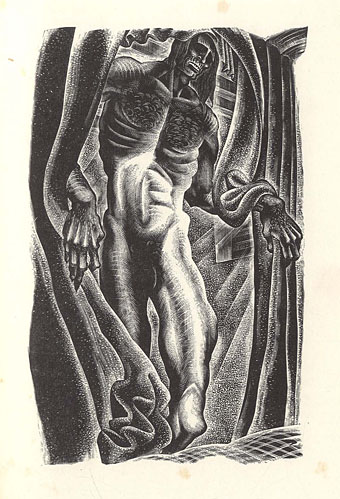
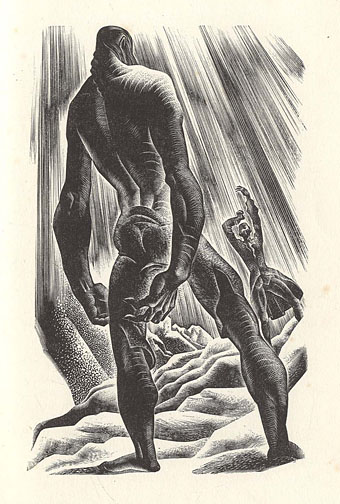
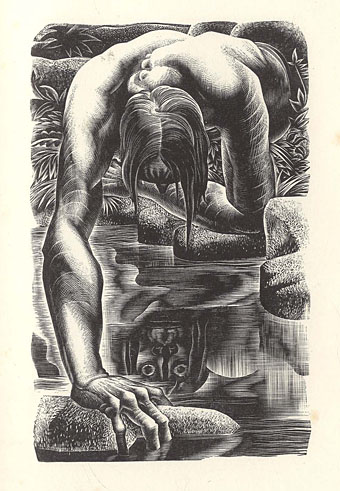
Mary Shelley’s novel illustrated in woodcuts by the great Lynd Ward (1905–1985). This edition appeared in 1934, a couple of years after the release of James Whale’s first Frankenstein film whose popularity may have led to its commission. It’s good to see Dover Publications keeping this one in print when first editions go for hundreds of pounds. VTS has more of the illustrations (there’s also this site), and many more examples of Ward’s work.

ward2.jpg

ward3.jpg

ward4.jpg

Elsewhere on { feuilleton }
The illustrators archive

Previously on { feuilleton }
Two Brides
Berni Wrightson’s Frankenstein
Cain’s son: the incarnations of Grendel
Gods’ Man by Lynd Ward

Big fish

undying.jpg

Illustration by Lawrence for The Undying Monster (1946) by Jessie Kerruish.

Another of those collisions between fine art and pulp fiction that I like to note now and then. The drawing above by Lawrence Sterne Stevens (from this page) I immediately recognised as borrowing its fish from the painting below by Néstor Martín-Fernández de la Torre (1887–1938), or Néstor as he’s usually known. Stevens was also usually credited by the single name Lawrence, and this is one of his many first-rate contributions to Famous Fantastic Mysteries. I’ve already noted a similar borrowing by his contemporary, Virgil Finlay, so this example isn’t too surprising. It’s unlikely that many of the readers eagerly devouring Jessie Kerruish’s tale would have been familiar with Néstor’s paintings. On the same Lawrence page there’s his illustration for Arthur Machen’s The Novel of the Black Seal which ran in the same issue.

nestor1.jpg

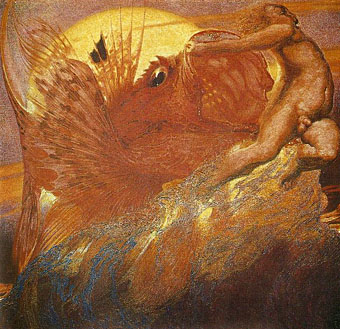
Poema del Mar: Noche (1913–1924).

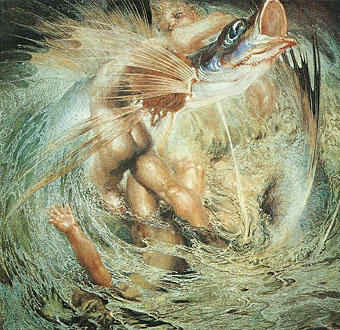
Néstor is distinguished by a predilection for aquarian scenes and writhing figures, all of which are presented in a very distinctive and recognisable style. He also happens to be one of the few major artists to come from the Canary Islands which no doubt explains his interest in the sea. The Poema del Mar series, and other works such as this satyr head, often find him numbered among the Spanish Symbolists although he’s rather late for that movement, and this assumes that every artist has to be placed in one box or another whether they belong there or not. These giant fish could just as well make him another precursor of the Surrealists, and they do occasionally receive a mention for their similarity to (and possible influence upon) Dalí’s enormous Tuna Fishing (Homage to Meissonier) (1966–67). There’s more of Néstor’s work over at Bajo el Signo de Libra (Spanish language).

nestor2.jpg

Poema del Mar: Tarde (1913–1924).

nestor3.jpg

Poema del Mar: Reposo (1913–1924).

Continue reading “Big fish”

Weekend links 194

roberts.jpg

Untitled glass sculpture by Richard Roberts.

Lord Horror: Reverbstorm, my collaboration with David Britton, makes The Quietus list of Literary Highlights of 2013. At the same site there’s Russell Cuzner talking to English Heretic. “His methodology takes in magick, psychogeography and horror film geekdom, along with firm roots in Britain’s industrial music culture of the early 1980s, to form potent, novel topographies of an otherwise unconnected world of occultists and psychopaths.”

• A slew of London links this week: Geoff Manaugh on how the capital was redesigned to survive wartime blackouts, a piece which inadvertently explains why you see so much black-and-white street furniture in post-war films | Bob Mazzer’s photos of the London Underground in the 1970s and 1980s | Philipp Ebeling’s photos of the capital and its inhabitants today.

• “Science has become an international bully. Nowhere is its bullying more outrageous than in its assault on the phenomenon known as subjectivity.” David Gelernter on “The Closing of the Scientific Mind”. Related: “When Science Becomes Scientism” by Stanislav Grof.

• My favourite book about Orson Welles is This is Orson Welles (1992), a collection of Peter Bogdanovich’s interviews with Welles edited by Jonathan Rosenbaum. Bogdanovich’s interview tapes can now be heard at the Internet Archive.

• Brian Dillon on Dada collagist Hannah Höch who he calls “art’s original punk”, and Sean O’Hagan talking to another collage artist, Linder Sterling, who says “Lady Gaga didn’t acknowledge I wore a meat dress first”.

• One Hundred Years Of Weird Fear: Daniel José Older on HP Lovecraft’s literature of genealogical terror. More fear (and Lovecraft): Will Wiles on the growth of Creepypasta.

The Last Alan Moore Interview? A lengthy discussion with Pádraig Ó Méalóid. Shunning interviews hasn’t done Cormac McCarthy any harm so if I was Alan I wouldn’t worry.

• And speaking of Cormac McCarthy, the headline of the week: “Cormac McCarthy’s ex-wife busted after pulling gun from vagina during alien argument“.

• Where the bodies are buried: Mick Brown presents a potted biography of Kenneth Anger who offers a few reluctant quotes.

• A short animation for gore-obsessed kids: Pingu’s The Thing by Lee Hardcastle.

Helen Yentus designs a 3D-printed slipcase for a novel by Chang-rae Lee.

Ralph Steadman‘s illustrations for Alice’s Adventures in Wonderland.

• Mix of the week: Secret Thirteen Mix 103 by Lustmord.

Collage art at Pinterest.

No Escape (1966) by The Seeds | Pushin’ Too Hard (1966) by The Seeds | No Escape (1979) by Cabaret Voltaire | Pushin’ Too Hard (1982) by Paul Parker