Weekend links 205

lin.jpg

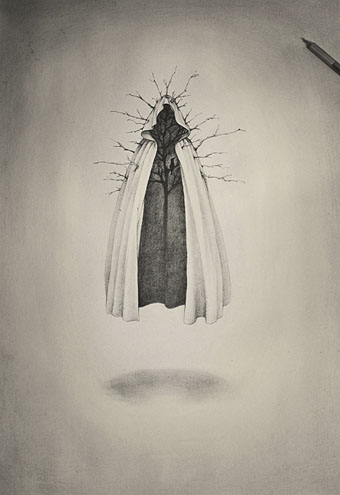
King’s Cloak (2012) by Alice Lin.

• The week in Finnegans Wake: illustrations by John Vernon Lord for a new Folio Society edition; The Guardian‘s review from 1939; Christina Scholz explores Joyce’s use of the Ant and the Grasshopper fable; Sheng Yun wonders when Dai Congrong will compete the first Chinese translation of the book; Stephanie Boland on riverrun, the latest theatrical adaptation.

• It’s Robert Aickman‘s centenary year so Faber are reissuing several volumes of his peerless “strange stories”. And it’s good to see the great Clark Ashton Smith finally receive the blessing of Penguin Classics.

• The Teenage Boyfriend of the Beat Generation: Marcus Ewart slept with Allen Ginsberg (who showed him how to give a proper blowjob), and had an eight-year relationship with William Burroughs.

Yet another advocate of shorter work time was JS Mill. He dismissed the ‘gospel of work’ proposed by Thomas Carlyle in part because it drew a veil over the real costs of work, including slave work that Carlyle sought to defend. Instead, Mill advocated a ‘gospel of leisure’, arguing that technology should be used to curtail work time as far as possible. This stress on technology as a means to shorten work time was later to feature in Bert­rand Russell’s 1932 essay, ‘In Praise of Idleness’.

David Spencer on The Case for Working Less

• More Steve Moore memorials: Mitch Jenkins put the pages from Unearthing online, while Pádraig Ó Méalóid posted a personal appreciation at The Beat.

Linda Marsa on how psychedelics are helping cancer patients deal with their illness.

• The Weird Album: art by Enrique Alcatena (including some Lovecraftian pieces).

• Didgeridoom: Director Ted Kotcheff talks to Robert Barry about Wake in Fright.

The Jealous God (1985), a comic strip by Alejandro Jodorowsky & Silvio Cadelo.

• The Dune in Your Head: Ethan Gilsdorf on the greatest SF film never made.

50 minutes of Kraftwerk on Rockpalast in 1970. Astonishing.

• At 50 Watts: Sheet-music covers from Sweden in the 1920s.

Harvard discovers old library books bound in human skin.

Same-sex marriage is now legal in England and Wales.

Wyrd Daze has reached issue 5.

Kaleidoscopes at Pinterest.

Flight From Ashiya (live on TV! 1967?) by Kaleidoscope (UK) | Lie To Me (1969) by Kaleidoscope (US) | Kaleidoscope (1984) by The Rain Parade
The Horror Fields

horror.jpg

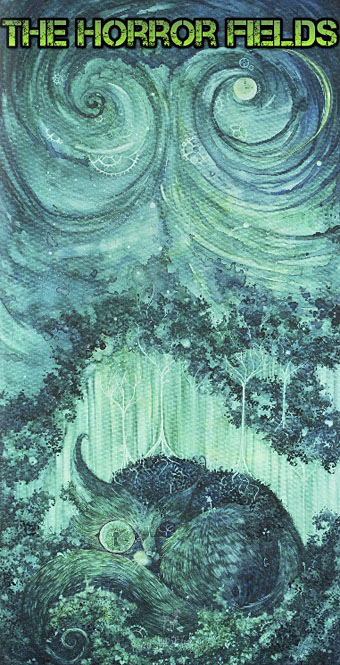
Cover art: In the Palm of the Absinthe Woods by Aria/ShePaintsWithBlood.

Last year I was asked to contribute a piece of fiction to a rural horror special of Morpheus Tales. In time for the Spring Equinox, The Horror Fields, edited by Matt Leyshon, is now unleashed. Inside there’s my short story, Figures in a Landscape, plus contributions from Rosalie Parker, Don Webb, Edward Pearce, Murphy Edwards & Brian Rosenberger, James Everington, Richard Farren Barber, Ian Hunter, Justin Aryiku, and Rhys Hughes.

Two editions are available at Lulu: digest-sized, and A4 size; both editions are discounted until the end of the month. There should also be a Kindle edition soon so when I have details I’ll mention them here. I’d recommend reading this in a field at night but here in the northern hemisphere it’s still a little too cold for that.

Previously on { feuilleton }
Robin Redbreast by John Bowen
Red Shift by Alan Garner
Children of the Stones
Penda’s Fen by David Rudkin

The Winchester Mystery House

winchester1.jpg

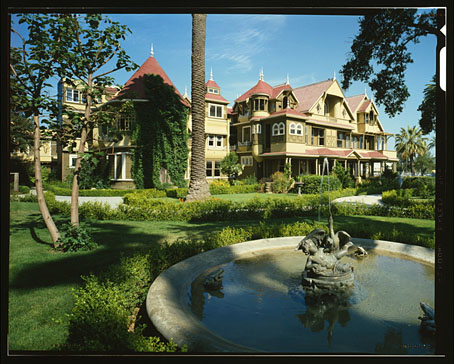
Winchester House, 525 South Winchester Boulevard, San Jose, Santa Clara County, CA.

“One of the peculiar traits of Hill House is its design—”

“Crazy house at the carnival.”

“Precisely. Have you not wondered at our extreme difficulty in finding our way around? An ordinary house would not have had the four of us in such confusion for so long, and yet time after time we choose the wrong doors, the room we want eludes us. Even I have had my troubles.” He sighed and nodded. “I daresay,” he went on, “that old Hugh Crain expected that someday Hill House might become a showplace, like the Winchester House in California or the many octagon houses; he designed Hill House himself, remember, and, I have told you before, he was a strange man. Every angle”—and the doctor gestured toward the doorway—”every angle is slightly wrong. Hugh Crain must have detested other people and their sensible squared-away houses, because he made his house to suit his mind. Angles which you assume are the right angles you are accustomed to, and have every right to expect are true, are actually a fraction of a degree off in one direction or another. I am sure, for instance, that you believe that the stairs you are sitting on are level, because you are not prepared for stairs which are not level—”

They moved uneasily, and Theodora put out a quick hand to take hold of the balustrade, as though she felt she might be falling.

“—are actually on a very slight slant toward the central shaft; the doorways are all a very little bit off centre—that may be, by the way, the reason the doors swing shut unless they are held…”

The Haunting of Hill House (1959) by Shirley Jackson.

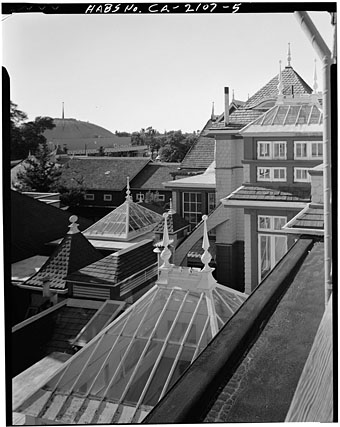
I re-read Shirley Jackson’s novel a few months ago but neglected at the time to follow-up the reference to the Winchester House. News this week that Sarah Winchester’s sprawling folly in San Jose is to finally allow overnight stays prompted some investigation. The most remarkable thing about the Winchester Mystery House is that it’s much more of an oddity than its fictional relation, if you overlook (so to speak) the fact that Shirley Jackson’s house is a home to malevolent spectres. Sarah Winchester was heir to the Winchester rifle fortune, and instituted a process of continual and completely uncoordinated house-building for thirty-seven years, believing that this would confound the ghosts of those killed by the weapons bearing her name. Among the house’s 160 rooms are extraneous chambers and closets, doors to nowhere, and stairways serving no purpose. The spirit-trapping decorations include repeated spider-web motifs, and a recurrence of the number 13; one room at least was originally a Séance Room. This blog post concerns a tour round the house as it is today, while the Library of Congress has a number of views of the place.

winchester2.jpg

View looking west from top floor.

It’s unfortunate that the house was built in California’s earthquake zone, the structure had reached seven stories until the 1906 earthquake forced the removal of the three topmost floors. I had to go looking for views of the pre-quake building, and happily there are a few preserved on old postcards. When Blue Öyster Cult chose Adolph Sutro’s Cliff House for the cover of their Imaginos album they certainly picked the more immediately photogenic building, but the Winchester Mystery House a few miles to the south has it beat when it comes to metaphysical cachet.

The Winchester Mystery House at Pinterest.

winchester4.jpg

winchester3.jpg

Previously on { feuilleton }
The Cliff House revisited
Adolph Sutro’s Gingerbread Palace

Weekend links 199

cordal.jpg

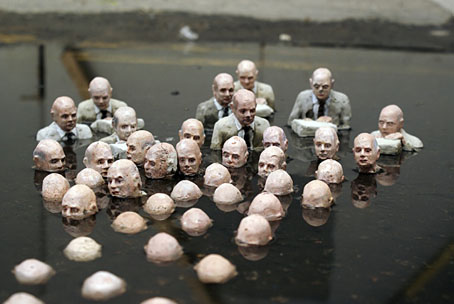
Follow the Leader (London, 2011) by Isaac Cordal.

• “Brutalism is the decor of dystopian films, literature and comics, just as gothic is for horror.” Jonathan Meades‘ A-Z of brutalism.

Vitaly Shevchenko on the urban explorers of the ex-USSR. Related: Photos by Vitaliy Raskalov from the top of the Shanghai Tower.

Joe Banks reviews the throbbing, hissing, minatory pulses of the Black Mill Tapes 1–4 by Pye Corner Audio.

Walter Benjamin is the only one among the commentators who attempts to pin down the anonymous, evanescent quality of Walser’s characters. They come, he says, “from insanity and nowhere else. They are figures who have left madness behind them, and this is why they are marked by such a consistently heartrending, inhuman superficiality. If we were to attempt to sum up in a single phrase the delightful yet also uncanny element in them, we would have to say: they have all been healed.” Nabokov surely had something similar in mind when he said of the fickle souls who roam Nikolai Gogol’s books that here we have to do with a tribe of harmless madmen, who will not be prevented by anything in the world from plowing their own eccentric furrow.

Le Promeneur Solitaire: WG Sebald on Robert Walser

Drink The New Wine, an album by Kris Force, Anni Hogan, Jarboe, Zoe Keating and Meredith Yayanos.

• At 50 Watts: Illustrations by Fortuné Méaulle for Alphabet des Insectes by Leon Becker.

Lawrence Gordon Clark, Master of Ghostly Horror. An interview by John D’Amico.

• Chapel Perilous: Notes From The New York Occult Revival by Don Jolly.

• Mix of the week: Secret Thirteen Mix 107 by Ernestas Sadau.

• An Occult History of the Television Set by Geoff Manaugh.

• Was Ist Das? The Krautrock Album Database.

• First dérive of the year by Christina Scholz.

John Waters’ Youth Manifesto.

Gardens of Earthly Delights

Psychedelic Folkloristic

Water Music I / Here Comes The Flood / Water Music II (1979) by Robert Fripp & Peter Gabriel | After The Flood (1991) by Talk Talk | Flood (1997) by Jocelyn Pook

Seward/Howard

burroughssphinx.jpg

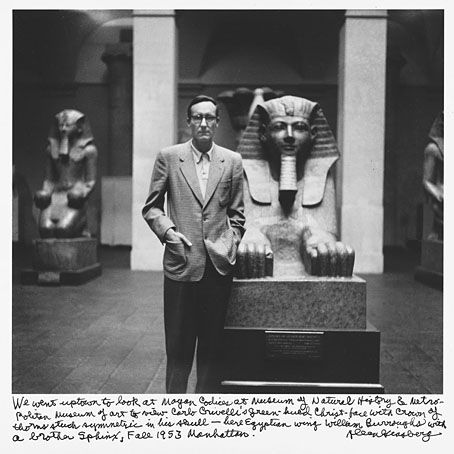
William Burroughs, New York, 1953. Photo by Allen Ginsberg.

Lonely lemur calls whispered in the walls of silent obsidian temples in a land of black lagoons, the ancient rotting kingdom of Jupiter – smelling the black berry smoke drifting through huge spiderwebs in ruined courtyards under eternal moonlight – ghost hands at the paneless windows weaving memories of blood and war in stone shapes – A host of dead warriors stand at petrified statues in vast charred black plains – Silent ebony eyes turned toward a horizon of always, waiting with a patience born of a million years, for the dawn that never rises – Thousands of voices muttered the beating of his heart – gurgling sounds from soaring lungs trailing the neon ghost writing – Lykin lay gasping in the embrace can only be reached through channels running to naked photographic process – molded by absent memory, by vibrating focus scalpel of the fishboy gently in a series of positions running delicious cold fingers “Stand here – Turn around – Bend”

The Ticket that Exploded (1962)

William Burroughs always talked favourably of Ernest Hemingway, and the famously spare style of Hemingway’s prose is evidently a style he sought himself, especially in the later works where there’s less of an emphasis on linguistic pyrotechnics. Something that always strikes me when I return to Burroughs’s earlier novels is the quality of passages like the one above which is a long way from the Hemingway style. What’s even more noticeable—and this is something which attracted me to Burroughs’s work from the outset—is the degree to which some of these passages are reminiscent of HP Lovecraft. In the case of the example above, taken from The Black Meat chapter of The Ticket that Exploded, some of this may be the work of Michael Portman who Burroughs credits as co-writer. What Portman contributed to The Black Meat and another chapter of that novel I’ve never discovered but there are plenty of other examples by Burroughs alone to show that he wasn’t incapable of this himself. The Ticket that Exploded was the first Burroughs book I read, and part of the shock and fascination came from encountering a recognisable Weird Tales-style atmosphere wrenched into inexplicable and thoroughly alien territory.

hpl.jpg

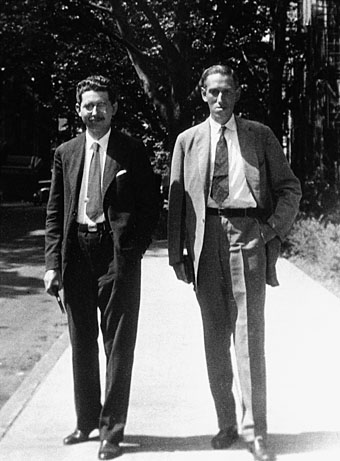
Frank Belknap Long and HP Lovecraft, New York, 1931. Photo by WB Talman.

There are others connections beyond literary style. When the Simon Necronomicon was published in 1977 Burroughs was asked to provide a blurb for the book. He wasn’t as effusive as the publishers might have hoped but the dubious volume was still advertised with his recommendation:

Let the secrets of the ages be revealed. The publication of the Necronomicon may well be a landmark in the liberation of the human spirit.

If it wasn’t for this then the extraordinary Invocation which opens Cities of the Red Night (1981) would have been diminished. Among the other “gods of dispersal and emptiness” whose names are called, Burroughs mentions “Kutulu, the Sleeping Serpent who cannot be summoned”, and “the Great Old One”, among a number of the usual Mayan gods, and several Sumerian deities whose descriptions (as with Kutulu) are taken from the pages of the Simon Necronomicon. It’s impossible to imagine Saul Bellow or John Updike opening a novel this way, just as it’s impossible to imagine many genre writers wandering into the areas that Burroughs explores elsewhere in that novel. This is one reason why Burroughs (and JG Ballard) were included in DM Mitchell’s The Starry Wisdom anthology in 1994, an attempt to expand the acceptable boundaries of Lovecraftian fiction, and also wilfully trample the fences that separate the genre and literary camps. I campaigned at the time for The Black Meat chapter to be included but Dave was set on Wind Die, You Die, We Die from Exterminator! (1973), a lesser piece although in the end it didn’t seem out of place in the book as a whole.

Elsewhere on { feuilleton }
The Lovecraft archive
The William Burroughs archive