May Wilson’s Snowflakes

wilson1.jpg

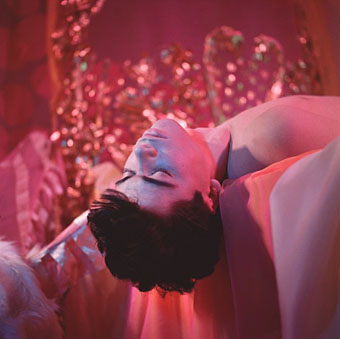
Snowflake Series (Pink Netting) (1965).

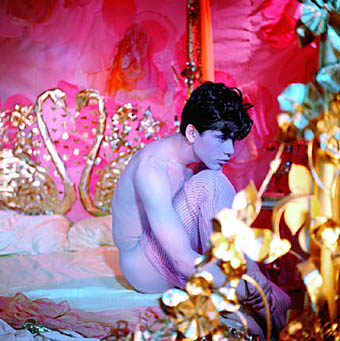
Discovered yesterday whilst searching for May-related pictures, some pieces from the Snowflake collage series by American artist May Wilson (1905–1986). Wilson was a mail artist as well as a collagist whose Snowflake series draws attention for its deployment of photos from beefcake magazines of the 1960s. It’s a commonplace that women often enjoy seeing gay porn but this interest hasn’t been reflected so much in art made by women. Offhand I can only think of the aforementioned Sibylle Ruppert making use of photos made by men for men. May Wilson produced similar works using glamour photos of women so her interest wasn’t solely concerned with the male form.

wilson2.jpg

Snowflake Collage (Male Nude in Woods) (1966).

Continue reading “May Wilson’s Snowflakes”

Weekend links 209

soundcarriers.jpg

Soundcarriers poster by Julian House.

A new release on the Ghost Box label is always a welcome thing but Entropicalia by The Soundcarriers, out on May 20th, is one I’m especially looking forward to. Julian House has made a video for new song Boiling Point, and there’s also the poster above which can be downloaded at larger size here. The Ghost Box Guest Shop has a couple of new additions including the recent Man Woman Birth Death Infinity album by Raagnagrok.

• “It’s a funny time to be making music, because we’re a generation of people who make music with screens instead of with ears.” Ben Frost talking to Tristan Bath.

• At Dangerous Minds: You Gotta Say Yes to Another Excess, a rare glimpse of Yello live in concert, 1983.

Our movements about London are closely circumscribed, and while we may imagine ourselves to be free, the truth is that the vast majority of our journeys are undertaken for commercial imperatives: we travel either to work or to spend. All about us during our daily existence we are presented with buildings we cannot enter, fences we cannot climb and thoroughfares it would be foolhardy to cross. We are disbarred from some places because we don’t have the money — and from others because we don’t have the power. The city promises us everything, but it will deliver only a bit.

The place-hackers draw our attention to how physically and commercially circumscribed our urban existence really is. […] As more and more international capital flows into London, so public space is increasingly eroded — it’s just too valuable for us ordinary folk to paddle about in any more.

Give the freedom of the city to our urban explorers, says Will Self. Related: Robert Macfarlane accompanied urbexer Bradley Garrett on a night-time jaunt.

Black Sabbeth: Metal band Gonga covering a classic with Portishead’s Beth Gibbons on vocals.

• Pelican books take flight again; Paul Laity on the resurrection of the non-fiction imprint.

• Finland’s homoerotic stamps are an ocular feast for women, too, says Nell Frizzell.

• “I guess you could say I am a Pagan.” Kenneth Anger on the occult.

• “How much gay sex should a novel have?” asks Caleb Crain.

• Mix of the week: Secret Thirteen Mix 112 by Kyoka.

The Gibraltar Encyclopedia of Progressive Rock

Zombi’s Guide to Goblin

Decadence Comics

Zombie Warfare (1979) by Chrome | Escape From The Flesheaters (Zombie) (1979) by Fabio Frizzi | Zombie’ites (1993) by Transglobal Underground

Maximin: ein Gedenkbuch by Stefan George

maximin01.jpg

This is a strange and beautiful book, a loving paean to a dead boy-poet from another poet, Stefan George (1868–1933), published in 1907. The “Maximin” of the title was Maximilian Kronberger (1888–1904) who was around 14 when he met George; the older man was 34 at the time. George was apparently smitten by the boy, and devastated when he died from meningitis two years later. Maximin: ein Gedenkbuch (A Memorial Book) is the result, a collection of mournful poems, beautifully designed and illustrated by Melchior Lechter in that rectilinear Art Nouveau style which the artist made his own. The memory of the dead Maximin became for George a quasi-religious obsession which makes Maximin the bible of the homosocial cult that George subsequently encouraged.

maximin02.jpg

What’s most surprising about all this behaviour is that it did nothing at all to harm his reputation, even among the Nazis who later revered his poetry. George was a contemporary of Oscar Wilde but the pair were poles apart in character, George’s chilly, high-minded aestheticism preserving him from the brickbats aimed at Wilde and others. Nonetheless, the inherent camp that results from the combination of such a remote attitude combined with flagrant boy-worship secured for George a place alongside Wilde in Philip Core’s essential Camp: The Lie that Tells the Truth (1984):

Strangely enough his overtly (if classically) homosexual verses, his preference for beautiful youth, and his severe black-clad dignity, all became immensely popular in the land of brüderschaft (brothers’ love). The camp Classicism of his ‘academy’ of the spirit, in surroundings of neo-Classical kitsch, hit just the right middle ground between Edwardian sentimentality and Hitlerian Imperialism.

Maximin: ein Gedenkbuch may be browsed or downloaded at the University of Heidelberg. There’s a more academic examination of George’s homoerotics here. Further page samples follow.

maximin03.jpg

maximin04.jpg

maximin05.jpg

Continue reading “Maximin: ein Gedenkbuch by Stefan George”

Tom of Finland postage stamps

stamp1.jpg

Finland’s most famous writer and female artist was a lesbian so it’s perhaps fitting that Tom of Finland is now firmly established as its most famous male artist. At one time you could have argued that Akseli Gallen-Kallela had more of an international profile but the rising visibility of gay art, and the pioneering erotica of Touko Laaksonen aka Tom of Finland, has changed all that. Tove Jansson’s Moomin characters have already appeared on a commemorative coin but later this year Tom of Finland’s beefy clones expose themselves to a wider public when they appear on postage stamps for the first time. The stamps have been designed by Timo Berry and Susanna Luoto. Even with all the recent social changes in the UK I can’t imagine anyone getting away with a stamp design featuring such a prominent pair of buttocks, however lovingly rendered. It’s also a sign of changing attitudes that many people today would be less likely to object to sight of a bare bum than they would to a picture of somebody smoking. There’s more about the stamp designs, including links to larger images, here.

stamp2.jpg

stamp3.jpg

stamp4.jpg

Elsewhere on { feuilleton }
The gay artists archive

Weekend links 207

barker.jpg

Chthonic Cities by David Chatton Barker. One of a series of Folklore Tapes screenprints available from Bleep.

• The original version of Kenneth Anger’s Lucifer Rising, the one with the Jimmy Page soundtrack that was completed in 1973, has always been described as lost/stolen/buried or otherwise gone forever. So you’d think the news that a print had been discovered recently by Brian Butler would have received greater attention. There’s a screening in Los Angeles this Thursday. When do the rest of us get to see it?

Chris Marker: A Grin Without a Cat, an exhibition and series of Marker-related events at the Whitechapel Gallery, London. Related: The Encounter of M. Chat & Chris Marker as Told By Louise Traon.

• The trailer for The Gospel According to St Derek, a forthcoming documentary about Derek Jarman. Related: Carl Swanson on why Tilda Swinton is not quite of this world.

Maybe there’s just something conservative at the bedrock of American fiction. […] Or maybe it’s just another symptom of the creeping conservatism that’s infected so many aspects of the culture.

Eric Obenauf talks to author Jeff Jackson whose comments about cultural conservatism could equally be applied to the UK.

• Primitive graphics, inventive graphics, budget Surrealism, and some great theme tunes; it’s Trunk TV, Episode 1: Title Sequences.

• Mixes of the week: Secret Thirteen Mix 110 by Black To Comm, and Intro To Drone For Debcon 1, almost 7 hours of music!

Joseph Burnett reviews Ett, an album of electronic music by Klara Lewis.

The Delian Mode (2009), a film about Delia Derbyshire by Kara Blake.

• Extracts from Tokyo Reverse by Simon Bouisson and Ludovic Zuili.

Dan Piepenbring on The Haunting Illustrations of Alfred Kubin.

• At Strange Flowers: Photos of arcades by Germaine Krull.

• Fish, Fiends, and Fantasy: The Gothic Art of Ian Miller.

• At 50 Watts: Richard Teschner and His Puppets.

• Sonic Foam: Ian Penman on Kate Bush and Coil.

Bits and Pieces

Lucifer (1968) by The Salt | Experiment IV (1986) by Kate Bush | Methoxy-N, N-Dimethyl (5-MeO-DMT) (1998) by Coil