Weekend links 333

timeout.jpg

Time Out (London), no. 2403. No illustrator or designer credited.

• October isn’t all about the dark, there’s also psychedelia: Ned Raggett reviews a new collection of British psych, Let’s Go Down And Blow Our Minds: The British Psychedelic Sounds of 1967, while Floodgate Companion, a forthcoming collection of art by Robert Beatty, is previewed here.

• Mixes of the week (aside from my own, of course): Samhain Seance 5: Invasion of the Robot Witch by The Ephemeral Man, Thee Finders Kreepers Halloween Spezial, and Secret Thirteen Mix 199 by Blue Hour.

• “No diggin’ ‘ere!” Adam Scovell revisits the ghostly locations of the BBC’s A Warning to the Curious, and presents a short film based on the same.

• Stanley Kubrick’s film of The Shining has lost its shine through endless quotation and over-familiarity, says Anne Billson. Hard to disagree.

Between Ballard’s Ears: in which two short stories by JG Ballard—Track 12 and Venus Smiles—are dramatised in binaural sound.

John Carpenter talks to Adam Woodward about remakes, his love of early synthesisers and why nostalgia works in mysterious ways.

• Next month at the British Library: Brion Gysin: A Centennial Invocation with Alan Moore, Iain Sinclair, Barry Miles and others.

Peter Bebergal on the Fraternity of the Rosy Cross, “a shadowy medieval brotherhood that probably didn’t exist”.

Until The Hunter, a new album by Hope Sandoval and The Warm Inventions, is streaming here.

• San Fran-disco: Geeta Dayal on how Patrick Cowley and Sylvester changed dance music forever.

• A small portion of Bill Laswell‘s vast back catalogue is now on Bandcamp.

• At MetaFilter: The strange history of books bound in human skin.

• Italian composer Fabio Frizzi remembers 50 years of cult horror.

Matthew Cheney on the strange horrors of Robert Aickman.

Jóhann Jóhannsson’s favourite records

Dark Start (1995) by ELpH vs Coil | Darkstalker (2000) by Bohren & Der Club Of Gore | Dark (2012) by Moritz Von Oswald Trio

Monsieur de Bougrelon by Jean Lorrain

mdb1.jpg

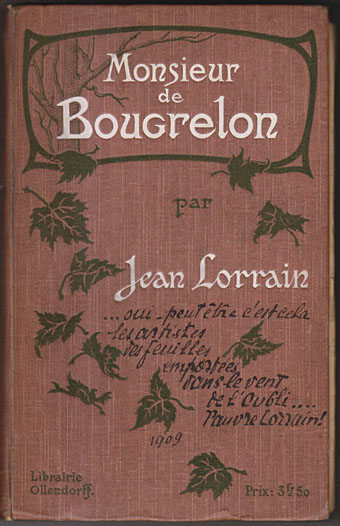
A reprint edition from 1909.

In 1881 there arrived from Normandy a good-looking young man with an unfortunate habit of painting his face: Jean Lorrain. He spent five years of his life in Montmartre, five years that were also the most dazzling ones for the hill whose chronicler he became. A brilliant journalist with an eye that missed no blemish, no absurdity, but could fill with tears on seeing beauty in a picture, a profile, a gown. From his first poems, Modernités, this fin-de-siècle Petronius evoked the whole life of Montmartre: transvestites, lesbians, go-betweens, outrageous bluestockings, failed poets declining into pimps, wrestlers, part-time gigolos for either sex.

Philippe Jullian in Montmartre (1977)

Among the books that Philippe Jullian wrote about notable fin-de-siècle personalities is a biography of Jean Lorrain (1855–1906), a volume which—to my continual frustration—has yet to be translated into English. If Lorrain is a neglected figure in contemporary France, he’s hardly known at all in the Anglophone world which is why the news last month of the first English translation of Monsieur de Bougrelon was so welcome.
lorrain.jpg

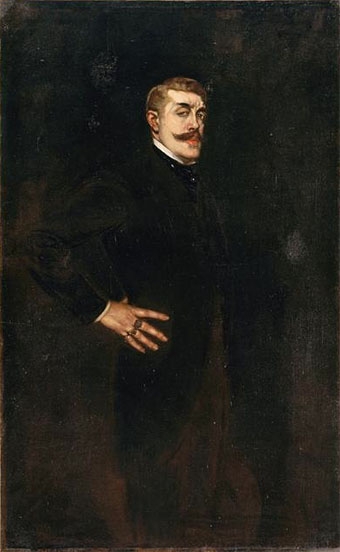
Jean Lorrain (1898) by Antonio de la Gandara.

I say that Lorrain is unknown but only to the general reader; to anyone familiar with fin-de-siècle Paris he’s an unavoidable presence, a chronicler of the city’s excesses and also one of the great characters of the period. Portraits and cartoons show the dandy but fail to communicate the reek of ether—he was an addict throughout his later years—which attended his presence. His drug-taking helped contribute to an early death at the age of 55 but, like Rainer Werner Fassbinder, Lorrain managed to combine several years of indulgent pleasure-seeking with serious industry, producing over 40 literary works. Like Fassbinder he was also open about his homosexuality. The Paris of the 1890s wasn’t exactly enthusiastic about this but the Code Napoléon had never made homosexual acts a crime which is one of many reasons that Paris (and France in general) was a haven for the beleaguered British. In his sexual proclivities, his dandyism, and his aesthetic connoisseurship Lorrain is a good contender for a French equivalent of Oscar Wilde, another of Philippe Jullian’s biographical subjects. Lorrain wrote novels, plays and poetry, while his columns of journalism combined gossip and satire with tips for the aesthetically minded. His taste in people was (again) Fassbinderesque:

I have a great fondness for hoodlums, fairground wrestlers, butcher-boys and assorted pimps, both ordinary and extraordinary, who, along with some absolutely exquisite women and some men of talent, such as yourself, are the only company that I keep in Paris.

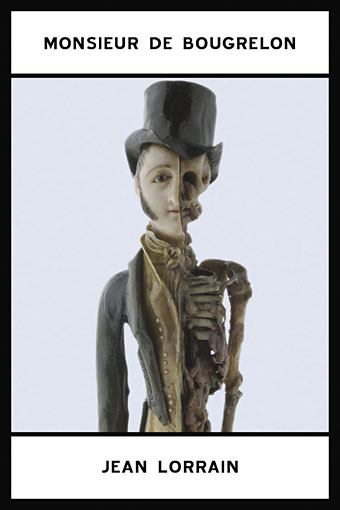
This life, and some of the author’s character, is reflected in Monsieur de Bougrelon, a short novel published in 1897. The story is narrated from the point of view of a pair of unnamed French visitors to Amsterdam who encounter their extraordinary compatriot when he makes a dramatic entrance into a cheap bordello. Monsieur de Bougrelon is an aged roué and purported aristocrat whose startling antique dress sense is dandyism gone to seed: swathed in old furs, bedizened with fake jewellery, and with dripping face-paint that prefigures another tragic figure in a city of canals, Thomas Mann’s Von Aschenbach. The French tourists have been made despondent by the dreariness of Amsterdam in winter so they welcome Monsieur de Bougrelon’s offer to lead them around the city, taking in museums, the city’s docks and the less reputable areas. While Monsieur de Bougrelon is present he maintains a running commentary, offering his opinions on the sights—Dutch art is amusingly dismissed as “bourgeois”—the people (“ugly”) and his own splendid life and lost loves. His tales about himself are tall and eventually verge on the improbable, but his presence engages the Parisians with its parade of lively invention, “imaginary pleasures” and phantom presences. Chief among the latter is Monsieur de Mortimer, de Bougrelon’s life-long friend, now dead and possibly the love of de Bougrelon’s life.
mdb2.jpg

This last matter is explored in an afterword by Eva Richter, the translator. While Monsieur de Bougrelon claims to be interested in women he has always been devoted to Monsieur de Mortimer, and the pair survive various affairs and obsessions to remain in each other’s company. Lorrain alludes to the true nature of the relationship when de Bougrelon compares himself and de Mortimer to Achilles and Patroclus. The surnames also offer clues with Mortimer signalling death while Bougrelon is a combination of the French name Bouglon and the word “bougre” whose equivalent in English is “bugger”. The French may have been more accepting of certain behaviours than the British but there were still limits, and Lorrain’s dallying with obscenity and homosexuality is decades in advance of Proust, Gide and Genet. But this isn’t the full substance of the novel. Monsieur de Bougrelon may be short but it contains some marvellous flights of fancy and torrents of description; it’s also blackly humorous in parts, although the dominant tone is of melancholy and a nostalgic regret for vanished days and lives. Melancholy and the omnipresence of death is a common theme in Decadent literature; Lorrain alludes in passing to another short melancholy story set in a city of canals, George Rodenbach’s Bruges-la-Morte (1892).

Spurl Editions are to be commended for resurrecting this neglected novel which is diligently translated and annotated. Monsieur de Bougrelon will be published on November 1st when it will join Monsieur de Phocas and Nightmares of an Ether-Drinker (aka The Soul-Drinker and Other Decadent Fantasies) in being one of the few works available in English from an exotic bloom of the French fin de siècle.

Previously on { feuilleton }
New Life for the Decadents by Philippe Jullian
Philippe Jullian, connoisseur of the exotic
Ma Petite Ville

Weekend links 332

seamans.jpg

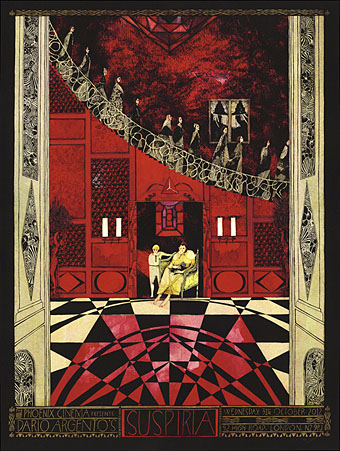
Suspiria (2012) by Jessica Seamans.

Matthew Sperling on Tom Phillips’ “treated Victorian novel” A Humument, which he calls “a multimedia masterpiece”. Phillips’ sixth and final edition of the book is published by Thames & Hudson next month.

Strange Flowers on Monsieur de Bougrelon (1897), a short novel by Jean Lorrain which will be published next month by Spurl Editions. The book is currently on my to-be-read-next pile.

Theodore Carter finds images of skulls by artists through the ages. I’d have included Giacometti’s almost abstract Head-Skull (1934) or his sketch of 1923.

• The horror stories of EF Benson contain “enough nastiness to give you just the right kind of frisson for the time of year,” says Nicholas Lezard.

• Covers for One, an American magazine of the 50s and 60s dedicated to “the homosexual viewpoint”.

Kelly Sullivan takes a close look at the illustrations and stained-glass work of the great Harry Clarke.

• Lost Moomins cartoon strips will be shown in the first UK Tove Jansson exhibition.

• The extravagant homes of Ludwig II of Bavaria are in urgent need of restoration.

• Mix of the week: The Nine Ten Never Sleep Again Mix by The Curiosity Pipe.

Ténéré Tàqqàl (what has become of the Ténéré), a new song by Tinariwen.

• The King of Weird: Joyce Carol Oates on HP Lovecraft.

• Charting the legacy of cult 1970s band, Big Star.

Falling (1992) by Miranda Sex Garden | Inferno (Version II) (1993) by Miranda Sex Garden | Peep Show (1994) by Miranda Sex Garden

Weekend links 331

jacobsen.jpg

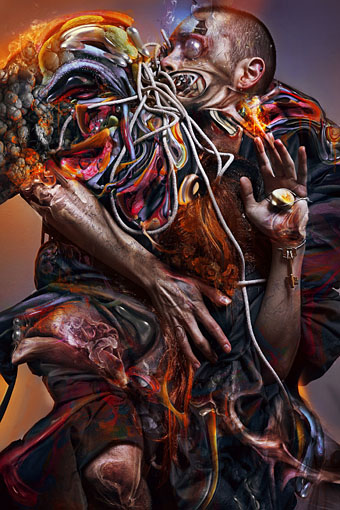
Ekeko (2016) by Jon Jacobsen.

Outer Space (1999), a short film by Peter Tscherkassky using reprocessed footage taken from The Entity (1982).

Pye Corner Audio playing live for 77 minutes at New Forms Festival, Vancouver 2016.

Salvador Dalí‘s rare Surrealist cookbook republished for the first time in over 40 years.

Keeping On Keeping On by Alan Bennett; extracts from the writer’s most recent diaries.

The Hagströmer Medico-Historical Library is a new source for free antique images.

• The shopfronts of independent Paris photographed by Sebastian Erras.

The Edge of the Ceiling (1980) is a short film about writer Alan Garner.

• Mix of the week: Secret Thirteen Mix 198 by Bestial Mouths.

Brenda S G Walter on eviscerating the body of Black Metal.

• “When did new age music become cool?” asks Geeta Dayal.

Barok Main, a new piece from Mica Levi & Oliver Coates.

• American gay magazine XY has been relaunched.

• Confessions of a vinyl junkie by David Bowie.

Touch Radio archive at the British Library.

Harvard’s collection of glass flowers.

Michelle Stuart‘s Magical Land Art.

Dali’s Car (1969) by Captain Beefheart & His Magic Band | Save Me From Dali (1980) by Snakefinger | Salvador Dali’s Garden Party (1989) by Television Personalities

Weekend links 329

vyletal.jpg

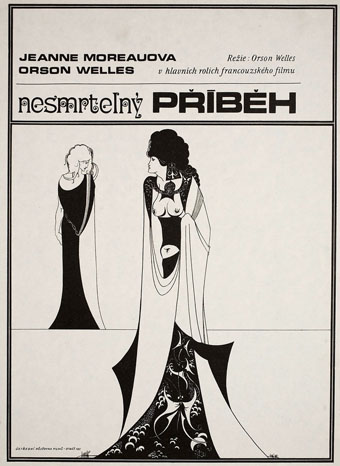
Josef Vyletal borrows figures from Aubrey Beardsley’s Salomé for a Czech poster promoting The Immortal Story (1969) by Orson Welles. Vyletal’s own paintings were often strange and surreal.

Pale Fire is Nabokov’s “great gay comic novel,” says Edmund White. A surprising but not inappropriate reappraisal. White has noted in the past that Nabokov “hated homosexuality” despite having a gay brother and uncle. The portrayal of Charles Kinbote in Pale Fire isn’t unsympathetic if you overlook his being delusional, and possibly insane…

• At Folk Horror Revival: details of the charity donations raised by sales of the Folk Horror Revival books, the first of which featured my David Rudkin essay. A one-day Folk Horror Revival event takes place later this month at the British Museum, London.

• Mixes of the week: The Bug presents Killing Sound Chapter 2: Inner Space, a 2-hour blend of “sci-fi scores, expansive atmospheres and synthesized psychedelia”; Decoded Sundays presents Scanner; Secret Thirteen Mix 197 is by LXV.

Stars Of The Lid unveil a James Plotkin remix of their Music For Twin Peaks Episode #30 Pt. 1. Related: the hype for the new Twin Peaks series gets into gear with a teaser.

• Robert Aickman’s only novel, The Late Breakfasters (1964), is being given its first US publication by Valancourt Books.

• “Don’t dream it, bet it.” Evan J. Peterson on 40 years of The Rocky Horror Picture Show.

• Anna von Hausswolff’s sister, Maria, directs a video for Come Wander With Me / Deliverance.

• RIP Michael O’Pray, film writer and curator of many festivals of experimental cinema.

• Oli Warwick talks to electronic musicians about the influence of the late Don Buchla.

Breakfast In Bed (1969) by Dusty Springfield | Alan’s Psychedelic Breakfast (1970) by Pink Floyd | Another Breakfast With You (2001) by Ladytron