Weekend links 483

doetecum.jpg

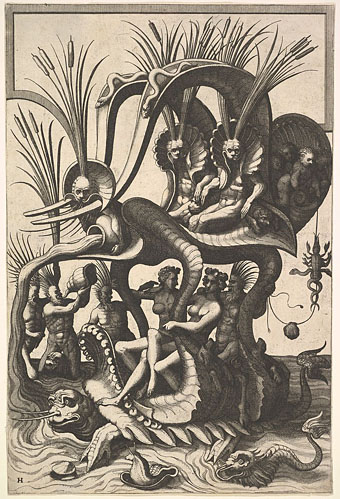
Fantastic Sea Carriage (1556) by Johannes van Doetecum the Elder.

• I’ve grown increasingly tired of Kubrick-related micro-fetishism (despite contributing to it myself with previous posts) but this piece at Film and Furniture about the history of David Hicks’ Hexagon carpet design is a good one.

• “In hindsight, we can see how rarely one technology supersedes another…” Leah Price on the oft-predicted, never arriving death of the book.

• From Rome To Weston-Super-Mare: Eden Tizard on Coil’s Musick To Play In The Dark.

“It is,” the editor of the London Sunday Express had written nine years earlier, sounding like HP Lovecraft describing Necronomicon:

the most infamously obscene book in ancient or modern literature….All the secret sewers of vice are canalized in its flood of unimaginable thoughts, images and pornographic words. And its unclean lunacies are larded with appalling and revolting blasphemies directed against the Christian religion and against the name of Christ—blasphemies hitherto associated with the most degraded orgies of Satanism and the Black Mass.

Regarded as a masterpiece by contemporary writers such as TS Eliot and Ernest Hemingway, celebrated for being as difficult to read as to obtain, Ulysses had been shocking the sensibilities of critics, censors, and readers from the moment it began to see print between 1918 and 1920, when four chapters were abortively serialized in the pages of a New York quarterly called The Little Review. Even sophisticated readers often found themselves recoiling in Lovecraftian dread from contact with its pages. “I can’t get over the feeling,” wrote Katherine Mansfield, “of wet linoleum and unemptied pails and far worse horrors in the house of [Joyce’s] mind.” Encyclopedic in its use of detail and allusion, orchestral in its multiplicity of voices and rhetorical strategies, virtuosic in its technique, Ulysses was a thoroughly modernist production, exhibiting—sometimes within a single chapter or a single paragraph—the vandalistic glee of Futurism, the decentered subjectivity of Cubism, the absurdist blasphemies and pranks of Dadaism, and Surrealism’s penchant for finding the mythic in the ordinary and the primitive in the low dives and nighttowns of the City.

Michael Chabon on the US trial of James Joyce’s Ulysses

• Mix of the week: Through A Landscape Of Mirrors Vol. III—France II by David Colohan.

• Another Not The Best Ambient And Space Music Of The Year Post by Dave Maier.

Sarah Angliss and friends perform Air Loom at Supernormal, 2019.

• Out next month: The World Is A Bell by The Leaf Library.

Amy Simmons on where to start with Pier Paolo Pasolini.

• At Dennis Cooper’s: Candy Clark Day.

• Uccellacci E Uccellini (1966) by Ennio Morricone | Liriïk Necronomicus Kahnt (1978) by Magma | Ostia (The Death Of Pasolini) (1986) by Coil

Weekend links 482

pacheco.jpg

Hades II (2004) by Ana Maria Pacheco.

• I’ve been reading a lot of Angela Carter over the past few weeks so the news of her house in Clapham being awarded a blue plaque was coincidental but also timely. Related: Angela Carter Online, and The Holy Family Album (1991), “a sacrilegious take on the history of Christian painting and iconography” written and narrated by Carter. Also, we’re still some distance from Halloween but take this as a precursor: Vampirella (1976), Angela Carter’s first radio play for the BBC, starring Anna Massey as a vampire countess.

• In May this year the Dark Entries record label announced the discovery of more tapes from Patrick Cowley’s pre-disco years in the 1970s. A selection from the archive, Mechanical Fantasy Box, will be released next month, together with a book of the same name reprinting Cowley’s homoerotic journal from the period.

• More Magma (there’s always more Magma): Warren Hatter on 7 essential albums from their sprawling discography. Related: Magma on film in 1972, appearing in Moi y’en a vouloir des sous, a short but typically intense performance.

• Out in November: Paul Wegener’s adaptation of Gustav Meyrink, Der Golem, wie er in die Welt kam (1920), receives a substantial blu-ray release from Eureka.

• Joe Banks’ forthcoming space-rock exegesis, Hawkwind: Days of the Underground, now has its own website.

• Mix of the week: The Stations Of Summer by Cafe Kaput.

Photos of London’s abandoned Underground stations.

• At Dennis Cooper’s: Alan Boyce grows invisible.

Gudrun Gut‘s favourite albums.

Tanz Der Vampire (1969) by The Vampires Of Dartmoore | Ketch Vampire (1976) by Devon Irons | Vampires (1999) by Pet Shop Boys

Weekend links 480

yokoo.jpg

Tadanori Yokoo (1974) by Tadanori Yokoo and Will van Sambeek. A poster from the Colourful Japan exhibition at the Stedelijk Museum, Amsterdam.

• The first decade of space-rock pioneers Hawkwind is explored by Joe Banks in Hawkwind: Days of the Underground — Radical Escapism in the Age Of Paranoia, coming soon from Strange Attractor Press. I created the wraparound cover for this one, and will be talking about it here in a later post. Those interested in the book should note that the special edition hardback will include an extra book, plus a print and postcards. Limited to 500 copies so don’t wait around.

• “What we look for in our formative years can be very different from the demands we make later as analytical adults, and it was certainly more important to me that representations of gayness were complex or colourful than that they were positive, whatever that meant.” Ryan Gilbey on 50 years of Midnight Cowboy.

• Mixes of the week: Through A Landscape Of Mirrors Vol. II – France I by David Colohan, and As Imperceptibly As Grief The Summer Lapsed Away by Haunted Air.

If we imagine the material world about us having a concealed component of the fictional and the fantastic, visions buried in its stones and mortar waiting for their revelation, then we may suppose that 18th-century Lambeth was a teeming hub of such imaginal biodiversity. Bedlam alone could account for this ethereal population boom, but then nearby was the Hercules Buildings residence of William Blake, which can have only added to the sublime infestation.

Alan Moore on the visionary art of William Blake

• At the Internet Archive: Ten issues of Ed Pinsent’s The Sound Projector Music Magazine (1996–2002), with bonus Krautrock Kompendium.

• “Like many dictators Franco considered himself an artist.” Jonathan Meades on how fascism disfigured the face of Spain.

Occulting Disk is a new album from the master of unnerving doomscapes, Deathprod, which will be released in October.

• Making MAD: Chris Mautner on the beginning and end of MAD magazine.

John Margolies’ photographs of roadside America.

Fair Sapphire by Meadowsilver.

Jarboe‘s favourite music.

Theme from Midnight Cowboy (1969) by John Barry | Astral Cowboy (1969) by Curt Boettcher | Dayvan Cowboy (2005) by Boards Of Canada

Weekend links 478

trip.jpg

Poster by Tadanori Yokoo for The Trip (1967).

• Post of the week is this long-overdue introduction by Warren Hatter to the French rock and electronic music of the 1970s and 80s, a variety of Continental culture which has never commanded the same level of interest in the Anglophone world as its German equivalent. The music made in Germany in the 1970s became popular in Britain thanks to record labels UA and Virgin, and support from enthusiasts like John Peel, but the label “Krautrock” demonstrates how even a favourable form could be promoted in a manner not much better than a tabloid slur. French underground music, as Hatter notes, was never recognised enough to be explicitly labelled although the term “Eurorock” was common for a while in the UK music press, useful for avoiding the slurs while also ignoring national boundaries. Now that German music of the period has been thoroughly explored, resurrected and plundered, more attention may be given to the musicians across la Manche.

Related: Eurock, the long-running distributor/publisher/website/podcast; David Elliott’s Neumusik fanzine, 1979–82; Richard Pinhas: Electronique Guerilla – A Profile by Tony Mitchell; and (linked here before) a Discogs list, French Underground Rock—1967/1980.

• More music: The Flower Called Nowhere, a previously unreleased instrumental version by Stereolab, and Midsummer’s Queen by Meadowsilver.

• Hard Time for the Hardcore: Nick Pinkerton on the pleasure of long feature films, and a decent article once you’re past the stupid sub-heading.

• Coming soon from Strange Attractor Press: Bass, Mids, Tops, An Oral History of Sound System Culture by Joe Muggs & Brian David Stevens.

Anthony Quinn reviews It Gets Me Home, This Curving Track, Ian Penman’s collection of music essays.

Bajo el Sigo de Libra on the art of Touko Valio Laaksonen, better known as Tom of Finland.

• Territory of Dreams: Becca Rothfeld on the world of Bruno Schulz.

• Mix of the week: XLR8R Podcast 601 by Sa Pa.

• RIP Richard Williams, master animator.

A trailer for The Trip. RIP Peter Fonda.

The Trip (1966) by Donovan | Trippin’ Out (1967) by Something Wild | The Trip (1968) by Park Avenue Playground

The Fallen King’s Penitent Soldier

penitent.jpg

Despite having been busy throughout this year I’ve not updated my website for a while so this is the first of several posts intended to remedy the situation. It’s also a dismaying entry since it not only sees the end of this series of gay romance titles by Megan Derr but also the end of the publisher, Less Than Three, who closed their doors a couple of months ago. The sombre appearance of The Fallen King’s Penitent Soldier (which I completed late last year) seems in retrospect like an omen. Gloom aside, I was pleased with the way this series evolved, with each cover posing a challenge in how to maintain the format while working a new variation on the theme.

There are more new book covers still to come, and—when I can find the time—some news of a personal project of my own. As with previous posts about Megan’s series, I’ve included the rest of the covers below.

mercenaries.jpg

loststar.jpg

derr2.jpg

derr1.jpg

Previously on { feuilleton }
The Mercenaries of the Stolen Moon
The Heart of the Lost Star
Tales of the High Court