Animation Magazine: The Brothers Quay

quays2.jpg

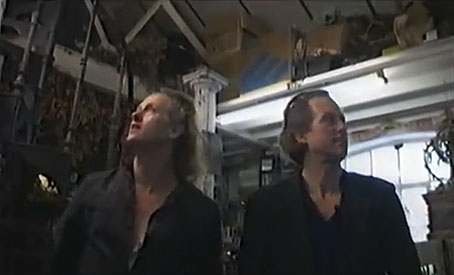
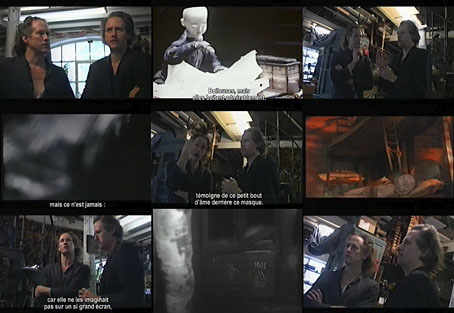
Interviews with the Brothers Quay have been quite plentiful in recent years—some may be found on their DVD releases—but for the Quay enthusiast some are more notable than others. This half hour programme for French TV stood out for me for taking place inside the London studio where many of the Quays’ short films have been made. The interview was conducted in 2002, and one of the brothers mentions that they may be leaving the premises soon; one of their exhibition catalogues has a recent photo of the studio so we can assume this wasn’t the case.
quays1.jpg

Since this was made for an animation series the discussion is mainly about the brothers’ animation techniques. There’s also some barbed comment later on about the conservative state of British television. The UK’s Channel 4 was a great champion of animation in its early days, and the channel’s budget for short films helped finance many of the early films by the Quays and their producer Keith Griffiths. This was at a time when there were only four TV channels to choose from; today we have numerous channels but no room on any of them for unusual or experimental fare. Similar sentiments are voiced on the BFI’s recent collection of Alan Clarke films. Just as there’s no room for the Quays in the current climate, there’s no room either for the single dramas that directors like Clarke were making in the 1970s and 1980s.

Elsewhere on { feuilleton }
The Quay Brothers archive

Weekend links 309

witch.jpg

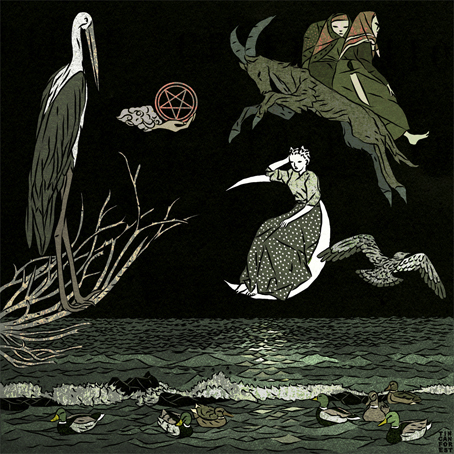
From What is a Witch, “an illuminated manifesto on witchcraft” by Pam Grossman and Tin Can Forest.

• “The other strand of influence for me from dance music was a production house called Savoy in Manchester, England. They were a super underground publishing house that printed cartoons and comic books, and they also released a series of underground dance records. And they were always being shut down by the police and all their stuff was being confiscated, because it was considered ‘anti-society’ in England.” Anohni giving a shout to my colleagues at Savoy Books in a new interview.

Belladonna of Sadness (1973), a feature-length animated film by Eiichi Yamamoto, has been restored, and is being given a premier release in the US. There’s a review here and a trailer here. No news as yet of a UK release but Finders Keepers has the soundtrack album.

Alejandro Jodorowsky talks to Daniel Kalder about his new novel, Albina and the Dog-Men, while Jodorowsky’s comic-book collaborator, Ladrönn, talks to Smoky Man about their new graphic novel, The Sons of El Topo.

Pretty little watercolours these are not. Made by bulldozers and dynamite instead of a paintbrush and easel, the works—often sited on baking sandscapes—fuse minimalism and modern industrial aesthetics to evoke the otherworldly structures of ancient civilisations, from Stonehenge to Mayan temples and the Egyptian pyramids.

Alex Needham on America’s land artists. A few years ago I tracked down some of the structures he describes using Google Maps.

• In every dream home a heartache: High Rise director Ben Wheatley on adapting Ballard, practical special effects and ’70s parenting.

Tom Phillips: From Prequel To Sequel, an exhibition of pages from A Humument at Shandy Hall Gallery.

• From fresh food to magic mushrooms: Michael Pollan probes the medicinal uses of psychedelic drugs.

• “Let’s not forget graphic design is an artistic discipline,” says Jonathan Barnbrook.

Supervert discusses censorship and related matters at SomethingDark.

• “I’ve sung gospel music when in great despair,” says Diamanda Galás.

• Mix of the week: FACT Mix 550 by James K.

Boy Club is a new gay magazine.

Gospel Trane (1968) by Alice Coltrane | The Gospel Comes To New Guinea (1981) by 23 Skidoo | Gospel Train (1990) by African Head Charge

Weekend links 306

midian.jpg

• The Midian Books Occulture catalogue launched this week sporting a cover that I pieced together for Midian’s Jonathan Davies. The design pastiches the look of the Process Church magazines of the early 1970s; inside there’s a haul of Process material on sale together with COUM/Throbbing Gristle ephemera (that’s Cosi Fanni Tutti on the right, as seen on her modelling business card), Kenneth Anger ephemera (that’s Bobby Beausoleil on the left) and much more.

• More occulture: Lost Envoy: The Tarot Deck of Austin Osman Spare launches on 11 May at Camden Arts Centre, Arkwright Road, London NW3 6DG, from 7–9pm. All are welcome.

• Out this week: Close To The Noise Floor – Formative UK Electronica 1975–1984: Excursions in Proto-Synth Pop, DIY Techno and Ambient Exploration.

• Mixes of the week: Spin Doctor’s All Vinyl Prince Tribute Mix, and the Rum Music Mix by Russell Cuzner.

David Gentleman’s illustrations for New Penguin Shakespeare books, 1967–1977.

• More electronica: Walberswick by Jon Brooks is now available in a digital edition.

• Blown up: Steve Rose on how cinema captured the dark heart of the swinging 60s.

• Six Quietus writers choose favourite Prince songs. Related: The A–Z of Prince

A Timeline of Slang Terms for Male Homosexuality by Jonathan Green.

Berenice Abbott’s views of New York streets then and now.

• Jan Švankmajer is crowd-funding his next film, Insects.

Laurie Anderson on the creation of O Superman.

• Blood Ceremony: The Great God Pan (2011) | Oliver Haddo (2011) | Ballad Of The Weird Sisters (2013) | Let It Come Down (2014)

Jan Švankmajer, Director

svankmajer.jpg

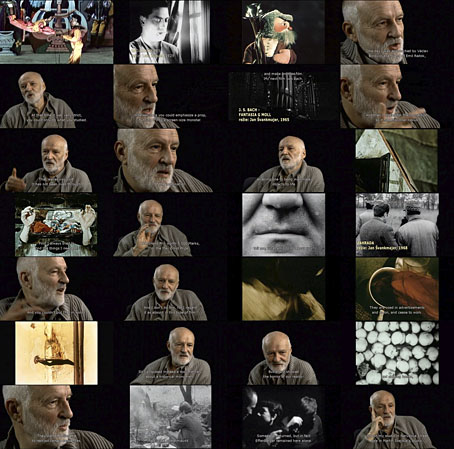
As I have always said, my aim is to make Surrealist documentaries. I want to show that our world is imaginative by nature, that you can look at it imaginatively. It has something that escapes the quotidian gaze. And it is possible to reveal it through the technique of animation. Animation thus becomes a sort of new alchemy.

Thus Jan Švankmajer whose production company, Athanor, is named after the furnace used by medieval alchemists. Jan Švankmajer, Director (2009) is an hour-long documentary by Martin Sulík, one of several films from Golden Sixties, a Czech television series about film directors. Švankmajer has been the subject of several documentaries following his rise to international prominence, one of which, Les Chimeres des Švankmajer (2001), may be found on the BFI’s DVD set of the complete short films. Martin Sulík’s documentary doesn’t cover as much ground as the French film—the focus is on the 1960s—but has an advantage by allowing Švankmajer to talk at length about his work. Topics include his discovery of the usefulness of animation, his approach to filmmaking (and art in general), and peripheral subjects such as the soundtrack music of Zdeněk Liška, and the activities of the Prague Surrealist group. (Via MetaFilter.)

Jan Švankmajer, Director: Part one | Part two | Part three | Part four

Previously on { feuilleton }
Don Juan, a film by Jan Švankmajer
The Pendulum, the Pit and Hope
Two sides of Liška
The Torchbearer by Václav Švankmajer

Weekend links 298

liu-wong.jpg

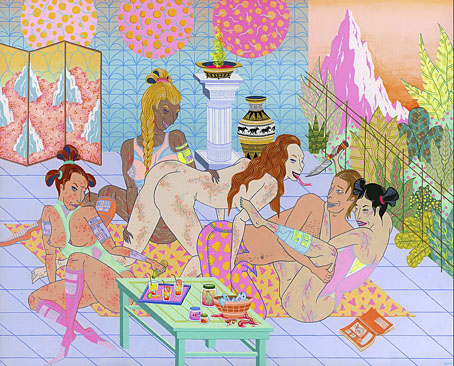
The Gathering (2015) by Kristen Liu-Wong.

• Tom of Finland’s house in Echo Park, Los Angeles, “is a trove of homoerotic masterpieces“. The house and its former owner are celebrated in Tom House, a book by Michael Reynolds with photos by Martyn Thompson. Related: Tom House exposed by Rizzoli.

• “Underlying the heightened nature of the films was a deep, questioning soulfulness related to literary antecedents coupled with a vision of cinema open to shifting levels of perception and fantasy.” David Thompson on Andrzej Żuławski.

• Memories of the Space Age: Photos by Roland Miller of the ruins of NASA’s old launch pads, bunkhouses and research facilities. A British equivalent (and a much more modest affair) is the Highdown Rocket Site on the Isle of Wight.

• Statues allegedly made for the John Huston film of The Maltese Falcon are among the most expensive props in cinema history even though there’s still dispute about their authenticity. Bryan Burrough investigates.

• Mixes of the week: The Solar Gate: Female Private Press New-Age Music – Vol.1 by Michael Tanner, and an “alchemical” Bowie selection by The Ephemeral Man.

• “What Does It Take To Be A ‘Bestselling Author’? $3 and 5 Minutes.” Brent Underwood on why Amazon ratings can’t be trusted.

Edward Gorey/Derek Lamb title sequences from the PBS/WGBH show Mystery! (1981).

• A Painter Possessed: Kate Kellaway on the occult abstractions of Hilma af Klint.

Invertebrate Harmonics: a new composition by Chris Watson.

• Frozen in time: Inside Bangkok’s first ever department store.

Roly Porter’s Favourite Space Records

• Space-Age Couple (1970) by Captain Beefheart & His Magic Band | Space Age Batchelor Pad Music (Mellow) (1993) by Stereolab | Space Age Ballad (2001) by Acid Mothers Temple & The Melting Paraiso U.F.O.