The art of Nick Hyde, 1943–2018

hyde05.jpg

Estate of Man (1967).

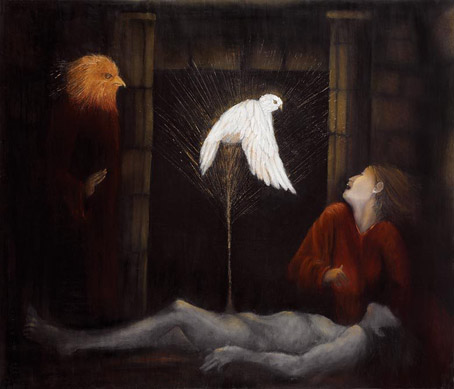
A short tribute to American artist Nick Hyde who I’ve been informed died last month. Hyde’s extraordinary paintings were featured here a few years ago after I found a copy of Visions (1977), an art book devoted to artists of the loosely-affiliated California Visionary school. Most of the paintings in the book are a type of fantastic art (not to be confused with fantasy art) that owes much to the hippy mysticism that later became codified as “New Age”, a vague term which covers a lot of territory. Several of the paintings were featured in the early issues of OMNI magazine but I don’t recall Nick Hyde’s art being among them. Hyde’s early paintings are darker and stranger than those of his Visions contemporaries, and they were ones I inevitably preferred to the rest, hence my earlier post highlighting his work. There isn’t much else I can say about him other than pointing to the official website and posting the following appraisal by Walter Hopps from Visions. All the paintings here are from Visions, and several of them (Abraxas in particular) look like they need to be seen at a much larger size.

hyde06.jpg

Cryptyde (1967).

I am not trying to clean myself of impurities, but to venture into a very real situation. I consider myself a true visionary—it comes to me and I flow with it. My imagery is always a dance.” Nick Hyde, 1976

The powerful nature of Nick Hyde’s art stands in certain important ways vividly apart from that presented here by his visionary colleagues. Rather than scenes of cosmic calm, serene process, or peaceful resolution, Hyde pours forth effulgent compositions of both hallucinatory intensity and tumultuous activity. The myriad visual events and details brought forth in an all-at-once total vision in Hyde’s paintings give rise to a unique tension between what seems the most violent of struggles and the most delicate of dances. In maintaining qualities of such polarity Hyde reveals a mastery of a sinuous, insinuating line structure that both divulges and dissolves images.

hyde03.jpg

Inside Out Breaking Free (1968).

In his extraordinary allegorical painting Estate of Man, human figures are disgorged from a Gothic tracery of lines that suggests the network of nerves of a livid inner eye. Closer inspection reveals the jaws of a hell-mouth that swallows these figures and assimilates them as functioning fibers in a self-conceiving infernal machine. At upper right, however, in a zone of apparent transcendence, Hyde paints a luminist landscape at the moment of sunrise. It is perhaps where one is to find redemption in the Eye of God: or is it merely the burning earth that bears man to offer him to hell?

hyde01.jpg

BethAnn (1969).

Hyde’s painting Abraxas touches on a note of subtle, mordant humor: the mythoid monster and his serpent-headed mate entwined in an infernal lair is, at the same time, a gentleman with his lady, reclining at ease, casually smoking. and telephone in hand. A clock—on the fire-place mantle at the right of the composition—is without hands, and ornamented by two barely perceptible figures. They repeat in reverse the pose of the two polymorphic companions. Abraxas, a god of good and evil, exists in a world abandoned of time, of rhythmic mimesis, of smoldering mockery. —Walter Hopps

hyde02.jpg

Urp (1970).

hyde04.jpg

Abraxas (1971).

Elsewhere on { feuilleton }
The fantastic art archive

Previously on { feuilleton }
Visions and the art of Nick Hyde

The Ingenious by Darius Hinks

hinks.jpg

My latest cover for Angry Robot Books was revealed this week at the Barnes & Noble blog (where I talk a little about the design aspects) so here it is. The Ingenious is an alchemy-themed fantasy by Darius Hinks, the brief for which required a depiction of the city of Athanor, the central character, Isten, and some indication of the novel’s occult flavour:

Thousands of years ago, the city of Athanor was set adrift in time and space by alchemists called the “Curious Men.” Ever since, it has accumulated cultures, citizens and species into a vast, unmappable metropolis.

Isten and her gang of half-starved political exiles live off petty crime and gangland warfare in Athanor’s seediest alleys. Though they dream of returning home to lead a glorious revolution, Isten’s downward spiral drags them into a mire of addiction and violence. Isten must find a way to save the exiles and herself if they are ever to build a better, fairer world for the people of their distant homeland.

I was also asked to do something in the detailed drawing style of artists such as Philippe Druillet and Ian Miller, a challenge I was happy to accept with the proviso that both those artists are inimitable. As I say in the B&N post, I went in a Miller direction although I don’t know whether anyone would spot the influence. I was more overt years ago in some of my borrowings from Druillet whose aesthetics can be discerned in my poor artwork for Hawkwind and my much better artwork for The Call of Cthulhu. The background pattern was the kind of thing I often do where I spend hours working on something then cover it over, but more of the interlacing and symbolism (all genuine alchemical symbols) will be visible on the back of the book.

The Ingenious will be published on 9th February, 2019.

Previously on { feuilleton }
De Sphaera
Delineations
Musaeum Hermeticum
A triangular book about alchemy
Alembic and Ligier Richier
Atalanta Fugiens
Splendor Solis revisited
Laurie Lipton’s Splendor Solis
The Arms of the Art
Splendor Solis
Amphitheatrum Sapientiae Aeternae
Cabala, Speculum Artis Et Naturae In Alchymia
Digital alchemy

The art of Manfred Sillner

sillner1.jpg

Über Regensburg (1979–82).

Manfred Sillner is a German artist whose work had eluded me until very recently when curiosity about a print on the cover of an obscure album impelled me to search for the person responsible. Happily, Sillner has a website (many contemporary painters let galleries do the web work) which gives a decent overview of his prints, drawings and hyper-detailed paintings. The picture above has a page of its own with a number of detailed views. I’m not always keen on the work of artists pursuing what many people would consider as late Surrealism, it’s easy to stray into whimsy with this anything-goes approach. Sillner avoids this for the most part, and I like the concentration on architecture. Some of the prints on his website are small reproductions but larger copies may be found elsewhere.

sillner2.jpg

Die Kirche von Villers-la-Ville (1987).

sillner3.jpg

Das Selbstportrait (1996–97).

sillner4.jpg

Hinter Traumvorhängen (1977–82).

Elsewhere on { feuilleton }
The fantastic art archive

Weekend links 423

howe.jpg

The Miracle (Genet’s Dream) (2001) by Delmas Howe.

• “Zachary Lipton, an assistant professor at the machine learning department at Carnegie Mellon University, watched with frustration as this story transformed from ‘interesting-ish research’ to ‘sensationalized crap’.” Oscar Schwartz on how the media gets AI alarmingly wrong.

• The Aesthetics of Science Fiction: what does SF look like after cyberpunk? Very Brutalist if you ask Rick Liebling, although the first example shown in his piece—the Brunel University Lecture Centre—appears briefly as future architecture in A Clockwork Orange.

• At Expanding Mind: Erik Davis talks with philosopher and religious studies professor Dustin Atlas about ancient skepticism, Madhyamaka Buddhism, the taste of honey, Montaigne, Robert Anton Wilson, and the path of doubt.

• At Muddy Colors: Part 1 of their choices for best fantasy book covers of the year so far, a list which includes my cover for Moonshine by Jasmine Gower. Thanks!

• Soundtracking with Edith Bowman, episode 84: director Todd Haynes on the music of Wonderstruck, I’m Not There, Carol and Far From Heaven.

• Mixes of the week: FACT mix 663 by Space Afrika, Secret Thirteen Mix 262 by Mieko Suzuki, and Black Minimalism, a playlist by David Toop.

• Two minutes, eight barrels: drone and GoPro footage of surfer Koa Smith riding the waves of the Namibia shoreline.

• David Lynch’s Sacred Clay: Shehryar Fazli reviews Room to Dream by David Lynch and Kristine McKenna.

Charlotte Higgins on myths, monsters and the maze: how writers fell in love with the labyrinth.

• Monstrous Geometries in the Fiction of HP Lovecraft by Moritz Ingwersen.

Listen to the mournful wails of planets and moons.

• A Peel Session by Laika

Surf Ride (1956) by Art Pepper | Surf (1976) by Tim Blake | Surfside Sex (1982) by Patrick Cowley

Bibliothek des Hauses Usher

rottensteiner.jpg

As promised a couple of weeks ago, this book-cover post is one of several that originates with Franz Rottensteiner’s horizon-expanding The Fantasy Book: The Ghostly, the Gothic, the Magical, the Unreal (1978). Rottensteiner’s study was important for me not only for its introduction to many hitherto unknown writers but also for its wide-ranging collection of illustrations and cover designs. Most of the artwork has since become very familiar but a few examples were by artists or designers I hadn’t encountered elsewhere. Hans Ulrich Osterwalder was one of these, his art for a series of German horror titles appearing inside the book and, in the case of the US edition of The Fantasy Book, on the cover. Searching for Osterwalder’s work a few weeks ago I was delighted to discover that the German covers were part of a series of horror/dark fantasy reprints for the Bibliothek des Hauses Usher imprint from Insel Verlag, for which Osterwalder created many more striking and unusual covers.

Bibliothek des Hauses Usher published 26 novels or story collections from 1969 to 1975. I thought at first that this was a paperback series but all the books were hardbacks with uniform black covers and white spines. The imprint logo is a rather ordinary looking House of Usher cracking down the middle (a nod to Arkham House, perhaps) with a slogan on the back cover borrowed from Ambrose Bierce: “Can such things be?” Each volume was printed on light green paper, at least until the paper stock ran out. The last three volumes were printed on white paper then on green again when further stocks were found.

page.jpg

Osterwalder’s work on this series stands out for being innovative, surreal and free of the cliches that persist on horror titles. Most of the artwork is illustrative of the contents but it manages this without being too overt or obvious which isn’t an easy thing to do. The list of authors is an interesting mix as well (if you overlook the typically lamentable absence of women writers): many of the names are those you’d expect in a series such as this but there are also some such as Jean Ray and Stefan Grabiński who you wouldn’t find in an Anglophone series. Grabiński was a Polish writer of weird fiction who receives a mention in Rottensteiner’s book (and is a favourite of China Miéville) but whose work is still largely unknown to Anglophone readers. Just as obscure to English readers is Thomas Owen who was a Belgian writer (real name Gérald Bertot) and a friend of Jean Ray’s. Tartarus Press published a collection of Owen’s stories in 2012 but I’ve not read it so can’t vouch for their quality.

All 26 covers are shown below in their order of publication. Hans Ulrich Osterwalder still works as an artist and designer, and has a website here. Franz Rottensteiner was interviewed at 50 Watts a few years ago.

usher01.jpg

usher02.jpg

usher03.jpg

Continue reading “Bibliothek des Hauses Usher”