Weekend links 414

polackova-vyletalova.jpg

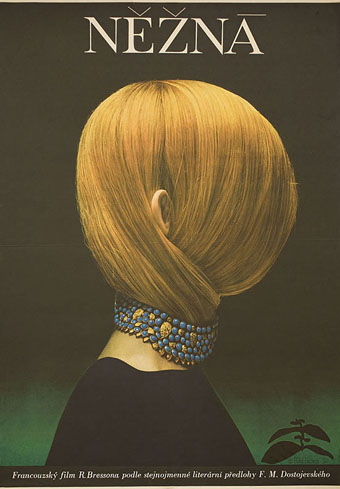
Czech poster for Robert Bresson’s Une Femme Douce (1969) by Olga Polácková-Vyletalová. There’s more about Polácková-Vyletalová’s striking poster designs (and this one in particular) at Mubi. See also the Polácková-Vyletalová collection at Terry Posters.

• “I heard that in Japan the tendency is to hammer down the nails that stick out. I think that Haruomi Hosono is a nail that sticks out. And has maintained that.” Van Dyke Parks on Haruomi Hosono, best known in the West for being one third of Yellow Magic Orchestra but a prolific artist in his own right. Hosono’s early solo albums are being reissued by Light In The Attic later this year.

Hua Hsu on The Spectacular Personal Mythology of Rammellzee. “Rammellzee will always feel like part of the underground,” says Geeta Dayal in a review of the Rammellzee exhibition currently showing in New York.

• Mixes of the week: Hassell’s Children, a Fourth World mix by Ban Ban Ton Ton, The Island of Bright Tombs by SeraphicManta, and a Radio Belbury mix by The Advisory Circle.

• More Robert Aickman: The Fully-Conducted Tour, a complete short story. Related: Matthew Cheney reviews the new Aickman collection, Compulsory Games.

• Another Kickstarter bid, this time for a reprint of Art Nouveau designs and illustrations by Carl Otto Czeschka.

Oliver Burkeman reviews How to Change Your Mind: The New Science of Psychedelics by Michael Pollan.

Art/design/architecture magazines online at the International Advertising & Design Database.

• Tonedeaf in our nose: Gerri Kimber on the musicality of James Joyce’s writing.

• More William Hope Hodgson: Greydogtales examines Hodgson’s poetry.

• The Art of Elsewhere: Jed Perl on the world of Edward Gorey.

• At Dennis Cooper’s: Records.

Beat Bop (1983) by Rammellzee vs. K-Rob | Equation (1989) by Material ft. Rammellzee | No Guts No Galaxy (1999) by Ramm Ell Zee & phonosycographDISK

Weekend links 400

bernard.jpg

Le Répit (La Mort allaitant une chauve-souris) (1895) by Valère Bernard.

Playhouse 90 presents Heart of Darkness by Joseph Conrad. An American TV production from 1957 starring Boris Karloff, Roddy McDowall, Eartha Kitt and others; introduced by Sterling Hayden. It’s bizarre. Acidemic goes into the detail.

• Erik Davis talks to occult writer and drug geek Julian Vayne about Baphomet, the (sur)reality of spirits, evolution, ritualizing entheogens, and his new book Getting Higher: The Manual of Psychedelic Ceremony.

• “Unsurprisingly, 1. Outside was the record that the #BowieBookClub readers most readily associated with Hawksmoor.” Anna Aslanyan revisits Peter Ackroyd’s architectural mystery.

The Flowers of Dorian Gray: part one of a series of posts examining one of Oscar Wilde’s favourite symbols.

• At Haute Macabre, an interview with Michael Locascio & Heather Jean Skawold of Dellamorte & Co.

One Minute Art History, an animated film by Cao Shu.

Film posters at the Harry Ransom Center, UT-Austin.

• Mix of the week: FACT mix 639 by Black Milk.

Susanna‘s favourite albums.

• Welcome to The Spoodoir.

• Flowers Of Evil (1983) by Cortex | Baphomet (1989) by Foetus Inc. | Heart Of Darkness (1989) by Syd Straw

The Scarlet Soul: Stories for Dorian Gray

scarlet.jpg

With the running out of the year it’s time to start posting some of the things I’ve been working on for the past few months. This year has been an incredibly busy one with little breathing space between projects. Last month I mentioned not having enough time to put together a decent mix for Halloween; I also haven’t had enough time to prepare a calendar for next year. The latter isn’t a great loss since last year’s effort was a particularly bad seller but I still like doing them when I have the opportunity.

Before I get to one of the big illustration projects, here’s a cover I put together last month for Dublin’s Swan River Press. The theme should be self-evident, and this marks my second entry into Dorian Gray territory. It’s also the second thing that I’ve worked on this year with a connection to Mark Valentine (see this post for details of the first). Swan River publish a range of elegant hardback editions so I’m looking forward to seeing this one in print. As to the artwork, the frame is adapted from a 1900 calendar design by one Oscar Ziemann which I found in an issue of Deutsche Kunst und Dekoration. There’s next to nothing about Herr Ziemann on the web so his design may have been a one-off. The poppies are my own replacement for Ziemann’s floral designs; they relate to the hints that Oscar Wilde gives to Dorian Gray’s opium indulgence, and they’re scarlet flowers, of course.

The Scarlet Soul will be published next month but it’s available for pre-order here. My next work for Swan River Press will be a major edition of William Hope Hodgson’s weird masterwork, The House on the Borderland. More about that later.

Previously on { feuilleton }
Picturing Dorian Gray

Weekend links 374

vasconcelos.jpg

Le Chasseur by Lupe Vasconcelos who was profiled this week at Unquiet Things, and whose work may also be seen at the Ars Necronomica art show in Providence, RI, until the end of the month.

• “After a morning’s writing, Stevenson would entertain himself with music, particularly the flageolet, which he played so badly ‘people fled from the sound’.” Peter Moore reviewing Robert Louis Stevenson in Samoa by Joseph Farrell.

• Jon Hassell’s 1981 album, Dream Theory in Malaya: Fourth World Volume Two, will be reissued next month.

• Mixes of the week: Secret Thirteen Mix 228 by Arma Agharta, FACT Mix 614 by Do Make Say Think.

Yet, entertaining as all this is, in a macabre key, the dead are hard to think about—and, in many ways, to read about. Unlike animals, which Lévi-Strauss declared were not only good to eat but bon à penser, too, I found that I averted my eyes, so to speak, several times as I was reading this book. Not because of the infinite and irreversible sadness of mortality, or because of the grue, the fetor, the decay, the pervasive morbidity—though Laqueur’s gallows humour about scientific successes in the calcination of corpses can be a bit strong—but because the dead present an enigma that can’t be grasped: they are always there in mind, they come back in dreams, live in memory, and if they don’t, if they’re forgotten as so many millions of them must be, that is even more disturbing, somehow reprehensible. The disappeared are the unquietest ghosts. Simone Weil writes that the Iliad is a poem that shows how “force…turns man into a thing in the most literal sense: it makes a corpse out of him.” But Laqueur is surely right to inquire why that thing, the “disenchanted corpse…bereft, vulnerable, abject”, is a very different kind of thing from the cushion I am sitting on or even my iPad (which keeps giving signs of a mind of its own). I have always liked Mme du Deffand’s comment, when asked if she believed in ghosts. A philosopher and a free thinker, she even so replied: “Non, mais j’en ai peur.” (“No, but I am frightened of them.”)

Marina Warner reviewing The Work of the Dead: A Cultural History of Mortal Remains by Thomas Laqueur

New Worlds magazine at the Internet Archive. Not a complete run but it’s a start.

Brigit Katz on breakthroughs in the scientific search to replicate psilocybin.

• The relaunched (and slightly renamed) Manchester Digital Music Archive.

• At Dennis Cooper’s: Robert Altman Day (restored/expanded).

• RM Rhodes presents the art of Philippe Druillet.

Fragile Self

Dream Lover (1964) by The Paris Sisters | Dream Street (1966) by Henry Mancini | Dream Letter (1969) by Tim Buckley

Being PrEPared

prepdiaries.jpg

I don’t know when I first noticed that the word “introvert” contains the word “invert” but if I require a shorthand self-identification beyond the vocational then “introvert invert” is a suitable candidate. Being an introvert isn’t always easy in a resolutely extrovert world, but being an introvert invert has considerable drawbacks, such as how you meet anyone like yourself when the available meeting places—club and bars—inspire severe loathing. Clubbing is no longer the only option now that we have online dating (and gay clubs have been dying off in any case…) but the options were few in the 1980s. It’s impossible for me to think about any of this without considering that if I wasn’t such an introvert I might not be alive today. I was 20 in 1982 when the AIDS epidemic was starting to travel the world; had I been more gregarious I might have been investigating all those wretched clubs and bars instead of sitting at home, listening to music and drawing pictures.

aids.jpg

The Thatcher government only started to get serious about HIV/AIDS in 1987 when this information leaflet was delivered to every household in Britain. (See scans of the whole thing here and here.) There was also an accompanying public information film narrated by John Hurt, and directed by Nicolas Roeg, of all people. It was quickly replaced with other films that were less apocalyptic.

Whatever your attitude to nightlife, if you were gay in the 1980s then AIDS was omnipresent even before it became an issue that politicians dared to discuss in public. I remember when Patrick Cowley died (November 1982); I remember when Klaus Nomi died (August 1983); I bought the Panic/Tainted Love single by Coil when it was released (May 1985), the profits of which went to AIDS charity The Terrence Higgins Trust (the first record release to make such a donation). Coil’s doom-laden Horse Rotovator album from 1986 was shaped by the group’s experience of watching many of their friends succumb to illness and death. There were many other such responses, one of the greatest being the monumental Masque Of The Red Death album cycle by Diamanda Galás, dedicated to Galás’s brother and her friends who were killed by the epidemic. I can’t think of artist and writer Philip Core without remembering the interview he gave to The Late Show from his hospital bed in 1989, a hollow-eyed ghost of his former self. The accumulated fear and paranoia of a dark decade lingered into the 1990s even after condom-use had become widespread and HIV became manageable with drug treatments.

aidsad.jpg

More from the fun decade. A government health ad from The Face magazine, February 1987.

The paranoia of the 1990s is one of the first things that Evan J. Peterson discusses in The PrEP Diaries, an account of growing up gay in America at a time when HIV was treatable but still something to be worried about. Evan is a friend whose previous books have been mentioned here (one of which I contributed to), but this is his first non-fiction title, a witty and enlightening combination of erotic memoir and public service declaration. “PrEP” refers to the drug marketed in America as Truvada, a pre-exposure prophylaxis anti-viral medication which has been gaining use in the US as a preventative treatment for HIV. The drug’s use is recommended primarily to partners of those who are HIV+ but it’s also being recommended to gay men with active sex lives as an additional safeguard against HIV. I’ve been aware of Truvada for several years but since it still isn’t easily available in the UK I’ve not followed the discussion around its use or effectiveness very closely.

One of the reasons for Evan writing The PrEP Diaries was to widen the discussion about PrEP/Truvada by showing how his own use of the medication has helped dispel the paranoia he felt about HIV risks, a paranoia that had been with him since childhood. He was born in 1982, the year that AIDS first began to make headlines so he’s of a generation that has never known a time without the risk of HIV. One of the notable things about his book is the way it shows the substantial differences of experience between the gay and straight worlds, differences that persist even as legislative equality grows. Sexual risk is one of these differences, something you’re always aware of if you’re gay or bisexual but which the straight world seldom considers at all. I have a half-brother who’s a few years older than Evan, and two nephews who are a decade younger; all are straight, and I doubt that any of them have given more than a moment’s thought to the idea that sexual activity could have life-changing consequences even though viruses don’t care about your sexuality. HIV can be kept under control today yet it continues to spread, in part because the serious concerns of previous decades are no longer prevalent. You can’t go on any gay dating site without eventually seeing someone with “poz” in their name or some other indication (usually a + symbol) of their HIV status. One of the benefits of PrEP that Evan discusses is its helping people who are HIV+ to find more partners as well as protecting those partners from infection. He also emphasises something you seldom see mentioned in general discussion of HIV, that positive status doesn’t describe a single condition; some people are positive but undetectable, meaning that their viral load is extremely small.

Continue reading “Being PrEPared”