The Cosmic Grill

hotmg1.jpg

Design and illustration by Barney Bubbles.

The past week’s music listening has alternated between the back catalogue of Seattle band, Earth (who I recommend highly), and the early recordings of my erstwhile employers, Hawkwind. The latter were reissued recently in a 10-CD box, This Is Your Captain Speaking…Your Captain Is Dead (The Albums And Singles 1970–1974) which I also recommend, it’s very good value, and packages the albums in those facsimile card sleeves that now seem de rigueur for album reissues. A swathe of my rare Hawkwind vinyl got sold off circa 1990, and I’ve never replaced any of the albums or singles so this was a good opportunity to catch up. If you like this period of the band there’s the added bonus of the complete Greasy Truckers concert from the Roundhouse in 1972, a ramshackle performance that nonetheless sounds pristine (my Greasy Truckers vinyl—which I do still own—was ruined by a previous owner with a spillage of tea on the Hawkwind side); there’s also the entirety of the 1999 Party concert from Chicago which I’d not heard before.

hotmg2.jpg

Listening again to Hall Of The Mountain Grill (1974) had me thinking about the origin of the album’s title. Hawkwind never took themselves as seriously as many of their contemporaries, but naming an album of ostensible space rock after a very mundane café in the Portobello Road was one of their more eccentric moments. The humour is compounded by Barney Bubbles’ cover design which for the title uses the kind of typeface (Palace Script) that you see on menus; on the inner sleeve there’s a photo of the fabled restaurant flanked by a pair of Barney’s futuristic towers. The verse beneath the photo (“from the Legend of Beenzon Toste”) refers to nearby Ladbroke Grove, and, of course, to Notting Hill Gate which in 1974 was still a haven for counterculture freaks, the very antithesis of that film. The verse was probably the work of Robert Calvert who explained the attraction of the restaurant in Pete Frame’s Hawkwind family tree:

The Mountain Grill was a working man’s café in Portobello Road—frequented by all the dross and dregs of humanity. Dave Brock always used to go and eat there—which is how I first met him…because I used to eat there too, when I worked on Frendz magazine. It was a kind of Left Bank café/meeting place for Notting Hill longhairs—a true artists’ hangout…but it never became chic, even though Marc Bolan, David Bowie and people like that often went there to eat lunch.

portobello.jpg

Photos on Flickr show how the place looked in 1977 when the sign from the album sleeve was still intact, and also in 2003 shortly before the restaurant closed down. The premises are a very different kind of eaterie today, remodelled and upmarket as befits a gentrified area.

Previously on { feuilleton }
Void City
Hawk things
The Sonic Assassins
New things for July
Barney Bubbles: artist and designer

The Contrary Tale of the Butterfly Girl

butterfly1.jpg

Three months after The Singular & Extraordinary Tale of Mirror & Goliath I can reveal my cover design for Ishbelle Bee’s sequel, The Contrary Tale of the Butterfly Girl. Here’s a summary, swiped once again from the Barnes & Noble SF & Fantasy blog:

Two orphans, Pedrock and Boo Boo, are sent to live in the sinister village of Darkwound. There they meet and befriend the magical and dangerous Mr Loveheart and his neighbour Professor Hummingbird, a recluse who collects rare butterflies. Little do they know that Professor Hummingbird has attracted the wrath of a demon named Mr Angel-Cakes.

One night, Mr Angel-Cakes visits Boo Boo and carves a butterfly onto her back. Boo Boo starts to metamorphose into a butterfly/human hybrid, and is kidnapped by Professor Hummingbird. When Mr Loveheart attempts to rescue her with the aid of Detective White and Constable Walnut, they are turned into butterflies.

Caught between Professor Hummingbird and the demon Angel-Cakes, Loveheart finds himself entangled in a web much wider and darker than he could have imagined, and a plot that leads him right to the Prime Minister and Queen Victoria herself…

I also supplied some comments about the design for the B&N post. I knew this would be an enjoyable job as soon as I read the title since I approve of anything involving butterflies. The main challenge was that the first cover came out so well—and has been very well received—that the new design needed to be just as successful. Ishbelle’s novels are wild and crammed with so much incident I keep thinking these covers are, if anything, a little sedate. But the main task of a cover is to attract new readers not illustrate every last plot detail, and in that the first cover seems to be doing its job. The Singular & Extraordinary Tale of Mirror & Goliath will be out at the end of June; The Contrary Tale of the Butterfly Girl will be published at the beginning of August.

Previously on { feuilleton }
The Singular & Extraordinary Tale of Mirror & Goliath

Weekend links 261

hardie.jpg

Salome (2013) by Lucie Hardie.

Aickmanesque, “A list of films that possess the same strange ambiguities, disturbing illogicalities, grim mundanities, psychological unpleasantness, narrative open-endedness, Freudian oddness and genuine disturbing moments of horror as the short stories of Robert Aickman.” One of those films, Symptoms (1974), has been out of circulation for a long time but may be watched at YouTube.

• “If this was psychedelia, then it had more in common with the variety peddled by US bands like The Rain Parade, The Three O’Clock…and The Bangles…all of whom had been grouped into a movement known as The Paisley Underground.” Joseph Stannard looks back at Around The World In A Day by Prince And The Revolution.

• “…what I do is not magical realism. I do realistic magic.” Alejandro Jodorowsky talking to Ilan Stavans about writing and filmmaking. A substantial interview in which Jodorowsky isn’t forced to express himself solely in English.

[Angela] Carter thoroughly upset the bien pensants with her essay The Sadeian Woman (1978) where she argued that Sade “was unusual in his period for claiming rights of free sexuality for women and in installing women as beings of power in his imaginary worlds … I would like to think that he put pornography in the service of women, or, perhaps, allowed it to be invaded by an ideology not inimical to women.” She also makes the connection between Sade’s misanthropy, as she calls it, and his splitting of women’s bodies from “the mothering function”. McQueen seems to me to fascinate for similar reasons. Some of the pull he exerts on huge numbers of people arises from this side of his sensibility: there’s no hint of motherhood; he disliked the way that traditional décolletage revealed the breasts, and instead encased the whole female torso in coiled silver, mussel shells or razor clams—even glass.

Marina Warner on Alexander McQueen whose Savage Beauty exhibition is currently running at the V&A

• London’s American poster king: Graham Twemlow on E. McKnight Kauffer’s posters for the London Underground.

• At Celluloid Wicker Man: Electronic music and mental illness in cinema.

• Mix of the week: Secret Thirteen Mix 154 by Moniek Darge.

#1 (1994), the first album by Skylab, has been reissued.

Vir·tu·al Ge·om·e·try

Tamborine (1985) by Prince And The Revolution | Indigo (1994) by Skylab | Metronomic Underground (1996) by Stereolab

La Bibliothèque de Babel

babel01.jpg

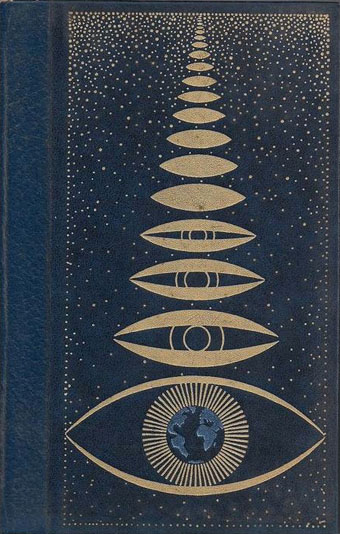
It was perhaps inevitable that this small collection of works of fantastic fiction was named after its director’s most famous creation, the Library of Babel. Jorge Luis Borges chose the titles, and also wrote introductions for each of the books. The series was published in France by Retz–Ricci, with 4000 numbered copies of each title appearing from 1977 to 1981.

Many of the selections will be familiar to Borges aficionados, others seem obscure as a result of the vagaries of translation: Jack London’s Les Morts Concentriques is The Minions of Midas, a story that Borges had earlier translated into Spanish as Las Muertas Concéntricas (The Concentric Deaths). The story of linked deaths apparently influenced the writing of Death and the Compass. I’ve never seen Borges discuss Arthur Machen at length so the inclusion of Machen in the selection is a welcome sight. In addition to The Shining Pyramid, the Machen volume also contained The Novel of the Black Seal and The Novel of the White Powder, two of the oft-anthologised sections of The Three Imposters.

The only detail that’s defeated me  is the identity of the illustrator of the series. If anyone knows who was responsible then please leave a comment.

Update: the covers are credited to publisher/designer Franco Maria Ricci and Marcella Boneschi. Thanks to herr doktor bimler and Al Diniz.

babel02.jpg

babel03.jpg

Continue reading “La Bibliothèque de Babel”

Art that transcends

ca56.jpg

Late last year, US design magazine Communication Arts asked me to write a piece about psychedelic art, past and present. The resulting feature has been out for a couple of weeks in the May/June issue (no. 56) but I hadn’t seen it in print until a copy turned up today. Attempting to wrangle discussion of a very wide-ranging and amorphous field into 1500 words isn’t an easy task but I managed to sketch a history of psychedelic art beginning with Aldous Huxley and Humphrey Osmond’s mescaline experiments in the 1950s. Art that can be considered psychedelic goes back into prehistory but Huxley’s The Doors of Perception (1954) is the first book that considered art in general from a psychedelic viewpoint. That book, and the later Heaven and Hell (1956), are still valuable for their aesthetic meditations however much Huxley’s optimism may have been tainted by the ferment of the 1960s.

earth.jpg

Primitive And Deadly (2014) by Earth. Art by Samantha Muljat.

The psychedelic art of the 60s isn’t exactly overlooked so I paid more attention to tracing the influence of the psychedelic style, and also mentioning painters such as Ernst Fuchs, Alex Grey, Martina Hoffmann and Mati Klarwein. Among the more recent artists, I was pleased that Samantha Muljat‘s album cover for Earth was featured. I’ve been listening to this album a great deal over the past few months, and loved that cover as soon as I saw it. One of the other contemporary names, Brazilian artist Duda Lanna, works in a very different style: bold, vivid, and often abstract. There seems to be a lot of this kind of work around at the moment, so much so that I kept spotting new examples after the article had been delivered. It’s difficult to say whether this is a developing trend or simply a case of there being more of everything around these days. I’ll play safe and suggest it’s probably a bit of both although, as I say at the end of the article, if the movement to legalise drugs gains momentum we can expect to see a lot more psychedelic art.

lanna.jpg

Garden of Psychedelic Delights by Duda Lanna.