More Esteban Maroto

maroto05.jpg

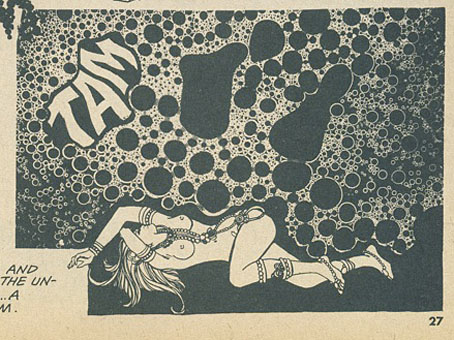
Psychedelic Kali from Vampirella 18.

Copies of the Dracula comics may be scarce these days but two of the artists who appeared in the title—Esteban Maroto and José Beá—were also appearing regularly in Vampirella around the same time. The Internet Archive has a large collection of Warren titles including an almost complete run of Vampirella. Esteban Maroto’s work stands out for me for his draughtsmanship, his page layouts, the atmosphere of heady eroticism, and the frequent touches of psychedelia of which the panel above is one of the more striking examples. The best strips are the ones he wrote himself; when he works with American writers the results tend to be more restrained. It’s a shame Vampirella was mostly a black-and-white title, so many of these pages would benefit from the same colour treatment as Wolff.

maroto01.jpg

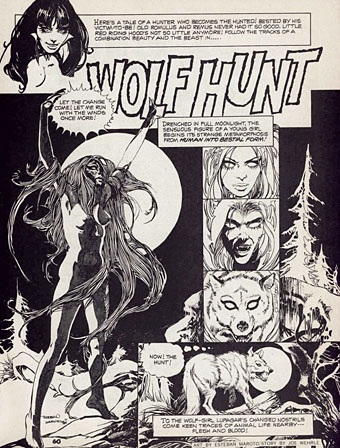
Wolf Hunt from Vampirella 14.

And speaking of wolves, there’s a similar collection of witches and lycanthropes in these stories.

maroto02.jpg

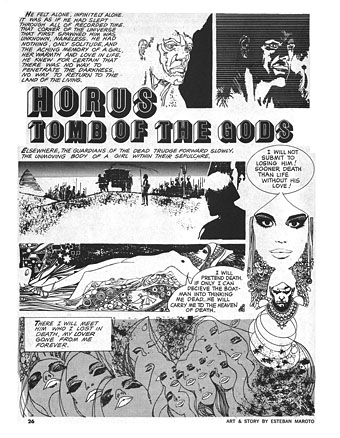
Tomb of the Gods: Horus from Vampirella 17.

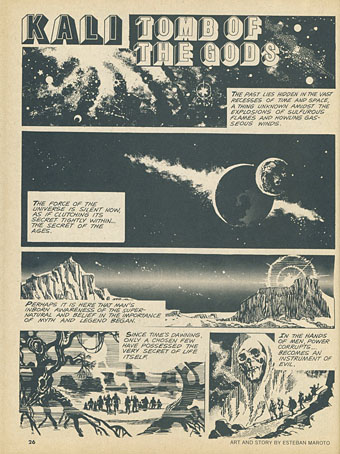
Tomb of the Gods is a short series in which mythological stories are explored Maroto-style. The exception is Gender Bender, a piece of science fiction with masculine and feminine psyches pitted against each other in a virtual arena. The story title is a surprise for anyone thinks that phrase originated in the 1980s.

maroto03.jpg

Tomb of the Gods: Kali from Vampirella 18.

Continue reading “More Esteban Maroto”

The Dracula Annual

wolff1.jpg

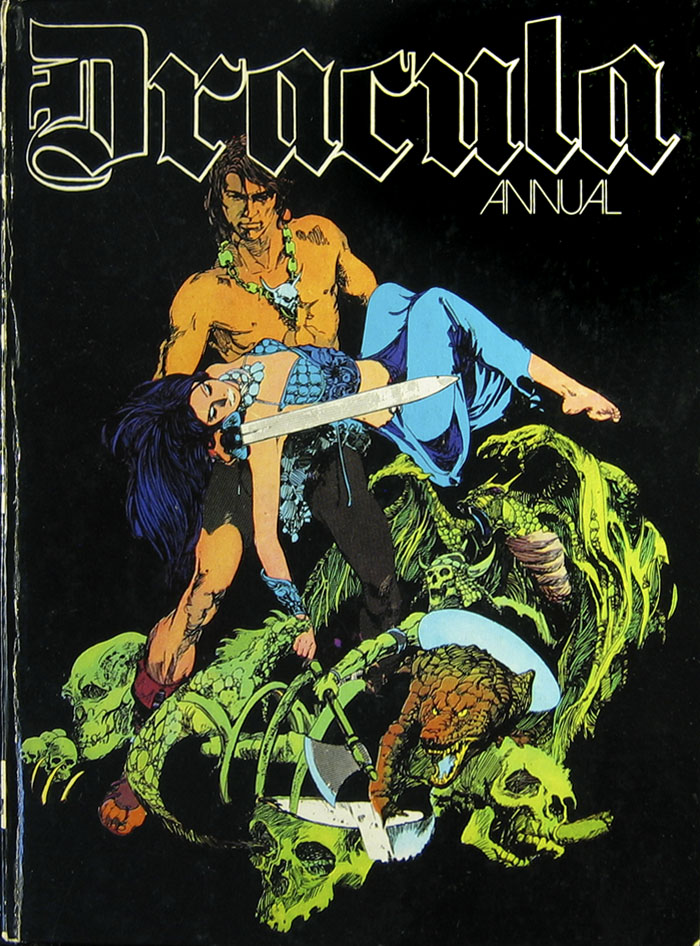
A comment by Modzilla in last month’s post about psychedelic comic book Saga de Xam is responsible for this recent book purchase. Dracula was a full-colour large-format comic book from notorious pulp imprint New English Library (later to be distributors for my colleagues at Savoy Books) that repackaged Spanish horror strips for a British audience. The comic ran for 12 issues in the early 1970s; the pages shown here are from the hardback annual that gathered all the issues into a single volume. I remember this being around in secondhand shops for years but I never paid it any attention at all so the artwork has been a revelation.

NEL’s Dracula isn’t much of a horror comic, despite its title; Dracula himself only appears in one story, and that’s a jokey throwaway piece. The two main episodic strips are Wolff, a Conan clone searching for his lost wife in a world ravaged by witches, werewolves and other supernatural threats; and Agar-Agar, a deliriously psychedelic picaresque concerning a hyper-sexual “sprite” (or a hippyish young woman with blue hair and magic powers) from the planet Xanadu. Everything in the book is redolent of the early 1970s when strains of psychedelia were still percolating through pop culture. Watered-down psychedelia used to bore me because I wanted the authentic stuff but forty years on this kind of work is much more attractive.

wolff2.jpg

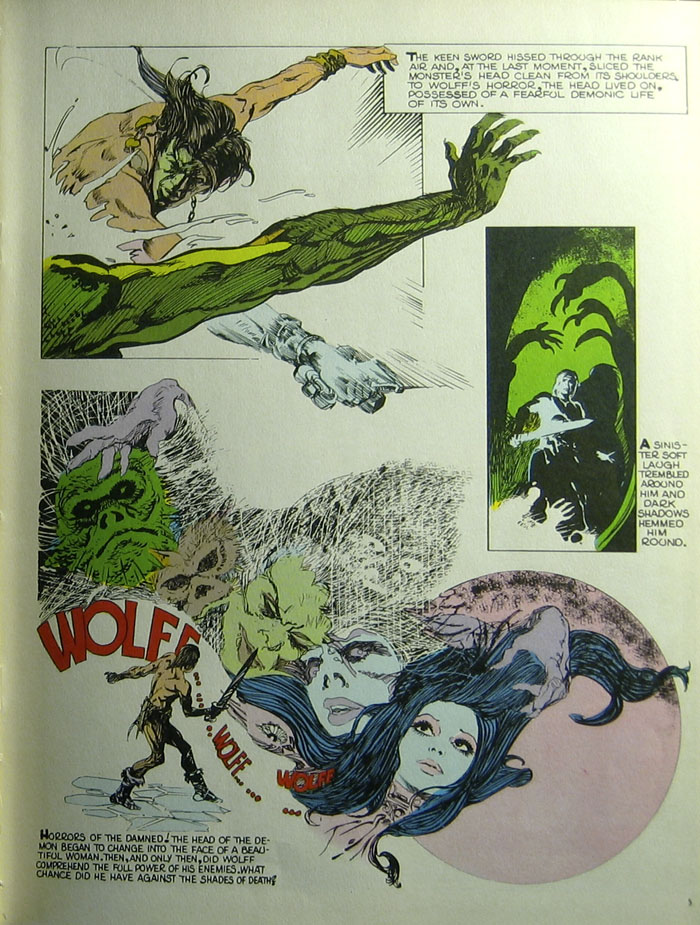
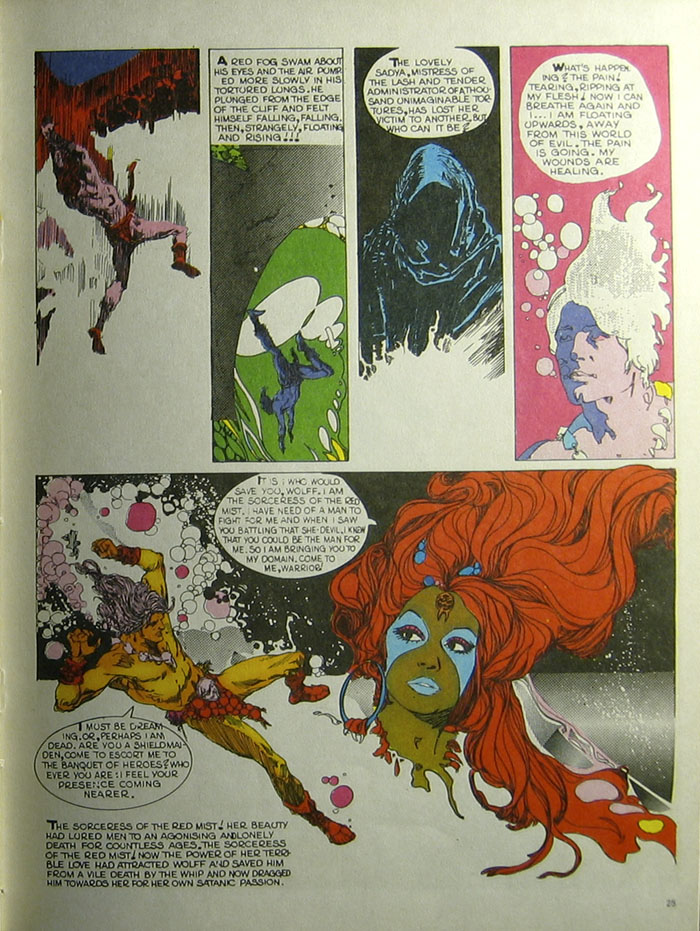
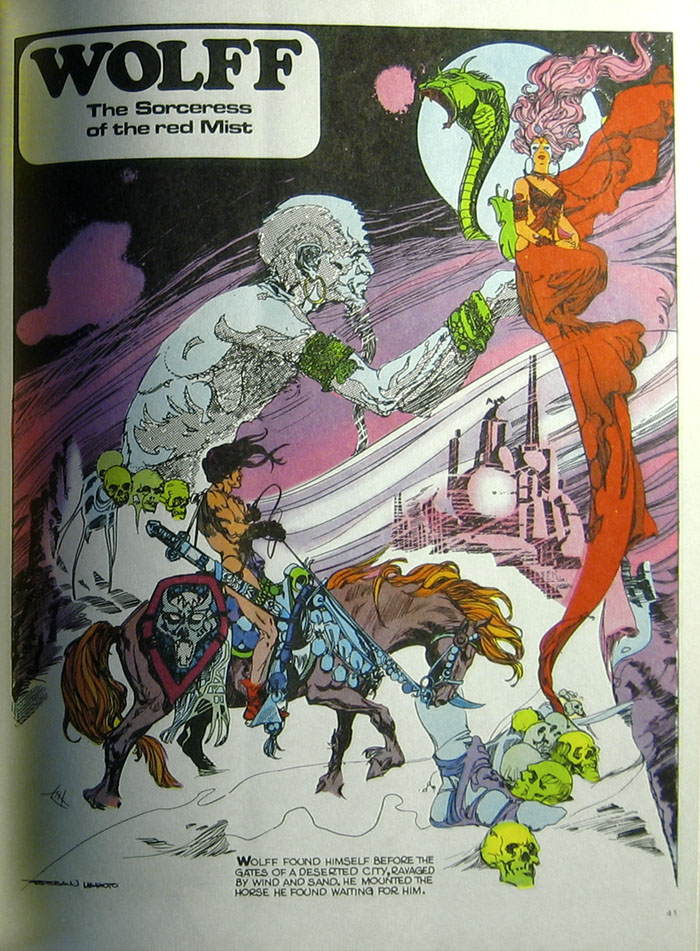
Wolff is the work of Esteban Maroto whose splash pages and inventive layouts give Barry Windsor-Smith’s Conan the Barbarian (which was running at this time) some serious competition. Wolff is very much in the Conan mould—he even shouts “Crom!” at crucial moments—a pawn of supernatural forces he often fails to comprehend. The artwork in Smith’s Conan was often praised for its details and decor but the Art Nouveau influence in Maroto’s work is much more overt. Maroto’s flame-haired witches are like Alphonse Mucha sirens—one panel even borrows from Mucha’s Salammbô—and he’s no slouch with the Frazetta-like demons either. The scripting is perfunctory but I don’t mind that when it turns up pages like these. There’s also a brief nod to Lovecraft when “R’Lyeh” is mentioned.

wolff3.jpg

wolff4.jpg

Continue reading “The Dracula Annual”

Dune designs

dune01.jpg

Currently racking up the bids at eBay (again) is an early draft of Alejandro Jodorowsky’s script for his ill-fated film of Dune. Aside from some diverting glimpses of dialogue and plot elaboration, what’s most interesting about the draft is the character and scene sketches, some of which are sampled below. I’ve still not seen the documentary about the unmade film so I can’t say whether any of these have appeared in public before but if they have they’re new to me. No artist is credited but the naive style rules out both Moebius and HR Giger (who arrived late to the project in any case). Best bet is either Jodorowsky himself—in 1967 he was writing and illustrating a comic strip, Fabulas Panicas—or Jodorowsky’s colleague from the Panic Movement days, Roland Topor. In the early 70s Topor was working with René Laloux on the animated SF film Fantastic Planet.

dune02.jpg

Many of the conceptions differ radically from the more graceful designs that Moebius produced later on. Also of note are details such as the anal entrance to the Emperor’s throne room, a Harkonnen orgy and an insemination scene viewed from inside Jessica’s vagina. By the time Giger joined the production team the instruction was not to create anything too erotic or adult since the film needed to reach a large audience.

There’s more from the Dune script (and larger copies of these images) here. (Thanks to Jay for the tip!)

dune03.jpg

Continue reading “Dune designs”

Haunted Corridors: The Temporal Enigmas of Sapphire and Steel

sands01.jpg

All irregularities will be handled by the forces controlling each dimension. Transuranic, heavy elements may not be used where there is life. Medium atomic weights are available: Gold, Lead, Copper, Jet, Diamond, Radium, Sapphire, Silver and Steel.

Sapphire and Steel have been assigned.

Voiceover at the beginning of each episode

Having revisited a fair amount of old television in the past few years I thought I was past being surprised, but this came as a revelation. Sapphire and Steel appeared at exactly the wrong moment for me to fully appreciate it the first time round. The six storylines ran on the ITV network from 1979 to 1982, a period when my home and personal life was so chaotic that I saw little television at all. At any other time a series featuring a pair of cosmic investigators immersed in mysteries involving haunted railway stations and people escaping from photographs would have been essential viewing. Sapphire and Steel was never repeated after those original screenings so watching the entire run recently has been like seeing it for the first time. In recent years the series has been included in discussion of the weirder British television of past decades; China Miéville in his interview in The Twilight Language of Nigel Kneale describes Sapphire and Steel as the strangest thing ever screened on British TV. After reading that, and a couple of other appraisals, I felt obliged to refresh my vague memories.

sands02.jpg

Assignment One: Sapphire (Joanna Lumley) and Steel (David McCallum).

Superficially, Sapphire and Steel belongs to the occult-detective subgenre, a minor category of weird fiction that in its early days included characters such as Sheridan Le Fanu’s Dr Martin Hesselius, Algernon Blackwood’s John Silence, William Hope Hodgson’s Thomas Carnacki and others. But several factors set Sapphire and Steel apart from their more staid predecessors: occult detectives are generally solitary figures whereas Sapphire and Steel operate as a pair; Sapphire is a woman in a field more commonly occupied by middle-aged men; and most striking of all, both Sapphire and Steel are supernatural beings themselves, dispatched to Earth by agencies we never see and learn nothing about, in order to mend ruptures in the flow of Time. Supernatural detectives had appeared in comic books before this but there’s no evidence that series creator PJ Hammond was considering such antecedents when he wrote The Time-Menders (as Sapphire and Steel was originally known). A few years earlier Hammond had been writing for Ace of Wands (1970–72), a mildly hippyish children’s TV series whose hero, Tarot, was a youthful stage magician with genuine occult powers. Between stage shows, Tarot and friends investigated supernatural events. Sapphire and Steel had originally been planned as a series for children but before the first script was finished it was moved to an early evening slot, thus allowing for darker and more adult-oriented material.

sands03.jpg

Assignment Two: the haunted railway station. The clothing worn by the pair changes with each assignment; on this occasion they’re in evening dress.

One of the attractions of Sapphire and Steel in a genre replete with origins and canonical histories is how little is explained about the two main characters, the source of their assignments, or even the true nature of the malevolent forces they have to face. Sapphire (Joanna Lumley) and Steel (David McCallum) embody the materials after which they’re named, the pair being part of a team of elemental operatives some of whose names are listed in the voiceover that introduces each episode. We only encounter two others: Lead (Val Pringle), a huge African-American man with superior strength; and Silver (David Collings), an effete and dandyish Englishman with the ability to mould metals, fix machines and replicate objects. Sapphire’s abilities are mainly psychometric—she reads the history and condition of people and places—but she can also rewind time for short periods; Steel is as cold and unyielding as his name; he’s fiercely analytical, often bad-tempered and also strong enough to tie a knot in a lift cable.

Continue reading “Haunted Corridors: The Temporal Enigmas of Sapphire and Steel”

Spare things

spare-cthulhu.jpg

Cthulhu Cultus: The Sun is Sick (no date) by Austin Osman Spare.

I’ve been telling people about this drawing for years but I’ve not posted it here before. Spare produced this piece after Kenneth Grant gave him some of HP Lovecraft’s stories to read. I’ve never seen it dated but it’s probably from the mid-50s when Kenneth and Steffi Grant were corresponding with Spare and commissioning new artworks. What’s notable for me is that this is probably the first Lovecraft-derived drawing that wasn’t either a magazine or book illustration, or something done for one of the horror fanzines.

coc.jpg

The Call of Cthulhu (1987) by John Coulthart.

Lovecraft aficionados have never seemed aware of Spare’s drawing since Lovecraft studies tended until very recently to remain fixed on popular media and the often parochial world of genre fandom. When I came to draw the swamp scene for The Call of Cthulhu in 1987 I borrowed the faces from Spare’s pillar for the column in the centre of the picture.

bulldogbreed.jpg

Bulldog Breed.

While we’re on the subject, and in the spirit of showing how all the obsessions here connect in one way or another, Phil Baker’s excellent biography of Austin Spare notes a surprising reference to the artist that predates Man, Myth and Magic via the psychedelic music scene. Bulldog Breed were a short-lived London group, one of many being promoted by the Deram label in the late 1960s. The group’s one-and-only album, Made In England, was released in 1969. The cover art is dreadful but the final song is a number entitled Austin Osmanspare [sic], a paean to the artist that turns AOS into a typical character from British psychedelia: an eccentric, oddly named, Victorian type with a sinister and mysterious glamour. According to Baker one of the band members had an aunt who knew Spare. It’s not a bad song, and the choice of magus gave them an edge over the Beatles who went for the more obvious Aleister Crowley. “They said he was before his time…”

Previously on { feuilleton }
Dreaming Out of Space: Kenneth Grant on HP Lovecraft
MMM in IT
Intertextuality
Abrahadabra
The Occult Explosion
Murmur Become Ceaseless and Myriad
Kenneth Grant, 1924–2011
New Austin Spare grimoires
Austin Spare absinthe
Austin Spare’s Behind the Veil
Austin Osman Spare