Querelle de Brest

querelle01.jpg

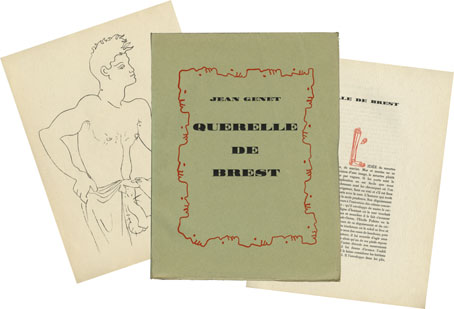
Querelle de Brest (1947) by Jean Genet. Cover design by Jean Cocteau.

This weekend’s viewing was Fassbinder’s Querelle (1982) which is marvellous in its new Blu-ray transfer, and a great improvement on the muddy picture of the earlier DVD release. The film is still only the briefest sketch of Genet’s novel (although Genet biographer Edmund White enjoyed it) but I like the overheated atmosphere, the phallic set designs, Franco Nero (hey, it’s Django Gay!), and the film as a whole is a fitting memorial to Brad Davis, everyone’s favourite sweating matelot. So in honour of all that, here’s a small collection of Querellerie past and present.

querelle02.jpg

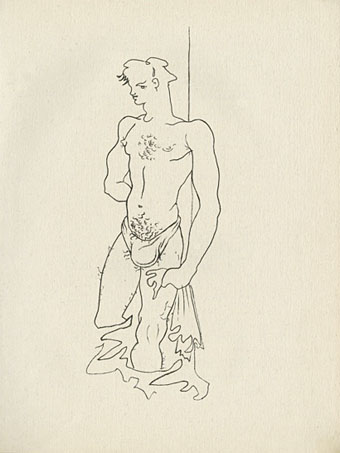
Querelle de Brest was published in a limited edition of 525 copies illustrated throughout by Jean Cocteau who didn’t avoid the pornographic details. Even though copies were seized by the authorities, and the author fined, Cocteau’s involvement did little to harm his public reputation, something that’s impossible to imagine happening elsewhere. A few of the illustrations follow below, many more of the series can be found scattered across various websites.

cocteau1.jpg

cocteau2.jpg

cocteau3.jpg

Continue reading “Querelle de Brest”

Weekend links 219

balbusso.jpg

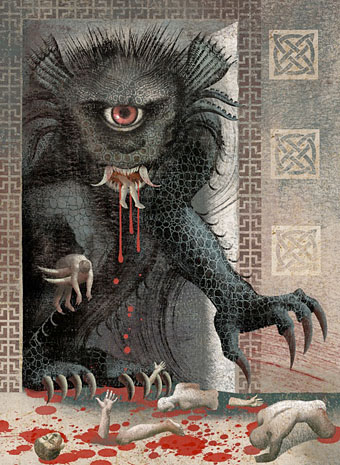
Grendel Monster (2013) by Anna & Elena Balbusso.

Rick Poynor looks at the Guide de la France mystérieuse (1964), a fantastic (in every sense) doorstop of a volume whose collage alphabet by Roman Cieślewicz can be seen on the cover of Carnival In Babylon (1972) by Amon Düül II.

• Boolean mathematics, Charles Howard Hinton, The Voynich Manuscript, and the effects of surveillance on the political process: Adam Curtis firing on all cylinders as usual.

• At Strange Flowers: The Picture of John Gray, remembering the minor fin de siècle figure who gave Oscar Wilde a surname for his most famous creation.

In “32 Cardinal Virtues of Dennis Cooper,” Wayne Koestenbaum remarks: “Cooper’s quest for the unseeable is virtually religious. I mean: sedulous, abstract, perpetual, unrewarded, unreasonable.” There’s much more to be said of Gone, its power, its pain, its odd intrigues, but perhaps it will suffice to say that it is revealing: unlike Burroughs’ scrapbooks hidden away by some private collector, never to see the light of day, Gone (and its sister texts at the Fales Library) illuminate in perpetuity Cooper’s obscure quest for the unseeable.

Diarmuid Hester looks at Dennis Cooper’s scrapbooks

The Sallow Tree, a single by Lutine. More music: An hour of Julia Holter‘s St John’s Sessions performance.

• At Dangerous Minds: Christian televangelists listen to Stairway To Heaven forwards.

• Cathy Camper reviews Fearful Hunter, a graphic novel by Jon Macy.

• Mix of the week: FACT mix 452 by Claude Speeed.

Roman Cieślewicz at Pinterest.

The Adobe Illustrator Story

The House of Julian

Unofficial Britain

• Amon Düül II singles: Rattlesnakeplumcake (1970) | Between The Eyes (1970) | Light (1971) | Lemmingmania (1971)

Weekend links 218

white.jpg

The End of a Thousand Years (2014) by Hilary White. Via Phantasmaphile.

• It’s taken a while to shamble into the world but A Mountain Walked, an anthology of Cthulhu Mythos stories edited by leading Lovecraft scholar ST Joshi, will be published by Centipede Press next month. The publisher’s page for the book shows that my contribution will be facing Joshi’s introduction which is something I wasn’t aware of until this week. It also says the 692-page limited edition is sold out, although book dealers often buy collectible volumes such as this to sell on after adding their own markup. Be warned that it was listed on Amazon at $160 so if there are copies available anywhere they won’t be cheap.

• It’s not such a surprise to hear that magic mushrooms were an inspiration for Frank Herbert’s Dune. David Lynch’s film of Dune receives passing mention in this profile by Jeremy Kay of Lynch and the Twin Peaks film/TV series.

• “Whitechapel station is one of Giambattista Piranesi’s imaginary prisons, colonised by frantic electrical engineers and watched over by CCTV.” Will Wiles on the chaos and tangled energy of modern cities.

The word perfume comes from the French root “fume”—smoke—and where there’s smoke, there’s fire! I think most people are turned on sexually by scents and smells. Certain body odours can be very sexually stimulating. We purposefully chose certain ingredients for my Obscenity perfume that are associated with occult or religious rituals, including vetiver, labdanum, and oud, and others that are considered aphrodisiacal, including patchouli and sandalwood. The point of Obscenity is that there is no conflict between the religious and the sexual, and in fact they should be completely complimentary. The fragrance is meant to stimulate you sexually, but it also literally contains water from Lourdes, so it also has religious notes and perhaps even healing properties!

Bruce LaBruce talks to Kathy Grayson about his new fragrance, Obscenity

The Baffler, “a journal of iconoclastic wit and cultural analysis” relaunches with full access to its archives from 1988 to the present.

Pineal, the new album by Othon, is dark and “properly, brilliantly queer,” says David Peschek.

• At Core77: How to improve the audio quality of vinyl records with wood glue.

• P. Adams Sitney interviews Kenneth Anger on WNYC’s Arts Forum (1972).

• At BibliOdyssey: Le Bestiaire Fabuleux by Jean Lurçat.

• Mix of the week: Secret Thirteen mix 123 by Evol.

Meawbin the Creepy Cat

Perfumed Metal (1981) by Chrome | Fragrance (Ode To Perfume) (1982) by Holger Czukay | The Perfume (2006) by Johnny Klimek, Reinhold Heil, Tom Tykwer

More Songs for the Witch Woman

cameron1.jpg

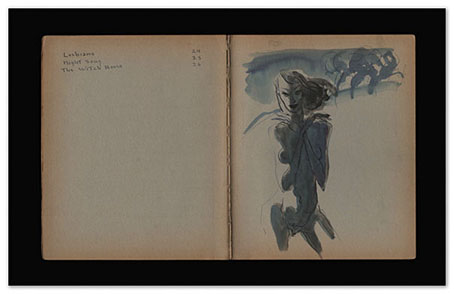
This month I’ve been enjoying the latest quality publication from Fulgur, Songs for the Witch Woman, the centrepiece of which is a cover-to-cover reproduction of the book of occult poetry and art created by Jack Parsons and Marjorie Cameron in the early 1950s. It’s been a great pleasure in recent years seeing the welling of interest in Cameron’s work. In 2001 when I was compiling notes for an abandoned study of occult cinema, Cameron as artist, witch or mere human being was a shadowy presence about whom nothing substantial seemed to have been written; her art was impossible to see anywhere, all one had were fleeting references in books, and her appearances in The Inauguration of the Pleasure Dome and Curtis Harrington’s Night Tide, a pair of films that only exaggerated her mystique. The intervening years have seen a lifting of successive veils so we’re now able to watch Curtis Harrington’s film portrait, The Wormwood Star, and see her work in books and exhibitions like this one (also titled Songs for the Witch Woman) which will be showing at the Pacific Design Center in Los Angeles from mid-October. As an early precursor to that there’s this feature by Robert Garrova at SPRC which includes comments about the exhibition from organisers Scott Hobbs and Yael Lipschutz.

cameron2.jpg

Pan: art by Cameron, poem by Parsons.

Previously on { feuilleton }
Songs for the Witch Woman
More Cameron
Inauguration of the Pleasure Dome: The Eldorado Edition
The Wormwood Star
Street Fair, 1959
House of Harrington
Curtis Harrington, 1926–2007
The art of Cameron, 1922–1995

Lovecraft: Démons et Merveilles

hpl-pd01.jpg

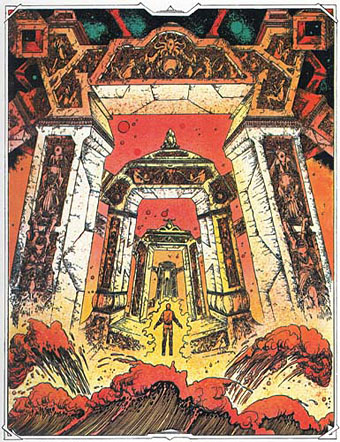
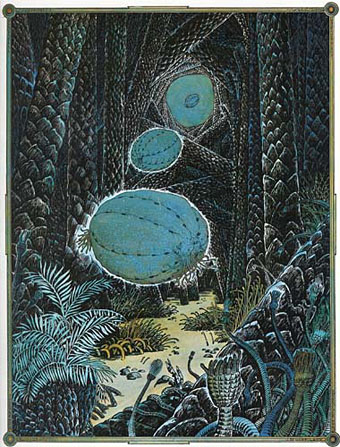
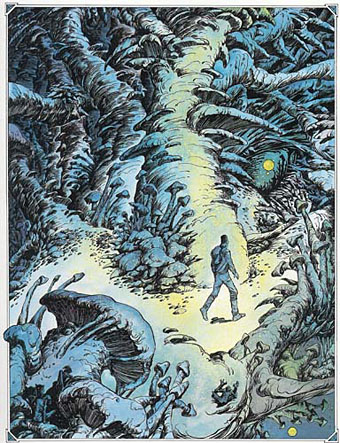
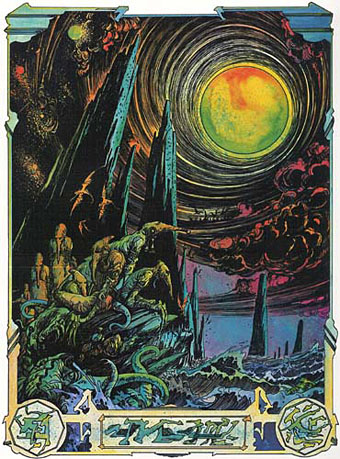
UK publisher Titan Books announced earlier this year that they’d be reprinting the first volume of Glénat’s excellent comic-strip adaptation of Michael Moorcock’s Elric novels in an English edition, a book that should be out in September. This was a surprise to me when I’ve complained for years that Titan seldom showed any interest at all in Continental comics, despite France and Belgium being over-burdened by world-class creators. I’ve been surprised again this week by the news that Titan will also be reprinting the English edition of Philippe Druillet’s The Six Journeys of Lone Sloane in March next year. Druillet’s books have been unavailable in English editions for decades so this is good news indeed, even if the attention is scandalously late.

As I noted in the post about Glénat’s Elric, Druillet illustrated Moorcock’s albino anti-hero in 1973. The artist is better known for his Lovecraftian depictions, however, even when—as in the adventures of Lone Sloane—the story could easily sustain itself without all those sinister temples, fish people, Cyclopean architecture and the menace of nameless gods. The Lovecraft influence, which can be found in some of his earliest illustrations, comes to the fore in Lovecraft: Démons et Merveilles, an HP Lovecraft story collection published in an expensive limited edition by Éditions Opta/André Sauret in 1976. Druillet provided ten colour illustrations plus a design for the boards. Some of these illustrations have since been used on paperback editions of Lovecraft in France, although many of them crop the artwork. Tentacles have become a perennial cliché in Lovecraftian art (I should know, I’ve drawn enough of them) so it’s worth noting how few there are in Druillet’s drawings.

hpl-pd02.jpg

hpl-pd03.jpg

hpl-pd04.jpg

Continue reading “Lovecraft: Démons et Merveilles”