Weekend links 535

beardsley.jpg

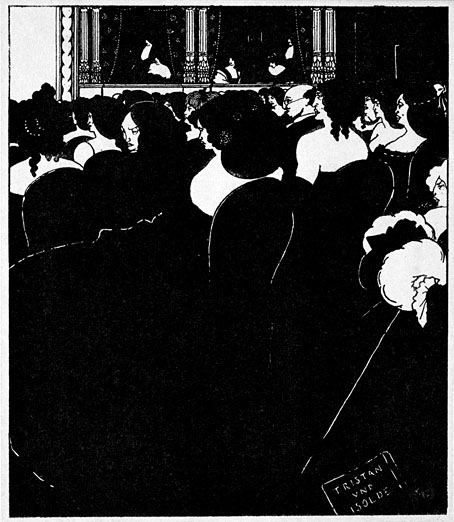
The Wagnerites (1894) by Aubrey Beardsley.

• “Part of my problem with influence is that the concept is too univocal; most of us are impacted by many others during our lifetimes, but often in oblique ways. So many of the most interesting bits of cultural transmission happen nonlinearly, via large groups of people, and in zigzag mutations. Assigning influence can also have the unintentional effect of stripping artists of their own originality and vision.” Geeta Dayal reviewing Wagnerism by Alex Ross.

• “Buñuel stubbornly refused to have any group affiliation whatsoever. Even though critics always tried to categorize him, he never wanted to explain the hidden meanings of any of his films and often denied that there were any.” Matt Hanson on the surreal banality of Luis Buñuel’s The Exterminating Angel.

• Next month Soul Jazz release the fourth multi-disc compilation in their Deutsche Elektronische Musik series devoted to German music from the 1970s and 80s. The third collection was the weakest of the lot so I wasn’t expecting another but this one looks like it may be better.

James Balmont chooses the five best films by Kiyoshi Kurosawa, who he calls “cinema’s master of horror”. I’ve yet to see any of these so I can’t say whether the label is warranted or not.

• At Wormwoodiana: Mark Valentine in a two-part post here and here charts the emergence of an under-examined sub-genre, the metaphysical thriller.

• Power Spots: 13 artists choose favourite pieces of music by Jon Hassell. A surprising amount of interest in his first album, Vernal Equinox.

• At Spine: George Orwell’s Animal Farm receives new cover designs for its 75th anniversary.

• “Pierre Guyotat’s work is more relevant now than ever,” says Donatien Grau.

• Mix of the week: FACT mix 775 by Sarah Davachi.

May 24th by Matthew Cardinal.

• Ry Cooder with Jon Hassell & Jim Keltner: Video Drive-By (1993) | Goose And Lucky (1993) | Totally Boxed In (1993)
The hundred-year Voyage

arcturus1.jpg

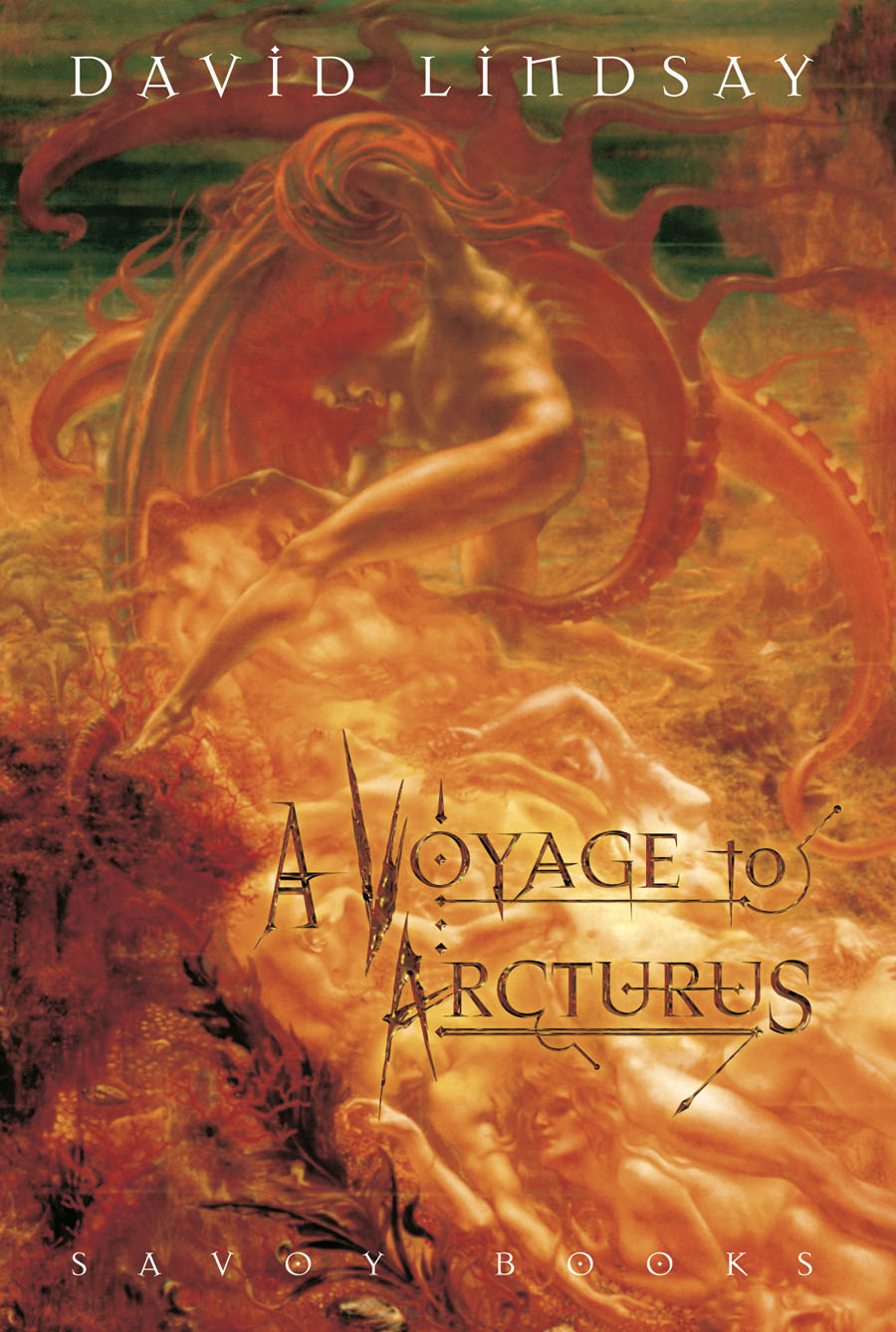
Today’s post at Wormwoodiana reminds me that David Lindsay’s unique novel of philosophical fantasy, A Voyage to Arcturus, was published a hundred years ago today. I designed a lavish reprint for Savoy Books in 2002, an edition which unfortunately used the re-edited text from earlier reprints instead of going to the original publication. This wasn’t done for lack of a first edition, it was more out of ignorance—nobody bothered to look into the history of the text—as well as convenience; Savoy’s earlier reprinting of Anthony Skene’s Monsieur Zenith the Albino had involved many weeks of text preparation, scanning pages from a photocopy of Skene’s very scarce novel, then running the copy through rudimentary OCR software and proofing the result. In Savoy’s slight defence, the reprint of Arcturus did correct a couple of typos that everyone else had missed.

arcturus2.jpg

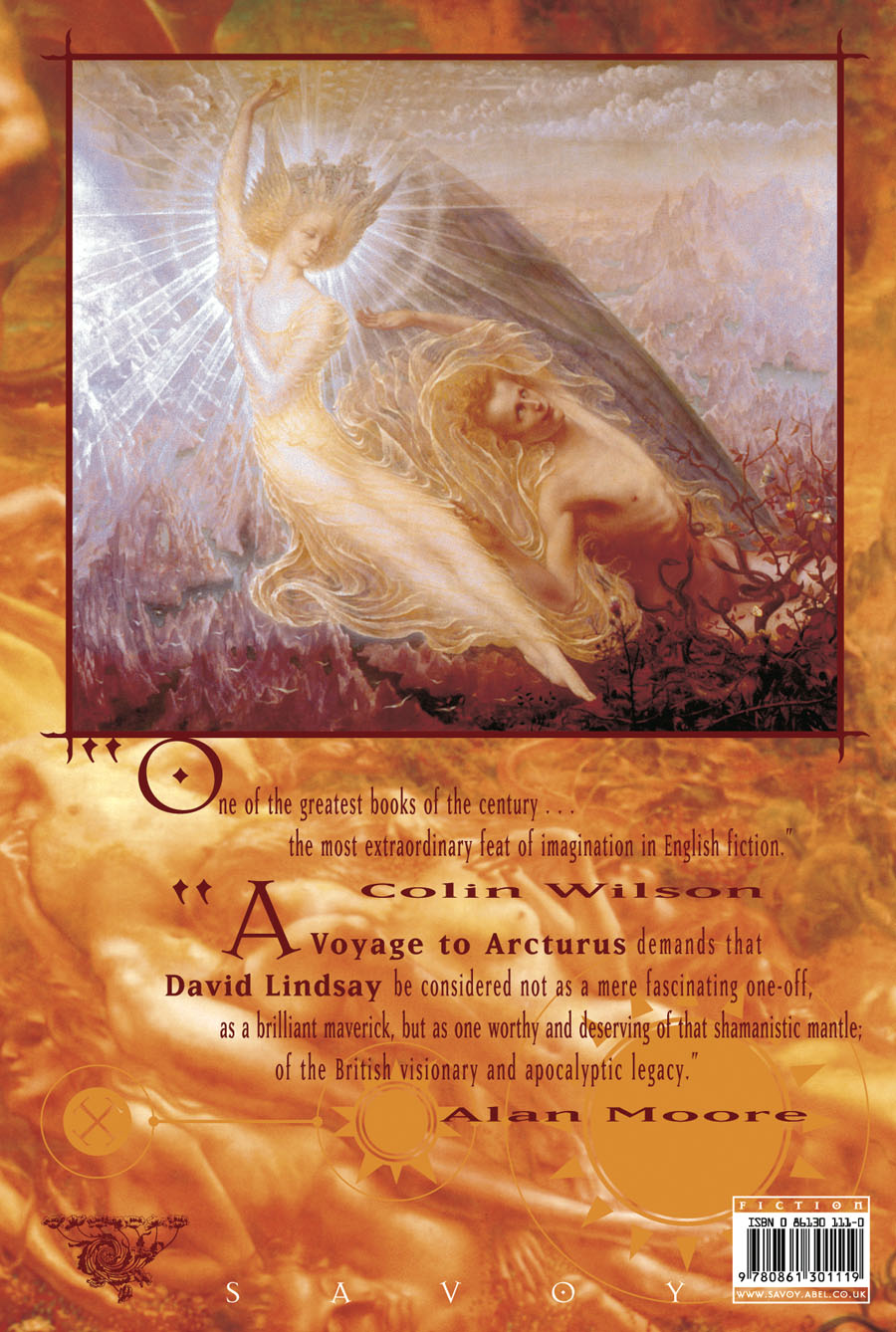
I still think the best feature of my design was the selection of Jean Delville’s remarkable Symbolist painting, The Treasures of Satan (1895), a picture used with the permission of the Brussels Museum of Fine Art. (They supplied us with a print of the painting together with a photo of Delville’s Angel of Splendour (1894) for the back cover.) With the exception of Bob Pepper’s artwork for the 1968 Ballantine paperback, previous reprints of the novel seldom reflected the contents on their covers. I’m no longer happy with the type layout on the rest of the dust-jacket, however, although the front cover looks okay. The Savoy edition included an introduction by Alan Moore, an afterword by Colin Wilson, a collection of philosophical aphorisms by David Lindsay, plus a couple of photos of the author which I don’t think had been published before. Despite its flaws, the book was well-received. The paper was heavier stock than is generally used for hardback fiction which made for a heavy and expensive volume but the edition still sold out.

Penguin are reprinting the novel next year in an edition which continues the tradition of unsuitable cover art. According to Lindsay site The Violet Apple the figure on the cover is from an illustration for a Dostoevsky novella, so what is it doing on Lindsay’s book? Cover art aside, the novel is in a class of its own, and very highly recommended.

Previously on { feuilleton}
The art of Bob Pepper
Masonic fonts and the designer’s dark materials

Weekend links 534

hasui.jpg

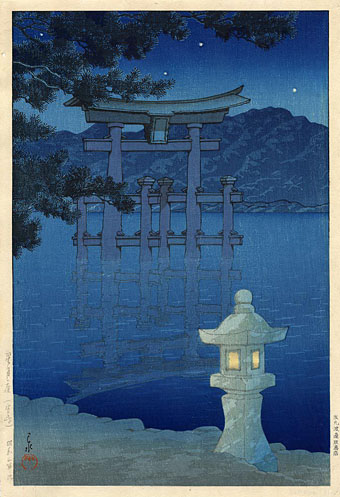
Beautiful night – moon and stars, Miyajima Shrine (1928) by Hasui Kawase.

• One announcement I’d been hoping for since last summer was the news of a second box of Tangerine Dream albums to follow the excellent In Search Of Hades collection. The latter concentrated on the first phase of the group’s Virgin recordings, up to and including Force Majeure. This October will see the release of a new set, Pilots Of Purple Twilight, which explores the rest of the Virgin period when Johannes Schmoelling had joined Froese and Franke. Among the exclusive material will be a proper release of the soundtrack for Michael Mann’s The Keep (previously a scarce limited edition), together with the complete concert from the Dominion Theatre, London. Also out in October, Dark Entries will be releasing a further collection of recordings from the recently discovered tape archive of Patrick Cowley. The new album, Some Funkettes, will comprise unreleased cover versions, one of which, I Feel Love by Donna Summer, is a cult item of mine that Cowley later refashioned into a celebrated megamix.

• “Did you know that Video Killed The Radio Star was inspired by a JG Ballard story?” asks Molly Odintz. No, I didn’t.

Casey Rae on the strange (musical) world of William S. Burroughs. Previously: Seven Souls Resouled.

• “And now we are no longer slaves”: Scott McCulloch on Pierre Guyotat’s Eden Eden Eden at fifty.

• At Dennis Cooper’s: Frank Jaffe presents…Dario Argento and his world of bright coloured blood.

• At Wormwoodiana: The Serpent Calls. Mark Valentine on a mysterious musical instrument.

• At Spoon & Tamago: Long-Exposure Photographs of Torii Shrine Gates by Ronny Behnert.

• Mix of the week: mr.K’s Soundstripe vol 4 by radioShirley & mr.K.

• Rising sons: the radical photography of postwar Japan.

• The illicit 1980s nudes of Christopher Makos.

• RIP Diana Rigg.

Garden Of Eden (1971) by New Riders Of The Purple Sage | Ice Floes In Eden (1986) by Harold Budd | Eden (1988) by Talk Talk

Bergling’s Art Alphabets

bergling02.jpg

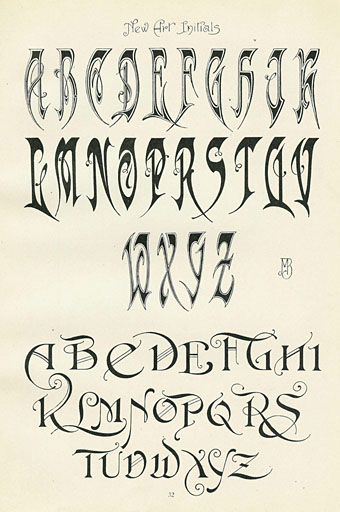
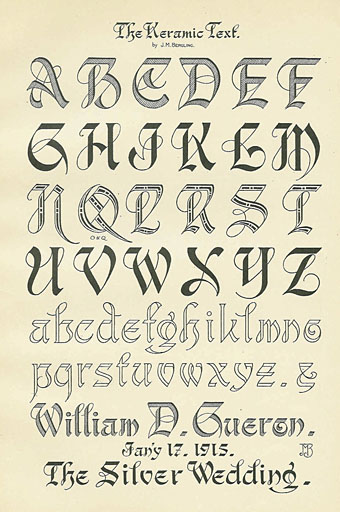
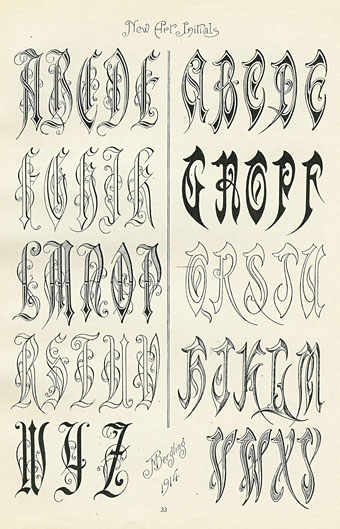
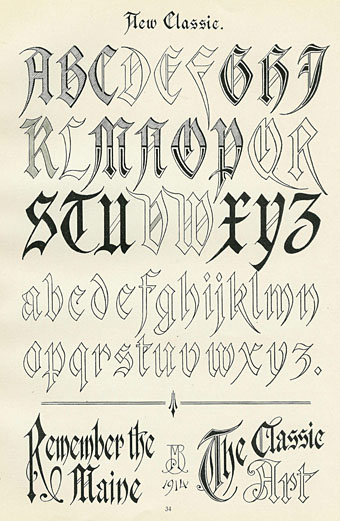
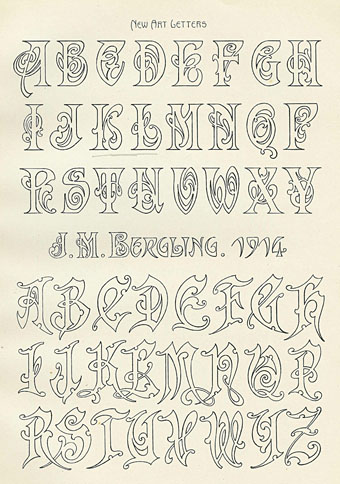
Old type catalogues seldom contain any unusual typefaces so you have to look to craft books for original letterforms. Art Alphabets and Lettering (1914) is an American book for artists and sign painters written and designed by JM Bergling which contains several pages of novel designs among its more familiar typefaces. Bergling evidently had a flair for alphabet design, there are more unique examples here than you’d usually find in a book of this kind, and Bergling’s letterforms are consistently stylish and inventive. In addition to providing a number of spiky variants on the Art Nouveau style (which by 1914 was going out of fashion), he also found time to draw his own version of a 19th-century staple, the Rustic Alphabet. There are two copies of the book at the Internet Archive: a complete one and an incomplete one, the latter volume possibly being a later printing since it contains a number of pages not included in the former.

bergling01.jpg

bergling03.jpg

bergling04.jpg

bergling05.jpg

Continue reading “Bergling’s Art Alphabets”

Phantom Cities by The Sodality of the Shadows

phantom.jpg

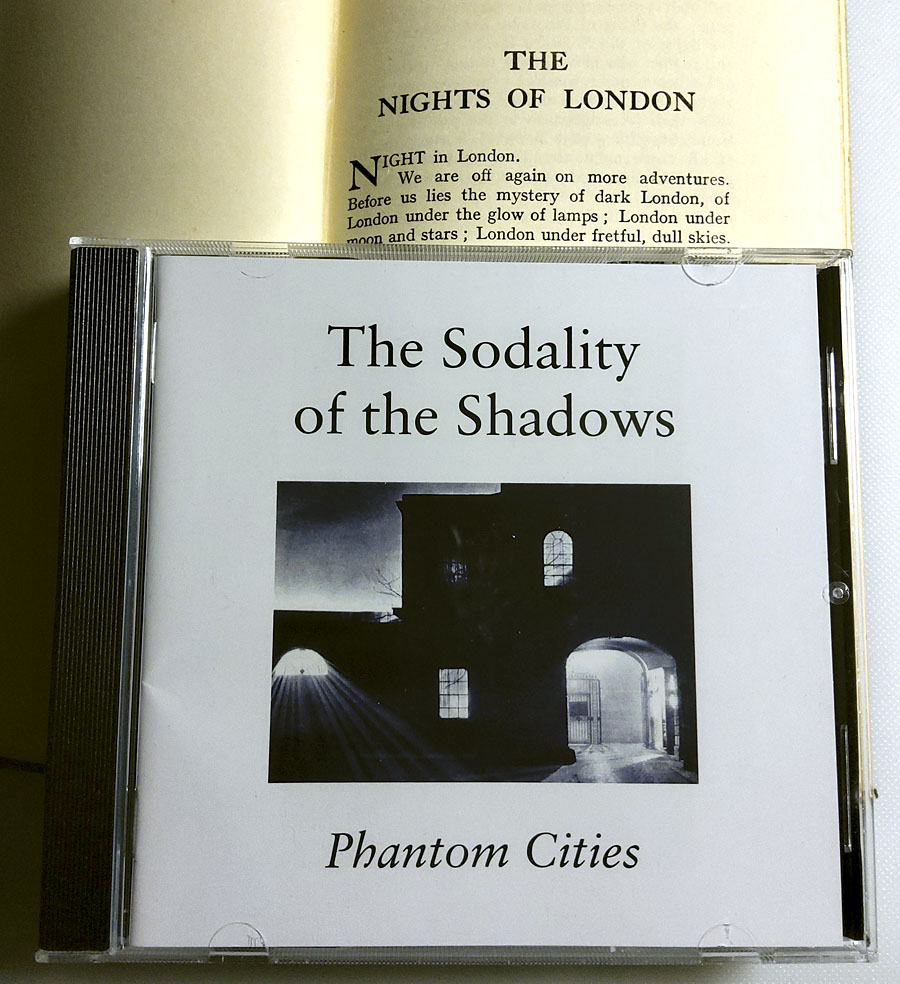
Book by HV Morton (1926) not included.

I like night music, any kind of night music, whether it be the shimmering sonorities of Béla Bartók and George Crumb, Julee Cruise exploring the dark, or the rumbling atmospheres of Thomas Köner. Phantom Cities by The Sodality of the Shadows is night music of another kind, more musically determined than the numerous purveyors of post-Köner dark ambience, with a character defined by weird fiction. The latter quality is perhaps inevitable given the people who comprise the group: Ray Russell and Rosalie Parker have been running Tartarus Press for the past 30 years; Mark Valentine is an author and editor (and occasional publisher) of many story collections, and Jon Mueller’s name has appeared here in the past via the soundtrack CD for the Swan River Press edition of The House on the Borderland that I illustrated. Phantom Cities sidesteps Robbe-Grillet’s Topology of a Phantom City for an older lineage, looking back to Arthur Machen (the group’s name is borrowed from a secret society formed by Machen and AE Waite) and the spectral metropolis of pre-war London photographed by Harold Burdekin in London Night (1934). The music is slow, sombre and reverberant; guitars pluck notes from the embracing dark while Mueller’s drums maintain a funereal pace; sporadic squalls of feedback suggest a deeper darkness, the latent possibilities of unpeopled streets. Mark Valentine had an earlier musical persona as The Mystic Umbrellas but his contribution here is textual accompaniment in the form of 12 fictional pieces, some of which are read by Rosalie Parker over and between the music. This isn’t a collection of readings, however, the album may be taken either as illustration of Burdekin’s photos and the texts or as a work that stands alone. A soundtrack for the longer nights of encroaching autumn.

Phantom Cities
Strange Houses Of Sleep

Previously on { feuilleton }
The Smoke
Two albums
Thomas Köner