Weekend links 553

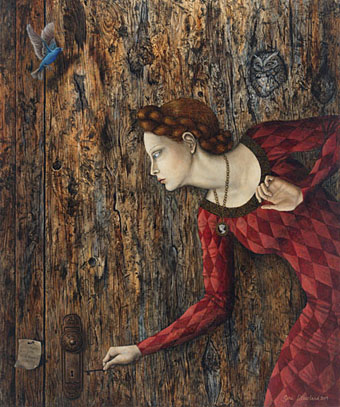
litherland.jpg

The Unknown Room by Gina Litherland.

• “He admired abstract painters like Mark Rothko, but also derived inspiration from the far less hip Pre-Raphaelite artists of the mid-1800s, especially the painter and poet Dante Gabriel Rossetti. Budd’s dreamy early breakthrough Madrigals of the Rose Angel, which featured a segment titled Rossetti Noise, was deliciously out of step with the hard-edged music of the 1970s.” Geeta Dayal on the late Harold Budd.

• “Here the experience is transformed into something more fabulist, and much more interesting than the memoir. In the novel, delusions of grandeur become real powers.” Elisa Gabbert on Leonora Carrington and The Hearing Trumpet.

• “The Japanese especially loved 3-inch CDs and there are many different examples throughout the 90s and 00s of them being used to great effect as promos.” DJ Food begins a series of posts devoted to one of my favourite music formats.

• New music: Viia, 24 minutes of live synthesis by Kikimore; Music For The Open Air, a free album of ambient music by K. Leimer (Soundcloud login required to download tracks).

• Sensory, Imaginative, and Psychic: S. Elizabeth interviews artist Gina Litherland.

• Puppets, Birds & Wycinanki: Clive Hicks-Jenkins talks to Anna Zaranko.

• Mix of the week: a 3-hour tribute to Monolake by Funky Jeff.

• At Wormwoodiana: The Flint Transmissions.

• At Dennis Cooper’s: Watery, Domestic.

• At Strange Flowers: 21 books for 2021.

Edge Of The Unknown (1973) by Nik Pascal | Unknown Passage (1999) by Robert Musso | The Unknown, Part 2 (2005) by Robin Guthrie & Harold Budd

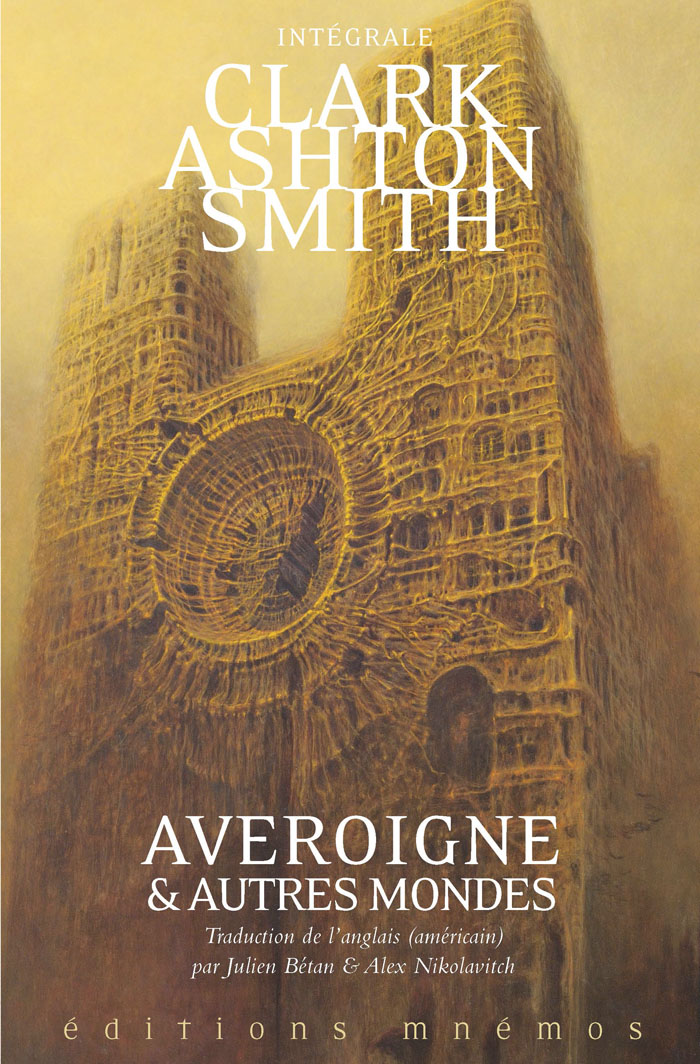
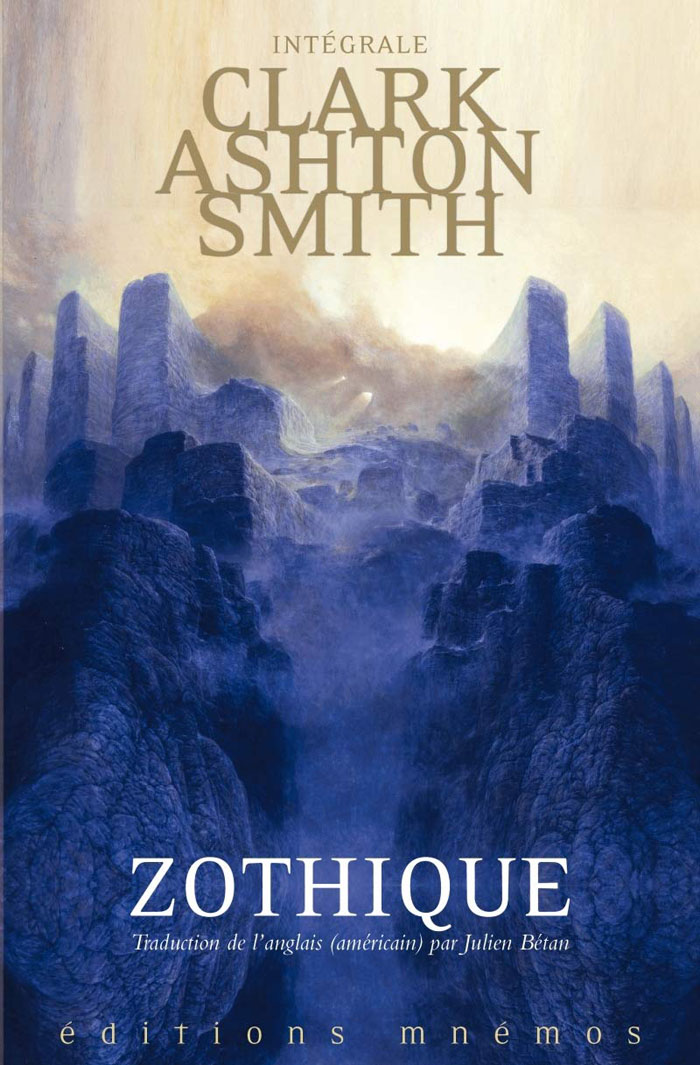
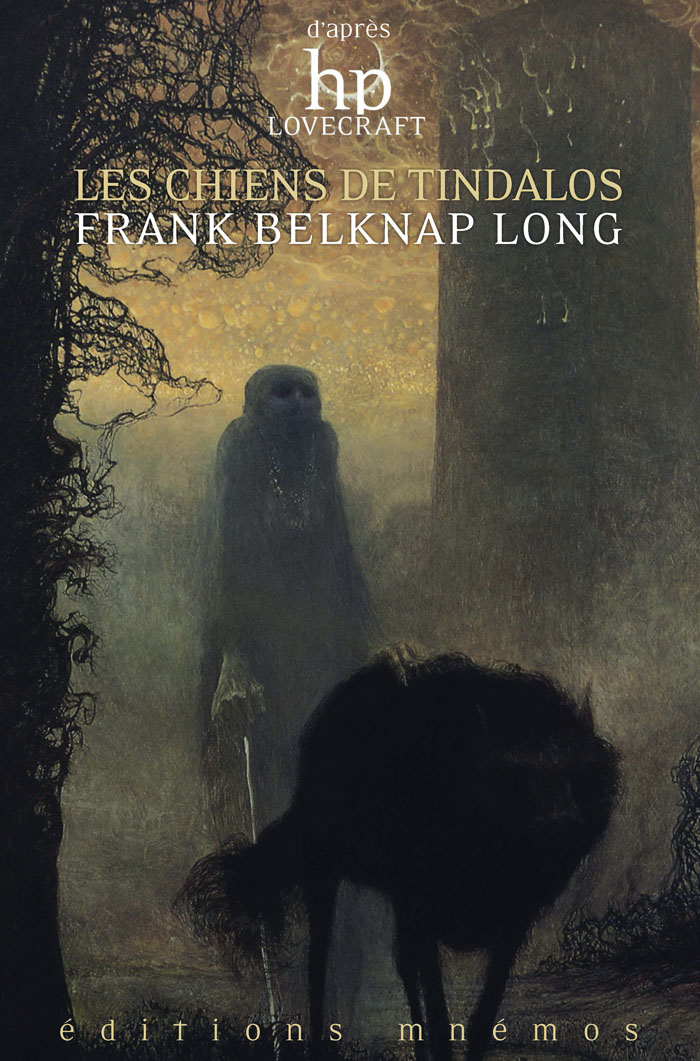
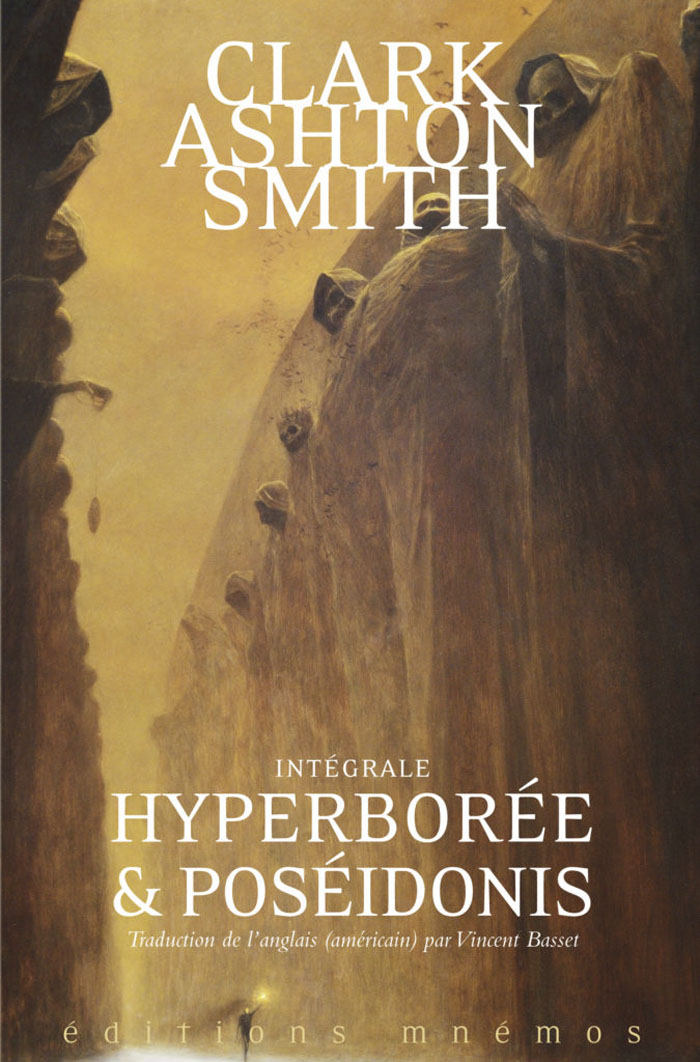
Beksiński at Mnémos

mnemos2.jpg

More book covers. Mnémos is a French publisher of horror, fantasy and science fiction some of whose recent titles have their covers filled with paintings by the great Polish artist Zdzisław Beksiński. The pairings of book and picture aren’t always ideal but I appreciate the impulse to choose art from other sources than genre artists. Omni magazine adopted a similar approach in its early issues, matching stories and science features with paintings by artists who are often grouped together as Fantastic Realists: Mati Klarwein, Ernst Fuchs, HR Giger, Bob Venosa, De Es Schwertberger and others. Beksiński’s work was less visible in the late 1970s than that of his contemporaries but one of his (always untitled) paintings did appear in a 1993 issue of the magazine.

mnemos1.jpg

Of the Mnémos covers the one for the collection of Averoigne stories by Clark Ashton Smith is the most immediately fitting, Averoigne being an invented region of France that suits a painting of a Gothic cathedral turned fibrous and fungal. The painting for Zothique, on the other hand, could easily be used for HP Lovecraft’s At the Mountains of Madness, while the dog-like creature on the cover of the Frank Belknap Long collection is nothing like the author’s trans-dimensional hounds. Mnémos have given Lovecraft his own Beksiński covers in a seven-volume collection of translated fiction, Lovecraft, l’intégrale prestige, but there doesn’t seem to be a page anywhere that shows the individual books.

mnemos4.jpg

What the artist would have made of all this attention may be gauged by comments like this one from The Fantastic Art of Beksiński (1998): “Meaning is meaningless to me. I do not care for symbolism, and I paint what I paint without meditating on a story.”

mnemos3.jpg

For more about the anti-symbolist, see The Cursed Paintings of Zdzisław Beksiński by Marek Kepa.

Elsewhere on { feuilleton }
The book covers archive
The fantastic art archive

Previously on { feuilleton }
Cosmic music and cosmic horror

Patricia Highsmith book covers

ph1.jpg

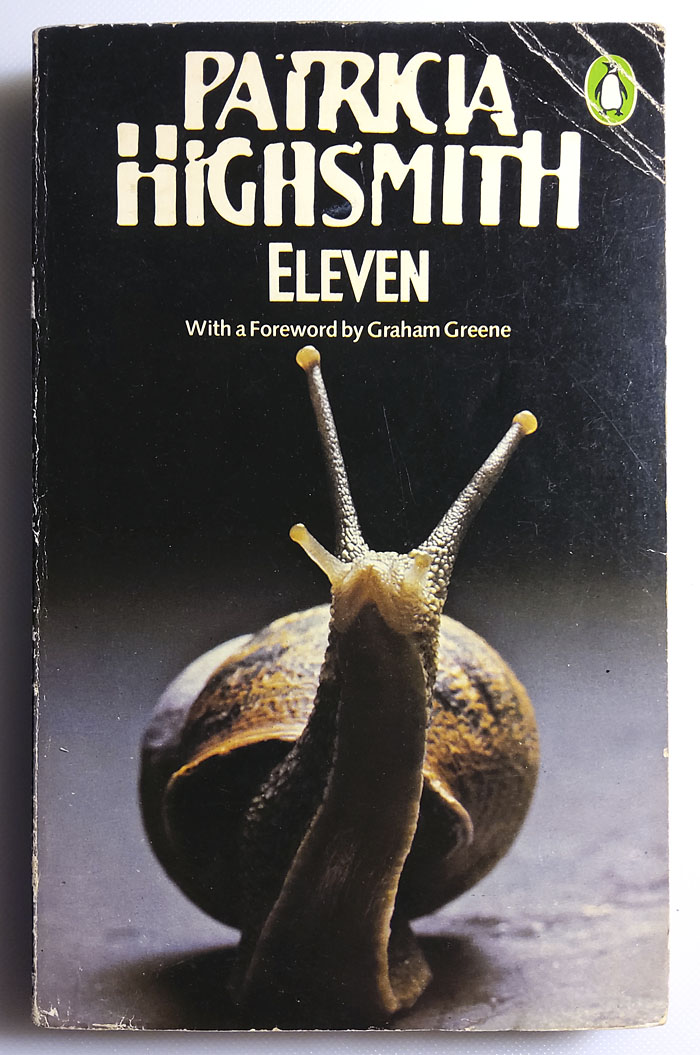
Penguin, 1980; photo by David Thorpe.

A post for Patricia Highsmith, born 100 years ago today. Filling the cover of one of Highsmith’s books with a photograph of a snail may seem like a bizarre or even perverse decision but Eleven is a collection of short stories, two of which concern the author’s beloved gastropods. The snails in The Snail-Watcher and The Quest for ‘Blank Claveringi’ aren’t so lovable, however, and both stories make frequent appearances in horror collections. The Quest for ‘Blank Claveringi’ was even the lead story in The 6th Fontana Book of Great Horror Stories, prompting another snail cover.

ph4.jpg

left: First UK edition, Cresset Press, 1957; no artist credited. Right: Pan, 1960; cover art by David Tayler.

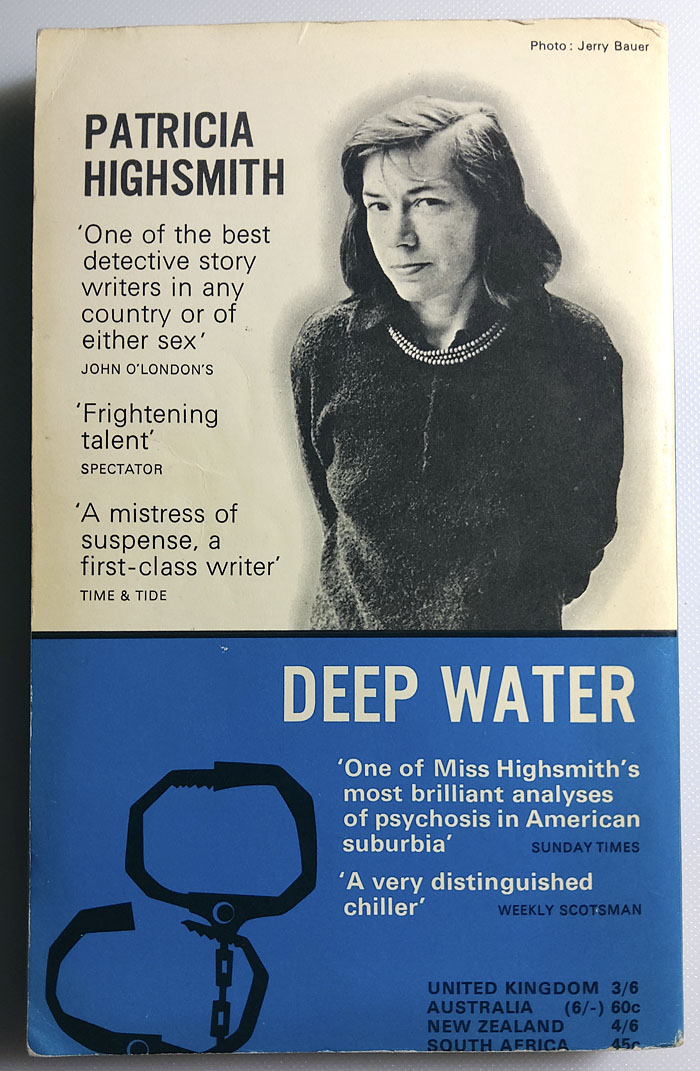
Highsmith’s enduring popularity means that most of her books have remained in print since their initial publication so there are many covers to look at. They’re a very mixed bag, as is often the case with thrillers where two design approaches predominate: symbolism that can either be vague or suggestive, or some kind of illustration which always runs the risk of spoiling the story. Nick Jones’ Existential Ennui blog contains a number of posts about Highsmith’s books, including this one which shows off his collection of first editions. I was surprised to see the bland cover for the original UK publication of The Talented Mr Ripley, an illustration that would suit any number of stories set on the Mediterranean coastline, and which gives no indication of the tangled web of deceit and murder inside the book. Perhaps this is a good thing but it feels like a missed opportunity. Another of Jones’ posts concerns Highsmith paperbacks, and here we see the spoilerish approach with the same novel featuring a painting that shows Ripley pushing Dickie Greenleaf’s body into the sea. This was common form for thriller paperbacks at the time: “Yes, there’s murder in this one!” My 1966 Pan paperback of Deep Water features a similar scene of body disposal (which rather spoiled the story while I was reading it) but it also has the following photo of the author on the back, looking as though she’s wondering how to dispose of your body when the time comes.

ph2.jpg

Pan, 1966; photo by Jerry Bauer. Also another book that features snails.

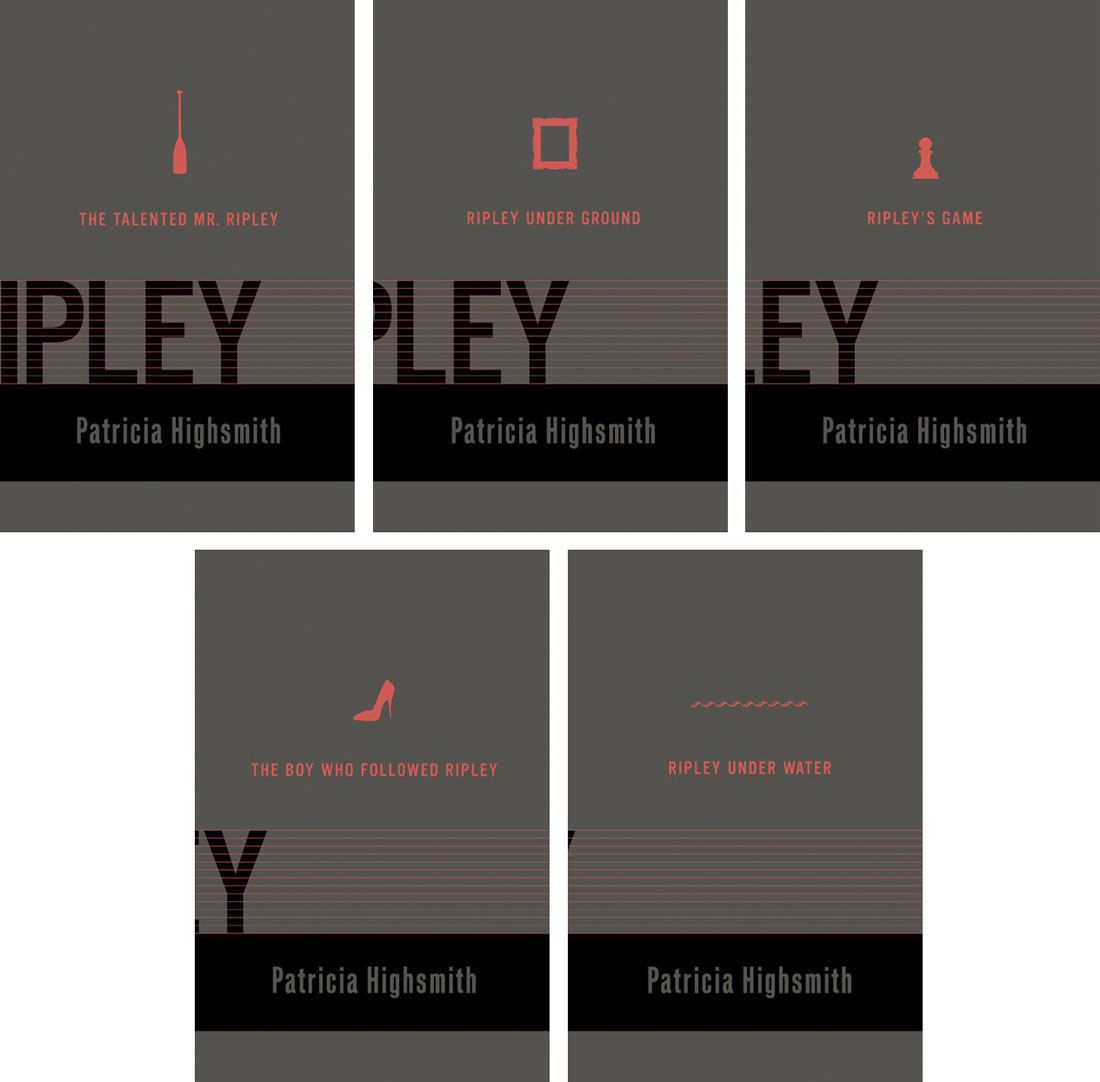
More recent Highsmith covers have tended towards the vague and symbolic, as seen in this blog post by Caustic Cover Critic. I’ve got several of those editions with the sketchy Vintage covers which I don’t like very much, most of them could too easily be applied to another book entirely. The same could be said for the Norton collection of the Ripley novels (below) which go the ultra-minimal route and reduce the contents of each book to a single motif. Individually these motifs might be used elsewhere but taken as a set they become unique. Choosing a high-heeled shoe for The Boy Who Followed Ripley is both funny and fitting but I won’t spoil the story by saying why.

ph3.jpg

Design by Chin-Yee Li.

A handful of Highsmith links:
Mavis Nicholson interviews Patricia Highsmith for Good Afternoon in 1978. From those far-off days when British television didn’t regard intelligent discussion as audience poison.
• “The interview was full of drama, as I suspected it might be.” Naim Attalah’s interview from 1993.
10 Best Patricia Highsmith Books as chosen by the author’s biographer, Joan Schenkar.
Patricia Highsmith’s Confessions and Rebellions at Yaddo by Richard Bradford.
The Patricia Highsmith Recommendation Engine.
Patricia Highsmith on Desert Island Discs, 1979.

Elsewhere on { feuilleton }
The book covers archive

Weekend links 552

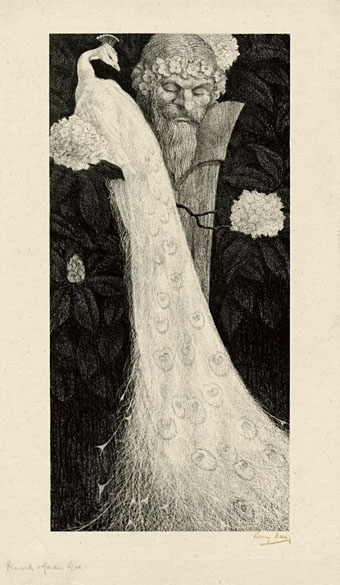
keen.jpg

White Peacock and Garden God (c. 1922) by Henry Keen.

• “Though both writers confront some of the most unsavory and unjust dimensions of human life, Genet revels in moral ambiguity and coarse language, while Erpenbeck satisfies her audience’s desire for tidy ethical responses by using careful, equally tidy sentences. Genet’s world is dirty; Erpenbeck’s is clean.” Christy Wampole compares two newly-translated collections of non-fiction writing by Jean Genet and Jenny Erpenbeck.

• Gaspar Noé’s notorious, controversial (etc, etc) Irreversible receives the prestige blu-ray treatment from Indicator in April. Still no UK blu-ray of Enter the Void is there? I had to order a German release.

Stereolab release Electrically Possessed: Switched On Vol. 4 next month, the latest in their series of albums which collect singles, compilation tracks and other rarities.

• At Nautilus: Antonio Zadra and Robert Stickgold on how dreaming is like taking LSD.

• At Dennis Cooper’s: Bollo presents…Éliane Radigue (& The Lappetites).

• Playwriting & Pornography: Adam Baran remembers Jerry Douglas.

• At Spine: Vyki Hendy on the joy of monochrome book covers.

• Mix of the week: Subterraneans 2 by The Ephemeral Man.

John Boardley’s favourite typefaces of 2020.

• New music: Spirit Box by Blanc Sceol.

Life In Reverse (1981) by Marine | Reverse World (1995) by David Toop | Reverse Bubble (2014) by Air

Ghost Box and The Infinity Box

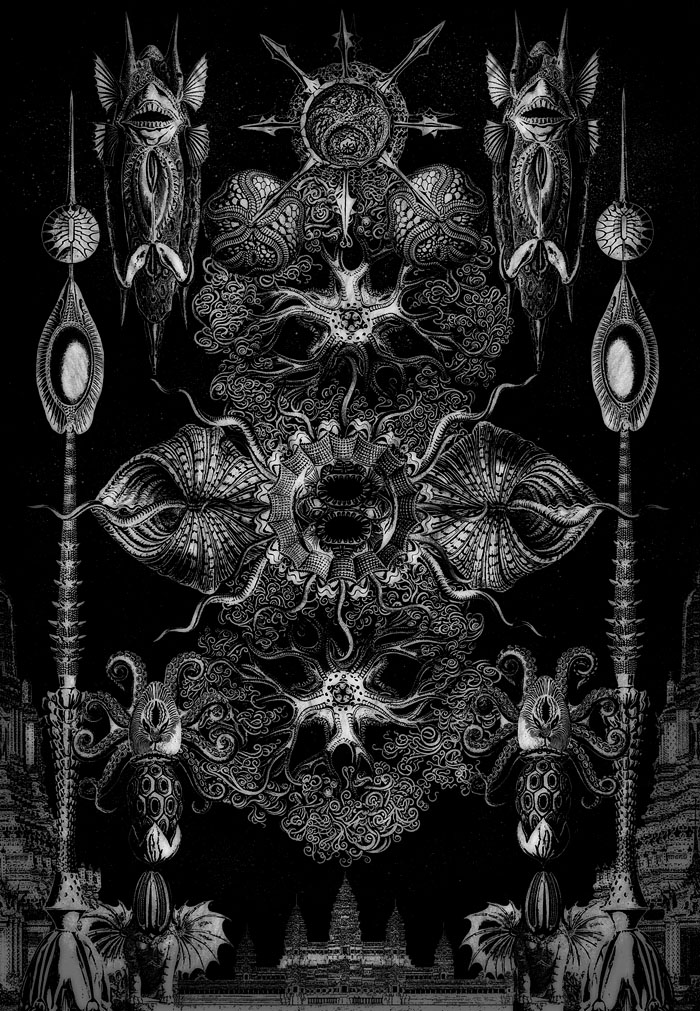
yuggoth.jpg

It’s less of a surprise than it may seem to go searching for the source of a quote only to find yourself immediately faced with one of your own artworks. The posts here go back almost 15 years, and when so many of them cover niche interests any attempt to further explore a particular niche can circle back to something I’ve already posted. The latest example is an unusual one, however. The picture above is the Haeckel collage I created for the Starry Wisdom collection of Lovecraftian fiction in 1994, a piece that was later digitally refashioned for The Haunter of the Dark book. The quote I was pursuing is as follows:

“Inside the infernal box are impossible spaces, dark screens and mirrors, terrible traces of light, calcified thought forms and endless idiot mutterings. The switch is thrown and the magnetic coils begin to generate their obscene flickering images. This contraption might have been conceived by the Old Ones long before it was assembled by human hands.”
—The Infinity Box, Alan Causley & MB Devot

The description appears together with a dialogue extract from Nigel Kneale’s The Stone Tape on the fourth Ghost Box release, Ouroborindra (2005) by Eric Zann, a one-off album of spooky sample soundscapes created by a pseudonymous Jim Jupp in between his Belbury Poly albums. All the Ghost Box releases feature significant quotes, most of which are genuine extracts from stories, novels, non-fiction works, etc. The description of the Infinity Box raised my suspicion about its authenticity when the only references to either it or Causley and Devot are in listings for the Eric Zann album. My Yuggoth collage appears on this page which further compounds the confusion by making it seem that my art is somehow connected to Causley and Devot and their mysterious box. This isn’t a complaint but it doesn’t help clarify the situation. Alan Causley has no credits anywhere outside the quote but there is another Causley, the celebrated poet, Charles, whose poems are sampled on later Ghost Box releases by The Focus Group, aka Ghost Box co-founder Julian House. Scrutiny of the other Ghost Box albums reminded me that quotes from MB Devot’s writings appear elsewhere on the early releases but I hadn’t bothered to look up the name until now.
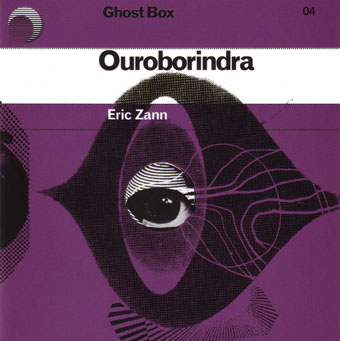
ouroborindra.jpg

It’s often the case with posts such as this that mild curiosity turns into deeper intrigue. The web of connections becomes more tangled on the first Ghost Box release, Sketches And Spells by The Focus Group, which has a Devot quote from a text with the apt title The Tangled Beams, and a final track with the title Starry Wisdom. Devot is described by reviewers as either a fictional writer or an authentic scholar, the latter designation being supported by a Wikipedia page. Wikipedia may be prone to errors but it isn’t known for fake entries so this was a surprising discovery; Devot is also referenced on the page for parapsychologist TC Lethbridge who happens to be another source of Ghost Box quotes. Suspicion returns when you try to search for any of Devot’s listed publications, none of which turn up in WorldCat or similar catalogues. One of the Wikipedia print sources is an issue of Fortean Times from 1989 but there’s nothing about Devot listed in the contents of that issue. Issue 53 was a crop circle special, however, so it certainly fits the Ghost Box interest in the paranormal as it manifests in the British countryside. We now know that crop circles were man-made, not the product of flying saucers or other phenomena, so this may be fitting as well.

devot.jpg

I would have left the search there but I did find one further Devot connection that I might otherwise have missed. Folklore and Mathematics is the title of a one-off Ghost Box periodical published in 2007 for people subscribed to the label’s mail order service. It’s a typically fine Julian House artefact that complements the Sketches And Spells album in both its title and its graphics. Inside we find “From the archives of MB Devot”, and discover another reference to the Infinity Box. Apparently the black-and-white graphics that cover all the early Ghost Box discs are vibration patterns—”verberations”—created by Devot’s occult apparatus.
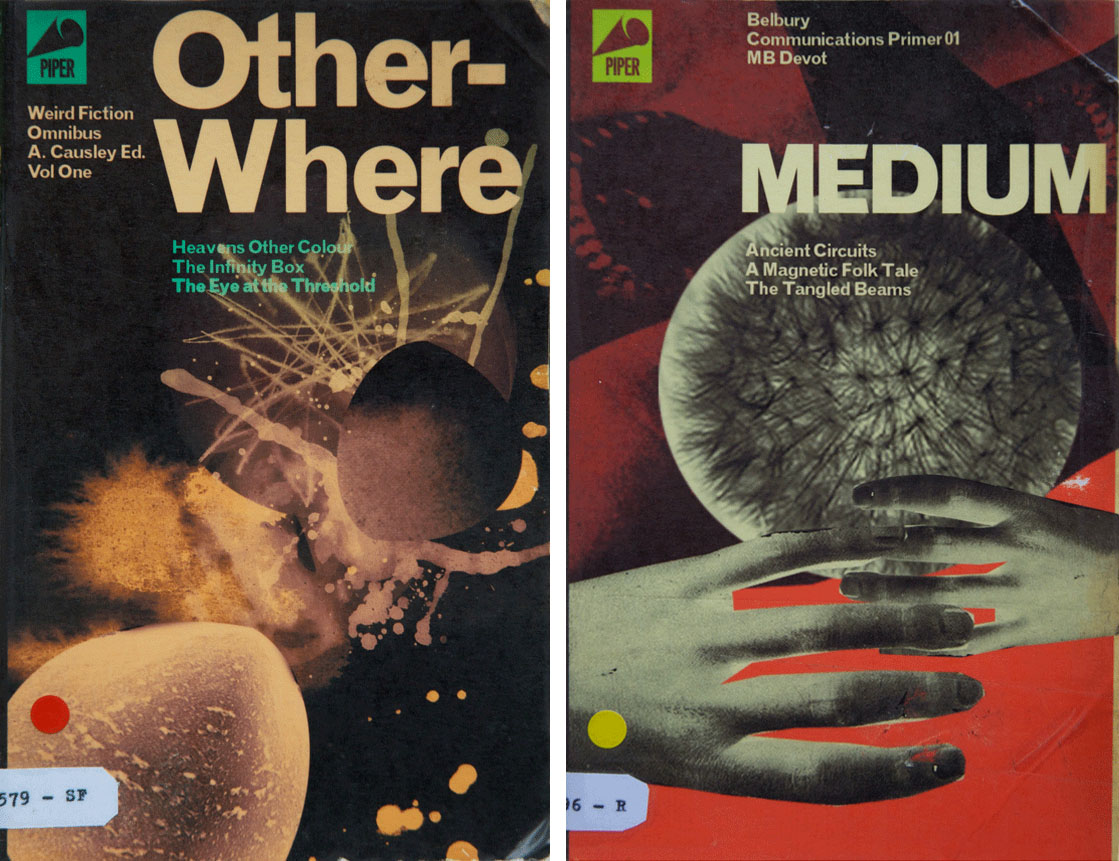
otherwhere.jpg

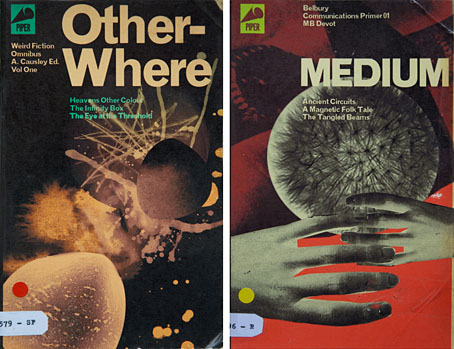
I wrote above that “any attempt to further explore a particular niche can circle back to something I’ve already posted” so I wasn’t too surprised to have all these explorations finding their way back here. In 2009 Julian House exhibited three invented books as part of The New Spirit Happening, an exhibition of Ghost Box-related work at the Architect’s Gallery in Teddington. I posted two of the covers after the exhibition but couldn’t recall who the books were credited to. The authors are—inevitably—”A. Causley” and “MB Devot”, and the volumes feature by-now familiar phrases: “The Tangled Beams”, “The Infinity Box”. Also more Lovecraftian verberations: “Heavens Other Colour”, “The Eye at the Threshold”. So Causley and Devot have been lurking here for the past decade, in which case having my artwork attached to their names no longer seems like an arbitrary association. “Inside the infernal box are impossible spaces, dark screens and mirrors…”. Indeed there are.

Previously on { feuilleton }
Unearthly tones
Owls and flowers
The White People by Arthur Machen
Stone Tapes and Quatermasses
The Ghost Box Study Series
A playlist for Halloween: Hauntology
Forbidden volumes
The Séance at Hobs Lane
Ghost Box