Weekend links 92

bmc1.jpg

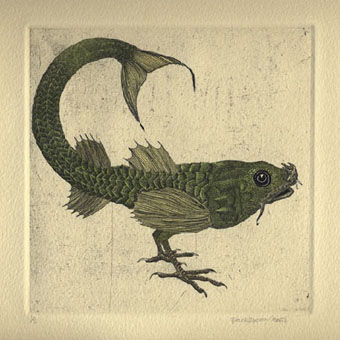
Untitled etching by Briony Morrow-Cribbs.

• An interview with author Paul Russell whose new novel, The Unreal Life of Sergey Nabokov, concerns the gay brother of the celebrated Vladimir.

• Joseph Cornell turns up again in a report at Strange Flowers about Locus Solus, an exhibition in Madrid devoted to the work of Raymond Roussel.

Night of Pan: 42 seconds of occult freakery by Bill Butler featuring Vincent Gallo, Twiggy Ramirez plus (blink and you miss him) Kenneth Anger.

Jan Švankmajer talks (briefly) about his new film Surviving Life. A subtitled trailer is here; the very different Japanese trailer is here.

Cormac McCarthy turns in his first original screenplay. I’d rather he turned in a new novel but any new Cormac is better than none at all.

Barnbrook show off another design for the latest CD from John Foxx & The Maths.

Melanie McDonagh asks “Where have all the book illustrators gone?”

• Congrats to Evan for getting his poetry in the New York Times.

Margaret Atwood on writing The Handmaid’s Tale.

Subliminal Frequencies: An Interview With Pinch.

The (Lucas) Cranach Digital Archive

The M.O.P. Radionic Workshop

• Music promos of the week from the Weird Seventies: All The Years Round (1972) by Amon Düül II, and Supernature (1977) by Cerrone.

Joseph Cornell, 1967

cornell1.jpg

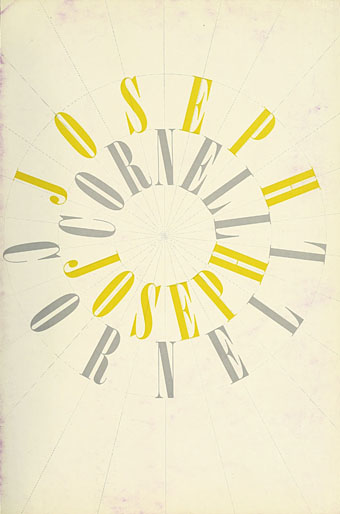
More Surrealism (sort of) from 1967. Joseph Cornell is a catalogue for an exhibition selected and presented by Diane Waldman at the Solomon R. Guggenheim Museum in 1967. The book is one of a number of new and very welcome additions from the Guggenheim Museum to the stock of scanned books at the Internet Archive. Old art books and catalogues often feature black-and-white reproductions but that drawback doesn’t invalidate the usefulness of their textual content. The Museum’s own pages for the archived books may be browsed here.

cornell2.jpg

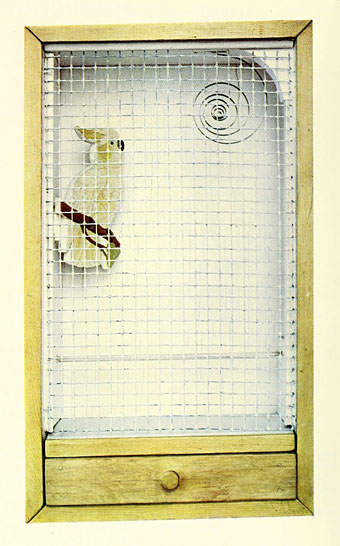
Cockatoo: Keepsake Parakeet (1949–1953).

For more on the Magus of Utopia Parkway I’d suggest the BBC’s documentary film Joseph Cornell: Worlds in a Box (1991) but only if you can find a copy since I’ve not seen it online anywhere. That’s a shame because it’s an excellent introduction to Cornell’s life and work, with the added bonus of commentary from Susan Sontag and Cornell’s film collaborators Stan Brakhage and Rudolph Burckhardt. There’s also a surprise appearance from Tony Curtis who was friends with the artist and who reads from his diaries.

cornell3.jpg

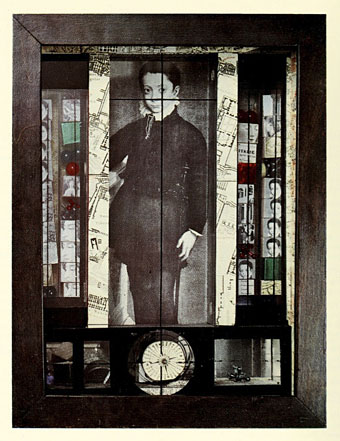
Medici Slot Machine (1942).

Elsewhere, Ubuweb has Cornell’s short films which proceed from the radical re-editing of Rose Hobart (1936) to more lyrical works such as Nymphlight (1957). And I’ve mentioned this before but it’s always worth another look: Americana Fantastica, the edition of Charles Henry Ford’s View magazine edited and illustrated by Cornell in 1943.

cornell4.jpg

Medici Princess (1952).

Previously on { feuilleton }
Rose Hobart by Joseph Cornell
View: The Modern Magazine

Weekend links 90

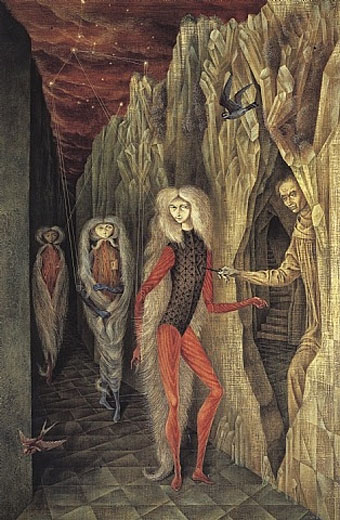
varo.jpg

Portrait of Dr. Ignacio Chavez (1957) by Remedios Varo (1908–1963) some of whose Surrealist paintings can be seen at Frey Norris, San Francisco, from 19th January. There’s also In Wonderland: The Surrealist Adventures of Women Artists in Mexico and the United States at the Los Angeles County Museum of Art from 29th January.

The current crop of Republicans jostling for the Presidential nomination have reminded me of the Downunder people in Harlan Ellison’s post-apocalypse novella A Boy and His Dog (1969): a retrograde, fear-ridden community who send troublesome individuals to be exterminated at “the farm”. Rick Santorum (unforgettably pictured here with family in 2006 after losing an election) almost received the majority of Iowa’s votes for his nomination last week, prompting renewed scrutiny of his negative views about gay people, sexually active people, foreign people (especially Arabs and Mexicans), and anyone generally who isn’t a white, Catholic, Downunder person. Santorum is against gay marriage, of course—it’s hard to find a Republican who isn’t—but he also wants to ban abortion even in cases of rape and incest, and given the opportunity would allow US states to prevent any use of contraception. Add to this his pro-torture stance (which offends current Catholic church policy), and his willingness to wage war with Iran, and it’s easy to see why his name prompts reactions such as this:

I have a history with Rick Santorum. In 2003, when Santorum, in an interview with the Associated Press, first compared gay relationships to child rape and dog fucking (have I mentioned that Santorum has compared gay relationships to child rape and dog fucking?), I held a contest to redefine Santorum‘s last name. The winning definition: “the frothy mix of lube and fecal matter that is sometimes the byproduct of anal sex.” (“Sometimes” is the most important word in the new definition of santorum; if you’re doing anal sex correctly, there won’t be any santorum – lower- or upper-case.) And since 2003, the new definition has been the No. 1 Google return when you search “santorum“.

Rick Santorum’s homophobic frothing by Dan Savage

Related: Santorum was named one of the three “most corrupt” Senators in 2006 | “Homohater fosser fram” which is how Dagbladet, Norway’s second largest tabloid newspaper, introduces Santorum to its readers | “Rick Santorum channels Saint Augustine” an article at Slate exploring the Handmaid’s Tale extent of Santorum‘s attitudes towards sex and morality | Rick Santorum quotes as New Yorker cartoons.

marlin.jpg

The Rod (1973) by Brigid Marlin.

• Ballardian posts a long-overdue interview with Brigid Marlin, famous now for having brought two lost Paul Delvaux paintings back to life for JG Ballard, but also a woman with an extensive career as a fantastic artist using Ernst Fuchs‘s laborious mische painting technique.

Quentin Blake on Ronald Searle, in which Blake notes that his hero was given a full-scale exhibition of his work at the Bibliothèque Nationale, France, in 1973 whilst being ignored throughout his life by the major institutions in Britain.

Alfred Jarry: A Pataphysical Life by Alastair Brotchie is reviewed by Michael Moorcock who tells me the Guardian cut out his references to Boris Vian, Maurice Richardson and David Britton.

Ian McKellen stirs things up by suggesting (not for the first time) that Shakespeare was bisexual.

• Ten posters by Only More Never Less inspired by Pink Floyd’s Dark Side of the Moon.

An end to bad heir days: The posthumous power of the literary estate.

Peace Eye! Fug! A Long Talk With Ed Sanders.

• Sand sculptures by Carl Jara.

Letterheady

• Skylab: These Are The Blues (1995) | Beyond The Breeze (1995) | Red Light, Blue Light (1995) | Indigo (Sabres of Paradise remix, 1995) | Seashell (Nobukazu Takemura mix, 1995).

The weekend artists

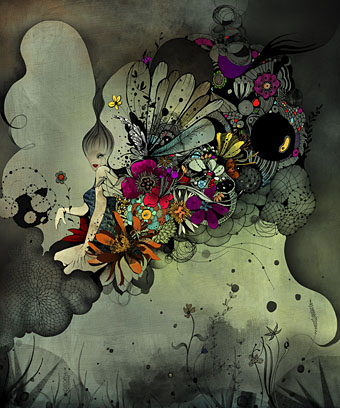
olofsdotter1.jpg

Flower Me Gently (2010) by Linn Olofsdotter.

Yes, this is one of those lazy end-of-year retrospectives, a look back at all the artists whose work was highlighted in the weekend posts for 2011. Thanks to BibliOdyssey, Form is Void and 50 Watts for so often pointing the way.

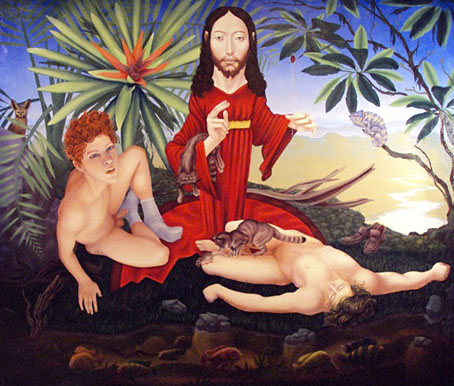
martin.jpg

Blasphemous Rumours (2009/2010) by Ryan Martin. The artist now has a dedicated site for his paintings.

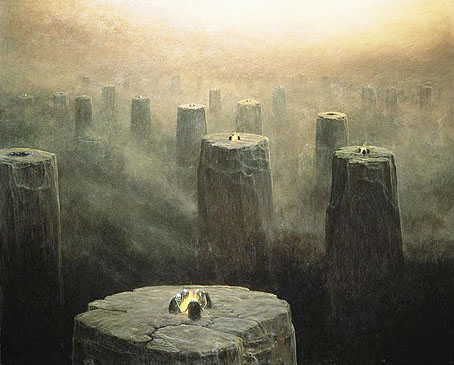
beksinski1.jpg

DG-2499 (1975) by the fantastic (in every sense of the word) Zdzisław Beksiński (1929–2005). See the Dmochowski Gallery for a comprehensive collection of the artist’s work.

Continue reading “The weekend artists”

Weekend links 88

zarnowerowna.jpg

Typographic Composition (1924) by Teresa Zarnowerówna from a post about Polish graphic design at 50 Watts.

• “Direct action is a matter of acting as if you were already free… […] …the link between military and money systems remains the dirty secret of capitalism.” A lengthy and essential interview with “anarchist anthropologist” David Graeber, author of Debt: The First 5000 Years.

• “…it was after being told by an art director that he preferred her images of women to men that Toyin [Ibidapo] began to shoot boys in an attempt to prove him wrong. Something that Cult of Boys does perfectly.”

The pornographic imagination is deeply intertwined with the pain and horror of life. Some of that comes from our basic biological reality, which is unpleasant enough, and much of it comes from our social structures. Biological life has been completely degraded and continues to become more and more degraded in novel and more horrific ways, so it is inevitable that our horrible social structures – our schools, prisons, families, slaughterhouses and farms – become sites for the pornographic imagination.

Stephen Beachy discusses his novel, boneyard.

• “To my right is a wall bracket that, on closer inspection, turns out to be a human face made of porcelain fruits. The anteater rests on top of the television.” Jonathan Jones meets Jan Švankmajer.

Anselm Kiefer‘s new exhibtion at White Cube, London, takes its name and some inspiration from Fulcanelli’s alchemical exegesis, Le Mystère des Cathédrales (1926).

• Today (Sunday, 11th December) on Resonance FM at 8.00pm GMT, Alex Fitch talks to Alan Moore about HP Lovecraft and related matters.

Nick Hydra is putting all 112 issues of occult encyclopaedia Man, Myth & Magic online.

• Ira Cohen ‘s 1968 film The Invasion of Thunderbolt Pagoda is available again on DVD.

• Colleen Corradi Brannigan’s paintings of Italo Calvino’s Invisible Cities.

• “Margate’s a bloody toilet!” Can you handle The Reprisalizer?

• Bibliothèque Gay on Cocteau’s Le livre blanc (in French).

• Josie & the Pussycats in A Clockwork Orange.

Lovely Book Covers

Words With The Shaman (1985) by David Sylvian w/ Jon Hassell, Steve Jansen & Holger Czukay – I: Ancient Evening | II: Incantation | III: Awakening (Songs From The Treetops).