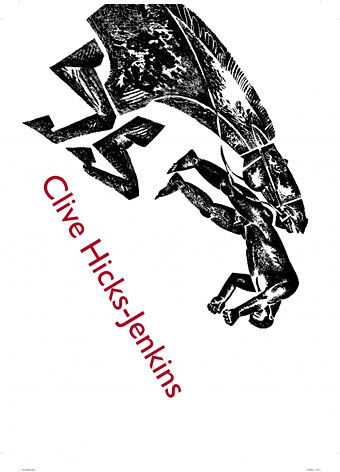
Clive Hicks-Jenkins: A Retrospective

chj1.jpg

I know I’m not the only person capable of grumbling about London’s monopoly on art exhibitions so I’m a little mortified to find I’ve not mentioned Clive Hicks-Jenkins: A Retrospective, an exhibition which has been running at the National Library of Wales, Aberystwyth, since May. There’s no excuse for the oversight since I read all of Clive’s blog posts and most of the recent ones have concerned the exhibition and an accompanying monograph published by Lund Humphries.
chj2.jpg

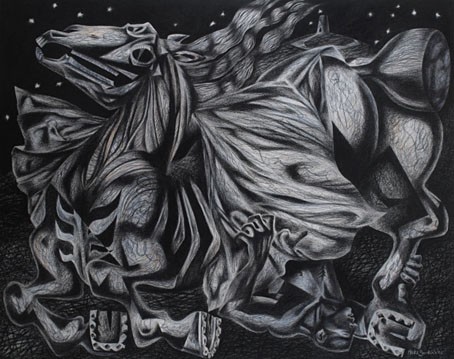
Both Fall (2001).

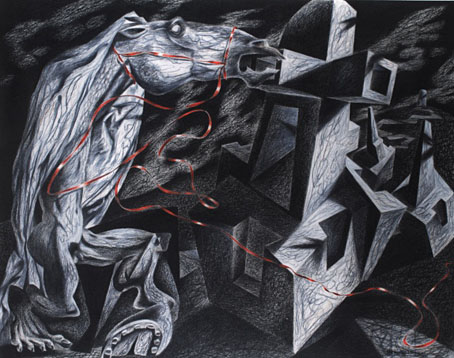
Among the pieces on display are some of his large Mari Lwyd drawings from 2001, two of which are shown here. I think these were the first works I saw of Clive’s and they remain favourites of mine despite their sombre subject matter. The combination of Picasso-like figures, disjunctive perspectives and monochrome nocturnal landscapes make for a very powerful series which Clive discusses in recent blog posts. Not everyone who’s this good with monochrome can handle a combination of tones effectively but Clive’s recent paintings use colour in a manner which is both confident and immediately striking. Form is Void has a small collection of some recent works but if you can get to Aberystwyth you can see them up close. Clive Hicks-Jenkins: A Retrospective runs to August 20th, 2011.
chj3.jpg

Red Flow (2001).

Previously on { feuilleton }
• Equus and the Executionist
• Dark horses
Weekend links 68

dorosheva.jpg

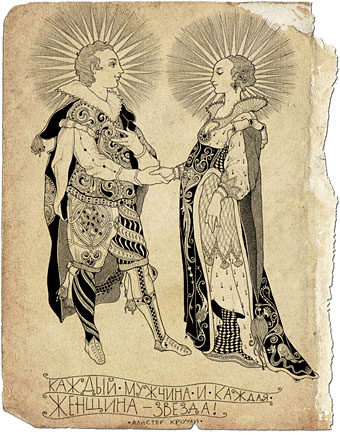
Every man and every woman is a star by Sveta Dorosheva.

• Matt Taylor (illustration) with Gregg Kulick and Paul Buckley (design) provide new Penguin covers for John Le Carré. I love the look which seems inspired by Daniel Kleinman’s title sequence for Casino Royale even if it doesn’t quite suit the shabby world of George Smiley and the Circus.

[Deborah Kass] told me that when she was going to art school in the ’70s, she tripped on LSD almost every week and she said she felt it was her “moral duty as an artist to take the trip.” […] I think psychedelic experience makes you think that there are multiple realities, that there isn’t just this one normal real world to which we’re supposed to conform, but that the reality changes depending on the state of consciousness that we’re in when we’re experiencing it. So, any different kind of art kind of posits a different reality. (more)

New York Times art critic Ken Johnson discussing his new book Are You Experienced?: How Psychedelic Consciousness Transformed Modern Art.

• “That got me thinking that evolution really isn’t survival of the fittest, when it comes to these things, it is more like survival of the interesting, survival of the beautiful, survival of the weird, cool stuff that managed to evolve.” Laurie Anderson and David Rothenberg discuss music and animals.

• Laura Cumming on the late Lucian Freud. And Stephen Heller on Alex Steinweiss, the originator in 1939 of the artistic record sleeve who also died last week.

• Alan Moore says “Think Locally: Fuck ‘Globally'”. He and Queen Calluz explain how Dodgem Logic magazine puts their ideas into practice.

• Adam Curtis gets interviewed while Alan Bennett returns to Armley Public Library in Leeds.

• Peacock’s Garden, a celebration of pavonine splendour.

• A visit to Seher Shah’s studio in Brooklyn, New York.

• Maximum androgyny at Epicenity, a Tumblr.

• Does your god have a penis?

• Chrysalide (1978) is an album of “cosmic” guitar instrumentals by Michel Moulinié which sounds at times like a French equivalent of Manuel Göttsching. It’s never been released on CD but a copy can be found here.

Troutsdale Press bookplates

troutsdale4.jpg

Amy M Sacker.

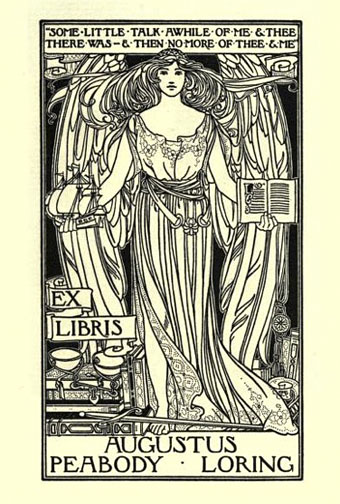
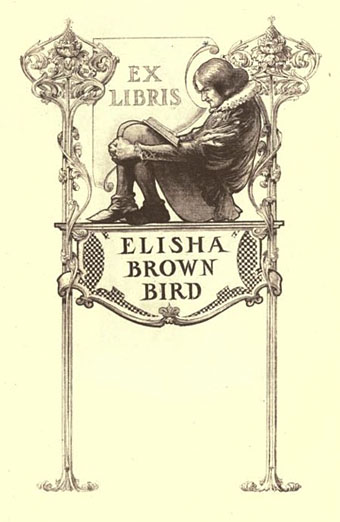
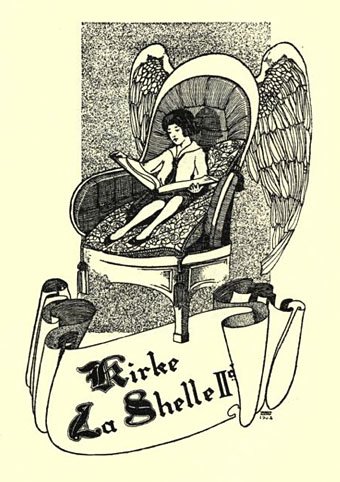
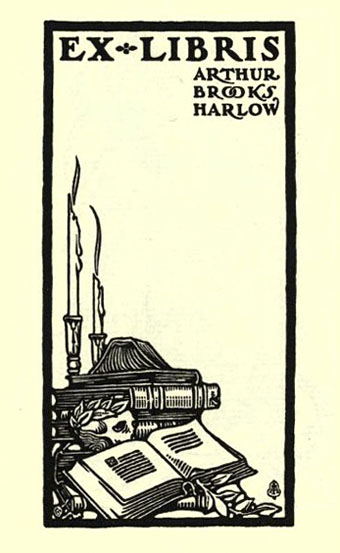
The work of four bookplate artists printed by the Troutsdale Press, Boston, in 1903 and 1904 is contained in these small volumes at the Internet Archive. None of the artists featured are names I’d come across before. Amy M Sacker’s work is of note for being that of a woman given equal status among her male colleagues, and a nice clear-line style reminiscent of Walter Crane. The short text at the beginning of her volume runs through the history of the female contribution to bookplate art, drawing the conclusion (in the usual chauvinistic terms of the period) that women can indeed compete with men at this game.

• Amy M Sacker | Elisha Brown Bird | F Arthur Jacobson | Adrian J Lorio

troutsdale1.jpg

The artist’s own bookplate by Elisha Brown Bird.

troutsdale2.jpg

F Arthur Jacobson.

troutsdale3.jpg

Adrian J Lorio.

• At the LA Times: What’s sticky and can be found in old books?

Previously on { feuilleton }
• Bookplates from The Studio
• Yuri Yakovenko bookplates
• Tranquillo Marangoni bookplates
• Book-plates of To-day
• Louis Rhead bookplates
• Pratt Libraries Ex Libris Collection
• The Evil Orchid Bookplate Contest
• The art of Oleg Denysenko
• David Becket’s bookplates

Hello Dali!

hellodali.jpg

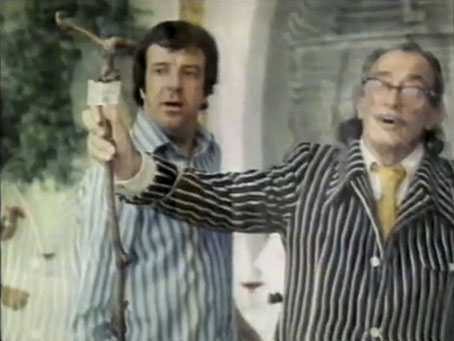
Russell Harty and Salvador Dalí, 1973.

This would have been a real find if the quality wasn’t so poor. Hello Dali! was a 50-minute documentary film about Salvador Dalí broadcast in the UK in 1973 as part of the Aquarius arts strand. The whole thing is on YouTube chopped into five parts and is unfortunately blighted by severe ghosting throughout. Apart from that it’s perfectly watchable.

hellodali2.jpg

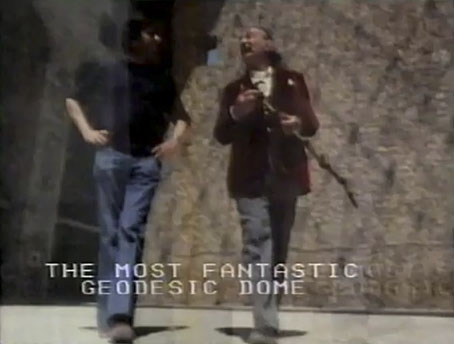
Some conversations are subtitled so viewers are better able to make sense of Dalí’s English/Spanish/French dialect.

Brits who are old enough may remember Aquarius, an ITV arts programme whose weekly slot was taken over in the late 1970s by The South Bank Show, episodes of which used the same format of a short studio introduction followed by a self-contained film. In place of the SBS’s Melvyn Bragg we have Humphrey Burton introducing a film directed by Bruce Gowers. Russell Harty is the front man, seen here in the days before he achieved greater fame as a gossipy chat-show host. I’d been wanting to see this for a long time, having lost a video tape of it years ago. I never saw the original broadcast but it was screened again after Dalí’s death in 1989, and I remembered it as being particularly good for showing a slightly more human side to the eccentric and occasionally annoying artist. So it is, giving us a brief portrait of Dalí in his 69th year, preoccupied at that time with the construction of his museum in Figueres. The value of Harty and Gowers coup in getting the artist to allow a film crew into his home can be found in subsequent UK documentaries, many of which use uncredited extracts from these interviews. It’s the brief moments of interview which make this even though they reveal little. It’s refreshing seeing Dalí talking conversationally in front of a camera instead of putting on a performance.

hellodali3.jpg

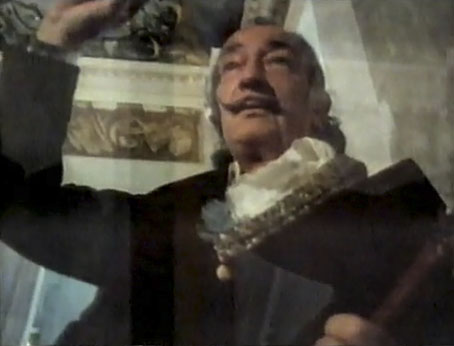
The early 70s saw the last flare of real interest in Dalí from the world at large. Dalí and Surrealism in general had a resurgence of popularity in the late 60s as a consequence of psychedelic culture. A number of books by or about the artist were published or reprinted, among them Peter Owen’s 1973 revival of Hidden Faces, a novel which Dalí had written in 1944. Alejandro Jodorowsky was circling the Dalí camp around the same time, trying to inveigle the artist into portraying the Emperor in his planned film adaptation of Dune. One detail worth noting in the conversation with Russell Harty is mention of a golden toilet, something which Jodorowsky says Dalí wanted as his throne if he was going to appear in the feature film. We never got to see Jodorowsky’s Dune but it’s good to find this documentary available once again. Here’s hoping a better copy turns up eventually.

• Hello Dali! Pt 1 | Pt 2 | Pt 3 | Pt 4 | Pt 5

Previously on { feuilleton }
• Dalí and the City
• Dalí’s Elephant
• Dalí in Wonderland
• Alejandro Jodorowsky’s Dune
• Dirty Dalí
• Impressions de la Haute Mongolie revisited
• Dalí and Film
• Salvador Dalí’s apocalyptic happening
• Dalí Atomicus
• Impressions de la Haute Mongolie

Weekend links 67

hofstatter.jpg

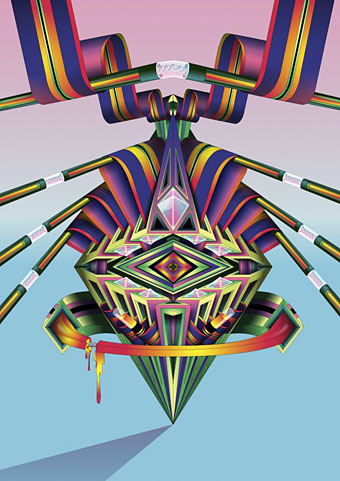
Neutron Drip (2011) by Amrei Hofstätter.

• The Lavender Scare is “the first feature-length documentary film to tell the story of the U.S. government’s ruthless campaign in the 1950s and ’60s to hunt down and fire every Federal employee it suspected was gay”. A film by Josh Howard based on the book by David K Johnson which the author has made a free download here.

• “Annette Peacock, the avant garde American composer, collaborator with Salvador Dalí, friend of Albert Ayler and Moog-synth pioneer, brought this seismically influential session out in 1972…” John Fordham reviews Annette Peacock’s I’m The One which can be purchased here.

• Writer and graphic design historian Steven Heller looks at The Steampunk Bible (edited by SJ Chambers & Jeff VanderMeer) in his column for The Atlantic. He also talks to Galen Smith about the book’s design.

• M John Harrison reveals more about his forthcoming sf novel Pearlent, a partial sequel to Light and Nova Swing. I just re-read Light, and I’m currently In The Event Zone with the follow-up, so I’m looking forward to this one.

• The Raven, a book by Lou Reed & Lorenzo Mattotti (and Edgar Allan Poe). A Journey Round My Skull previewed this in 2009.

• Orson Welles’ Falstaff film, Chimes at Midnight, emerges into the light once more. When do we get a decent DVD release?

• More of the usual concerns: Iain Sinclair’s struggles with the city of London and Erik Davis talks to Alan Moore about psychogeography, John Dee, comic gods, and the art of magic.

• Eddie Campbell takes a tip from Jim Steranko. Related: “Hey! A Jim Steranko effect!”

• Lambshead Cabinet: Win Jake von Slatt’s Mooney & Finch Somnotrope!

• Tilda Swinton is The Woman Who Fell to Earth.

• XXth Century Avantgarde [sic] Books at Flickr.

• Sound sculptures & installations by Zimoun.

• I’m The One (1972) by Annette Peacock.