Weekend links 303

belbury.jpg

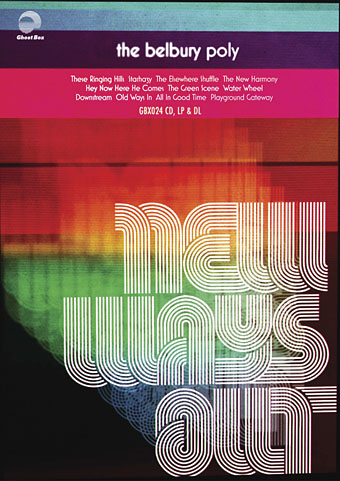
Design by Julian House.

• The last major release by Ghost Box recording artists Belbury Poly was The Belbury Tales in 2012, so news of a new album is most welcome. New Ways Out by The Belbury Poly (that definite article is a fresh addition) will be released next month. The Belbury Parish Magazine has links to larger copies of Julian House’s artwork for this and the recent release from Hintermass, The Apple Tree.

But before New Ways Out appears there’s a compilation album from A Year In The Country released at the end of April. The Quietened Village is “a study of and reflection on the lost, disappeared and once were homes and hamlets that have wandered off the maps or that have become shells of their former lives and times. Audiological contents created by Howlround, Time Attendant, The Straw Bear Band, Polypores, The Soulless Party, The Rowan Amber Mill, Cosmic Neighbourhood, A Year In The Country, Sproatly Smith, David Colohan and Richard Moult.” I’ve been fortunate to hear an advance copy, and it’s an excellent collection.

• “London’s architecture has become laughably boorish, confidently uncouth and flashily arid,” says Jonathan Meades in a review of Slow Burn City: London in the Twenty-First Century by Rowan Moore.

I feel very ill, physically and mentally ill when I hear Christmas carols. I feel so angry, so much like getting out a sniper’s rifle when I hear that kind of music. And Broadway shows with their sentimental songs, those kinds of things are terrifying for me because they call up memories from far back and I don’t necessarily know what they are but they just break me, they break my heart, they break my soul. Iannis Xenakis, the great Greek composer, he said the same thing. He couldn’t listen to the music his mother had played to him when he was young, because it was akin to thinking of someone who was disemboweled. And so for me, if I do a song that’s what you’d say is pretty, my interpretation takes it to another place because it shows the death of the virgin, the animal that goes out in the spring and then gets shot by a hunter. It is prettiness that is very alarming to me, so I tend to do a juxtaposition of something that might be pretty with something that is harsh, just because I feel that they occur in life together.

Diamanda Galás talking to Louise Brown about her work

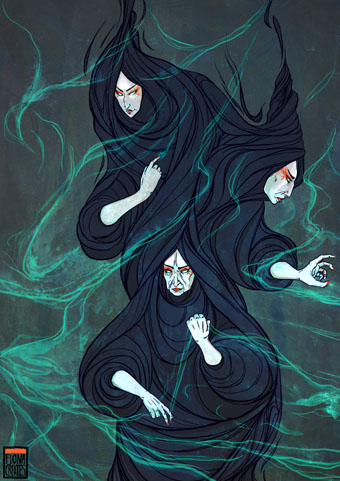
The Fantastical Otherworlds of Adam Burke: S. Elizabeth talks to the artist behind Nightjar Illustration.

• “I try to frighten myself”: Master musician and curator David Toop on his extraordinary cassette tape archives.

• Silver Machine: Hawkwind’s Space Rock Journey throughout Science Fiction and Fantasy by Jason Heller.

• Mixes of the week: Secret Thirteen Mix 179 by Mesmeon, and a new Italian Occult Psychedelia Festival Mix.

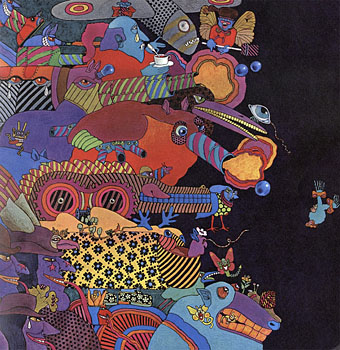
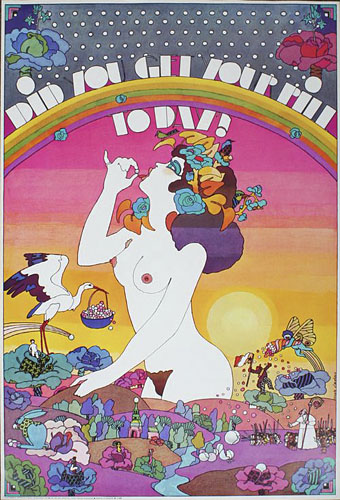
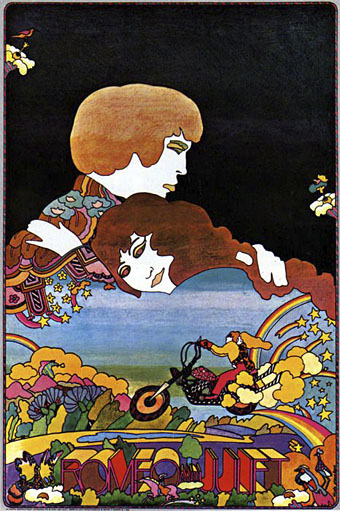
• Offset Identities: Kenneth FitzGerald on graphic designer Barney Bubbles.

The Cine-Tourist lists some of the many cats in the films of Chris Marker.

John Patterson on Ran (1985), Akira Kurosawa’s last great masterpiece.

• Britain’s scarecrows photographed by Colin Garratt.

Strange Flowers explores the city of Turin.

The Museum of Talking Boards

Giallo-themed playing cards

Origami bookmarks

Silver Machine (1972) by Hawkwind | Silver Machine (1973) by James Last | Silver Machine (1988) by Alien Sex Fiend
Everyman and Other Plays by John Austen

austen01.jpg

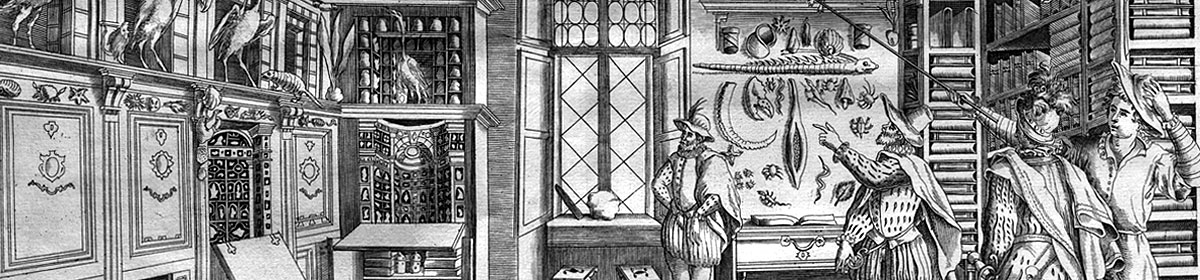
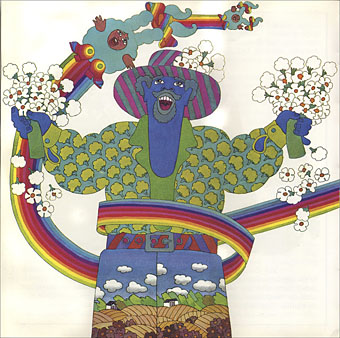
Given the religious theme I ought to have posted this last week. Everyman and Other Plays (1925) is a collection of three medieval plays—Everyman, The Nativity and The Shepherd’s Play—illustrated by British artist John Austen. The scans are from a recent auction at eBay by silver-gryph, some of whose other book scans have appeared here in the past. Austen was a prolific illustrator but many of his books have been out of print for decades, and the drawings can be hard to find online. This is one volume I’d not seen before, not as impressive as some of his earlier works but the minimal colouring works well. The printed book will look a lot more striking since the dull greenish tones are gold ink. There are more plates and vignettes on the auction page. (As before, thanks to Nick for the tip!)

austen02.jpg

austen03.jpg

austen04.jpg

Continue reading “Everyman and Other Plays by John Austen”

Weekend links 300

goudal.jpg

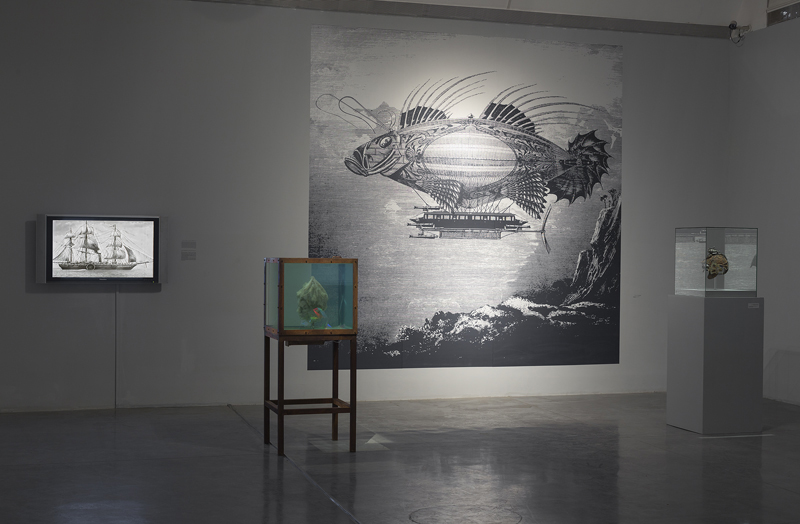
Observatoire IX from the Observatoires series by Noemie Goudal.

• “Before Lady Raglan’s intervention, this figure had been anonymous. She gave him a name: the Green Man.” Josephine Livingstone on the persistence of a supposed figure from pagan folklore.

Ben Wheatley: “Financing a film as crazy as [High-Rise] takes good casting”. Related (in a Ballardian sense): the abandoned hotels of the Sinai Desert.

• “We were in danger of becoming full-time, paid up musicians…” Drew Daniel and Martin “MC” Schmidt of Matmos look back over their career.

Fahey didn’t make many new friends with his scything dismissal of the folk revival. He distrusted the way that folkies regarded music as a carrier for the correct political messages of the moment. As Lowenthal puts it: “To him, the student idealists had naïve worldviews and dreamed of unrealistic political utopias,” whereas Fahey “attempted to channel darkness and dread through his music.” For Woody Guthrie and Pete Seeger devotees, the ideological message came first, with musical tone or trickery a distant second. As Fahey saw it, the dizzyingly strange source music they borrowed from and then built their careers on emerged as little more than a scrubbed-up ventriloquist’s doll, all the coarse grain and troubling metaphysic of its original voices jettisoned. He also detected high condescension and low reverse racism in how the folk-revival people preferred their old blues guys barefoot and wearing dungarees—even if they now usually dressed in sharp suits and often preferred to play amplified, electric urban blues.

Ian Penman on John Fahey

• “It’s amazing how quickly a sound can lose its moorings and float off into this kind of unchartered territory,” says Robin The Fog.

• Mixes of the week: FACT Mix 540 by Via App, and Secret Thirteen Mix 178 by BlackBlackGold.

Oliver Wainwright on Edward Johnston, designer of the typeface for the London Underground.

• At Dennis Cooper’s: DC’s: Spotlight on…The Free-Lance Pallbearers (1967) by Ishmael Reed.

Each drop of Hennessy X.O is an Odyssey: Nicolas Winding Refn makes an alcohol ad.

Wayne Shorter & Herbie Hancock pen an open letter to the next generation of artists.

Japan’s scariest manga artist (Junji Ito) loves Japan’s creepiest cosplayer (Ikura).

• “He was a sexual outlaw.” Jack Fritscher‘s love affair with Robert Mapplethorpe.

Peter De Rome: the RAF pilot who became “the grandfather of gay porn”.

The Strange Case of Mr William T. Horton

• RIP Big George Martin and Ken Adam.

Shortwave Radio World

Viriconium FAQ

Nine Feet Underground (1971) by Caravan | Green Bubble Raincoated Man (1972) by Amon Düül II | Betyárnóta (Outlaw Song, 1989) by Muzsikás

Edmund Dulac’s Tanglewood Tales

dulac23.jpg

Another Dulac I’d not seen before, and what an exceptional edition it is. Tanglewood Tales is Nathaniel Hawthorne’s retelling of Greek myths, a popular book for children that’s been through many reprints. Dulac’s edition dates from 1918, with the illustrations combining some of the stylisation of Greek art with Dulac’s own derivations from Persian miniatures. This might seem odd historically—the Greeks and Persians were enemies, after all—but every plate is a beautiful piece of work. Collectors of Pan imagery should note a fine example in the twelfth painting.

dulac24.jpg

dulac25.jpg

Continue reading “Edmund Dulac’s Tanglewood Tales”

Edmund Dulac’s Tempest

dulac02.jpg

This is a copy of The Tempest that I managed to miss when I was looking for illustrated editions a few years ago. When Edmund Dulac is away from his beloved (and mythical) Arabia or Persia his work tends to resemble that of Arthur Rackham, and that’s what you get in this volume from 1915, a series of Rackham-like colour plates with a handful ink vignettes. Dulac shows us Ariel in his harpy form, and as the more familiar fairy being, while Caliban is depicted as a bearded troglodyte. Of note near the end is Prospero’s sword—which has a moon-shaped hilt of a type only seen in modern-day witchcraft or ritual magic—and the plate for “We are such stuff as dreams are made on”, a suitably strange and almost abstract rendering of a dissolving cosmos.

dulac01.jpg

dulac03.jpg

dulac04.jpg

Continue reading “Edmund Dulac’s Tempest”