Things

thing01.jpg

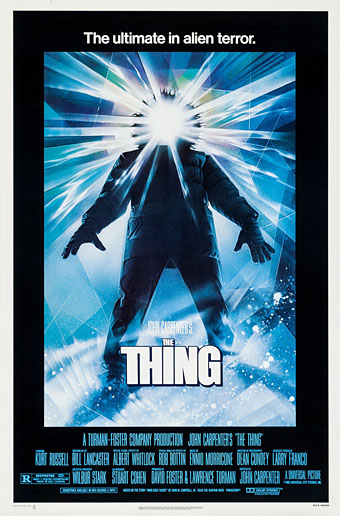
Art by Drew Struzan.

One of my current commissions is a piece of art for a book based on John Carpenter’s The Thing, due to be published next year. This was a request I agreed to immediately, having been astonished by the film when it appeared in 1982 (I saw it three times), and having rated it ever since as Carpenter’s best, as well as one of my all-time favourite horror films. I haven’t started on the planned piece just yet but the commission encouraged me to upgrade my DVD copy of the film to the Blu-ray version, and to also read for the first time John W. Campbell’s “Who Goes There?”, the short story that was the origin of both Carpenter’s film and The Thing From Another World (1951) directed by Christian Nyby. Reading the story set me hunting around for other interpretations of Campbell’s alien.
thing02.jpg

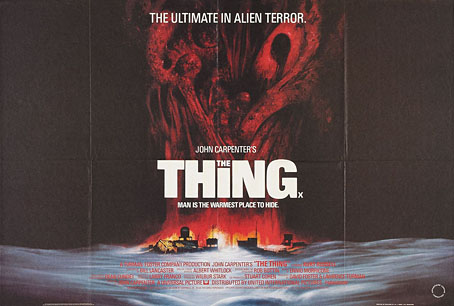
UK poster. Art by Les Edwards.

The story was instructive in several ways, the first being how closely Bill Lancaster’s script for the Carpenter film follows the story’s outline. The paperback collection I was reading has an introduction by James Blish which complains about the Howard Hawks/Christian Nyby production turning the polymorphous alien into another clone of Frankenstein’s monster. That’s true but the Nyby film still scared me to death when I first saw it aged 11 or so, and it has its merits. Lancaster not only stayed closer to the original shape-shifting premise but also kept many of the character names, plus details such as the blood test and the Thing’s attempt at the end to build a machine to escape from the encampment. The unforgettable opening, however, with the lone helicopter pursuing the dog, is all Lancaster’s.
thing03.jpg

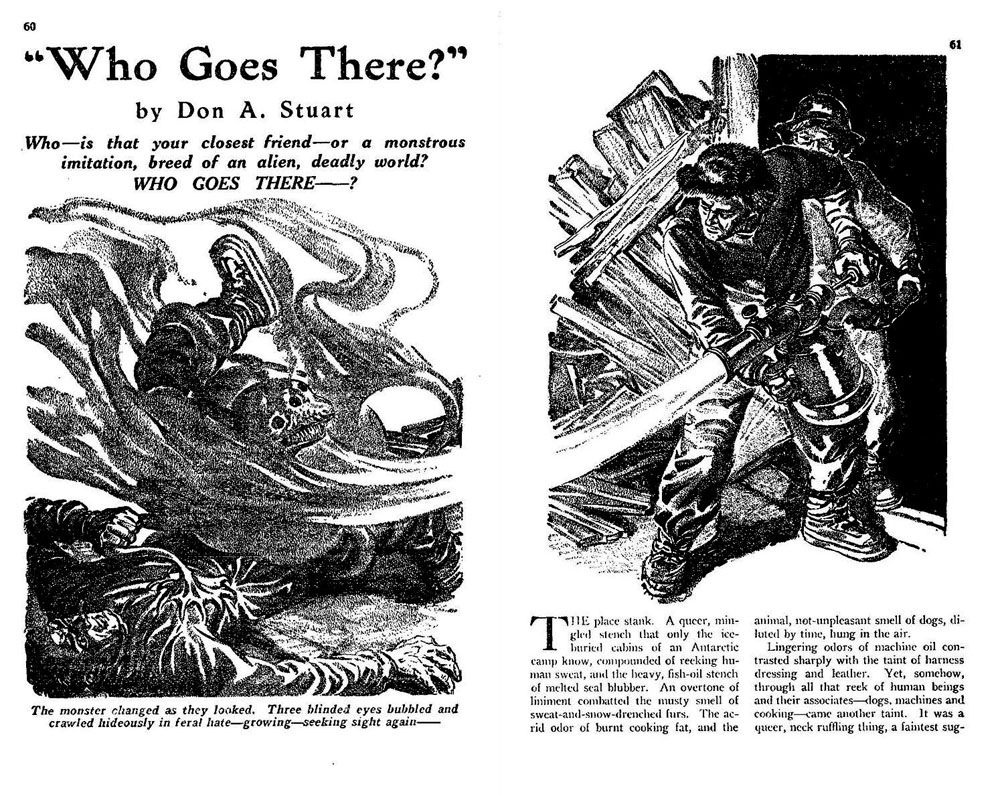
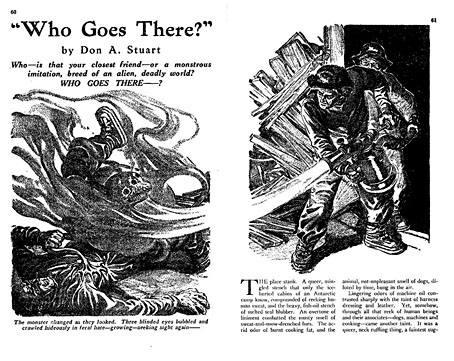
Astounding Science-Fiction, August 1938; artist unknown. “Don A. Stuart” was a pseudonym for John W. Campbell, at that time the newly appointed editor of Astounding. Campbell’s editorship changed the name of the magazine from Astounding Stories to Astounding Science-Fiction.

It was face up there on the plain, greasy planks of the table. The broken haft of the bronze ice-axe was still buried in the queer skull. Three mad, hate-filled eyes blazed up with a living fire, bright as fresh-spilled blood, from a face ringed with a writhing, loathsome nest of worms, blue, mobile worms that crawled where hair should grow—

Campbell’s description of the ice-bound alien is better than some of his writing elsewhere. I’m used to tempering my judgement when visiting stories written for the pulps but Campbell’s writing is really awful, and a reminder of why I never got very far with the early SF writers. Weird Tales magazine had its share of ham-fisted journeymen (and women), but Campbell’s contemporaries such as Clark Ashton Smith and HP Lovecraft read like the most finessed and mandarin prose stylists in comparison. Well, The Thing isn’t the first great film to be based on a poor-quality story so we can at least thank Campbell for his scenario, although how much of it was his own has never been clear. The idea of ancient aliens in Antarctica (some of which are amorphous shape-shifters) had already been explored by HP Lovecraft in At the Mountains of Madness; Lovecraft’s story was published in 1936 by Astounding Stories, the same magazine that published “Who Goes There?” two years later. This lineage, and the possible influence, makes The Thing one of the foremost Lovecraftian films even without all of its tentacled abominations.
thing04.jpg

Art by Hannes Bok.

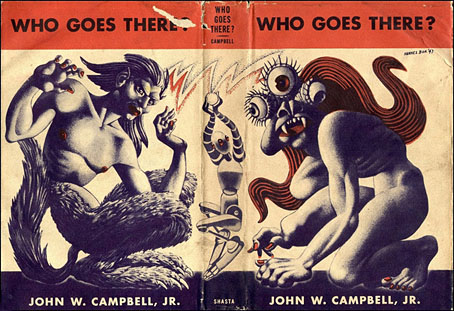
The story provided the title of Campbell’s debut collection of short fiction in 1948. I’ve known the Hannes Bok cover art for many years but hadn’t realised until recently that the three-eyed monster on the front was a Bokian rendering of Campbell’s alien. The figure on the back is presumably a human/husky hybrid, while I’d guess the robot relates to one of the author’s other stories.

Continue reading “Things”
Weekend links 335

oelze.jpg

The Expectation (1936) by Richard Oelze.

Richard Oelze, 1900–1980 is an exhibition of paintings and drawings at the Michael Werner Gallery, London, which runs until January 2017. More Surrealist works by Oelze may be seen at But Does It Float and Ubu Gallery.

Will McMorran on the problems of translating the Marquis de Sade’s most obscene work. Related: Jay Sina on Sexistential Horror: HP Lovecraft and the Marquis de Sade as perverse peers.

• Mixes of the week: More Halloween horror at No Condition Is Permanent, Secret Thirteen Mix 200 by JK Flesh, and a mix for The Wire by Botany.

The Chronicles of Clovis (1911), a story collection by Saki (HH Munro) who died 100 years ago this week.

• “Jack is 24, sometimes he’s a drag queen named Sabrina.” The Queen (1968).

• The Mindset of the Macabre: An interview with Abigail Larson.

• “The world is full of bloviators,” says MAD cartoonist Al Jaffee.

Ginette Vincendeau on how the French birthed film noir.

• How to throw a dinner party like Salvador Dalí.

Sastanàqqàm, another new song by Tinariwen.

• At A Year In The Country: more Quatermass.

• Photographs by Klaartje Lambrechts.

Paul Bailey on Pasolini’s lost boys.

Adam Shatz on Leonard Cohen.

Subterranean London

Joan Of Arc (1986) by Jennifer Warnes with Leonard Cohen | Who By Fire (1986) by Coil | The Future (1992) by Leonard Cohen

Weekend links 332

seamans.jpg

Suspiria (2012) by Jessica Seamans.

Matthew Sperling on Tom Phillips’ “treated Victorian novel” A Humument, which he calls “a multimedia masterpiece”. Phillips’ sixth and final edition of the book is published by Thames & Hudson next month.

Strange Flowers on Monsieur de Bougrelon (1897), a short novel by Jean Lorrain which will be published next month by Spurl Editions. The book is currently on my to-be-read-next pile.

Theodore Carter finds images of skulls by artists through the ages. I’d have included Giacometti’s almost abstract Head-Skull (1934) or his sketch of 1923.

• The horror stories of EF Benson contain “enough nastiness to give you just the right kind of frisson for the time of year,” says Nicholas Lezard.

• Covers for One, an American magazine of the 50s and 60s dedicated to “the homosexual viewpoint”.

Kelly Sullivan takes a close look at the illustrations and stained-glass work of the great Harry Clarke.

• Lost Moomins cartoon strips will be shown in the first UK Tove Jansson exhibition.

• The extravagant homes of Ludwig II of Bavaria are in urgent need of restoration.

• Mix of the week: The Nine Ten Never Sleep Again Mix by The Curiosity Pipe.

Ténéré Tàqqàl (what has become of the Ténéré), a new song by Tinariwen.

• The King of Weird: Joyce Carol Oates on HP Lovecraft.

• Charting the legacy of cult 1970s band, Big Star.

Falling (1992) by Miranda Sex Garden | Inferno (Version II) (1993) by Miranda Sex Garden | Peep Show (1994) by Miranda Sex Garden

Weekend links 326

schaechter.jpg

Anchoress by Judith Schaechter.

• The publication of Alan Moore’s Jerusalem is imminent so the NYT asked him about his favourite books and writers of the moment. For the next post I’ll be writing about my own involvement with Moore’s novel.

Chris Campion on David Bowie and the missing soundtrack: the amazing story behind The Man Who Fell to Earth. Related: cinematographer Anthony Richmond on his memories of shooting the film.

Mr Beatnick on how the B-side of Change The Beat by Beside became the most sampled song of all time.

Lisa Hix on An Un-Conventional Thirst: Collecting 7Up’s most beautiful, hallucinatory billboards.

Rub Out The Word: Steve Buscemi & Elliott Sharp present texts by William Burroughs.

• Opening next month at the Corridor Gallery, Brighton (UK): An exhibition of art by Ian Miller.

• Folk singer Shirley Collins will be releasing a new album, Lodestar, her first for over 35 years.

A trip to the mythical Isle of Tiki, Polynesian Pop and A/C Eden.

• Mix of the week: Harvest Hymns by Melmoth The Wanderer.

• Wandering In Space: composer Jherek Bischoff interviewed.

Heavy Water is a new short film by Adam Scovell.

• “When will New York sink?” asks Andrew Rice.

The World’s Largest Synthesizer

The Thai Occult by Jenx

• RIP Richard Neville

The Other Without

We Are Cult

Heavy Rock (1976) by Sound Dimension | Heavy Charm (1995) by The Ear | Heavy Water (2008) by Crackle

Roger Dean book covers

dean1.jpg

The View Over Atlantis (1972).

The covers in question are the handful that Roger Dean produced for paperbacks in the 1970s and 80s, rather than those for his own books and the ones he edited. Given the popularity of Dean’s work in the 1970s you’d expect there to be more than this although I’m not sure he would have had the time for any more work than he was doing already.

The two covers for Pan Science Fiction vexed me for a while since the art is reproduced in Dean’s Views collection but with no mention of the book titles. It’s taken some time, but ISFDB has updated its Roger Dean page so I can finally sate my curiosity. The Michell cover is an ideal illustration for the author’s theorising about ley lines but the Pan SF paintings are vague enough to be used on other books, or even on album covers.

dean2.jpg

The Puppet Masters (1973).

dean3.jpg

Gold the Man (1973).

dean4.jpg

The War of the Worlds (1986).

I’ve not read the Colin Greenland books so I can’t say whether their cover art relates to the novels but the Wells cover certainly does. A rare example of Dean depicting a scene from somebody else’s imagination.

dean5.jpg

The Hour of the Thin Ox (1987).

dean6.jpg

Other Voices (1988).

Elsewhere on { feuilleton }
The book covers archive

Previously on { feuilleton }
Design as virus 17: Boris and Roger Dean
Roger Dean: artist and designer