Weekend links 46

finalprogramme.jpg

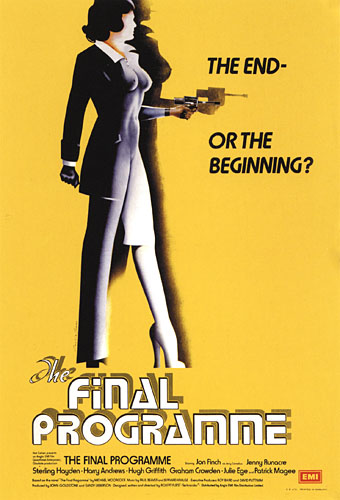
The Final Programme (1973). Philip Castle’s poster art implied the androgynous finale of Moorcock’s novel which the film itself evaded.

They were musty-smelling 10p messages from the futuristic past, complete with cover designs (and content) that were unlike anything I’d seen before. I’m fairly certain that this was how I first came across Michael Moorcock, in an early-70s Mayflower paperback, with a psychedelic cover by Bob Haberfield.

(…)

Moorcock steered New Worlds towards a set of concerns that chimed with the times; this was the period ruled by Marshal McLuhan and RD Laing, and the exploration of “inner space” seemed just as interesting as the “outer space” of satellites and moonshots. This turn was controversial, not just with die-hard pulp fans, but, surprisingly, with people such as the pop artist Richard Hamilton, another denizen of the London scene. “He thought we were turning science fiction into something namby-pamby, losing its roots,” Moorcock says. “He wanted explosions and spaceships and robots.”

When Hari Kunzru met Michael Moorcock, a major feature on a great writer and cultural catalyst. Kunzru posted the full transcript of their conversation here. Jovike’s Moorcock Flickr set has many of the lurid Mayflower covers.

• Moorcock is among the contributors to the forthcoming Thackery T. Lambshead Cabinet of Curiositities. io9 posted a list of contents (and one of my pics) while co-editor Jeff VanderMeer added some detail.

• So long to The White Stripes whose dissolution was announced earlier in the week. We know they’ll be back one day. Jay Babcock gave them their first major interview for the LA Weekly in 2000 which he’s reposted here.

Mister Blues (1962) by Lasry-Baschet aka Structures Sonores, a rare 7″ single showcasing the unique glass-and-metal sounds of the Cristal Baschet. Young Teddy Lasry on clarinet was playing in prog-jazz outfit Magma a few years later. Related: John Payne on Magma and The Mars Volta.

Here’s one thing that changed me: a close reading of Flannery O’Connor’s Mysteries and Manners. In it, she says that, “it is the business of fiction to embody mystery through manners,” manners being those concrete details — depictions of the real — in story. “Mystery through manners…” I had never heard a modern author seeking deep metaphysical mystery through realism before. Well, sure, Robert Musil, Bruno Schulz, Robert Walser, and a handful of other personal faves. By deep mystery I mean, mystery about our relationship with the planet, not anthropocentric mystery. I get sick of thinking about humans quickly, as we only constitute about 1% of what’s happening in our universe, if that much, and it was refreshing to me to hear O’Connor critiquing Henry James’ idea that modern people should aspire to know nothing of mystery, to be completely rooted in humanity. That notion makes me feel like hurling myself off a cliff. In her opinion, great literature seeks to embrace and express mystery through its mimicry of actual mannerisms. Mystery — fantasy — through the real. And with that, the borders between fantasy and realism were completely transgressed in my brain. Suddenly, I saw them as two good means to the same end. This made me excited to write real human situations again.

Trinie Dalton is interviewed here.

• And speaking of mystery through the real, there’s London Intrusion, a sequence of metropolitan adumbrations by China Miéville. Am I the only person to spot an intrusion of a different kind in the presence there of one of Eugène Atget’s Parisian views? There’s a doorway to Viriconium in that curious wedge of buildings but nobody can tell you where.

Rupert Murdoch—A Portrait of Satan. Adam Curtis on top form looking at the Dirty Digger’s career and a reminder of why some of us have always called one of his rags The Scum. A key point for me: Murdoch’s insecure railing against “elites”, a favourite term of aspersion on his Fox News network.

• Rick Poynor asks What Does JG Ballard Look Like? Related: “…only two people in Bucharest are going to read this.” Eduardo Paolozzi in conversation with JG Ballard and Frank Whitford, 1971.

How many days does Bill Murray’s character really spend reliving Groundhog Day?

• Silent Porn Star explores The Translucent Beauty of Androgyny.

Ballets Russes brought back to life on film, and also here.

Dewanatron Electronic Music Instruments.

RIP Tura Satana. Remember her this way.

Warm Leatherette (1978) by The Normal | Warm Leatherette (1982) by Grace Jones | Warm Leatherette (1998) by Chicks On Speed.

Deutsche Kunst und Dekoration #6

dkd06-01.jpg

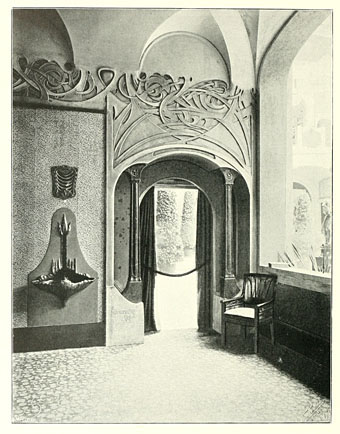
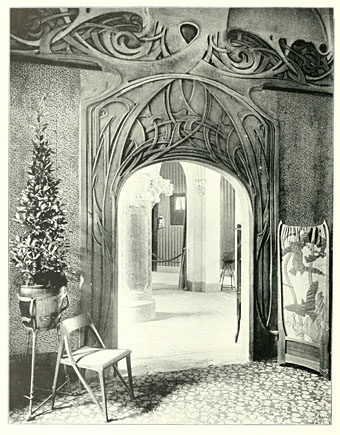
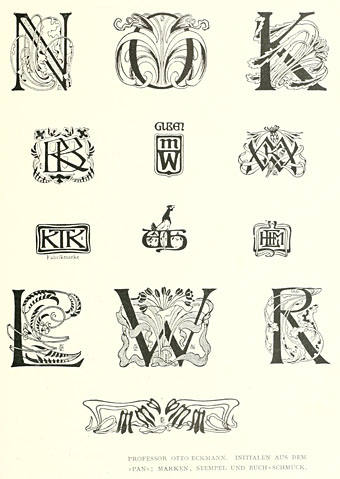
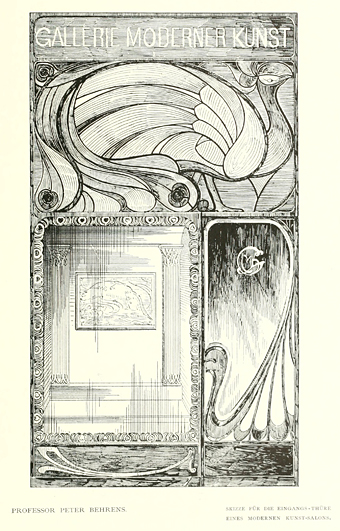
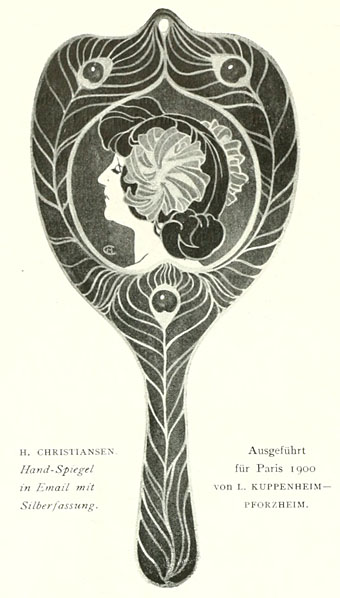
Continuing the delve into back numbers of Deutsche Kunst und Dekoration, the German periodical of art and decoration. Volume 6 covers the period from April to September 1900, and the content is still Art Nouveau all the way, with a dash of Symbolism. Among the contributors in this edition there’s Otto Eckmann and more work from Hans Christiansen, both frequent contributors to Jugend magazine There are further examples of stylish Art Nouveau interiors, and of considerable interest to this Exposition Universelle obsessive, a look at the Paris exposition of 1900 from the German side of things. As before, anyone wishing to see these samples in greater detail is advised to download the entire volume at the Internet Archive. There’ll be more DK&D next week.

dkd06-02.jpg

The ubiquitous peacocks were never far away in 1900.

dkd06-03.jpg

Continue reading “Deutsche Kunst und Dekoration #6”

Weekend links 45

sa4.jpg

That essential journal of esoteric culture, Strange Attractor, announced a fourth number this week sporting a psychedelic cover which may be the work of Julian House (no credit is given on the SA site). As to the contents:

From Haiti and Hong Kong to the fourth dimension and beyond: discover the secrets of madness in animals; voodoo soul and dub music; ancient peacock deities; Chinese poisoning cults; the history of spider silk weaving; heathen mugwort magic; sentient lightning; Jesuit conspiracy theories; junkie explorers; Dali’s Atlantis; the resurgence of Pan (in London’s Crouch End); anarchist pirates on Madagascar; an ancient Greek Rip Van Winkle; French anatomical waxworks; Arthur Machen’s forgotten tales and Alan Moore’s unpublished John Dee opera.

Further details and the means to order a copy can be found here.

• Resonance FM’s Weird Tales For Winter has returned beginning with a presentation of The Gateway of the Monster, one of the better Carnaki tales by William Hope Hodgson. The story is read by Moon Wiring Club‘s Ian Hodgson (no relation) and the musical atmospheres are provided by The Advisory Circle. I ought to have posted this news yesterday since you’ll have missed the broadcasting of the first half but the second half will go out at midnight (UK time) on Monday. Details here, and the next release on the Café Kaput label in February will be the soundtrack, Music for Thomas Carnaki (Radiophonic Themes & Abstracts).

keepcalmcthulhu2.jpg

• The Keep Calm and Carry On Image Generator lets you work your own variations on the ubiquitous poster. It wouldn’t work for me, however, so I rolled up my sleeves and made my own. This may be good as a CafePress design, yes?

Interplay is an album by John Foxx and The Maths due to be released on March 21st. As with last year’s collection of Foxx instrumental pieces, DNA, the package design is by Jonathan Barnbrook. John Foxx first came to prominence as the lead singer in Ultravox (do I need to say “of course”? Okay…“of course”) and Ultravox’s debut album was part-produced by Brian Eno. It’s been painfully obvious recently (and it pains me to say it) that Foxx’s DNA was a far more accomplished and engaging work than Eno’s recent collection of over-hyped instrumentals. Related: Barnbrook Design’s albums of 2010.

Word Horde 2.0, “a substantial archive of manuscript material, correspondence, and books and printed matter, mostly signed” from the William Burroughs archives can be yours for $260,000. Related: William Burroughs’ Wild Boys photos. Also: Rudy Rucker on David Cronenberg’s Naked Lunch.

• “Nabokov described how ‘a modern taxonomist straddling a Wellsian time machine with the purpose of exploring the Cenozoic era’ would encounter the following series of events in the evolution of these butterflies…” The Royal Society confirms that a contentious theory of Vladimir Nabokov’s concerning the descent of butterfly populations was accurate.

• The work of Gérald Bertot aka Thomas Owen, a Belgian author of weird fiction, is explored at A Journey Round My Skull.

The Other Side of the Wind, Orson Welles’ unfinished film from 1972, may finally be given a release.

• Jon Savage celebrates Roy Harper and his extraordinary Stormcock album.

Philip Pullman wants the Tory philistines to leave our libraries alone.

• Rick Poynor takes a dérive through the arcades of Paris.

Space music new and old.

Young Savage (1977) by Ultravox | Clicktrack (2010) by John Foxx & Jonathan Barnbrook.

Deutsche Kunst und Dekoration #5

dkd05-01.jpg

Continuing the delve into back numbers of Deutsche Kunst und Dekoration, the German periodical of art and decoration. Volume 5 covers the period from October 1899 to March 1900, and the Art Nouveau style is in full flower at this point, as it was across most of Europe. This is also the place at which the journal becomes so laden with impressive design work that it’s impossible to easily do justice to over 300 pages of contents. Anyone wanting to see more is encouraged to download the whole thing as either page scans or a PDF. As before I’ve tended to concentrate on the graphic material but this issue also features more lavish interior designs, a range of jewellery, and ponderous monumental architecture including proposals for some of Germany’s many Bismarck Towers. Examples follow below. There’ll be more DK&D next week when we take a trip to the Exposition Universelle in Paris.

dkd05-02.jpg

Sascha Schneider was Karl May’s favourite illustrator and one of the few openly gay artists in Germany at the time. He’s represented here with a small feature on his paintings among which there’s this depiction of a team of strapping oarsmen.

dkd05-03.jpg

Continue reading “Deutsche Kunst und Dekoration #5”

Weekend links 44

bradley.jpg

Poster by Will Bradley for Victor Bicycles (c. 1895).

• G. Wayne Clough, chief exective of the Smithsonian Institution, finally admits that he made a hasty decision in removing David Wojnarowicz’s video from the Hide/Seek exhibition of gay art. Related: “Finland’s cultural gifts to the world include Sibelius, the Moomins and an artist that the country has been less eager to celebrate.” The belated homecoming of Tom of Finland.

The Fiend with Twenty Faces: Jonathan Clements examines the legacy of Edogawa Rampo (Hirai Taro), the Japanese master of mystery and imagination.

• RIP Susannah York. The Guardian posted a selection of clips including one from Robert Altman’s Images (1972).

• More mixtapes: Trish Keenan’s Mind Bending Motorway Mix and a selection for Quietus by Chris & Cosey.

• “Ruin photos speak to our desperate desire to have our world re-enchanted.”

tomorrow.jpg

Promo poster by Hapshash and the Coloured Coat for My White Bicycle by Tomorrow (1967).

The Raging Peloton: Iain Sinclair on two wheels good, four wheels bad.

The unknown Jorge Luis Borges: five new anthologies reviewed.

The French house untouched for 100 years (and also here).

Electrotypes on Drugs: old chemists’ labels.

South China Sea Pishkun by Dinh Q. Lê.

Bike (1967) by Pink Floyd | My White Bicycle (1967) by Tomorrow | Trip On An Orange Bicycle (1968) by Orange Bicycle.