Weekend links 127

whirlpool.jpg

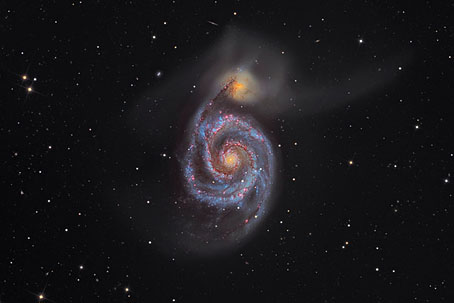
M15, The Whirlpool Galaxy photographed by Martin Pugh. The overall and deep space winner of Astronomy Photographer of the Year, 2012.

The Final Academy, the series of William Burroughs-themed events that took place in London and Manchester in 1982, will be celebrated at the Horse Hospital, London, on 27th October. Academy 23, a publication edited by Matthew Levi Stevens, will include my report on the Manchester Haçienda performances.

• “Architects are the last people who should shape our cities,” says the thrillingly pugnacious Jonathan Meades in a piece from his new writing collection Museums Without Walls. Andy Beckett reviews the book here.

• Ex-Minimal Compact singer/bassist Malka Spigel talks about her new album, Every Day Is Like The First Day, which can be streamed in full here.

What’s new about the current acknowledgments page is that it’s unsolicited—it appears like an online pop-up ad, benefiting no one but the author and his comrades. This is surely why these afterwords are often so garrulously narcissistic and strewn with clichés. The most radical experimentalist adheres to the most mindless acknowledgments-page formula; the most stinging social critic suddenly becomes Sally Field winning an Oscar.

Sam Sacks at the New Yorker on the blight of novelists’ acknowledgments pages. DG Myers at Commentary Magazine piles on.

• Another streaming album: Composed by Jherek Bischoff. Try Insomnia, Death & The Sea featuring Dawn McCarthy.

• Film of Lindsay Kemp being interviewed in 1977 about his production of Salomé.

Electronic Performers (2004): a video by Machine Molle for the song by Air.
djuna.jpg

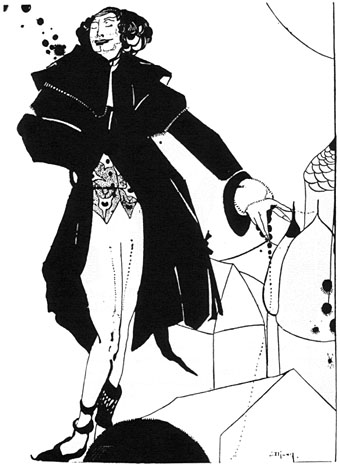
One of a series of Beardsley-like drawings by Djuna Barnes posted at Strange Flowers. The resurgent Ms. Barnes is mentioned three times in this Terry Castle review of All We Know: Three Lives by Lisa Cohen.

Fictitious Dishes, meals from novels photographed by Dinah Fried.

• Life, the Dinosaurs & Everything: Cosmicomics by Italo Calvino.

The Baby Died: Morbid Curiosities found in Old Newspapers.

• Portishead’s Adrian Utley gives a tour of his synth collection.

• Minimal Compact: Babylonian Tower (1982) | Not Knowing (1984) | When I Go (1985) | Nil Nil (1987).

Weekend links 125

cme.jpg

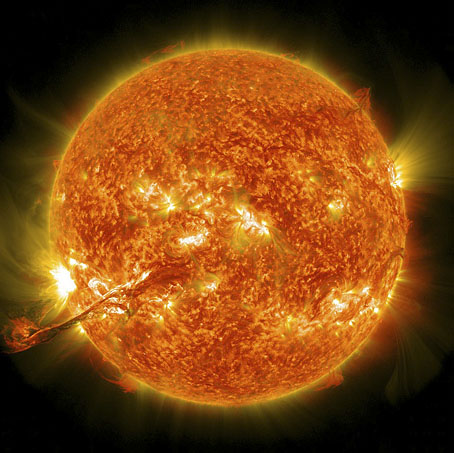
Coronal Mass Ejection from the surface of the Sun, August 31st, 2012.

• “Most of the main parts were recorded in a single day using Vangelis’s famous technique: try to play as many synths as possible at once.” Simon Drax on the prolific musical output of Zali Krishna. The new Krishna opus is Bremsstrahlung Sommerwind, free to download at the Internet Archive.

• The Northants International Comics Expo (N.I.C.E.) opens on September 22nd. Among the many attendees there will be Mr Alan Moore making his first convention appearance since 1987.

• “Isolated for one night in a boat overlooking the Thames, Geoff Dyer explores representations of reality through the lens of Joseph Conrad’s Heart of Darkness.”

Now seems the right time to revisit this secret archive of public broadcasting. It’s an antidote to the celebrity-led, format-driven nature of so many arts documentaries made today. It shows that it’s possible to produce TV that is both populist and experimental. And it also refutes the cliché that the 1970s was a decade only of crisis and downturn. “Feminism, political theatre, Ways of Seeing: I wasn’t thinking, ‘what a terrible time’. It was very dynamic, activist, political. Creatively it was very exciting. Yet all they show on those television retrospectives are episodes of Top of the Pops.”

Sukhdev Sandhu talks to Mike Dibb, the director of Ways of Seeing.

• From 1999: Colm Tóibín reviews A History of Gay Literature: The Male Tradition by Gregory Woods.

What We See: a song by Julia Holter & Nite Jewel with a film by Delaney Bishop & Jose Wolff.

Rick Poynor on The crash test dummy: from subcultural fringes to pop culture mainstream.

In his 1973 book on Joyce, Joysprick, Burgess made a provocative distinction between what he calls the “A” novelist and the “B” novelist: the A novelist is interested in plot, character and psychological insight, whereas the B novelist is interested, above all, in the play of words. The most famous B novel is Finnegans Wake, which Nabokov aptly described as “a cold pudding of a book, a persistent snore in the next room.” The B novel, as a genre, is now utterly defunct; and A Clockwork Orange may be its only long-term survivor.

Martin Amis on A Clockwork Orange, fifty years on. My old post about the film’s record shop scene continues to be one of the most popular pages here.

• Wild Boys: David Bowie and William Burroughs in 1974, hand-coloured by DB.

Alfred Kubin‘s illustrations for Haschisch (1902) by Oscar AH Schmitz.

• Revolution off: industrial ruins photographed by Thomas Jorion.

• Tetrahedra of Space: 22 pulp illustrations by Frank R. Paul.

The Blue Boy Studiolo: a Tumblr.

Marina Warner visits Hell.

• The art of Casey Weldon.

RainyMood.com

Third Stone From The Sun (1967) by The Jimi Hendrix Experience | Sunrise In The Third System (1971) by Tangerine Dream | 3rd From The Sun (1982) by Chrome.

Weekend links 118

owczarek.jpg

The Garden of Urban Delights (2010) by Marcin Owczarek.

His protagonists are misfits: alienated, implicitly gay, longing for love, frequently hard to be around, always fixated on small pleasures that compensate for an essential feeling of not belonging. […] His patroness Edith Sitwell termed him “that rare being, a born writer.” William Burroughs dedicated The Place of Dead Roads to him, declaring Welch “certainly the writer who most directly influenced my work.” John Waters has called In Youth is Pleasure “so precious, so beyond gay, so deliciously subversive, [it] is enough to make illiteracy a worse social crime than hunger.”

Sadie Stein on Denton Welch, a writer I’m embarrassed about still not having read. Edith Sitwell and William Burroughs had a famously disputatious correspondence in the pages of the TLS over The Naked Lunch. An appreciation of Welch’s work was one of the few things they had in common.

• Don’t mention guitars: Robert Hampson on acousmatic music, the curse of Loop and the rebirth of Main.

• No Straight Lines: A Collection Of Queer Comics part one, part two, part three. A history by Justin Hall.

Pieces Of Gold by The Aikiu: shots from gay porn videos repurposed via some smart editing.

• RIP İlhan Mimaroğlu, electroacoustic composer. Ubuweb has a selection of his recordings.

“A good ground rule for writing in any genre is: start with a form, then undermine its confidence in itself,” he says. “Ask what it’s afraid of, what it’s trying to hide – then write that.” For Harrison, the most satisfying writers are “at odds with their cultural context. They’re trying to fit in and failing, or they’re trying to remove themselves and failing. The attempt to resolve the conflict is an angle – a frame or a context – in itself.”

The Guardian’s A Life in Writing profiles M. John Harrison. His new novel, Empty Space, was published on Thursday. There’s also this recent video interview with Arc magazine.

• Stephen Usery interviews editor Russ Kick about The Graphic Canon: Volume One.

At home with Prince Zaleski, the “most decadent and imperial detective in fiction”.

• A Visit with Magritte: photographs by Duane Michals.

Loitering airships could dispense drones on demand.

• Creating a Forever Object: Ian Schon’s Pen Project.

• A Tumblr for the late, lamented Arthur Magazine.

• “Few cities can boast a railway line for the dead.”

The Lost Tapes by Can: An Oral History.

Space Reflex (1963) by Dick Hyman & Mary Mayo | Space Is Deep (1972) by Hawkwind | Space Is The Place (1973) by Sun Ra | Space Moment (1995) by Stereolab | Space Pong (2006) by T++

Be prepared

sherer2.jpg

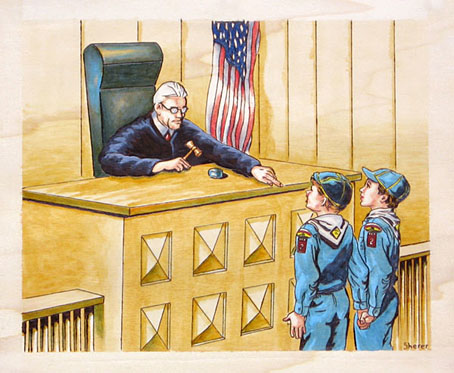
Sodomites (no date) by Robert Sherer.

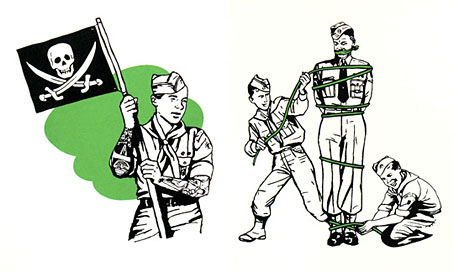
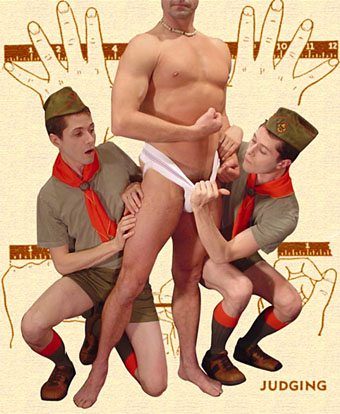
The Boy Scouts of America yet again proved itself a retrograde organisation by deciding this week after a two-year review to maintain its policy of exclusion for gay scouts and gay scout leaders. The Girl Scouts of America don’t have this kind of policy, nor do UK Scouting organisations. In honour, then, of the Boy Scouts of America’s decision here’s some work by a trio of North American artists all of whom have used scouting iconography for subversive or satirical purposes. Robert Sherer and Jason Driskill are both American while Daryl Vocat is Canadian. Vocat’s portfolio of prints is particularly funny, showing scouts tattooing each other and making bombs; William Burroughs would love it. Poor old Chuck Norris, meanwhile, would no doubt collapse with a fit of the vapours at the sight of Sherer’s scouts holding hands.

vocat.jpg

Prints from A Boy’s Will (no date) by Daryl Vocat.

driskill.jpg

Judging (2004) by Jason Driskill.

Elsewhere on { feuilleton }
The gay artists archive

Haçienda ephemera

hac01.jpg

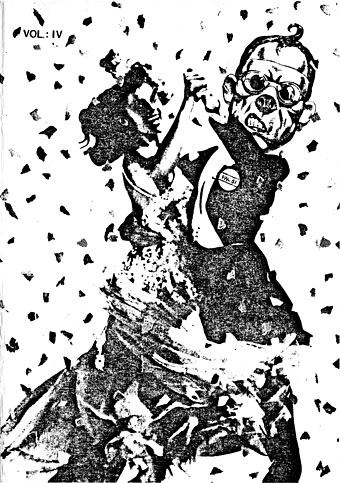
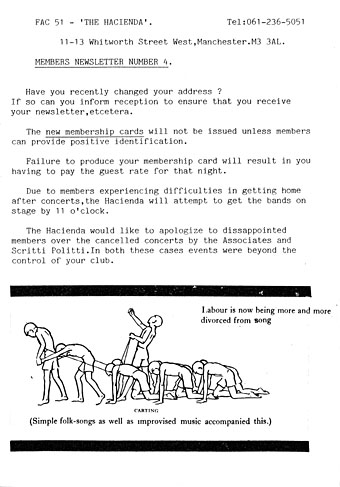
Haçienda Members’ Newsletter IV, 1982. (The head collaged onto the male figure is from RanXerox by Tanino Liberatore.)

Searching through some papers at the weekend turned up something I’d completely forgotten about: a members’ newsletter for Manchester’s Haçienda club. When the place first opened you needed to be a member to get in, unless you already knew a member in which case you could be signed in as a guest. One reason the place was so empty in its first couple of years was the restricted access, a policy they later dropped.

haccard.jpg

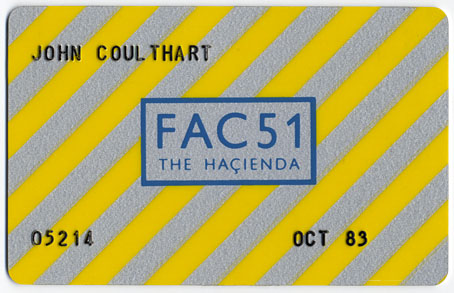
I paid for my membership in September 1982 since I was eager to see William Burroughs appearing in the Final Academy event on October 4th. I think the newsletter must have arrived with the nice Peter Saville-designed card. If there were any other newsletters after this I never received any but then I was never a conscientious club-goer and only went there if there was a decent band playing.

hacflyer.jpg

And speaking of decent bands, I also found this flyer, the only one I have from that period. Einstürzende Neubauten played the Haçienda twice, in August 1983 and February 1985, and I saw them on both occasions. The flyer is for the second event and is a lot more typical of Haçienda products than the fanzine-style newsletter. Neubauten’s first appearance there was sparsely attended but remains one of the best events I’ve witnessed. This was at the tail end of their metal-bashing period, and the performance that night involved a lot of hammering, flames, showers of sparks and broken glass flying into the audience. The climax came when one of them picked up the pneumatic road-drill they used for their noise-making and drilled straight into the concrete wall at the side of the stage. The machine was left hanging there to the consternation of the club staff. A few months later they staged their notorious performance at the ICA in London which was cut short when they started dismantling the stage. The second Haçienda gig drew a larger crowd but was a more subdued affair which would have disappointed those who were yelling for destruction between the songs.

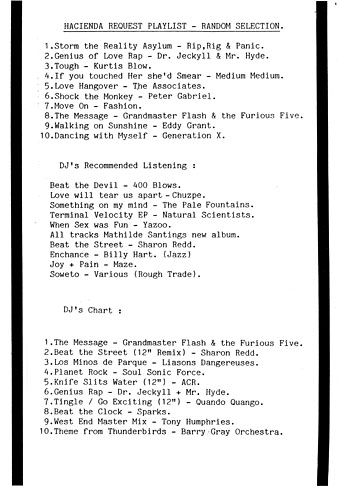
The Haçienda is demolished now so that drilling incident may be seen as a precursor of the inevitable. But the history persists in exhibitions like the recent one at the V&A in London which recreated some of the decor. The typewritten and photocopied members’ newsletter shows a more humble origin than the usual “design classic” label that gets endlessly recycled. Further page scans follow, or you can download a PDF I made. The last two scans in this post are a sheet of guest passes for members to fill, and that ultimate low-tech item: a handwritten and photocopied events list for late 1982. I don’t remember Jah Wobble playing the day after the Burroughs event; I would have liked to have seen that one as well.

hac02.jpg

hac03.jpg

Continue reading “Haçienda ephemera”