A Secret Wish by Propaganda

propaganda1.jpg

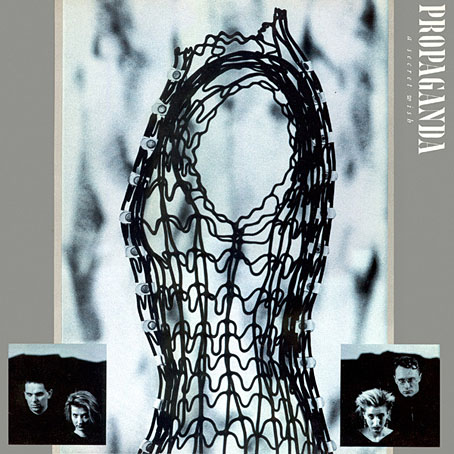
A Secret Wish (1985). Design by the London Design Partnership.

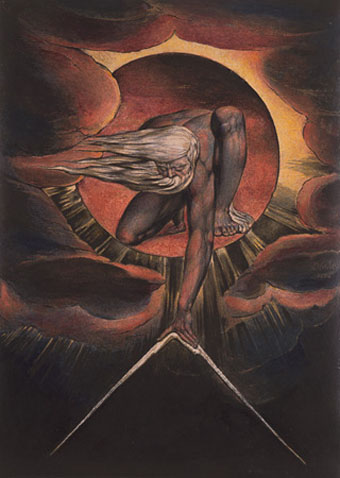
The dark Religions are departed & sweet Science reigns
— William Blake

It’s a hallmark of musical obsession when you find yourself buying the same album over and over. Propaganda’s meisterwerk from 1985, A Secret Wish, was finally released in a definitive double-CD version this week, the fourth edition I’ve bought (after the original vinyl and two other CD releases). This new set is easily the best of the lot.

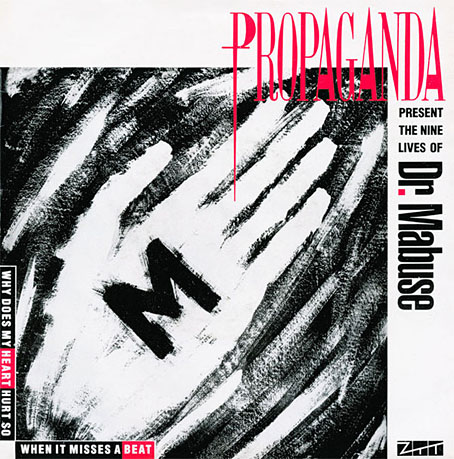
Propaganda were always my favourites among the early acts on Trevor Horn and Paul Morley’s ZTT label, smarter than Frankie Goes To Hollywood and more musical than the Art of Noise. How could I resist another quartet of Germans from Kraftwerk’s home city of Düsseldorf, a group memorably described in the music press as “ABBA from Hell”? The first single in 1984, Dr Mabuse, came along when I’d been immersed in Lotte Eisner’s celebrated study of German Expressionist cinema, The Haunted Screen; an avant-garde pop outfit devoted to the same material was just the thing I wanted to hear. Almost a mini-album, the single’s A-side was filled by an epic ten-minute song describing the nature of Dr Mabuse, a villainous anti-hero from several Fritz Lang films. On the B-side there was a cover of The Velvet Underground’s Femme Fatale (and another Lang reference in the subtitle, The Woman with the Orchid), followed by some metal bashing and a taste of the A-side’s Schönberg-esque orchestral stabs before Dr Mabuse returned again at the end. Cover versions were an important thing at ZTT, as was the idea of the 12-inch single as a self-contained work, Mabuse being a prime example. All of this came packaged in a sleeve whose Anton Corbijn painting referenced another Fritz Lang film, M… It felt as though they were doing this purely for my benefit.
propaganda2.jpg

Dr Mabuse (1984). Design by Anton Corbijn and XL.

The intertextual reference on this and subsequent releases isn’t surprising given the people involved. Paul Morley took a great delight in embellishing the ZTT releases with quotations—the Frankie album was probably the first chart-topping release with a recommended reading list—while band member Ralph Dörper had been with the Neue Deutsche Welle group Die Krupps prior to Propaganda, and it was his influence which gave the new group the abrasive industrial edge that I found so attractive. While between groups he released an experimental EP in 1983 under his own name featuring versions of In Heaven from Eraserhead and John Carpenter’s theme from Assault on Precinct 13, and it was Dörper who chose Throbbing Gristle’s Discipline as the demo song which the group used to catch the attention of ZTT. That particular cover version never made it to A Secret Wish although they did perform it live on The Tube, and a later version appeared on the remix album, Wishful Thinking. This recording is happily included on the second disc of the new reissue.

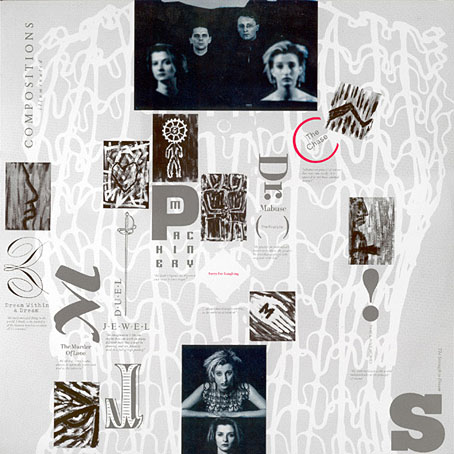
A Secret Wish was released in 1985 and pushed further buttons of obsession for me with the opening track, Dream Within A Dream, which is Edgar Allan Poe’s poem set to music. The album artwork came liberally decorated with Morley’s signifying quotes, the one for the Poe track being the opening lines from HP Lovecraft’s The Call of Cthulhu. Yes, they really were doing this for my benefit… Two further 12-inch singles appeared: Duel/Jewel was the same song presented in an “ABBA” version and a “from Hell” version: sweet and melodic versus harsh and industrial.
propaganda3.jpg

A Secret Wish inner sleeve.

The third and final single, p:Machinery, expanded the short mix from the album into another 9-minute epic whose vision of a population enslaved to industrial technology easily invokes Fritz Lang’s Metropolis, so much so that I used to play the single while running taped scenes from the film on TV. The enormous “Polish” mix of this song has always been scarce on CD, with a Japanese release in 1988, and a later reissue (with some shoddy and superfluous remixes) in 1995. Another benefit of the new edition of the album is that the extended mix provides the climax of the second disc and sounds even more enormous, its brass fanfares accurately described in a review at the time as conjuring images of cities rising from the sea.

Also present for the first time on the new CD is Do Well, the 20-minute Duel suite which was a cassette-only release, plus a number of other previously unavailable mixes. If you have this double-disc set and the Outside World single collection from 2002 then you’ll own pretty much everything that’s great about Propaganda. A lot of pop music from the 1980s sounds horribly dated now: tinny synths, empty production and a paucity of ambition. Propaganda sound as thunderingly magnificent as they did in 1985, and still unique. It’s a shame that A Secret Wish was their finest moment, things fell apart fairly soon after. But one masterpiece will always be worth fifty Duran Duran travesties.

Elsewhere on { feuilleton }
The album covers archive

Previously on { feuilleton }
Metropolis posters

The art of Jim Leon, 1938–2002

leon1.jpg

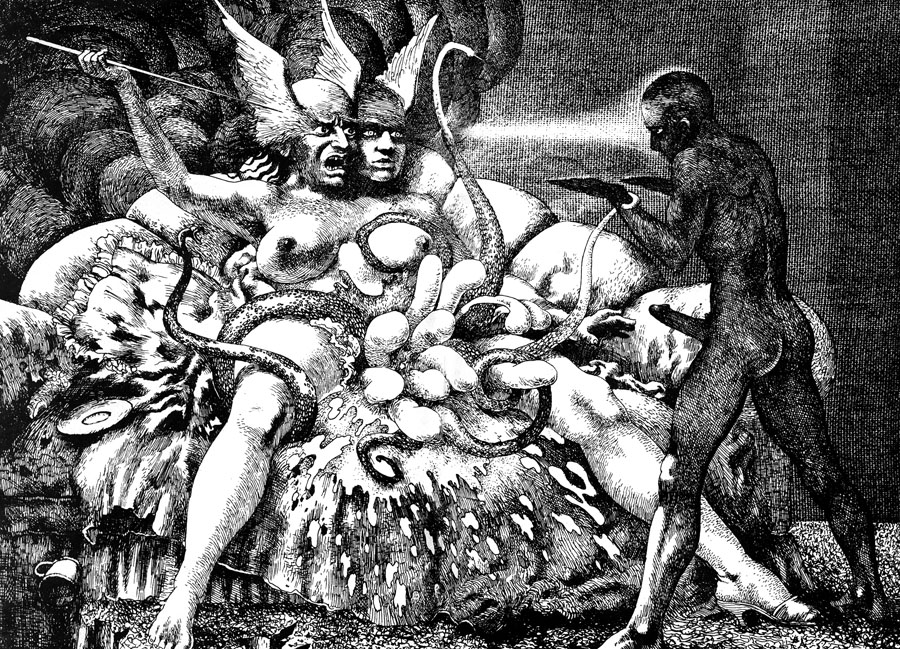
Psychopathia Sexualis (1967).

This, dear friends, is what the art of the fantastic could give us but rarely does, something which combines the metaphysical intensity of the Symbolists with a post-Freudian sensibility to create what Philip José Farmer once called “the pornography of the weird”. Jim Leon was a British artist whose work gained prominence via the underground magazines of the 1960s, especially Oz, although he was never really a psychedelic artist as such. Many of his earliest paintings show the influence of the Pop artists, it was only later in the decade that a distinctly original and surreal imagination came to the fore. Oz was always pretty scurrilous and had no qualms about challenging the authorities with bizarre sexual imagery which other magazines would never dare to print. Leon and other artists were fortunate to have such a public forum for outré work, a few years earlier or later and they might not have found an outlet at all.

leon2.jpg

Untitled (1979).

His early work blended influences from Francis Bacon, surrealism and the baroque. Lurking there is also the English visionary William Blake, together with the obsessive Romanticism of the pre-Raphaelites. A number of his early paintings and drawings refer to William Burroughs’s Naked Lunch (first published in Paris in 1959). These were just some of the ingredients of an amazing, semi-abstract, spatially complex, ritualistic, orgiastic flesh-painting, expressing highly wrought morbidity, eroticism, transcendence and ecstasy; astonishing explorations of the murkier depths of the human mind. (More.)

A Very English Visionary by Simon Wilson.

I first encountered Leon’s work thanks to David Britton’s curating of a portfolio feature in Wordworks magazine which was republished in the Savoy Books anthology, The Savoy Book in 1980. Having seen a Leon painting in a back issue of Oz I was surprised that an artist with such a powerful imagination was so little-known. It turns out that he’d been working all along, albeit far from the public gaze, having moved to Lyons in France where he spent the 1970s and 80s painting many canvases of mystical scenes similar to those produced by the California artists featured in the Visions book. None of his later work explores the darker realms of his earlier Psychopathia Sexualis drawings, and since it’s the early work that I prefer, that’s what’s featured here. These drawings and paintings bear comparison with the art of Raymond Bertrand but where Bertrand has had his work published in lavish book collections, we have to rake through back issues of magazines for Leon’s endeavours. Leon’s later paintings at least have a website which is maintained by his family.

Continue reading “The art of Jim Leon, 1938–2002”

The Red Book by Carl Jung

jung.jpg

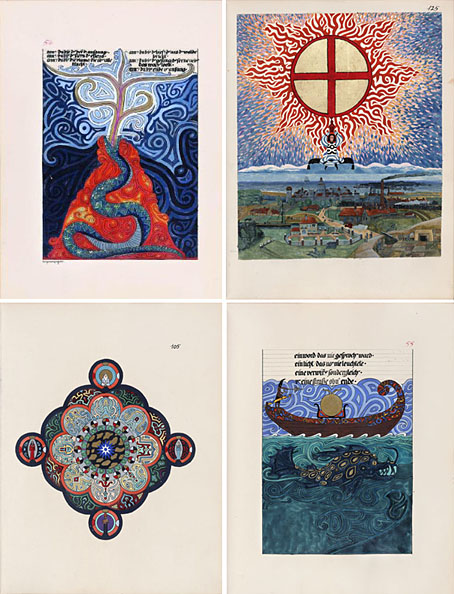
This month is a major one in book publishing as Carl Jung’s magnum opus The Red Book, or Liber Novus, which has remained unpublished for 80 years, is issued in a facsimile edition. Selections of pages have been turning up in reviews and online previews which easily whet the appetite.

In his late 30s, Jung started writing a book called The Red Book. The Red Book is part journal, part mythological novel that takes the reader through Jung’s fantasies — hallucinations he self-induced to try and get to the core of his unconscious. … The book detailed an unabashedly psychedelic voyage through his own mind, a vaguely Homeric progression of encounters with strange people taking place in a curious, shifting dreamscape. Writing in German, he filled 205 oversize pages with elaborate calligraphy and with richly hued, staggeringly detailed paintings. (More.)

Jung maintained a lifelong fascination with alchemical symbolism and many of these pages resemble the kind of plates one finds in alchemical treatises such as the Splendor Solis, if that book had also contained additions from William Blake and Hildegard von Bingen. The only drawback is the price: at £120 this isn’t a casual purchase, but then this is over 400 pages of full-colour at a big size, 45.7 x 30.5 x 5.1 cm. Time to start petitioning rich relatives for Christmas.

The Holy Grail of the Unconscious

Previously on { feuilleton }
The art of Julien Champagne, 1877–1932
Digital alchemy
In the Shadow of the Sun by Derek Jarman

Hip Gnostics and more Moore

gnostic.jpg

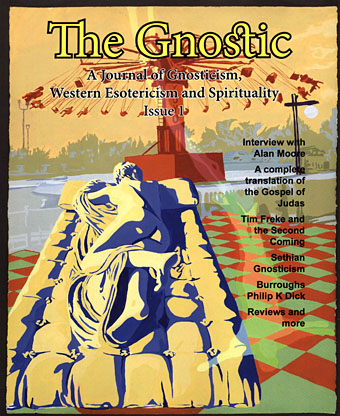
Coincidence abounds: on Wednesday I was following a few referral URLs to see who’d been linking here and was led to a Lexic.us page about hermaphrodites which in turn had me looking again at the wonderful Borghese Hermaphroditus in the Louvre. Thursday’s postal delivery brought issue 1 of The Gnostic which prominently features the Louvre sculpture on its cover. Inside there’s my portrait of William Burroughs illustrating a piece about Burroughs’s Gnostic identification by Sven Davisson. (I linked to another essay on the same theme in 2007.) The Gnostic is an excellent publication which, the Alan Moore interview aside, I’ve only skimmed through so far. Alan’s piece is very enlightening since the discussion stays fixed around religion, science and the occult and includes the most thorough extrapolation I’ve seen to date of his long work in progress, Jerusalem. There’s also a transcript of part of his William Blake piece from 2001, Angel Passage. If you want to know more I suggest you order a copy ($12 / £8 / €9) from Bardic Press.

Coincidence further abounds as this arrived just as Pádraig Ó Méalóid publicly announced his discovery of the long-lost and unpublished third issue of Alan Moore’s Big Numbers. This was Alan’s self-published “real life” comic series from 1989 which got off to a great start then fatally collapsed when artist Bill Sienkiewicz, then his replacement, Al Columbia, both dropped out of the project. It’s one of the great lost projects of contemporary comics and seeing the third issue sustaining the quality of the first two is deeply frustrating.

The last piece of Moore news concerns The Mindscape of Alan Moore once again which is now available to buy through iTunes. $9.99 will only get you the feature-length documentary, however. If you buy the double-disc DVD you also get my groovy interface design and an extra disc of interviews with major comic artists.

Update: Alan Moore has certainly ruled the week in this household with the delivery on Friday of The Extraordinary Works of Alan Moore, a new edition of George Khoury’s book-length autobiographical interview with Alan, and an essential purchase for anyone with more than a cursory interest in Alan’s life and work. The book features copious artwork examples by many Moore collaborators including my CD designs and the cover for the forthcoming Moon & Serpent Bumper Book of Magic.

Previously on { feuilleton }
William Burroughs: Gnostic visionary

William Blake in Manchester

blake.jpg

Europe: A Prophecy by William Blake (1794).

Two exhibitions based around the work of William Blake open today at Manchester’s Whitworth Art Gallery, Mind-Forg’d Manacles, “organised to coincide with the 250th anniversary of Blake’s birth as well as the 200th anniversary of the Parliamentary abolition of the transatlantic slave trade” and Blake’s Shadow: William Blake and his Artistic Legacy. The latter seems to be the more interesting of the two.

Blake’s Shadow: exhibition summary

This exhibition explores Blake’s continuing fascination for artists, filmmakers and musicians. It features around sixty watercolours, prints and paintings in addition to numerous illustrated books and a range of audio-visual material. Blake is a unique figure in British visual culture, attracting both academic and popular interest. In the years since his death in 1827, Blake has continued to influence the world of creativity and ideas. He has inspired people with such wide ranging interests as literature, painting, book design, politics, philosophy, mythology through to music and film making. Alongside works by Blake—prints, watercolours, engravings and book illustrations—the exhibition spans two centuries of his influence.

• His contemporaries in the late 18th and early 19th century are represented with works from John Flaxman, Edward Calvert, Samuel Palmer, J.H. Fuseli and Thomas Stothard
• Blake’s influence on artists in the Victorian period is explored through works by Ford Madox Brown, Walter Crane, Frederic Shields, John Everett Millais, Dante Gabriel Rossetti, Simeon Soloman and G.F. Watts.
• British artists working in the 20th and 21st century include Cecil Collins, Douglas Gordon, Paul Nash, Anish Kapoor, David Jones, Ceri Richards, Patrick Proctor, Austin Osman Spare and Keith Vaughan. This section of the exhibition features photographs and original works.
• From the 1960s onward, writers, musicians, film makers like Allen Ginsberg, Bob Dylan, Jim Morrison of The Doors and John Lennon have adopted Blake as a mystical seer and anti-establishment activitist. More latterly, as British musicians and activists like Billy Bragg and Julian Cope have grappled with notions of national identity, Blake has enjoyed something of a renaissance. Blake’s Shadow examines this more recent influence as evidenced in work by the filmmakers Jim Jarmusch and Gus Van Sant, and various musicians, notably Patti Smith and Jah Wobble.

spare.jpg

The Dawn by Austin Spare (no date).

It’s good to see Austin Spare being included in something like this. He always referred to Blake as an influence but, as I’ve mentioned before, he’s frequently been treated disrespectfully by an art establishment that doesn’t know what to make of the occult basis of his work.

Mind Forg’d Manacles runs to 6 April 2008, Blake’s Shadow to 20 April.

Elsewhere on { feuilleton }
The illustrators archive

Previously on { feuilleton }
Austin Spare in Glasgow
Tygers of Wrath
Austin Osman Spare