Old Weird and New Weird

savdreams.jpg

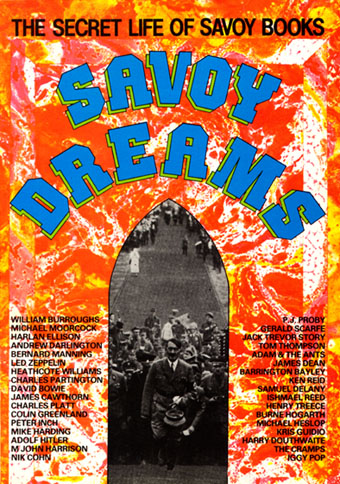
Savoy Books, 1984.

A couple more recent arrivals that feature my work. These are of minority interest but worth noting since academic articles don’t always travel beyond a small audience of subscribers.

A recent issue of Foundation (The International Review of Science Fiction), Volume 45.1, number 123, contains an article by Mark P. Williams, Underground Assemblages: Savoy Dreams and The Starry Wisdom. This examines the legacy of New Worlds magazine under the editorship of Michael Moorcock (from 1964 to 1974) via two writing collections, Savoy Dreams (Savoy Books, 1984) and The Starry Wisdom (Creation Books, 1994). The two collections are very different: Savoy Dreams, edited by David Britton and Michael Butterworth, was an eclectic overview of Savoy’s publishing endeavours up to that point. Among the original writing there’s fiction by Butterworth, M. John Harrison (the first publication of the Viriconium story, Lords of Misrule) and others, plus a reaction by Michael Moorcock to William Burroughs’ Cities of the Red Night, a book that Savoy had contracted to publish before police harassment forced the company’s bankruptcy. The rest of the book is taken up with press reviews of Savoy books.

starrywisdom.jpg

Creation Books, 1994. Cover art by Peter Smith.

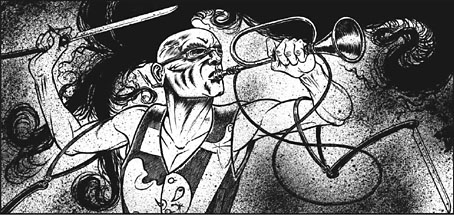
The Starry Wisdom should require less of an introduction since the book has been in print since 1994, and has a small, possibly notorious, reputation among HP Lovecraft enthusiasts. Editor DM Mitchell felt that the assembling of post-Lovecraftian fiction up to that point had been too cosy and insular: too many story collections were being edited and written by groups of friends in the genre fiction “community”, with the result that the stories were often stale and complacent. The startling newness of Lovecraft’s imagination in comparison to many of his contemporaries in Weird Tales seemed to have been bled away into pastiche, a process that began soon after Lovecraft’s death. Mitchell’s solution was to commission original pieces of Lovecraft-inspired work from writers outside the genre world, notably Alan Moore, Grant Morrison, and newcomer David Conway; he also reprinted pieces that would never appear elsewhere as Lovecraftian fiction, including Wind Die. You Die. We Die. by William Burroughs, and Prisoner of the Coral Deep by JG Ballard. Burroughs and Ballard connect directly to New Worlds, of course (Ballard wrote about Burroughs for the magazine), while the pair cast a shadow over many of Savoy’s book productions. Both Savoy Dreams and The Starry Wisdom featured comic strips; Tales of the Cramps by Kris Guidio appeared in Savoy Dreams, while The Starry Wisdom contained strips by Mike Philbin & James Havoc, Rick Grimes, and the first publication of my own adaptation of The Call of Cthulhu.

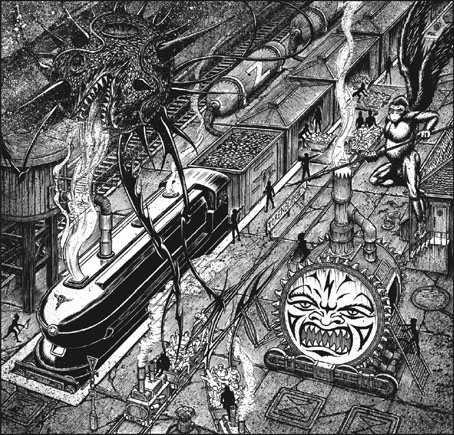
I was surprised—and pleased—that my comic strip receives a fair amount of scrutiny in Williams’ piece. My Lovecraft strips have received almost no attention from the comics world, a consequence of having been printed by book publishers and distributed to book shops. (A rare exception was this recent piece by Matt Maxwell.) When you’ve been overlooked in this manner it’s a surprise to find your work receiving serious evaluation from an entirely different quarter. Mark P. Williams’ essay examines the contents of both collections, my strip included, as “assemblages”. This is a valid critique in the case of the Cthulhu strip since Lovecraft’s story is itself an assemblage of what seems at first to be unrelated data. The comic adaptation assembles a range of cultural references—some genuine, others invented—to parallel the narrator’s investigation, and even uses genuine documents in places, including columns from The New York Times. I don’t know if Williams has seen the blog post I made that points out many of the cultural references but he notes some of the more overt ones, such as Joseph Conrad appearing as the doomed Professor Angell, Arnold Böcklin’s The Isle of the Dead, and so on. While I was drawing the strip I was trying to imagine the story as an RKO production, a hybrid of two island films—The Most Dangerous Game and King Kong—and Orson Welles’ unmade Heart of Darkness. These references, many of which aren’t very obvious, were largely for my own amusement. The series I created with David Britton that followed the Lovecraft strips, Reverbstorm, puts assemblage and cultural reference at the forefront.
genre.jpg

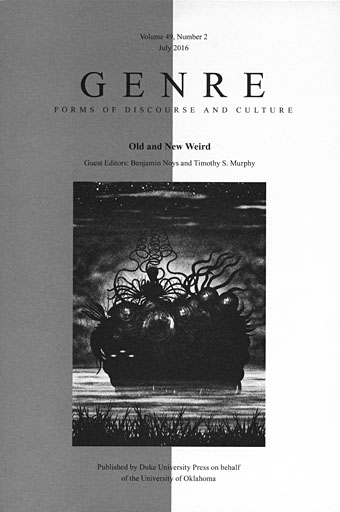
Cover art is my illustration for Remnants from Lovecraft’s Monsters, edited by Ellen Datlow.

The Cthulhu strip and the Reverbstorm series—now collected as Lord Horror: Reverbstorm—are the subject of a very perceptive piece by Benjamin Noys in the latest edition of Genre, an academic journal published by Duke University Press. This number of the journal is a kind of Weird special edited by Benjamin Noys and Timothy S. Murphy. Noys’ Full Spectrum Offence: Savoy’s Reverbstorm and the Weirding of Modernity is the final article in a publication that examines aspects of the “Old Weird” (ie: the Lovecraft-era Weird Tales) and contrasts it with the more recent “New Weird”. The latter was a short-lived label coined by M. John Harrison in 2003 for a range of fiction that was ignoring genre boundaries, and consciously developing the Weird as a project. China Miéville was one of the most visible proponents of the New Weird, and Harrison’s term emerged in part as a response to Miéville’s fiction. Miéville is interviewed in this issue of Genre where, as usual, he has some very worthwhile things to say. He prefers the term “haute Weird” for the original manifestation, possibly because it avoids the negative connotations of the word “old”.
reverbstorm.jpg

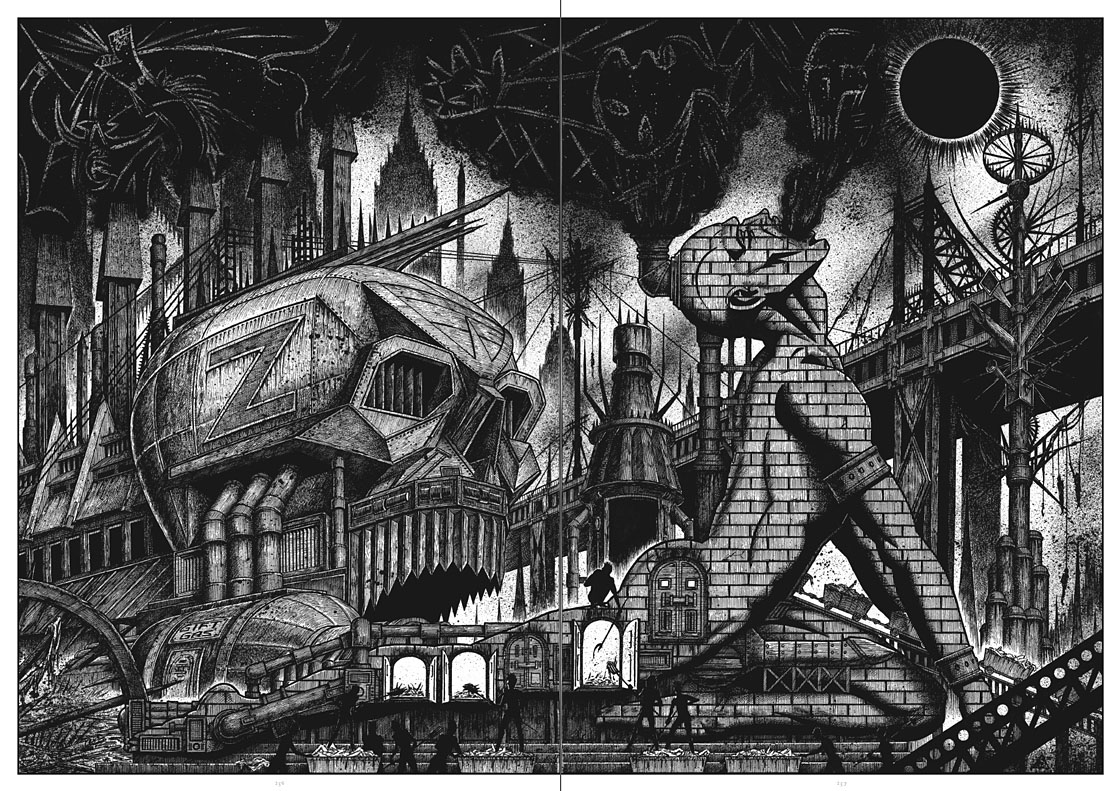
A spread from part 7 of Reverbstorm.

Benjamin Noys’ article is lengthy and resists easy summary, but it begins by investigating the way my work on the Lovecraft strips permeated the Lord Horror comics and dictated some of the imagery, in particular the architectural forms and eruptions of monstrosity. Later discussion concerns the way that Reverbstorm forces the Weird and Modernism together, a collision that I believe is still unique anywhere, never mind in the comics medium. Noys’ piece has given me a lot to think about, not least for its being the first substantial critical appraisal of Reverbstorm. The series is a difficult one, being deliberately excessive and avant-garde, and presenting the reader with a torrent of interrelating cultural references. Many of these are itemised in the appendix but the success (or not) of their working together, and the potential sparking of connections, depends very much on the prior knowledge of the individual reader. Noys is not only knowledgeable but adept at forging his own connections while situating the series in the larger context of the Weird, old (or haute) and new. Even without the inclusion of my work inside the journal and on the cover, I’d recommend this issue of Genre to anyone with an interest in the subject. One of the reasons I favour the Weird as a chosen work label is the way it evades (or ignores) generic boundaries. Years ago I realised that many of the things I liked the best in the arts were the chimeras, those works that transgress boundaries and created new hybrids. No surprise then that I enjoy a genre that refuses easy definition. There aren’t many masts I pin my colours to but the Weird is one of them.

Previously on { feuilleton }
The Weird

Weekend links 289

hermes.jpg

Fathomless Sounding (1932) by Gertrude Hermes.

• Over at Greydogtales (“weird fiction, weird art and even weirder lurchers”) I talk about art, design, the writing of this blog, and I also reveal more about my ongoing Axiom project. The latter currently stands at two novels, a couple of half-finished stories and a few pieces of artwork. I may be unveiling some of the art in the new year so watch this space.

• Howard Brookner’s Burroughs: The Movie (1983), a definitive film portrait of William Burroughs, is released at last on DVD/Blu-ray. US-only for the moment but further releases elsewhere are promised. The director’s nephew, Aaron Brookner, has a documentary about his uncle released next year.

• “…beautifully articulated bawdiness, perverse pleasures and a radical, though nondidactic, political view.” Melissa Anderson reviews Boyd McDonald’s Cruising the Movies: A Sexual Guide to Oldies.

The crisis, as Ellis and Silk tell it, is the wildly speculative nature of modern physics theories, which they say reflects a dangerous departure from the scientific method. Many of today’s theorists — chief among them the proponents of string theory and the multiverse hypothesis — appear convinced of their ideas on the grounds that they are beautiful or logically compelling, despite the impossibility of testing them. Ellis and Silk accused these theorists of “moving the goalposts” of science and blurring the line between physics and pseudoscience. “The imprimatur of science should be awarded only to a theory that is testable,” Ellis and Silk wrote, thereby disqualifying most of the leading theories of the past 40 years. “Only then can we defend science from attack.”

Natalie Wolchover on A Fight for the Soul of Science

• Mixes of the week: A mix by Front & Follow, and The Ivy-Strangled Path Vol. XIV by David Colohan.

• “Psychedelics can’t be tested using conventional clinical trials,” says Nicolas Langlitz.

• At Dangerous Minds: Ralph Steadman illustrates Ray Bradbury’s Fahrenheit 451.

• Why does Moby-Dick (sometimes) have a hyphen? Erin Blakemore investigates.

• My thanks again to Dennis Cooper for including this blog on his year-end list.

• Cian Traynor was given 20 minutes to ask Ennio Morricone some questions.

Lolita at 60: Ten writers reconsider Nabokov’s novel, page by page.

• At Ballardian: High-Rise: Wheatley vs Cronenberg.

Poison Ivy: The Queen of Psychobilly Punk

The Cinema of Hotels: a list

Solo intimacy DIY

Moby Dick (1970) by Led Zeppelin | William Burroughs Don’t Play Guitar (1996) by Islamic Diggers | Physical (2001) by Goldfrapp

The Cramps at the Haçienda

cramps1.jpg

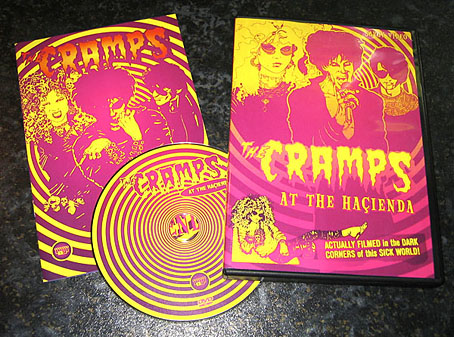
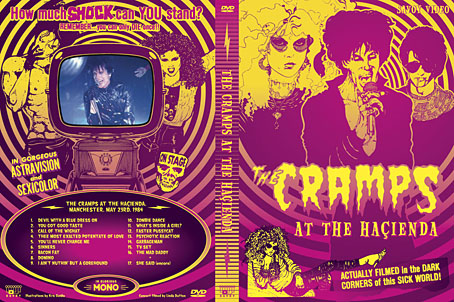
At last: something that has no connection with HP Lovecraft… This was one of several design jobs during a very busy summer, a long-delayed DVD release by Savoy of the Cramps playing Manchester’s trendiest club of the 1980s, the Haçienda. The posthumous reputation of the Hac (as it was locally known) has been inflated in recent years; you’ll hear much about its thriving dance nights but little about the early days when the huge and often chilly space was seldom even half full. The Cramps played there twice in 1984, and like many bands with a cult following, managed to fill the floor with eager fans; Savoy’s video captures the second performance on May 23rd. It was standard policy at the Haçienda to film every event, and some of the more popular performances—William Burroughs’ reading, a concert by The Birthday Party—were later released by Ikon, the video wing of Factory Records. Two cameras on either side of the Haçienda balcony covered the stage but on the night of the Cramps’ performance none of the Ikon staff wanted to assist Linda Dutton in filming the gig. So this recording is a rudimentary one—a single U-matic camera and mono sound—but Linda captured a tremendous hour-long concert with an outstanding Iggy Pop-like performance from Lux Interior.

cramps2.jpg

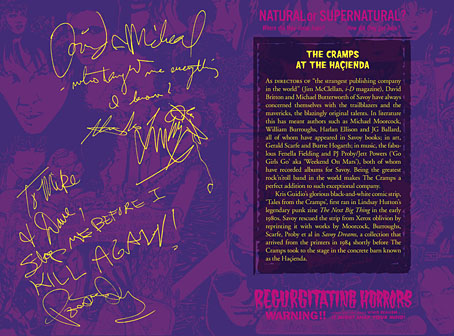
For my design I wanted to avoid Goth clichés and create something in keeping with the band’s trashy rock’n’roll aesthetic. All the portraits are by Kris Guidio from the comic strips he was producing in the early 1980s for Lindsay Hutton’s Next Big Thing zine; the lurid headlines are lifted from film posters found in back issues of Psychotronic Video magazine. The DVD has an 8-page booklet and an interface which I also designed although this is merely functional, nothing like the elaborate animated affair I created for The Mindscape of Alan Moore. When concerts such as this are routinely put onto YouTube for free it hardly seems worth going to all this trouble, but for Savoy it provides another connection to a favourite band. The PAL DVD is priced at £10, and may be ordered direct.

cramps3.jpg

Previously on { feuilleton }
Haçienda ephemera
Lux Interior, 1946–2009
The Final Academy

Weekend links 271

flyhead.jpg

Environment Transformer/Flyhead Helmet by Haus-Rucker-Co (1968). From Hippie Modernism at the Walker Art Center, Minneapolis.

• From 2006: Weird Tales: The Strange Life of HP Lovecraft. Geoff Ward examines Lovecraft’s life and work for BBC Radio 3 with contributions from Neil Gaiman, ST Joshi, Kelly Link, China Miéville and Peter Straub. Meanwhile, Ned Beauman wonders whether Ford Madox Ford is “as scary as Lovecraft”.

• Alexei German’s years-in-the-making feature film, Hard to be a God (previously), receives a UK release this week. Paul Duane reports on an overwhelming viewing experience, while Nigel Andrews says it “may be the greatest film since the millennium began”.

• Mixes of the week: Adventures In Sound And Music, 30 July 2015, hosted by Joseph Stannard, and RCMIX9 by worriedaboutsatan.

As Nabokov insisted, “Literature is invention. Fiction is fiction. To call a story a true story is an insult to both art and truth.” The genre thrives because its deceptions are liberating. For Wood, the thrill of reading fiction is intimately connected with the awareness that fiction constitutes “an utterly free space, where anything might be thought, anything uttered.” The excitement comes when, as readers, we’re allowed to participate in this freedom and experience the fiction imaginatively, without being required to believe that it is true.

Joanna Scott on The Virtues of Difficult Fiction

• “Writing used to be a solitary profession. How did it become so interminably social?” asks Meghan Tifft.

• The original, real-life dystopian cityscape of Kowloon Walled City, and the artwork it inspired.

• The Long, Lonely Walk: Nick Ripatrazone on hallways in horror films.

New cover designs for the Essentials range from Penguin Books.

Lemi Ghariokwu: “How I designed Fela Kuti’s album covers”.

• “Do CDs sound better than vinyl?” asks Chris Kornelis.

• Magic Fly (1977) by Space | Human Fly (1978) by The Cramps | I Am The Fly (1978) by Wire

Reverbstorm on sale

reverbstorm1.jpg

At long last, the news that many people have been waiting for: the Reverbstorm book is now on sale at Savoy. From the hyperbolic press release:

“Surfin’ bird Bbbbbbbbbbrbrbrbrbrb…awawawawawawawaaaaaah! A-pa-pa-pa-pa-pa-pa-pa-pa-pa-pa-pa-pa-pa-pa-pa-pa-pa-pa-pa-pa-pa-pa-pa-pa-pa-pa-pa-pa-pa-pa-ooma-mow-mow Papa-oom-mow-mow!” The Trashmen, Surfin’ Bird

Welcome to the nightmare metropolis of Torenbürgen, where New York’s Art Deco architecture has fused with the termination machinery of Auschwitz. In this urban inferno Jessie Matthews is singing Sondheim, James Joyce is at work on a new novel and Lord Horror, ex-Nazi propaganda broadcaster and Torenbürgen’s model citizen, is stalking the streets in search of fresh victims for his razors. Murderous apes infest the alleyways, Ononoes feast on the living and the dead, while above the rooftops the Soul of the Virgin Mary drifts like a swollen Lovecraftian dirigible, picking at bodies destined for the charnel furnaces.

Lord Horror: Reverbstorm is a unique graphic collaboration between writer David Britton, the author of four Lord Horror novels, and artist John Coulthart, whose book of Lovecraft-derived comic strips and illustrations, The Haunter of the Dark, featured a collaboration with Alan Moore. Reverbstorm was originally published in serial form and is now being presented in a single volume for the very first time. Britton’s debut novel, Lord Horror (1990), was the last work of fiction to be banned in the UK; an earlier Lord Horror comic series, Hard Core Horror, was also banned by a British court in 1995. Coulthart’s death-camp artwork from the final issue in that series appears in Reverbstorm as a prelude to the main narrative.

There’s never been a comic like this surreal collision between Modernist art and pulp aesthetics, a world where Finnegans Wake is drenched in Alligator Wine and Picasso’s Guernica is invaded by Tarzan’s simian hordes. Ambitious, transgressive and meticulously rendered, Reverbstorm is one answer to the eternal question posed by those cultural philosophers, The Cramps: “How far can too far go?”

“Bababadalgharaghtakamminarronnkonnbronntonnerronn-
tuonnthunntrovarrhounawnskawntoohoohoordenenthurnuk!”
James Joyce, Finnegans Wake

reverbstorm2.jpg

rev2.jpg

Previously on { feuilleton }
Reverbstorm in print
Reverbstorm update
James Joyce in Reverbstorm
A Reverbstorm jukebox
Reverbstorm: Bauhaus Horror
Reverbstorm: an introduction and preview