Weekend links 208

sungwon.jpg

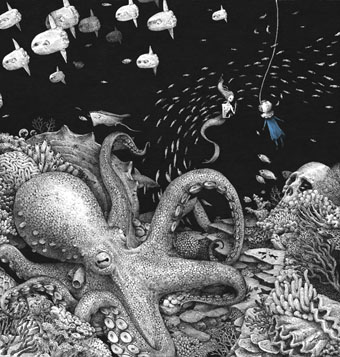
The Blue Girl (2013) by Sungwon.

• “Meanwhile, in her parents’ room [Max] Ernst painted aardvarks eating ants and big human hands around the windows. ‘Sexual connotations, I think,’ she says shyly.” Agnès Poirier talks to Cécile Eluard about her childhood among the Surrealists.

• “Thrilling and prophetic”: why film-maker Chris Marker‘s radical images influenced so many artists. Sukhdev Sandhu, William Gibson, Mark Romanek and Joanna Hogg on the elusive director.

• At Dangerous Minds: Throbbing Gristle live in Manchester in 1980, and Brian Butler talks about the rediscovered early print of Kenneth Anger’s Lucifer Rising. There’s a trailer!

• From 1981: The Art of Fiction No. 69 at The Paris Review, an interview with Gabriel García Márquez. Related: Thomas Pynchon reviewed Love in the Time of Cholera in 1988.

• “Seven years ago, a stolen first edition of Borges’s early poems was returned to Argentina’s National Library. But was it the right copy?” Graciela Mochkofsky investigates.

• “What was Walter Benjamin doing with his shirt off in Ibiza?” Peter E. Gordon reviews Walter Benjamin: A Critical Life by Howard Eiland & Michael W. Jennings.

• A video by Marcel Weber for Måtinden, a track from Eric Holm’s Andøya album. Another album on the Subtext label that I helped design.

• More Ian Miller: Boing Boing has pages from his new book, The Art of Ian Miller, and there’s an interview at Sci-Fi-O-Rama.

Outrun Europa, a free compilation of 80s-style electronic music. There’s a lot more along those lines here.

• Praise Be! Favourite religious and spiritual records chose by writers at The Quietus.

Ralph Steadman illustrated Alice’s Adventures in Wonderland in 1973.

British Pathé is uploading 85,000 of its newsreel films to YouTube.

• Drawings by Lebbeus Woods at The Drawing Center, New York.

• At Pinterest: Ian Miller and Kenneth Anger.

Lucifer Sam (1967) by Pink Floyd | The Surrealist Waltz (1967) by Pearls Before Swine | Which Dreamed It (1968) by Boeing Duveen And The Beautiful Soup
Weekend links 194

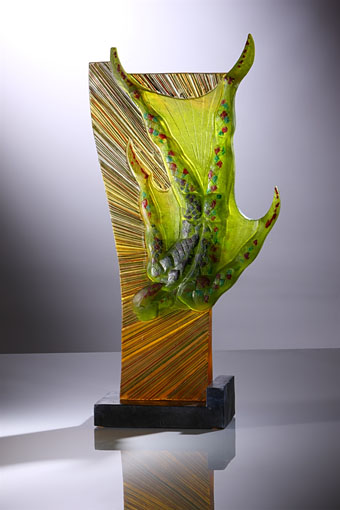
roberts.jpg

Untitled glass sculpture by Richard Roberts.

Lord Horror: Reverbstorm, my collaboration with David Britton, makes The Quietus list of Literary Highlights of 2013. At the same site there’s Russell Cuzner talking to English Heretic. “His methodology takes in magick, psychogeography and horror film geekdom, along with firm roots in Britain’s industrial music culture of the early 1980s, to form potent, novel topographies of an otherwise unconnected world of occultists and psychopaths.”

• A slew of London links this week: Geoff Manaugh on how the capital was redesigned to survive wartime blackouts, a piece which inadvertently explains why you see so much black-and-white street furniture in post-war films | Bob Mazzer’s photos of the London Underground in the 1970s and 1980s | Philipp Ebeling’s photos of the capital and its inhabitants today.

• “Science has become an international bully. Nowhere is its bullying more outrageous than in its assault on the phenomenon known as subjectivity.” David Gelernter on “The Closing of the Scientific Mind”. Related: “When Science Becomes Scientism” by Stanislav Grof.

• My favourite book about Orson Welles is This is Orson Welles (1992), a collection of Peter Bogdanovich’s interviews with Welles edited by Jonathan Rosenbaum. Bogdanovich’s interview tapes can now be heard at the Internet Archive.

• Brian Dillon on Dada collagist Hannah Höch who he calls “art’s original punk”, and Sean O’Hagan talking to another collage artist, Linder Sterling, who says “Lady Gaga didn’t acknowledge I wore a meat dress first”.

• One Hundred Years Of Weird Fear: Daniel José Older on HP Lovecraft’s literature of genealogical terror. More fear (and Lovecraft): Will Wiles on the growth of Creepypasta.

The Last Alan Moore Interview? A lengthy discussion with Pádraig Ó Méalóid. Shunning interviews hasn’t done Cormac McCarthy any harm so if I was Alan I wouldn’t worry.

• And speaking of Cormac McCarthy, the headline of the week: “Cormac McCarthy’s ex-wife busted after pulling gun from vagina during alien argument“.

• Where the bodies are buried: Mick Brown presents a potted biography of Kenneth Anger who offers a few reluctant quotes.

• A short animation for gore-obsessed kids: Pingu’s The Thing by Lee Hardcastle.

Helen Yentus designs a 3D-printed slipcase for a novel by Chang-rae Lee.

Ralph Steadman‘s illustrations for Alice’s Adventures in Wonderland.

• Mix of the week: Secret Thirteen Mix 103 by Lustmord.

Collage art at Pinterest.

No Escape (1966) by The Seeds | Pushin’ Too Hard (1966) by The Seeds | No Escape (1979) by Cabaret Voltaire | Pushin’ Too Hard (1982) by Paul Parker

Beardsley and His Work

beardsley1.jpg

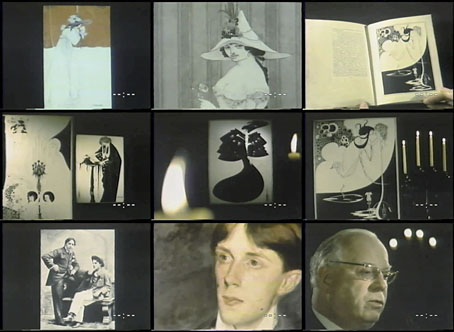
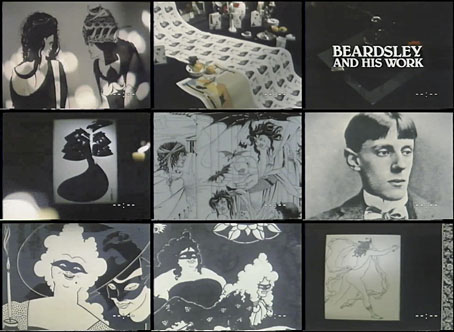
Back in 2008 I wrote at some length about Aubrey, an excellent BBC TV dramatisation of the last years of Aubrey Beardsley’s life written by John Selwyn Gilbert, and screened once in 1982. Mr Gilbert himself added a comment to that post in which he mentioned that he’d written and directed a documentary which was screened in tandem with the play, Beardsley and His Work. I have the documentary on tape but it’s a copy of a copy and is also missing ten minutes or so of its opening so it’s good to find that the entire thing is now on YouTube. (Thanks to Dominique for drawing my attention to this.)

Beardsley and His Work is essential viewing for Beardsleyphiles since it’s the only place you’ll see Beardsley scholar Brian Reade—author of the huge monograph, Beardsley (1967)—and Brigid Brophy—author of two excellent studies, Black and White (1968) and Beardsley and His World (1976)—talking at length about the artist. In addition there’s another artist, Ralph Steadman, examining some of Beardsley’s original artwork and discussing the techniques of ink drawing. The fifty-minute film is divided into four chunks, unfortunately, but is otherwise complete:

Part one | part two | part three | part four

beardsley2.jpg

Elsewhere on { feuilleton }
The Aubrey Beardsley archive

Ubu

ubu.jpg

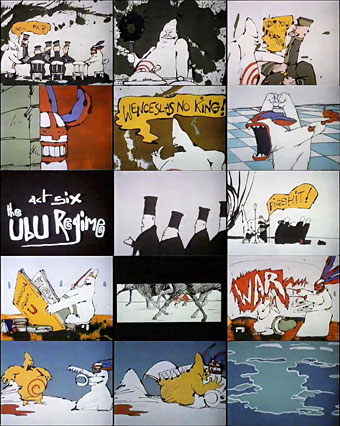
One last film post for a very busy week. Ubu is a highly-stylised animated adaptation of Alfred Jarry’s Ubu Roi. This was a British production directed in 1978 by Geoff Dunbar who employs an ink-spattered style reminiscent of Ralph Steadman’s drawings; in place of vocal dramatisation Pa and Ma Ubu shriek horribly and occasionally spit out speech balloons. As a condensation of the play, and a taste of Jarry’s grotesquery, this feels a lot closer to its source than Jean-Christophe Averty’s 1965 film which seems polite by comparison. Ubu took a long time to arrive on YouTube so watch it while you can, it may well vanish again.

Ubu pt. 1 | Ubu pt. 2

Previously on { feuilleton }
Bring Me the Head of Ubu Roi

Gerald Scarfe’s Long Drawn-Out Trip

scarfe.jpg

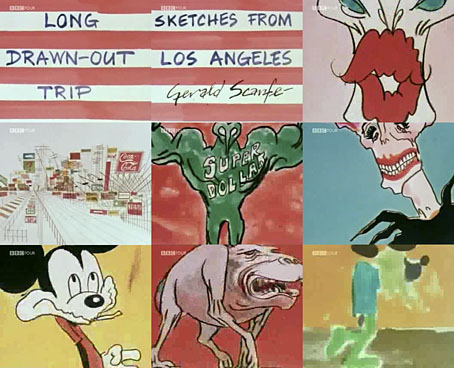
Yet more animation. Long Drawn-Out Trip was Gerald Scarfe‘s first foray into the medium, produced in 1972 at the request of the BBC who sent the artist to Los Angeles to try out the new De Joux animation system. The process needed only six or eight drawings per second of film thus reducing the usual amount of labour. Scarfe says in the first book collection of his work, Gerald Scarfe (1982), that the 16-minute film was still very labour intensive.

The subject of Long Drawn-Out Trip is Los Angeles and America itself, the concerns being the same ones that Ralph Steadman was depicting the same year in his illustrations for Hunter S. Thompson’s Fear and Loathing on the Campaign Trail ’72: venality, violence, vulgarity and the omnipresent spectre of Richard Nixon, a president who had the good fortune to be drawn many times by two of Britain’s greatest living satirists although he wouldn’t have thanked them for it. In Scarfe’s film we also find Mickey Mouse being reduced to his constituent lines and colours after smoking a joint. In the 1980s Scarfe regularly drew Ronald Reagan wearing the famous mouse ears, something that nearly got him fired from his post at the Sunday Times after Rupert Murdoch saw one of the cartoons. Long Drawn-Out Trip had a more favourable effect when it was seen by Roger Waters who asked Scarfe to create some animations for Pink Floyd’s Wish You Were Here tour. The animated sequences for The Wall have their origin in this short film. Watch it here.