The exquisite corpse will drink the new wine

ec01.jpg

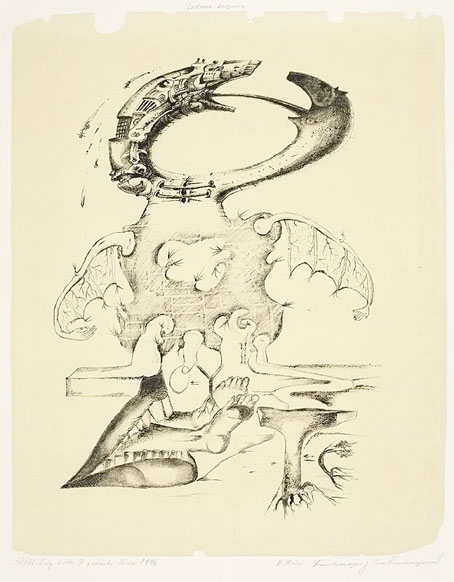
From One Dough (1996) by Martin Stejskal, Jan Švankmajer, Eva Švankmajerová.

From A Dictionary of Surrealism by José Pierre (Eyre Methuen, 1974):

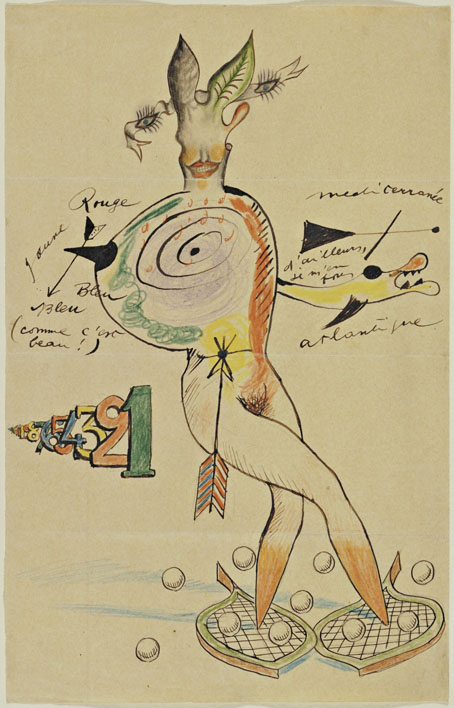
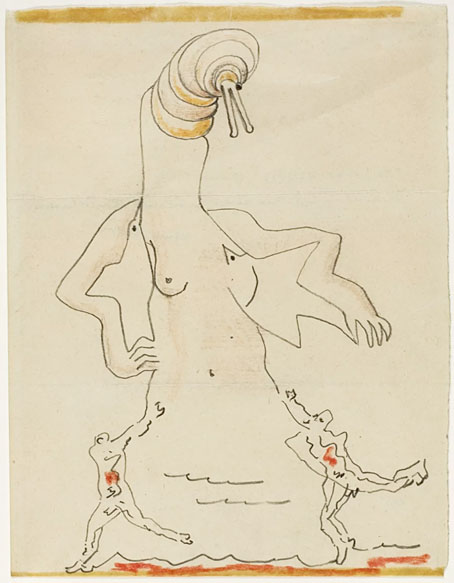
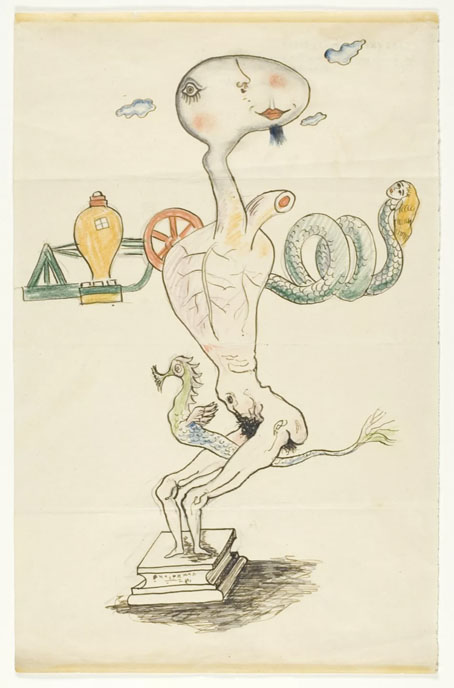
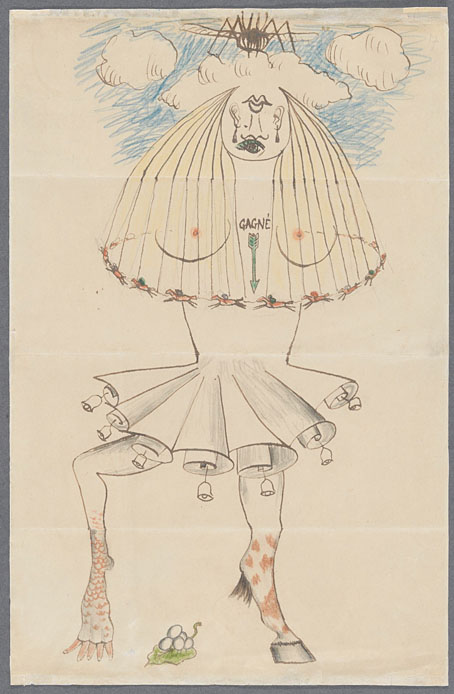
Exquisite corpse. The most famous of the surrealist games takes its name from the opening sentence that materialized: “Le cadavre—exquis—boira—le vin—nouveau” (1925) (The exquisite corpse—will drink—the new wine). It was produced by five players writing in turn subject, adjective, verb, object, complement, each folding over the paper so that the next player could not see what had been already written. The violent whiff of strangeness and the droll effects obtained by these verbal collages reappeared in the drawn “exquisite corpses” in which Surrealist poets and painters often combined. Despite the fact that each contribution—especially in the case of painters—is relatively identifiable, the total effect (mostly in the form of a “personage”) results from the combined elements. In this, the “exquisite corpse” can claim to have scored a victory for collective invention over individual invention and over the “signature”.

ec09.jpg

Nude (1926–27) by Yves Tanguy, Joan Miró, Max Morise, Man Ray.

ec04.jpg

Exquisite Corpse (1927) by André Masson, Max Ernst, Max Morise.

ec06.jpg

Exquisite Corpse (1928) by Man Ray, André Breton, Yves Tanguy, and Max Morise.

ec07.jpg

Exquisite Corpse (1928) by Man Ray, Max Morise, André Breton, Yves Tanguy.

Continue reading “The exquisite corpse will drink the new wine”

Covering Maldoror

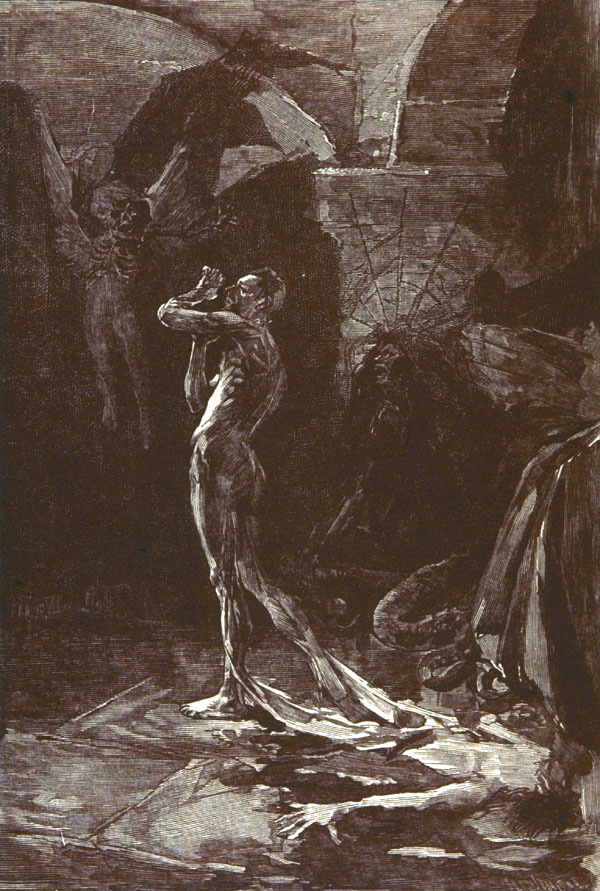
roy.jpg

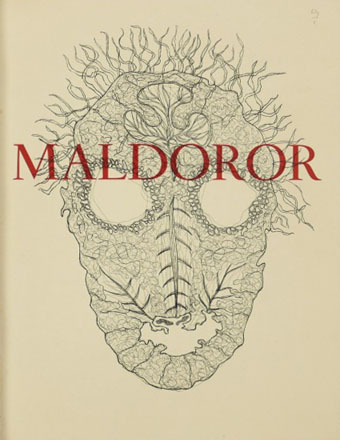
This illustration by José Roy is a frontispiece created for a rare edition of Les Chants de Maldoror published by Genonceaux in 1890. Roy (1860–1924) was a French artist whose work receives little attention today but his Maldoror illustration happens to be the first of its kind, and a picture that serves the text better than some of those being produced a few years later. The detail of a flayed man stepping out of his skin prefigures Clive Barker by almost a century, a further example of the ways in which Lautréamont’s baleful masterpiece was ahead of his time.

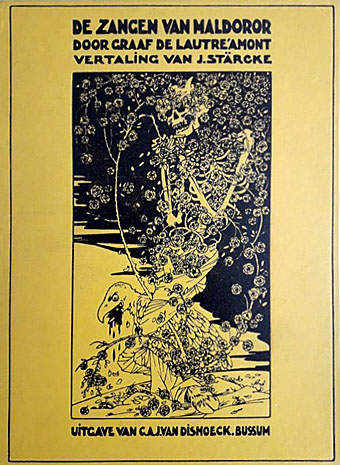
maldoror01.jpg

Netherlands, 1917. Cover art by WF Gouwe.

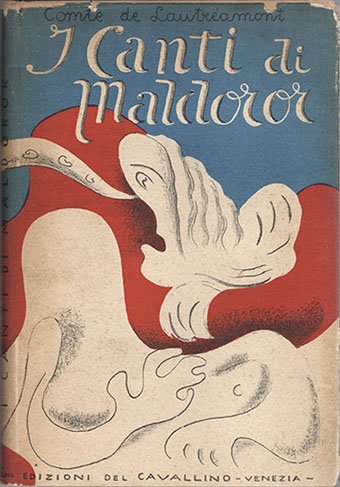
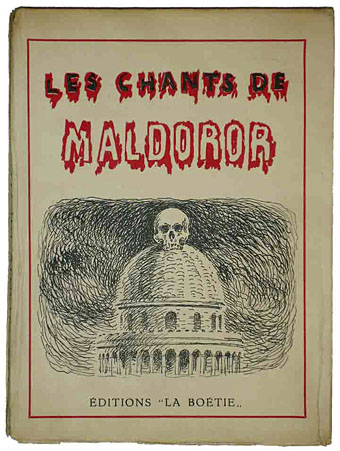
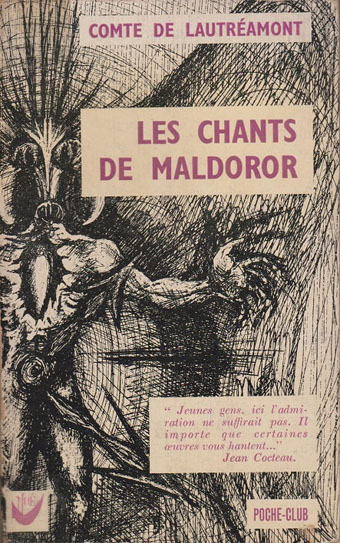
Previous posts here have concerned illustrated editions of Maldoror but this one is all about the covers. Literary classics aren’t always very rewarding in this respect but Maldoror’s textual and imaginative wildness has prompted an assortment of illustrative choices that range from the appropriate to the bewilderingly arbitrary. The following covers are a selection of the more notable examples, avoiding those without pictures or ones that use photographs of the book’s enigmatic author, Isidore Ducasse.

maldoror02.jpg

Italy, 1944. Cover art by Mario De Luigi.

maldoror26.jpg

France, 1947. Cover and interior illustrations by Jacques Houplain.

Salvador Dalí was the first well-known artist to illustrate Maldoror but his 1934 edition was published with plain black boards. Houplain’s illustrations follow the text more closely than do those by Dalí, Magritte or Bellmer, all of whom remain preoccupied with their own obsessions.

maldoror03.jpg

Belgium, 1948. Cover and interior illustrations by René Magritte.

maldoror04.jpg

France, 1963. Cover art by Paul Jamotte.

Continue reading “Covering Maldoror”

Into the Midnight Underground

midnight01.jpg

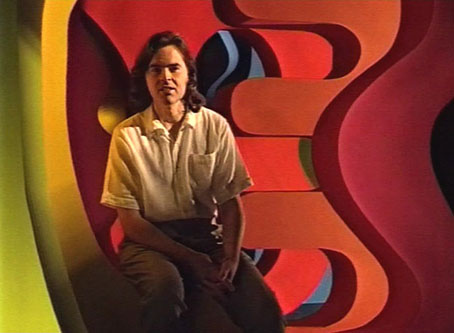
Browsing Vimeo recently I found a film by Anna Thew, Cling Film, which I remembered seeing years ago on Midnight Underground, a TV series devoted to avant-garde cinema. The series was broadcast by Channel 4 (UK) for eight weeks in 1993, with each episode being screened shortly after midnight. The presenter was the always reliable Benjamin Woolley, sitting before a backdrop resembling one of Verner Panton’s psychedelic environments from where he introduced the cinematic offerings, an eclectic blend of avant-garde and experimental films, unusual dramas plus a couple of animations. Episodes ran for around an hour, with each installment following a different theme. The films were a mix of the old and the new: “classics” (for want of a better term) of underground cinema set alongside more recent works. This was very much a television equivalent of the screenings of avant-garde cinema which Film and Video Umbrella had been touring around Britain’s arthouses since the mid-1980s; one of the founders of FVU, Michael O’Pray, is thanked in the series credits. Midnight Underground was so tailored to my interests at the time it was easy to feel like this was being screened for my benefit alone. I taped everything as it was broadcast but I never got round to digitising all the episodes, so that many of the films shown there, Cling Film included, I haven’t seen for a long time.

midnight02.jpg

Benjamin Woolley.

The discovery of Anna Thew’s film set me wondering whether it would be possible to replicate the contents of Midnight Underground via links to various video sites. Since this post exists, the answer is obviously yes, or almost… Of the 44 films shown in the series only 3 are currently unavailable, with one more being limited to an extract and another as pay-to-view. This was a much better result than I expected, especially for works with such a limited appeal. The majority of the films shown in the series were being screened on British TV for the first time, also the last time for most of them. In 1993 Channel 4 was still maintaining its original brief, offering a genuine alternative to the programming on the other three terrestrial channels. As I’ve often complained here, this didn’t last; the underground remained underground. Woolley’s series was a brief taste of a televisual world where the concept of diversity could apply to form and content as well as identity. It’s a world the corporate channels will never show you, one you have to find for yourself.

* * *

1: Strange Spirits
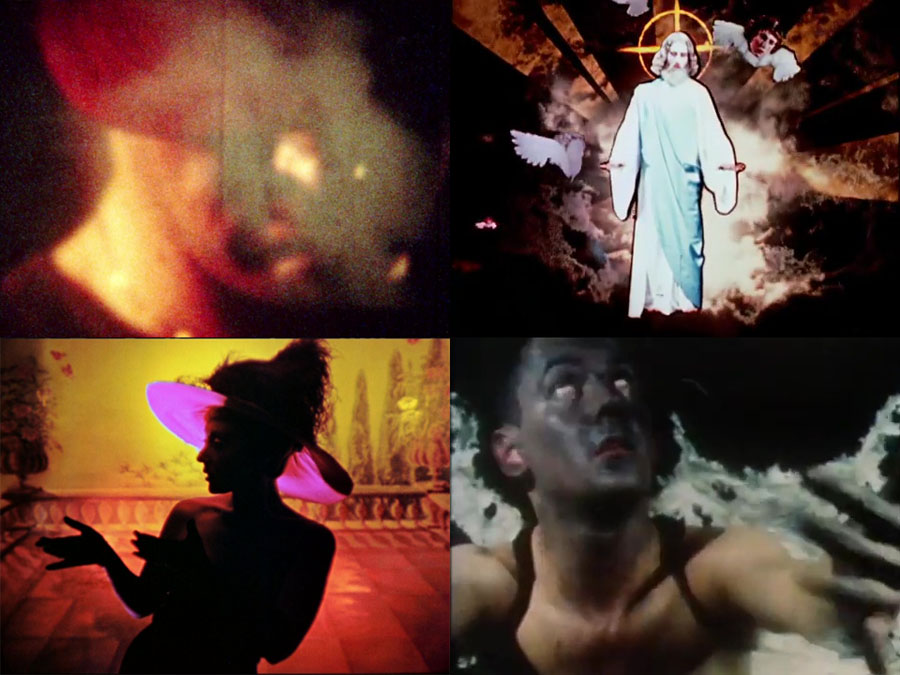
The opening episode shows why I felt they were broadcasting this for me alone. Derek Jarman’s grainy film of a Throbbing Gristle performance is probably the first (and only?) time the group appeared on British TV. This was the first surprise. The second one was Kenneth Anger’s film being shown with its Janácek score. I’d seen this at an FVU screening a couple of years before with its ELO soundtrack, the so-called “Eldorado Edition”, which Anger later discarded. As for Daina Krumins’ weird and creepy religiose short, I expected this one to be unavailable but the director now has several of her films on YouTube. Don’t miss her even-weirder animated slime moulds, Babobilicons. The angel in Maggie Jailler’s film is artist (and Jarman/TG associate) Cerith Wyn Evans.

midnight03.jpg

TG: Psychic Rally in Heaven (Derek Jarman, 1981)
The Divine Miracle (Daina Krumins, 1973)
Inauguration of the Pleasure Dome (Kenneth Anger, 1954)
L’ange frénétique (Maggie Jailler, 1985)


2: Music for the Eye and Ear
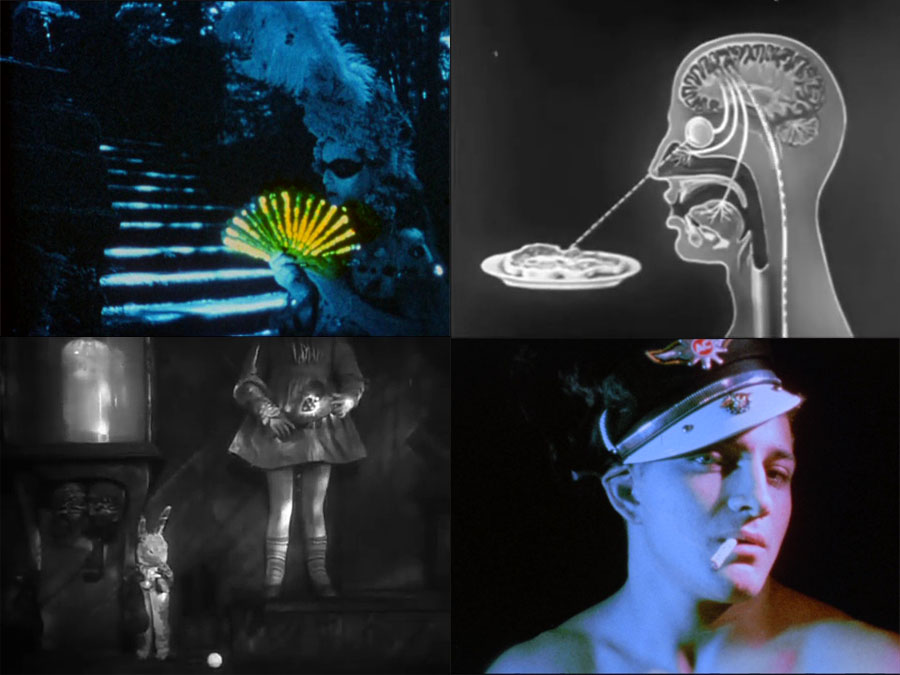
Bruce Conner’s films are continually elusive on the internet, especially those made to accompany music by Devo and Eno & Byrne. The version of Mongoloid linked here differs slightly from the original but it’s essentially the same film. Versailles II is taped from the Midnight Underground broadcast, and includes Benjamin Woolley’s introduction.

midnight04.jpg

Eaux d’artifice (Kenneth Anger, 1953)
Mongoloid (Bruce Conner, 1978)
Versailles II (Chris Garratt, 1976)
Stille Nacht II: Are We Still Married? (Quay Brothers, 1992)
All My Life (Bruce Baillie, 1966)
Scorpio Rising (Kenneth Anger, 1964)


3: New Sexualities
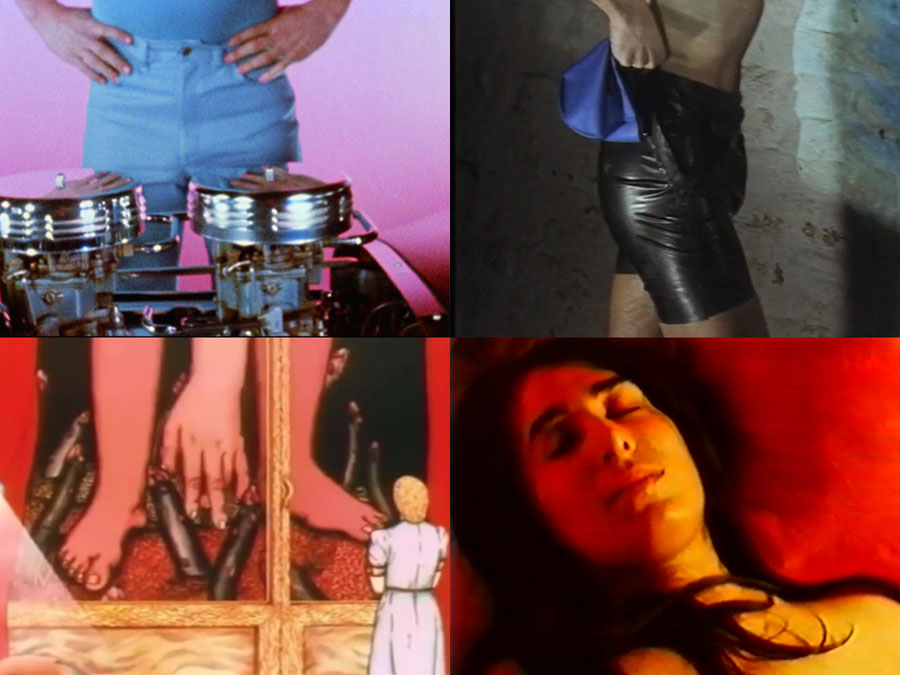
Stephen Dwoskin’s film is the one that shows a close-up of a woman’s face during the act of masturbation. This is paralleled later in the series by Antony Balch’s masturbatory self-portrait in Towers Open Fire. Cling Film is all about safe sex, and was broadcast in a slightly amended form to avoid being too explicit. The version on Vimeo is uncensored.

midnight05.jpg

Kiss (Chris Newby, 1992) (no video)
Kustom Kar Kommandos (Kenneth Anger, 1965)
Cling Film (Anna Thew, 1993)
Stain (Simon Pummell, 1992)
Asparagus (Suzan Pitt, 1979)
6/64: Mama und Papa (Materialaktion Otto Mühl) (Kurt Kren, 1964)
Moment (Stephen Dwoskin, 1969)


4: London Suite
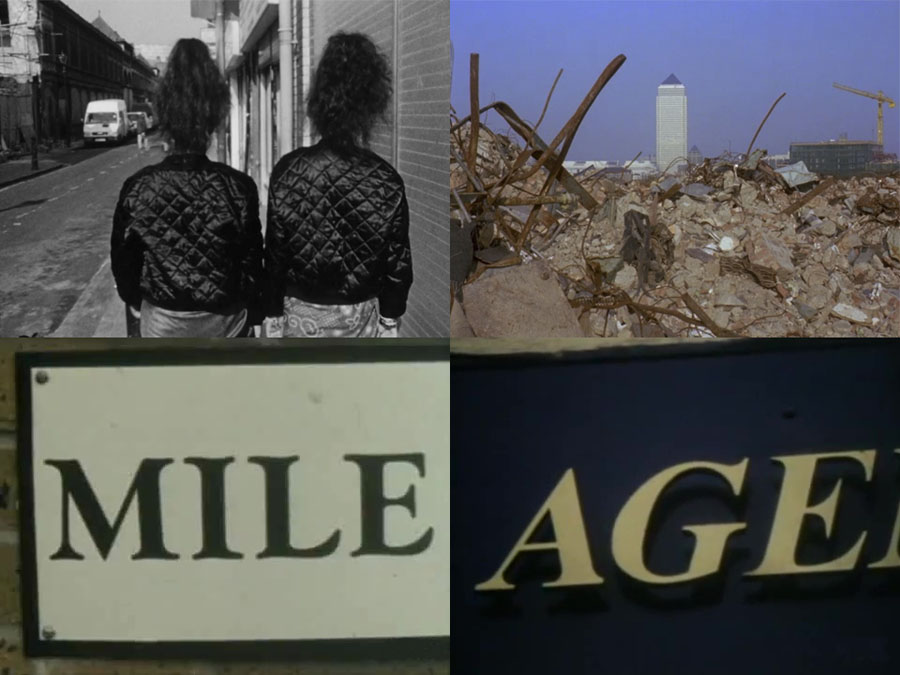
Sundial and Mile End Purgatorio have both appeared here before as a result of my seeing them on Midnight Underground.

midnight06.jpg

Latifah and Himli’s Nomadic Uncle (Alnoor Dewshi, 1992)
Sundial (William Raban, 1993)
The London Story (Sally Potter, 1987) (pay-to-view)
Mile End Purgatorio (Guy Sherwin, 1991)
London Suite (Vivienne Dick, 1989) (no video)


Continue reading “Into the Midnight Underground”

Man Ray and the Marquis

manray1.jpg

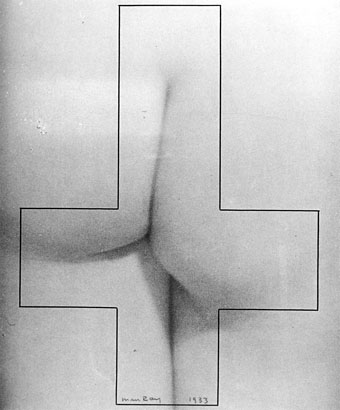
Monument to D.A.F. de Sade (1933).

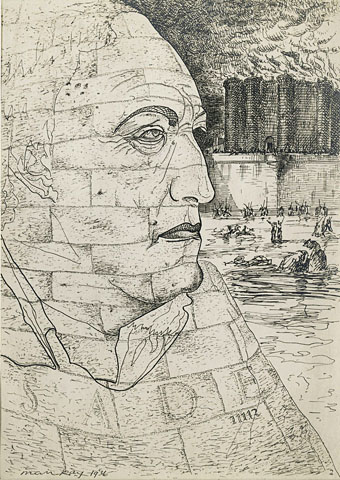
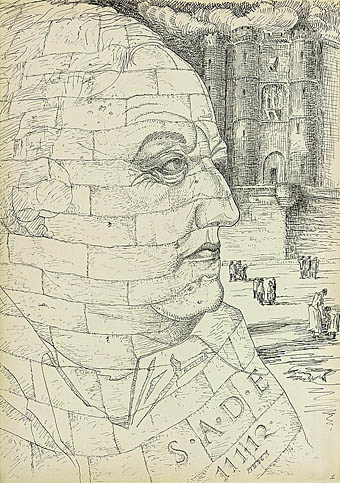
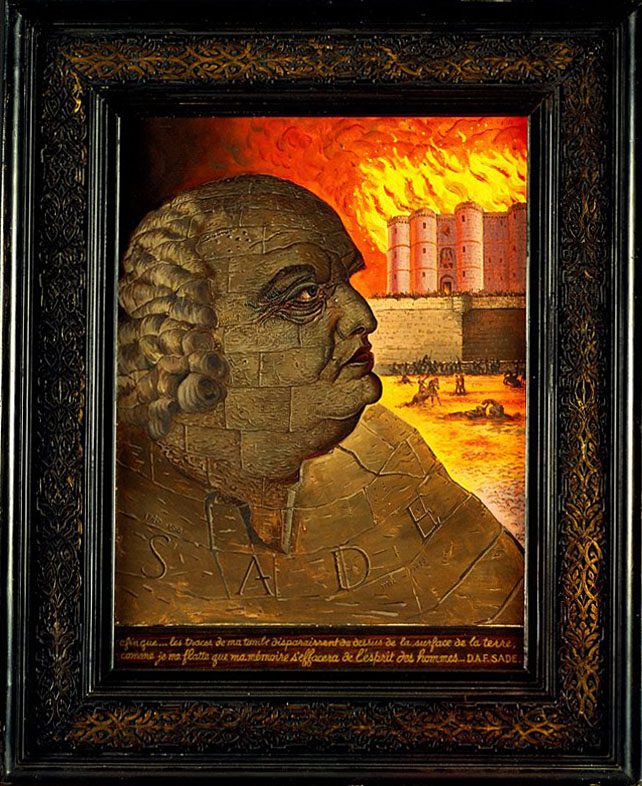
A slight return to the literary outlaw. Man Ray was more preoccupied by the Marquis de Sade than many of his fellow Surrealists, although he never took his interest as far as the obsessive Jean Benoît. His imaginary portraits were created after Sade scholar Maurice Heine complained that the only surviving picture of the Marquis was a drawing that could be of any other young aristocrat of the time.

manray2.jpg

Imaginary Portrait of D.A.F. de Sade (1936).

Man Ray’s portraits ran through several variations, first as drawings, then as two paintings, finally as a bronze. These always seemed to me to be more representations of Sade’s character as it comes through his writing than portraits of the writer himself. The two paintings could easily depict the villainous Duke de Blangis from The 120 Days of Sodom, with the castle of the Bastille standing for the castle where Blangis and his colleagues conduct their murderous games. An earlier photo work, Monument to D.A.F. de Sade (1933), was used by Mary Reynolds in a metal binding she created in 1935 for the first print edition of the 120 Days. Penguin used the same photo on the cover of their new translation of the book in 2016. And it would be remiss of me if I didn’t mention the gay variation designed by Peter Christopherson for the CD release of Scatology by Coil.

manray3.jpg

Imaginary Portrait of D.A.F. de Sade (1936).

manray4.jpg

Imaginary Portrait of D.A.F. de Sade (1938).

Continue reading “Man Ray and the Marquis”

Chance encounters on the dissecting table

maldoror2.jpg

In times of great uncertainty about our mission, we often looked at the fixed points of Lautréamont and De Chirico, which sufficed to determine our straight line.

André Breton, Surrealism and Painting, 1928

1: The metaphor, 1869
maldoror.jpg

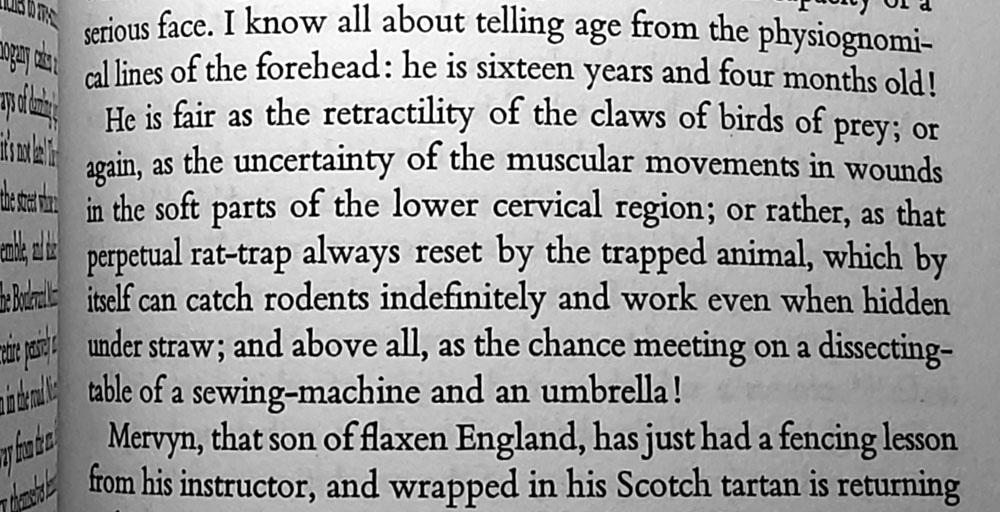
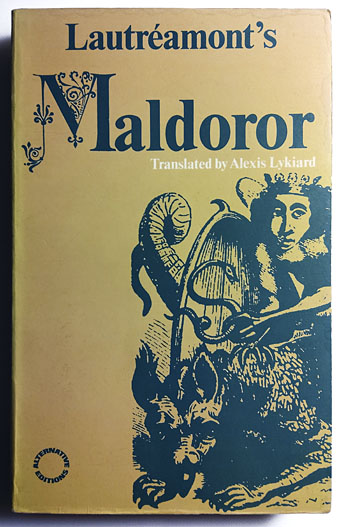
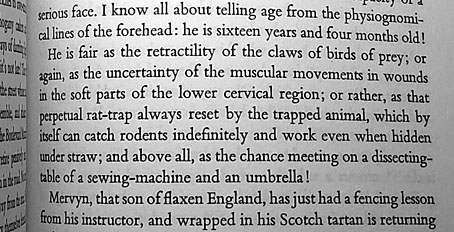
You can’t read the history of Surrealism for very long before encountering some variation of the most famous line from Les Chants de Maldoror by the Comte de Lautréamont/Isidore Ducasse: “beautiful as a chance encounter on a dissecting table of a sewing-machine and an umbrella”. Translations vary, as do misquotations; the page above is from the Alexis Lykiard translation where you can also read the surrounding text. The context of the description is seldom mentioned when the quote is used, and reveals that the words are describing the attractiveness of an English schoolboy living with his parents in Paris. The insipid Mervyn is stalked, seduced and finally murdered by the villainous Maldoror. Lautréamont’s metaphor, like so much else in the book, carries a sting in its tail.


2: The Enigma of Isidore Ducasse, 1920
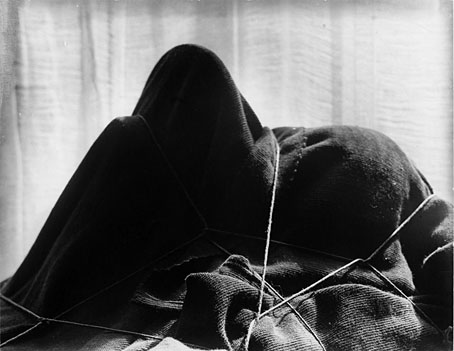
ray.jpg

Man Ray, like Mervyn, was a foreigner living in Paris when he created this artwork. The “enigma” may be taken as referring both to the wrapped object (a sewing machine sans umbrella) as well as to the mysterious author of Les Chants de Maldoror, who died at the age of 24 after writing his explosive prose poem, and about whose life little is known. I first encountered Ducasse’s name in art books showing pictures of this piece which is one of the earliest works of Surrealist art. For a young art enthusiast the enigma was more in the name itself: who was this Ducasse, and why was he enigmatic? The original of Man Ray’s piece was subsequently lost, like many of his pre-war sculptures, but may be seen inside the first issue of La Révolution Surrealiste. Editions of the work that exist today are recreations made in the 1970s.


3: An illustration for Les Chants de Maldoror, 1934
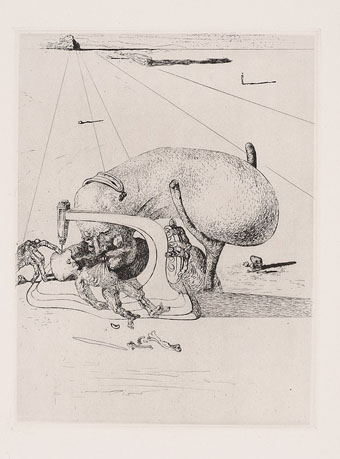
dali3.jpg

Salvador Dalí created 30 full-page etchings and 12 vignettes for an illustrated edition of Lautréamont’s work published by Skira in Paris in 1934. Dalí must have seemed an ideal match for a book whose prose descriptions offer copious atrocities and mutations but, as with many of Dalí’s illustrations, the pictures owe more to his obsessions than to Lautréamont’s text, and could easily be used to illustrate something else entirely. Plate 19 does, however, feature a sewing machine.


4: Electrosexual Sewing Machine, 1935
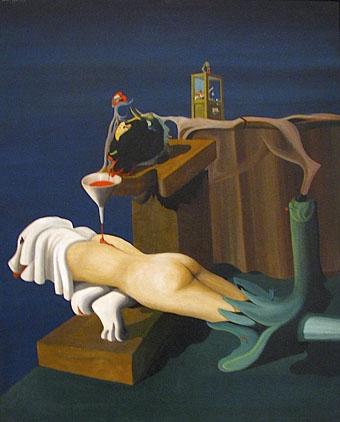
dominguez.jpg

A Surrealist painting by Oscar Dominguez which emphasises the sexual nature of Lautréamont’s metaphor, or at least the Freudian interpretation of the same. Breton and company took the sewing machine for a female symbol, while the umbrella was male; the dissecting table where their encounter takes place is, of course, a bed.

[In Electrosexual Sewing Machine] the dissection appears to be under way. There is a strange abusive surgery being undertaken, the thread of the sewing machine replaced with blood which is being funnelled onto the woman’s back. The plant itself may even echo de Lautréamont’s umbrella. Domínguez has taken one of the central mantras of Breton’s Surreal universe and has pushed it, through a combination of painterly skill and semi-automatism, in order to create an absorbing and haunting vision that cuts to the quick of the movement’s spirit. (via)


5: Sewing Machine with Umbrellas in a Surrealist Landscape, 1941
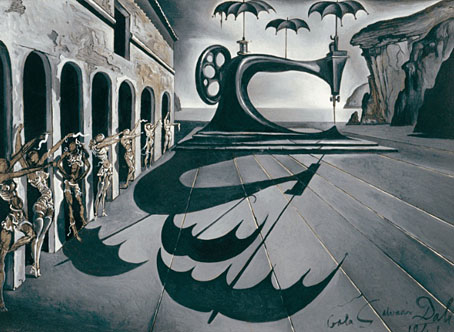
dali4.jpg

More from Dalí who was hired by Fritz Lang to create images for a sequence of drunken delirium in the film Moontide. The commission arrived four years before Dalí’s work for Hitchcock on Spellbound, and if successful might have even dissuaded Hitchcock from hiring Dalí, but Lang left the film once shooting had begun, and his replacement, Archie Mayo, disliked the artist’s contributions. This surviving concept painting seems lazy compared to the Spellbound sequences (which were also trimmed by the ever-interfering David O. Selznick): the colonnade is a bald swipe from De Chirico, while the umbrella-bedecked sewing machine makes clumsy and literal use of the Lautréamont metaphor which is better left as a provocative collision of verbal imagery.


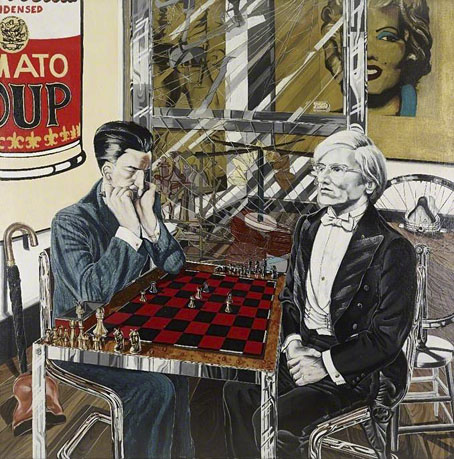
6: “As beautiful as the chance meeting on a dissection table of a sewing-machine and an umbrella…”: Andy Warhol and Marcel Duchamp, 1976
core.jpg

A painting by Philip Core, part of a series in which well-known cultural figures (eg: Harold Pinter and Joe Orton) encounter each other in rooms that reflect their works. Core wrote a biography of Andy Warhol, so maybe he knew something that I don’t, but I’d be very surprised if the Pop artist ever played a game of chess in his life, never mind being proficient enough to win so many pieces from the chess-obsessed Duchamp. As for Marcel, he’d raise an eyebrow at that wrongly positioned chess board…


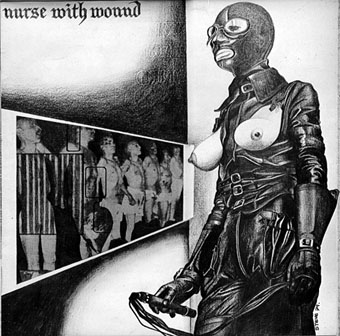
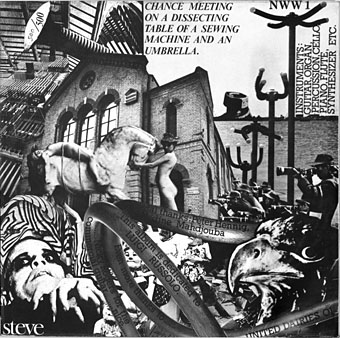
7: Nurse With Wound, 1979
nww1.jpg

Lautréamont infects another medium. Steven Stapleton’s music group/art project has been infused from the outset by a pranksterish Dada/Surrealist spirit, so the purloining of the metaphor for the title of the first Nurse With Wound album is entirely fitting.
nww2.jpg


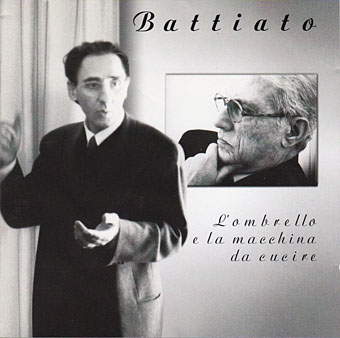
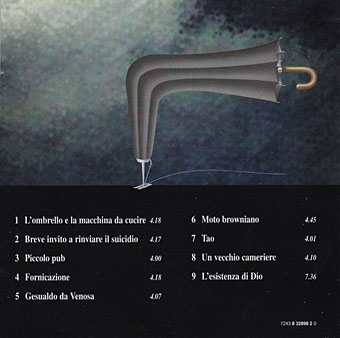
8: L’Ombrello E La Macchina Da Cucire, 1995
battiato1.jpg

Unlike this album by the very prolific Franco Battiato which Discogs describes as “experimental”. The first piece on the album uses the same title as the album, and is anything but experimental, especially compared to the improvised racket created by Nurse With Wound.
battiato2.jpg


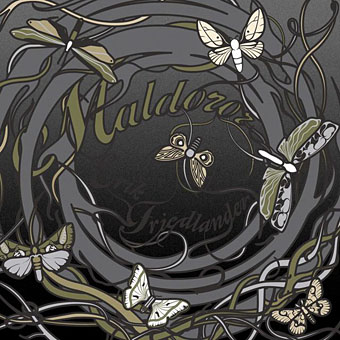
9: Maldoror, 2003

friedlander.jpg

A jazz album by Erik Friedlander which I haven’t heard but which takes its track titles from phrases by Lautréamont.

Do other examples exist? No doubt they do, but the more recent uses of Lautréamont’s words only demonstrate how over-familiarity dulls an effect that was once shocking and original.

Previously on { feuilleton }
Santiago Caruso’s Maldoror
Jacques Houplain’s Maldoror
Hans Bellmer’s Maldoror
Les Chants de Maldoror by Shuji Terayama
Polypodes
Ulysses versus Maldoror
Maldoror
Books of blood
Magritte’s Maldoror
Frans De Geetere’s illustrated Maldoror
Maldoror illustrated