Maldoror illustrated

maldoror.jpg

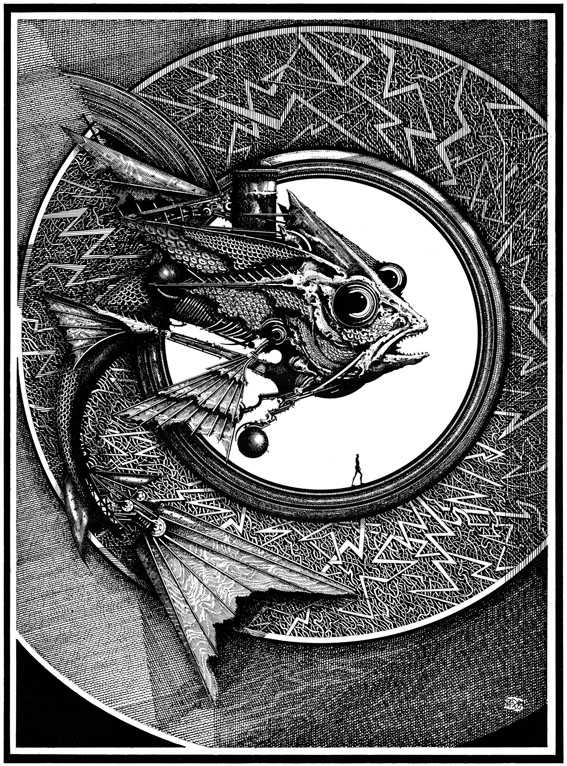
Les Chants de Maldoror by Corominas (2007).

There seems to be no escaping from HP Lovecraft just now, the illustration above having been created for a PDF publication entitled CTHULHU, Cómics y relatos de ficción oscura, produced by these people. The Cthulhu-zine seems to be unavailable but you can see more of these splendid illustrations, based on Lautréamont’s Les Chants de Maldoror (1869), at Dorian Gray BD. The artist, Corominas, has an additional blog showcasing more commercial work.

maldoror2.jpg

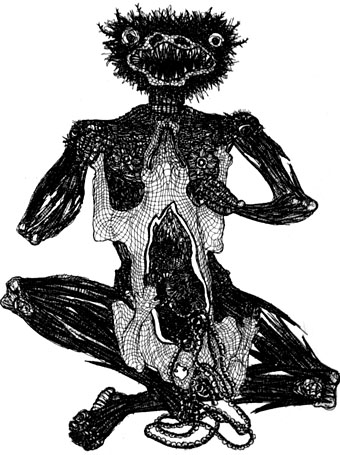
Les Chants de Maldoror by Jacques Houplain (1947).

Lautréamont’s delirious masterpiece isn’t exactly the easiest book to illustrate but the Corominas drawings certainly capture some of its ferocious energy. The Surrealists were big Maldoror enthusiasts, of course, and did much to establish Lautréamont’s current reputation. Salvador Dalí produced a series of engravings for a Skira edition in 1934 although his drawings look less like illustrations of the text than a rifling of the artist’s usual preoccupations. The picture above by Jacques Houplain is one of a series of twenty-seven engravings produced for a French edition in the 1940s. More recently, Jean Benoît created (among other things) a Maldororian dog and there’s even been an attempt at a comic-strip adaptation from Hernandez Palacios. On the whole I prefer the Corominas pictures but then I’m biased towards that style of drawing which owes something to all the comic artists and illustrators influenced by Franklin Booth.

Elsewhere on { feuilleton }
The illustrators archive
The etching and engraving archive

Previously on { feuilleton }
Franklin Booth’s Flying Islands
Carlos Schwabe’s Fleurs du Mal
The art of Jean Benoît

New things for July

leyendecker_flapper.jpg

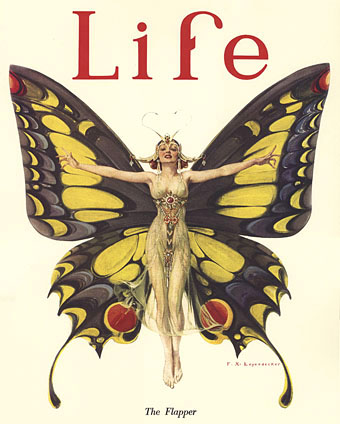
The Flapper by Frank X Leyendecker, Life magazine (1922).

• 2008 is turning out to be a great year for Lovecraft aficionados. As well as the stupendous Lovecraft Retrospective: Artists Inspired by HP Lovecraft, we’re also awaiting Frank Woodford’s feature length documentary, Lovecraft: Fear of the Unknown. I’m lucky to have my work included in Frank’s film which is easily the best documentary to date concerning the life and work of HPL. Among the interviewees are Neil Gaiman, John Carpenter, Guillermo Del Toro, Caitlin R Kiernan, Peter Straub, Ramsey Campbell and Lovecraft scholar ST Joshi. The film will receive its first (?) public screening later this month at the San Diego Comic Con:

Thursday, July 24
8:00–9:45pm
Room 26AB

• Over the weekend Arthur Magazine cleared the $20,000 it needed to keep running before the three-day deadline elapsed. A stunning piece of fund-raising which shows how much people value Jay and company’s efforts.

• The gorgeous cover above is the work of Frank X Leyendecker (1876–1924), brother of the more well-known (and gay) Joseph C Leyendecker. Makes me think I should make a post of Butterfly Women if only as an excuse to track down more pictures of Loie Fuller.

• Last but not least: happy birthday Lorraine!

The monstrous tome

hpl1.jpg

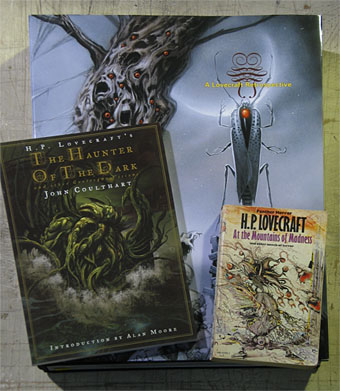
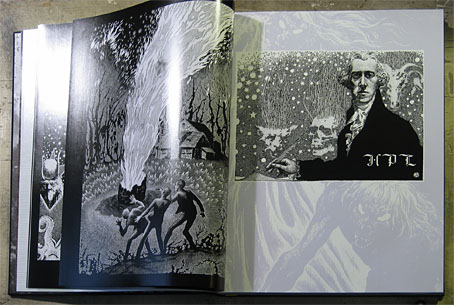
So it arrived at last, yesterday in fact, the colossal volume that is A Lovecraft Retrospective: Artists Inspired by HP Lovecraft from Centipede Press. Calling this a book is like calling the Great Pyramid of Cheops a pile of stones, technically accurate but the words somewhat fail to convey the existential reality. This is the heaviest book I’ve ever come across, 400 pages of heavy-duty art paper at BIG size. (Amazon gives the dimensions as 16.1 x 12.6 x 2.3 inches or 409 x 320 x 580 mm.) The photo above shows the scale beside an old Mountains of Madness paperback (Ian Miller‘s cover art appears in full in the new book) and my own Haunter of the Dark collection. The cover art is by Michael Whelan, a detail from his wonderful 1981 HPL panoramas.

hpl2.jpg

The Virgil Finlay section showing The Colour Out of Space and his definitive Lovecraft portrait.

The range of contributors past and present includes JK Potter, HR Giger, Raymond Bayless, Ian Miller, Virgil Finlay, Lee Brown Coye, Hannes Bok, Rowena Morrill, Bob Eggleton, Allen Koszowski, Mike Mignola, Howard V. Brown, Michael Whelan, Tim White, Frank Frazetta, John Holmes, Harry O. Morris, Murray Tinkelman, Gabriel, Don Punchatz, Helmut Wenske, John Stewart, Thomas Ligotti and John Jude Palencar. The introduction is by Harlan Ellison and there’s an afterword by Thomas Ligotti. Many pages fold out to reveal spreads like the Giger ones below. Print quality is exceptional, of course, but then ladling the superlatives is pointless when it’s obvious this is a sui generis masterpiece of Lovecraftian art. Naturally I’m very happy indeed to be a part of it.

Continue reading “The monstrous tome”

The art of Ian Miller

ian_miller9.jpg

From the Hollywood Gothic series (1984).

Jeff VanderMeer has a great post about artist/illustrator Ian Miller at io9 which prompts me to write a few words about his work myself, something I’ve intended for a while.

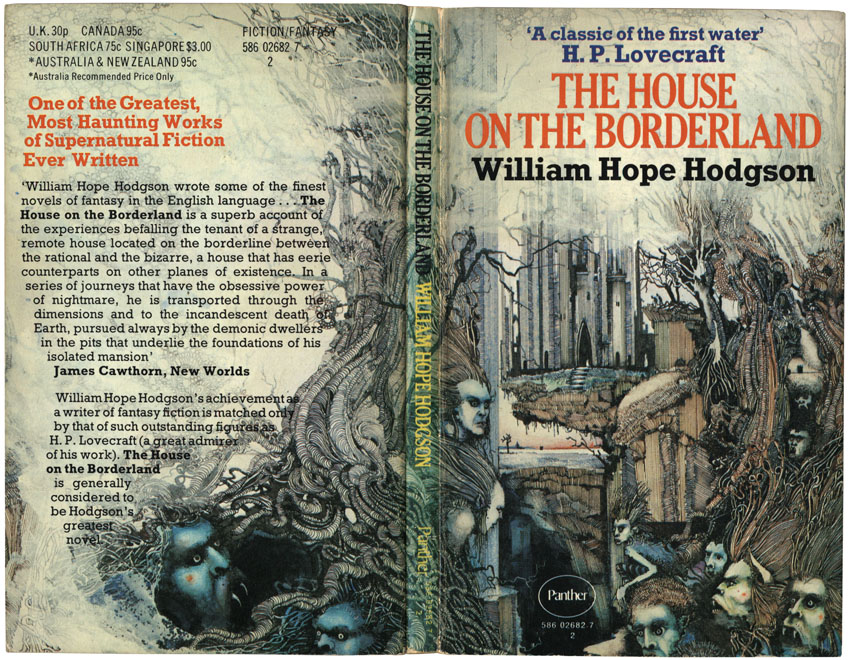
Miller is indelibly linked for me with HP Lovecraft on account of his covers for the Panther Horror editions of the 1970s, the first Lovecraft volumes I bought. His sinister and minutely detailed ink drawings were a big inspiration when I started to draw seriously myself, unsurprisingly when my own drawings possessed a similar quantity of detail and macabre atmosphere. I still think his cover for William Hope Hodgson’s The House on the Borderland (below) is one of the most successful anyone has produced for that novel. His Mountains of Madness cover, while not being a direct illustration, perfectly encapsulates the feel of much of Lovecraft’s later fiction.

Jeff’s post has a wide range of work which I’ve avoided duplicating. The items shown here are all scans from my own library. More of Miller’s Lovecraft illustration will appear in the forthcoming Artists Inspired by HP Lovecraft from Centipede Press, along with several pieces by yours truly.

ian_miller4.jpg

The House on the Borderland (1972).

Continue reading “The art of Ian Miller”

John Phillip Law, 1937–2008

pygar.jpg

Pygar the angel, Barbarella (1968).

John Phillip Law, who died on Tuesday, was featured here last year in a look at Mario Bava’s crazy live action fumetti, Danger Diabolik (below). Law made that film the same year as he played a blind angel in an equally crazy slab of Sixties’ decadence, Barbarella. In a more serious role, he played opposite the very formidable Rod Steiger in The Sergeant which was released the same year; together with Victim, this was one of the first films I remember watching that dealt with same-sex attraction (albeit in the usual angst-ridden mode), with Law’s character being the understandable object of Steiger’s doomed affection.

After those heights, things tended to be more down than up but I do have an affection for Ray Harryhausen’s The Golden Voyage of Sinbad (1974). Law’s Sinbad was pretty good even if he spends much of the time fighting monsters while Tom Baker was great as the villainous Koura. And I always appreciated that screenwriter Brian Clemens made Lemuria the destination of the voyage, a lost continent mentioned by Madame Blavatsky and many of the Weird Tales writers, including HP Lovecraft in The Haunter of the Dark.

diabolik.jpg

Danger Diabolik (1968).

Previously on { feuilleton }
CQ
Danger Diabolik