Weekend links 486

magma.jpg

Magma concert poster, 2017. Art by Jofre Conjota.

The Dream Foundry is a new venture with a mission “to bolster and sustain the nascent careers of professionals working in the field of speculative literature.” This includes artists as well as writers, and to this end I was asked to answer a few questions about my work as a creator of book covers. I also offer some advice about visibility as an artist which I tried not to hedge with too many caveats. Related: my cover for The Resurrectionist of Caligo by Wendy Trimboli & Alicia Zaloga was one of the covers of the month at Muddy Colors.

• “…for a band that were so compositionally advanced, they were adept at producing primordially insistent and hypnotic rhythms.” John Doran on Magma (again), appraising the band’s music and history before presenting Christian and Stella Vander with questions from appreciative musicians.

• Mixes of the week: FACT mix 731 by Meemo Comma, mr.K’s Soundstripe vol 2 by radioShirley, The Ivy-Strangled Path Vol. XIX by David Colohan, and The Pumpkin Tide by Haunted Air.

• At Dangerous Minds: Roddy McDowall reads HP Lovecraft’s The Outsider and The Hound. Related: David McCallum reads HP Lovecraft’s The Dunwich Horror and The Haunter of the Dark.

• “Mathematics is not unique in drawing out charlatans and kooks, of course…” David S. Richeson on cranks, past and present.

• “I plan to take psychedelics again…” Helen Joyce, the finance editor of The Economist, takes a trip.

• The City of Light and its shadows: Brassaï’s Paris.

• At Dennis Cooper’s: Dennis Hopper Day.

Paris (1958) by Perez Prado And His Orchestra | Paris 1919 (1973) by John Cale | Paris 1971 (1971) by Suzanne Ciani

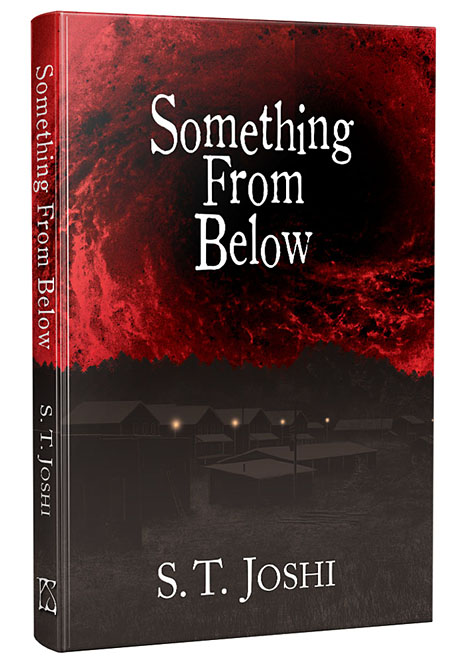
Something from Below

My first encounter with author, editor and Lovecraft biographer ST Joshi was in the form of an artwork request that arrived out of the blue in the late 1980s. My comic-strip adaptation of The Haunter of the Dark had just been published in a large-format edition by Caermaen Press, a small imprint run by Roger Dobson and Mark Valentine, and this prompted a flurry of interest among weird-fiction enthusiasts in Britain and the USA. Joshi was editing Lovecraft Studies for Necronomicon Press at the time, and asked if I’d be willing to contribute illustrations, something I ended up not doing for a variety of reasons. I always felt bad about this, and admitted as much when we eventually met at the Providence NecronomiCon in 2015, so my cover art for his new cosmic-horror novella may be regarded as a kind of recompense.

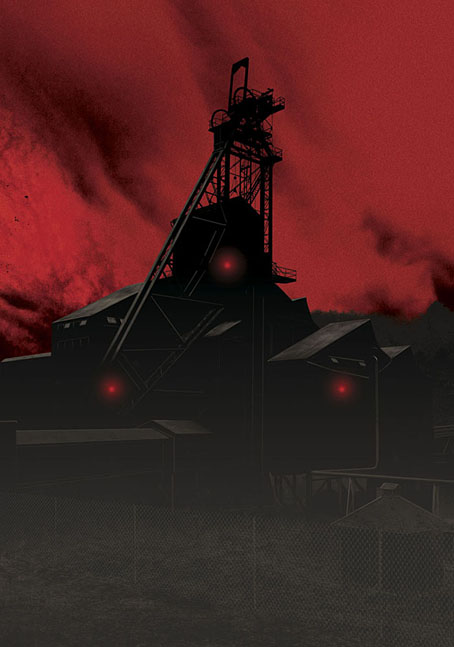
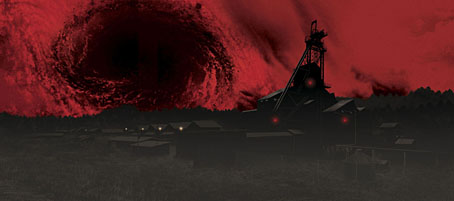
Something from Below is horror with an industrial setting and a Lovecraftian slant, hence the sinister coal mine dominating the artwork:

When 22-year-old Alison Mannering returns to her home in northeastern Pennsylvania after college, she finds a troubling situation. Her father, Guy Mannering, a longtime coal miner, has died recently under suspicious circumstances, and her mother refuses to provide any details of his passing. Alison feels she has no option but to investigate the matter herself, enlisting her high school sweetheart, Randy Kroeber, as well as Randy’s twin sister, Andrea called Andy, to assist her… (more)

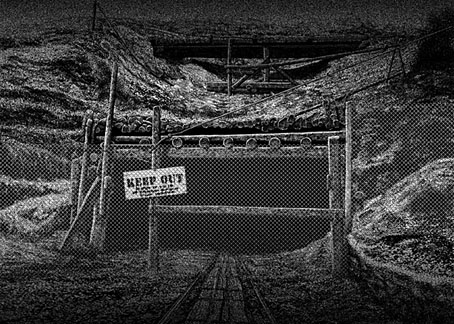
The brief for this one was to create a wraparound cover without showing anything overtly monstrous, something I was happy to do since I dislike horror covers that reveal too much. In addition to the wrap I also produced a black-and-white piece for the inner boards. As is evident from the pictures above, the artwork was flipped around in the design but that’s okay, it works both ways. The coal mine is the central location, however.

Something from Below is published this month by PS Publishing in signed and unsigned hardcovers.

Elsewhere on { feuilleton }
The Lovecraft archive

Weekend links 483

doetecum.jpg

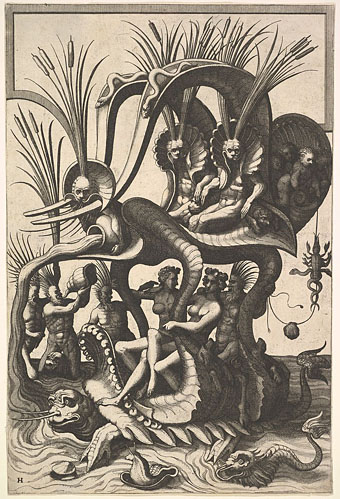
Fantastic Sea Carriage (1556) by Johannes van Doetecum the Elder.

• I’ve grown increasingly tired of Kubrick-related micro-fetishism (despite contributing to it myself with previous posts) but this piece at Film and Furniture about the history of David Hicks’ Hexagon carpet design is a good one.

• “In hindsight, we can see how rarely one technology supersedes another…” Leah Price on the oft-predicted, never arriving death of the book.

• From Rome To Weston-Super-Mare: Eden Tizard on Coil’s Musick To Play In The Dark.

“It is,” the editor of the London Sunday Express had written nine years earlier, sounding like HP Lovecraft describing Necronomicon:

the most infamously obscene book in ancient or modern literature….All the secret sewers of vice are canalized in its flood of unimaginable thoughts, images and pornographic words. And its unclean lunacies are larded with appalling and revolting blasphemies directed against the Christian religion and against the name of Christ—blasphemies hitherto associated with the most degraded orgies of Satanism and the Black Mass.

Regarded as a masterpiece by contemporary writers such as TS Eliot and Ernest Hemingway, celebrated for being as difficult to read as to obtain, Ulysses had been shocking the sensibilities of critics, censors, and readers from the moment it began to see print between 1918 and 1920, when four chapters were abortively serialized in the pages of a New York quarterly called The Little Review. Even sophisticated readers often found themselves recoiling in Lovecraftian dread from contact with its pages. “I can’t get over the feeling,” wrote Katherine Mansfield, “of wet linoleum and unemptied pails and far worse horrors in the house of [Joyce’s] mind.” Encyclopedic in its use of detail and allusion, orchestral in its multiplicity of voices and rhetorical strategies, virtuosic in its technique, Ulysses was a thoroughly modernist production, exhibiting—sometimes within a single chapter or a single paragraph—the vandalistic glee of Futurism, the decentered subjectivity of Cubism, the absurdist blasphemies and pranks of Dadaism, and Surrealism’s penchant for finding the mythic in the ordinary and the primitive in the low dives and nighttowns of the City.

Michael Chabon on the US trial of James Joyce’s Ulysses

• Mix of the week: Through A Landscape Of Mirrors Vol. III—France II by David Colohan.

• Another Not The Best Ambient And Space Music Of The Year Post by Dave Maier.

Sarah Angliss and friends perform Air Loom at Supernormal, 2019.

• Out next month: The World Is A Bell by The Leaf Library.

Amy Simmons on where to start with Pier Paolo Pasolini.

• At Dennis Cooper’s: Candy Clark Day.

• Uccellacci E Uccellini (1966) by Ennio Morricone | Liriïk Necronomicus Kahnt (1978) by Magma | Ostia (The Death Of Pasolini) (1986) by Coil

Weekend links 463

eye.jpg

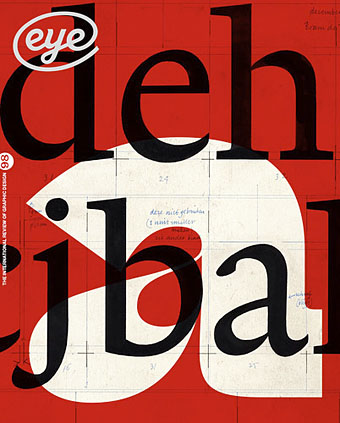
Eye 98: Beatrice Display Black, Sharp Type, 2018, and a detail from an original drawing for Lexicon by Bram de Does, 1989.

Issue 98 of Eye, the international design journal, is out this month. The new issue is a typography special but also features my review of Mark Dery’s Born to be Posthumous: The Eccentric Life and Mysterious Genius of Edward Gorey. This is the second time I’ve written about Dery’s book, with the new piece focusing more on Gorey’s work as a designer/book creator, and his place in the history of illustration.

Portal is a new release by Slovakian metal band Doomas, the artwork of which adapts one of my illustrations for Lovecraft’s Monsters. The band also have a suitably Lovecraftian video.

• Reading recommendations by M. John Harrison: the old (the excellent Rogue Moon by Algis Budrys) and the new (Underland et al).

I first started drawing in my Wake to count the number of rivers mentioned in an episode, one page alone counting 85. Gradually, I would be so moved by a line or a character I would colour them in, the most obvious being the 28 Rainbow girls to the more obscure nebulae, railroad tracks, hidden mythical islands and turn of the century lightships. Themes began to emerge which demanded documentation and always the sad, ecstatic relief of finishing a chapter merited some sort of coloured tribute. By the time I finished four years later, I simply drew a leaf to reflect Joyce’s metaphor on the last page: my leaves have drifted from me. All. But one clings still.

Susie Lopez on Finnegans Wake at 80

• Old ghosts at The Paris Review: a preview of The Spectacle of Illusion by Matthew L. Tompkins.

• At Dangerous Minds: Malcolm McDowell and the making of Lindsay Anderson’s O Lucky Man!

Herbie Hancock: “I felt like I stood on the shoulders of giants and now it’s my turn”.

• Mix of the week: XLR8R Podcast 590 by Christian Löffler.

• The discography of Diamanda Galás is now at Bandcamp.

• RIP Quentin Fiore, graphic designer and book creator.

• At Dennis Cooper’s: Haunted dolls.

Antique Doll (1967) by The Electric Prunes | The Doll’s House (1980) by Landscape | Voodoo Dolly (1981) by Siouxsie And The Banshees

Weekend links 462

chanctonbury.jpg

The next release on the Ghost Box label, Chanctonbury Rings is “a blend of folk, electronic music, poetry, prose and environmental sound” by Justin Hopper & Sharron Kraus with The Belbury Poly. The album will be available in June. Design, as always, is by Julian House.

• Clumsy and insensitive translations can ruin the enjoyment of a foreign-language film. Don’t blame us, say the subtitlers pressing film-makers for more appreciation of their art. Anne Billson on the difficulties of translating for a medium of moving images.

• At Expanding Mind: Hypermedia researcher and author Konrad Becker talks with Erik Davis about algorithms from hell, the madness of rationality, media seances, and the martial art of freedom.

The HP Lovecraft Cat Book: a limited collection of Lovecraft’s writings about cats edited by ST Joshi and illustrated by Jason C. Eckhardt.

Amacher was also inspired by a short story she found in the 1986 cyberpunk anthology Mirrorshades, edited by Bruce Sterling—a tale called Petra by Greg Bear, about a grand cathedral, possibly Notre Dame in Paris, in a ravaged, postapocalyptic landscape. Stone gargoyles and other statues mate with humans, creating new hybrids who wander the labyrinthine chambers of the battered house of worship.

Geeta Dayal on composer Maryanne Amacher

• The novel that wouldn’t leave Anthony Burgess alone: Alison Flood on the discovery of a non-fiction continuation of the themes in A Clockwork Orange.

Kristina Foster on photographs of Central Asia’s Striking Soviet Architecture.

Adrian Shaughnessy‘s ten favourite design and visual culture books.

William Joel on the process behind Helvetica’s 21st century facelift.

• The Stupid Classics Book Club by Elisa Gabbert.

The Haunted Generation by Bob Fischer.

Haunted Cocktails (1983) by Intro | Haunted Gate (1997) by David Toop | The Universe Is A Haunted House (2002) by Coil