The Cthulhu Mythos in the pulps

mythos01.jpg

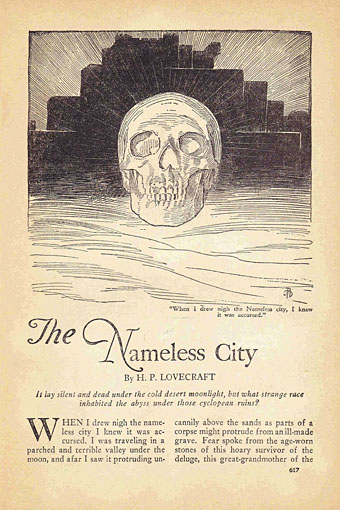
The Nameless City: First published in The Wolverine, November 1921. Reprinted in Weird Tales, November 1928. Illustration by Joseph Doolin.

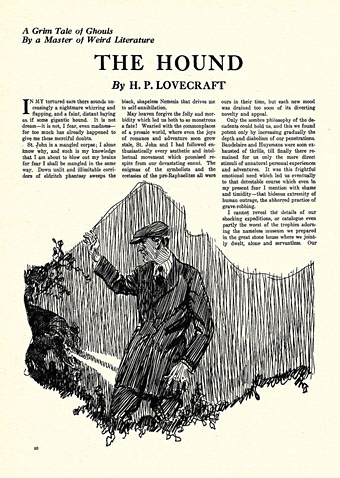
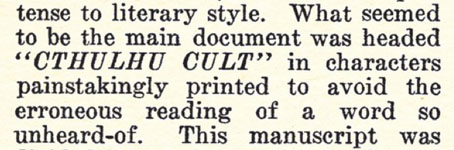
This would have been “The Cthulhu Mythos in Weird Tales” if some of HP Lovecraft’s more substantial stories hadn’t been published elsewhere. To prevent sprawl I’ve limited the list to Lovecraft’s own stories even though the Mythos takes in the work of contemporaries such as Clark Ashton Smith, Robert E. Howard, Frank Belknap Long, Zealia Bishop, August Derleth and others. I like seeing the first appearance in print of familiar tales, and I like seeing their accompanying illustrations even if the drawings are inferior pieces, which they often were for the first decade of Weird Tales. These are the short-story equivalent of first editions, and in the case of The Call of Cthulhu you get to see the first printing anywhere of that mysterious name.

mythos02.jpg

The Hound: Weird Tales, February 1924. Illustration by William Fred Heitman.

This issue is also notable for a story by Burton Peter Thom which shares a title with a Mythos-derived song by Metallica, The Thing That Should Not Be.

mythos03.jpg

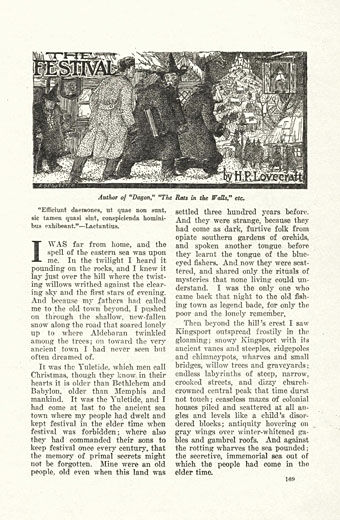
The Festival: Weird Tales, January 1925. Illustration by Andrew Brosnatch.

mythos22.jpg

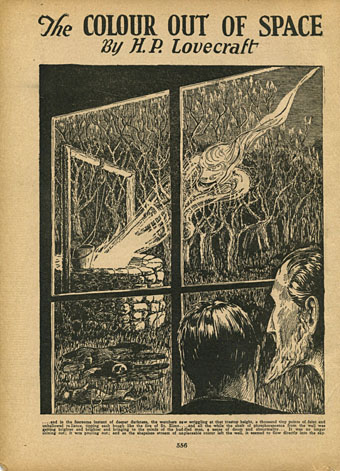
The Colour Out of Space: Amazing Stories, September 1927. Illustration by JM de Aragon.

Lovecraft didn’t think that Weird Tales would appreciate this one even though it’s more horror than science fiction so he sent it to Amazing Stories instead.

mythos04.jpg

mythos26.jpg

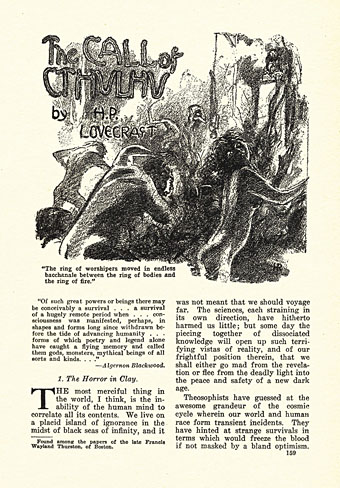
The Call of Cthulhu: Weird Tales, February 1928. Illustration by Hugh Rankin.

It’s doubtful that Rankin, Senf and co. would have been up to the task of depicting Great Cthulhu or the non-Euclidean nightmare of R’lyeh, but this hardly excuses editor Farnsworth Wright’s decision to give the cover to Elliott O’Donnell’s ridiculous ghost table.

Continue reading “The Cthulhu Mythos in the pulps”

Last and First Men

johannsson1.jpg

“Existence has always been precarious. At any stage of its career, humanity might have been exterminated by some slight alteration to its chemical environment, by a more than usually malignant microbe, by a radical change of climate, by the manifold effects of its own folly.”

I loved this, but then it had several points immediately in its favour: a late work by Jóhann Jóhannsson (with a superb score written in collaboration with Yair Elazar Glotman); a study of the concrete memorials from the former Yugoslavia known as spomeniks; narration by Tilda Swinton; and science fiction that isn’t more tiresome Hollywood space opera. Olaf Stapledon’s novel was published in 1930 but it took until 2017 for it to reach a cinema screen when Jóhannsson’s film was premiered at the Manchester International Festival. The film is not only the first adaptation of the novel but also the first film based on any of Stapledon’s novels. Last and First Men and Star Maker (1937) have inspired many notable writers but the philosophical nature of Stapledon’s work combined with the colossal spans of time he deals with make his novels resistant to adaptation by popular narrative forms. Jóhannsson’s film is very small-scale—mostly black-and-white, and shot on grainy 16mm—but it demonstrates how a work that those with greater resources might consider unfilmable can be turned into a substantial drama. The technique of using narration to connect disparate images is a familiar one from documentaries but is less common in fiction cinema despite its flexibility and convenience, especially for low-budget films such as this.

johannsson2.jpg

Tilda Swinton’s voice is that of a spokesperson for “the Eighteenth Men”, a terminal evolution of the human species 2,000 million years in the future. The last humans now live on the planet Neptune, a forced relocation after the expansion of the Sun has made the inner planets of the solar system uninhabitable. Swinton’s unidentified messenger is speaking to us, “the First Men”, describing some of the history that awaits while also warning of an impending and inescapable cataclysm. This is the last section of Stapledon’s novel, the previous chapters of which relate the intervening aeons between our time and the distant future. While the voice informs us about humanity’s fate we contemplate the enigmatic spomeniks, filmed in close-up or at a distance, in bright sunlight or shrouded in mist. What connection there is between the narration and the concrete structures is for the viewer to decide, there are few points of direct correspondence. The combination of strange architectural forms with a vast, invented history had me thinking of At the Mountains of Madness by HP Lovecraft, although in Lovecraft’s story the stellar evolution is an alien one which human beings discover. The congruence is reinforced by Lovecraft’s enthusiasm for Stapledon’s novel which he called “a thing of unparalleled power“. It should be noted, however, that Jóhannsson never suggests that the monuments are anything other than what they are.

johannsson3.jpg

Roger Luckhurst’s Sight & Sound review of the film included questions about the use of the spomeniks, while elsewhere Owen Hatherley has expressed concern about the fetishising of memorials and structures that mark sites of wartime massacre. Stapledon’s novel explores the continuity of human endeavour in all its best and worst aspects; warfare and strife remain persistent problems, so Jóhannsson’s roaming views may be taken as signposts to the future as much as remembrances of the past. There’s also one significant detail that many critics will be unaware of (and which Luckhurst does acknowledge): the first part of the novel is titled “Balkan Europe”, and the opening chapters describe the wars that ravage the Earth throughout the 21st century, wars which have their root in the very conflicts that the spomeniks record. Stapledon’s future history was an attempt to consider the ways in which humanity might overcome its worst impulses. Beyond this, the concrete structures also stand as simple markers of the passage of time; many of the monuments are now weathered and eroded, blained with lichens and besieged by weeds. Humanity may live long enough to resolve its own internal conflicts but its creations, whatever they represent, face a continual struggle against the universal process of entropy.

johannsson4.jpg

Jóhannsson’s film is available in a digipak release from Deutsche Grammophon which packages a blu-ray disc with a CD of the score. This is now a memorial to its creator so the sombre livery seems appropriate: the last major work we’ll have from a remarkable, much-missed artist.

Further reading: The Spomenik Database.

Demons by rail-light: Stefan Grabiński’s weird fiction

grabinski.jpg

Thanks to the demons of distraction it’s taken me a long time to find my way to these books by Polish author Stefan Grabiński (1887–1936) but I’m very pleased to have done so at last. Grabiński was one of several writers first drawn to my attention by Franz Rottensteiner’s The Fantasy Book: The Ghostly, the Gothic, the Magical, the Unreal (1978), a lavishly illustrated popular study that charted the history of fantasy and horror fiction. The book is inevitably dominated by Anglophone authors but Rottensteiner was looking at the genres from a global perspective, to an extent that some of the writers in the sections devoted to Continental Europe were either difficult to find or, as with Grabiński, hadn’t yet been translated into English. Robert Hadji’s Grabiński entry in the Penguin Encyclopedia of Horror and the Supernatural (1986) further stoked my curiosity. Neither Rottensteiner nor Hadji mention how they came to read these obscure tales but I’d guess it was in the two collections published in Germany under the Bibliothek des Hauses Usher imprint, Das Abstellgleis (1971) and Dunst und andere unheimliche Geschichten (1974); several covers from the imprint appear in Rottensteiner’s book. Wherever it was that they read the stories, both writers praised Grabiński as an overlooked master of weird fiction. Rottensteiner notes that he was a contemporary of HP Lovecraft, and with a similar biography—briefly married and suffering artistic neglect during his lifetime—but neither Rottensteiner nor Hadji use the common shorthand descriptions of Grabiński as “the Polish Poe” or “the Polish Lovecraft”. These labels are intriguing but misapplied.

grabinski2.jpg

Bearing in mind that these stories are translated works, one of the surprises of finally reading them is how fresh they seem compared to so many British ghost stories from the same period. Grabiński was writing during the birth of Modernism but the stories of his Anglophone contemporaries can often read like the products of an earlier epoch. His economical prose lacks the ornamentation of Poe and Lovecraft, just as it lacks Poe’s morbid Romanticism and has nothing of Lovecraft’s cosmic scale. But there are recurrent themes, particularly that of possession, whether by the spirits of the dead, by inhuman elementals, or by idée fixe. The latter provides the subject of The Glance, a story that also demonstrates Grabiński’s knack of finding horror in the most mundane situations: a man whose wife died prematurely is troubled by the sight of an open door, the same door through which she walked out of his life, and subsequently, out of her own. The man’s obsession with the door grows into a fear of closed doors and the implicit tragedies they may conceal, an obsession that soon extends itself to anything that hides too much of the world: curtains, rugs, the sharp corners of city streets… Edgar Allan Poe was fond of cataloguing madness in this manner but Grabiński’s stories go beyond glib formulations of insanity. “Metaphysical” is a word often used in discussion of the Grabiński oeuvre; the fixations of his protagonists reveal truths about the world to which others are blind.

grabinski3.jpg

Continue reading “Demons by rail-light: Stefan Grabiński’s weird fiction”

Weekend links 528

durer.jpg

The Rhinoceros (after 1620) by Albrecht Dürer.

• “Today—Tolkien, Lovecraft, Miéville and M John Harrison!” Paul StJohn Mackintosh at Greydogtales explores HP Lovecraft’s lack of interest in fictional worldbuilding. The piece includes one of my book covers (ta!) plus a link to an earlier post I wrote about the cover designs of M. John Harrison’s Viriconium books. Since I’m connected to the thesis I’ll suggest that Lovecraft was resistant to the worldbuilding impulse in part because he was almost always writing horror stories. Having studied the genre at length he was well aware of the need to leave suggestive voids for the reader’s imagination.

• RIP Denise Johnson. All the obituaries mention the big names she worked with, notably New Order and Primal Scream, but being in the pool of Manchester session artists she also appeared on a couple of records by my colleagues at Savoy. Her voice is one of those you first hear on the PJ Proby cover of I’m On Fire, while with friend Rowetta she improvised her way through a Hi-NRG original (and a favourite of Anohni’s), the scurrilous Shoot Yer Load.

• At the BFI: Axel Madsen interviews Fritz Lang in 1967; Serena Scateni on where to begin with Nobuhiko Obayashi; and Roger Luckhurst reviews the spomenik-infested  Last and First Men by Jóhann Jóhannsson.

• “Be more aware of the rest of the world!” says Jon Hassell, talking to Alexis Petridis about a life spent making music.

John Boardley on the Renaissance origins of the printed poster. Worth it for the selection of engraved details alone.

• “What Ever Happened To Chicken Fat?” Jackson Arn on a tendency to over-abundance in Jewish humour.

Erik Davis has a new writing home at Substack that he calls The Burning Shore. Bookmarked.

• Mix of the week: The Ivy-Strangled Path Vol. XXII by David Colohan.

• Garry Hensey on The Strange World of John Foxx.

• At Dennis Cooper’s: Sergei Parajanov Day.

Romantic Rhino (1981) by Ananda Shankar | The Lone Rhinoceros (1982) by Adrian Belew | Blastic Rhino (2000) by King Crimson

Weekend links 519

minotaure.jpg

Cover of Minotaure no. 8 (1936) by Salvador Dalí.

• At Dangerous Minds: Irmin Schmidt talks to Oliver Hall about his new album of prepared piano, Nocturne, and also reveals more about the planned release of live recordings by Can.

• “Even the most zealous fan of the genre can learn something new from this book,” says Geeta Dayal in a review of Bring That Beat Back: How Sampling Built Hip-Hop, by Nate Patrin.

• The subject of a previous post but the video was later removed: Italo Calvino in a rare documentary feature for an English audience, on the BBC’s Bookmark in 1985.

• On 9th May, carillonneur Malgosia Fiebig played The Model by Kraftwerk on the bells of the Dom Tower in Utrecht as a tribute to the late Florian Schneider.

• Film footage of Alice Coltrane in her prime is a rare thing so even 17 minutes of TV from 1970 is something special.

Dan Reynolds on the fantastic alphabets designed by Jean Midolle. See also Luc Devroye’s page.

• Mix of the week: Jon Hassell tribute, part 1: Jon and his collaborators, by Dave Maier.

Nicolas Winding Refn on some of the films he’s been watching during lockdown.

• At Haute Macabre: Surrealist décor and tiny secret drawers.

HP Lovecraft dreams of a Providence trolley car in 1927.

The Museum of Ridiculously Interesting Things

Xerrox Voyage, a new recording by Alva Noto.

• At Dennis Cooper’s: Jean-Pierre Léaud Day.

The Model (1979) by Snakefinger | Model (1992) by The Balanescu Quartet | Das Modell (1997) by Rammstein