Illustrating Dracula

holloway.jpg

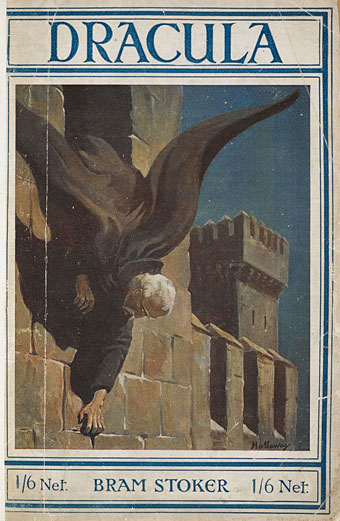
Cover art by Edgar Alfred Holloway for the Rider edition of Bram Stoker’s novel, an edition reprinted many times during the early 20th century. Holloway’s Count is shown as Stoker describes him in the early chapters of the book, white-haired and bearded.

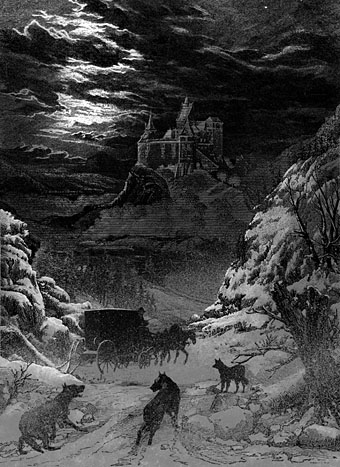
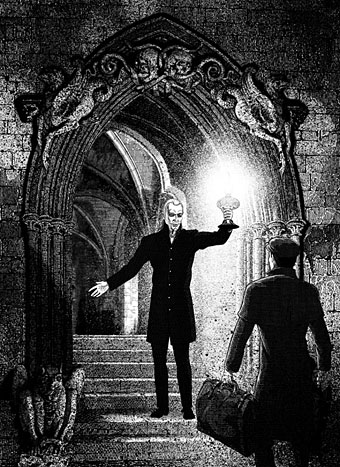
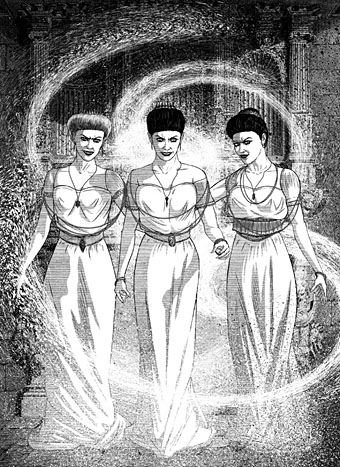
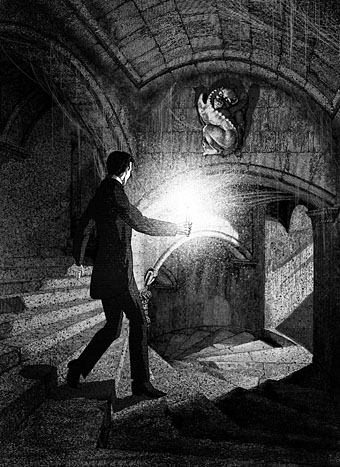
Last year I illustrated a number of stories by Edgar Allan Poe, and the entirety of Mary Shelley’s Frankenstein for Spanish publisher Editorial Alma. Earlier this year I was illustrating Dracula for the same publisher; now the book is in print I can show the results here. This was another difficult task since I had a few weeks to illustrate all 27 chapters of the novel while trying to do something new (or at least slightly different) with a very familiar story.

As with Frankenstein, I opted for fidelity to the text and period details. Despite its epistolary form, Dracula is much more readable (in a contemporary sense) than Frankenstein, so more people will have read Stoker than Shelley; but the sheer scale of cultural mauling that Dracula has been subject to means that—as with Frankenstein—even the allegedly faithful adaptations often deviate from the novel. The lounge-lizard vampire that everyone knows was a creation of Hamilton Deane’s 1924 stage adaptation, the success of which led to Tod Browning’s film and Bela Lugosi’s performance (which I’ve never liked); film and theatre may have made Dracula universally popular but the Lugosi stereotype has overshadowed the more powerful and violent character that Stoker gives us, with his bearded face, hairy palms and glowing eyes. So that’s who you see here, although the restrictions of time and brief (one picture per chapter) meant that some of the moments I’d have liked to illustrate had to be forfeit. Poor old Renfield gets short shrift, and some of the minor male characters are out of the picture altogether.

dracula01.jpg

On the plus side (I hope), many of the background details are well-researched even if they’re not at all obvious. The castle in the first picture (above) is Bran Castle, known today as “Dracula’s Castle” even though the building in the novel is Stoker’s invention; it certainly looks the part. As before, the full run of pictures follows below. All may be seen at a larger size here.

dracula02.jpg

dracula03.jpg

dracula04.jpg

Continue reading “Illustrating Dracula”

Weekend links 385

picasso.jpg

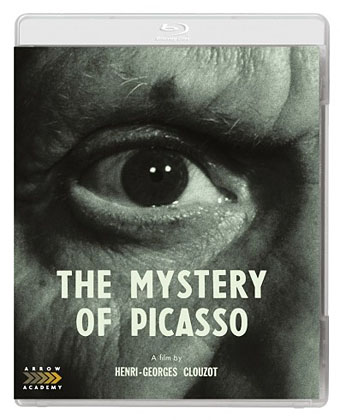
• It won’t be out until late January—and then in the UK only—but the blu-ray premiere of The Mystery of Picasso (1956) by Henri-Georges Clouzot was announced this week. The initial run of the discs (there’s also a DVD) will include a booklet containing my essay about the film, something I was very pleased and honoured to be asked to write. Clouzot’s remarkable study of Picasso drawing and painting for the camera was made immediately after his masterwork, The Wages of Fear (also newly available on UK blu-ray), and this new edition will include two short extras, one of which, A Visit to Picasso (1949) by Paul Haesaerts, is an excellent precursor/companion to the main feature. More on this subject later.

• At the Internet Archive: an almost complete run of The Twilight Zone Magazine (1981–1989). While masquerading as a TV-series spin-off, TZ under the editorship of TED Klein was an excellent periodical devoted to horror and dark fantasy. In addition to running original fiction by major authors (Stephen King was a regular), the magazine contained features about older writers such as Lovecraft and Machen along with book reviews by Thomas Disch, film reviews by Gahan Wilson, interviews and more.

• “Bram Stoker was gay,” says Tom Cardamone in a review of Something in the Blood: The Untold Story of Bram Stoker, the Man Who Wrote Dracula by David J. Skal. I’ve not read Skal’s book so can’t comment on its claims but his earlier Hollywood Gothic (about Dracula on page and screen) includes some discussion of “sexual ambiguity” in Stoker’s work.

• Mixes of the week: FACT mix 625 by Elena Colombi, Secret Thirteen Mix 235 by Rhys Fulber, and XLR8R Podcast 514 by Tommaso Cappellato.

Help, Help, The Globolinks! is a previously unreleased electronic soundtrack by Suzanne Ciani, out next week.

La Région Centrale (1971), Michael Snow’s epic of landscape gyrations in two parts, here and here.

Alexander Calder and the Optimism of Modernism: Jed Perl in Conversation with Morgan Meis.

• Illustrations by Lynd Ward for The Haunted Omnibus (1935) edited by Alexander Laing.

Daniel Dylan Wray on the gay-porn music of disco pioneer Patrick Cowley.

• It’s that man again (and his drawings): Ernst Haeckel: the art of evolution.

• At Dennis Cooper’s: Steve Erickson presents A Black Psychedelia Primer.

Bootsy Collins‘ favourite albums.

Picasso (1948) by Coleman Hawkins | Pablo Picasso (1976) by The Modern Lovers | Picasso Suite pt. 1 (1993) by David Murray Octet

Weekend links 357

brzezanska.jpg

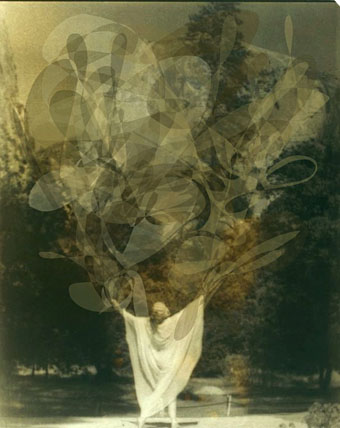
Ruth St Denis (2010) by Agnieszka Brzezanska.

As Above, So Below: Portals, Visions, Spirits & Mystics is an exhibition of occult-oriented art at IMMA, Dublin. “An alternative history of art of the last century,” says Aidan Dunne.

THIS IS THE SALiVATION ARMY: a Tumblr archive of Scott Treleavan’s queer-pagan-punk zine, 1996–1999.

• Mixes of the week: Secret Thirteen Mix 219 by Paper Dollhouse, and a Mika Vainio Tribute Mix by broken20.

• Valdimar Ásmundsson’s Icelandic translation of Bram Stoker’s Dracula has been translated back to English.

• First evidence for higher state of consciousness found (thanks to psychedelic drugs).

• At Bibliothèque Gay: Narkiss (1908) by Jean Lorrain.

Boyd White on finding Arthur Machen’s bookplate.

Barry Adamson’s favourite albums.

John Waters: By the Book.

Dread: Lustmord in dub.

XXY Oscilloscope

Vampire (1976) by Devon Irons | Keep On Dubbing (1976) by Augustus Pablo | African Dub (1977) by The Silvertones

Weekend links 347

kubin.jpg

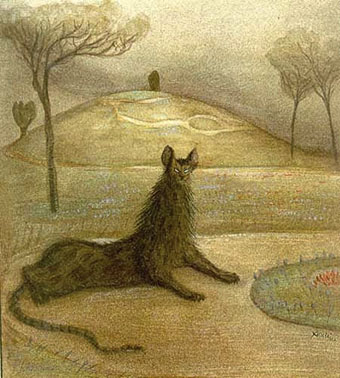
Dream Animal (1903) by Alfred Kubin.

• The week in Finland: A set of Finnish emojis includes icons for notable cultural exports such as Tom of Finland and Moominmamma. Tove Jansson’s creations have received fresh attention this month with the debut release of the electronic soundtrack music for The Moomins, an animated TV series made in Poland in 1977, and first broadcast in the UK in 1983. Andrew Male talked to Graeme Miller and Steve Shill about creating Moomins music with rudimentary instrumentation.

• Russian company Mosfilm has made a new copy of Andrei Tarkovsky’s science-fiction masterpiece, Stalker (1979), available on their YouTube channel. Tarkovsky’s films have been blighted by inexplicable flaws in their home releases, as Stalker was when reissued on a Region B Blu-ray last year. The new Mosfilm upload looks better than my old DVD so for the moment this is the one I’ll be watching.

• Before straight and gay: the discreet, disorienting passions of the Victorian era. Deborah Cohen reviews A Very Queer Family Indeed by Simon Goldhill. Related: Kevin Killian reviews Murder in the Closet: Essays in Queer Clues in Crime Fiction Before Stonewall, edited by Curtis Evans.

• “How many graphic designers owe their introduction to typography to a teenage encounter with the typefaces and lettering found on album covers?” asks Adrian Shaughnessy.

• Mixes of the week: Secret Thirteen Mix 210 by Ascion, FACT Mix 587 by Seekersinternational, and The Séance, 4th February 2017.

Pankaj Mishra on Václav Havel’s lessons on how to create a “parallel polis”. Related: The Power of the Powerless by Václav Havel.

Hans Corneel de Roos on Dracula‘s lost Icelandic sister text: How a supposed translation proved to be much more.

• “I live outside the world in a universe I myself have created, like a madman or a holy visionary.” — Michel de Ghelderode.

• The Metropolitan Museum of Art makes 375,000 images of public art freely available under Creative Commons Zero.

Richard H. Kirk on Thatcherite pop and why Cabaret Voltaire were like The Velvet Underground.

Emily Gosling on what David Lynch’s use of typography reveals (or doesn’t).

White Noise Sounds of Frozen Arctic Ocean with Polar Icebreaker Idling.

John Gray on what cats can teach us about how to live.

• At Dennis Cooper’s: Day of the Mellotron (Restored).

The Warburg Institute Iconographic Database.

Sastanàqqàm by Tinariwen.

Tanz Der Vampire (1969) by The Vampires of Dartmoore | Dracula (1983) by Dilemma | Vampires At Large (2012) by John Zorn

Dracula and I by Christopher Lee

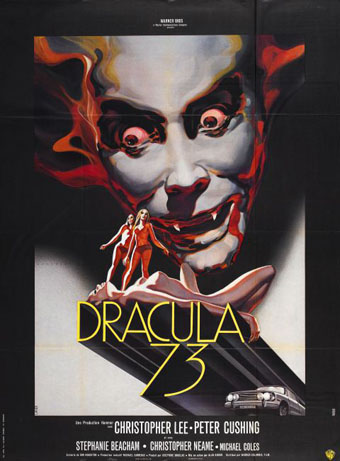
dracula.jpg

Impossible, not to say foolish, to attempt a brief summary of Christopher Lee’s incredible life and career. Rather than compete with the obituaries, here’s something you won’t find elsewhere, a short piece by Lee himself about his relationship to the role that made him famous. This is taken from The Dracula Scrapbook, a collection of Dracula and vampire-related cuttings assembled by Peter Haining for New English Library in 1976. The Lee piece was originally written for Midi Minuit Fantastique, Éric Losfeld’s film magazine which, we’re told, ceased publication in 1971. Haining dates Lee’s article as 1973 so I’ve left it undated, although it does seem to have been written around the time he was making (or had made) Dracula AD 1972. To compound the confusion, the poster above is for that very film but titled Dracula 73. Lee preferred Jesús Franco’s Count Dracula (1970) to the two final Hammer Draculas but the latter have their enthusiasts.

*

DRACULA AND I by Christopher Lee

I should certainly be pleased to play the part of Dracula again on the screen (surely it is the immortal role par excellence?), although I have many times refused to accept it. Nowadays I think the public identifies me with this part, and if I have sometimes refused it, it was for fear that, like the unfortunate Bela Lugosi, I should spend the rest of my life unable to play anything else. However I would willingly play it again, always provided that the production and scenario of this great subject satisfied me to the full. In any case, I have no intention of playing it to gain some sort of cheap publicity or for the financial benefit of a group of individuals incapable of appreciating or understanding the great power and the classical style of this great subject.

The part is one which needs to be played with respect and dignity, although one must always consider the commercial angle, which nowadays cannot be ignored.

I wrote recently that a true actor ought to be able to play a great diversity of parts. I think I have proved this as far as I am concerned, and that consequently there is no danger for me of being ‘typed’. But I am first and foremost an actor and must earn my living, and if the occasion arises again I shall he delighted to play the part of Dracula again under conditions which satisfy me.

Above all I should wish my interpretation to be more faithful to the novel of Bram Stoker. It seems to me that in the film Horror of Dracula (which, by the way, was excellent and a great success) the scenario left in the shade some aspects of the novel which, if they had been retained, would have improved the film as a whole considerably. For example, the sequences with the wolves and the capital scene with Jonathan Harker and the mirror, not to mention the boat sailing for England. The omission of Renfield was also very regrettable.

I believe that these scenes were not shot for financial reasons; they would have made the film considerably longer and therefore called for a great increase in the production budget.

It may surprise you to know that I have not seen any of the other versions of Dracula. Most of them were produced when I was very young and my age did not allow me to go to see them. But I think this is an advantage in my case, for above all I should not like to be influenced in my approach to the part by those who preceded me, even by the great Bela Lugosi. It will always be a cause for great regret to me that I never met him, whereas I know Boris Karloff very well and have a great admiration for him.

My personal idea of the interpretation of Count Dracula was of course based on the novel which I have read over and over again, and within the framework of the scenario and the production I have tried to give my personal view of its interpretation.

Bram Stoker’s grand-daughter came to see me on the set during the shooting, and was kind enough to assure me that my interpretation was excellent, and that she was sure her grandfather would have appreciated it.

Of course there was a great difference between the scenario and the novel, but I have always tried to emphasise the solitude of Evil and particularly to make it clear that however terrible the actions of Count Dracula might be, he was possessed by an occult power which was completely beyond his control. It was the Devil, holding him in his power, who drove him to commit those horrible crimes, for he had taken possession of his body from time immemorial. Yet his soul, surviving inside its carnal wrapping, was immortal and could not he destroyed by any means. All this is to explain the great sadness which I have tried to put into my interpretation.

Another problem was involved in the interpretation, a problem of a sexual nature. Blood, the symbol of virility, and the sexual attraction attached to it, has always been closely linked in the universal theme of Vampirism. I had to try to suggest this without destroying the part by clumsy over-emphasis. Above all, I have never forgotten that Count Dracula was a gentleman, a member of the upper aristocracy, and in his early life a great soldier and leader of men.

Of course it was impossible, within the limits of the scenario, to show this, but it is still possible by one’s interpretation to suggest the facts of the past without actually showing them.

As I have already told you, I am quite in favour of the idea of playing the part of Count Dracula again, always provided that the period and the Gothic atmosphere of the novel are respected.

I believe it is perfectly possible for a production of a film on this subject to be made in a modern setting, but there is only one Dracula, and his period must not be changed under any circumstances.

I have not read the whole of Bram Stoker’s work; I have only read (apart from Dracula) The Lair of the White Worm and one of his shortest stories, The Squaw. The first could not be screened, but the second in a shortened form would make an extraordinary film. The Squaw is, moreover, one of the most terrifying stories that Bram Stoker ever wrote.

The part of Count Dracula was one of the great opportunities of my career, and earned me a worldwide reputation.

It is one of the greatest parts ever created, one of the most famous and fantastic…no actor can ask more.

Midi Minuit Fantastique

Previously on { feuilleton }
The Dracula Annual
Nightmare: The Birth of Horror
Albin Grau’s Nosferatu
Count Dracula
Symbolist cinema